

GameStop Corp. (GME) enters late March 2026 at its most significant turning point since the 2021 short squeeze. Trading at $22.57, the company is no longer just a struggling brick-and-mortar retailer; it has evolved into a hybrid investment vehicle. With $8.8 billion in cash and marketable securities, including a tactical $500 million Bitcoin reserve, the narrative has shifted from surviving to spending.
By March 2026, Cohen’s strategy of "Value via Liquidity" has become clear. The company has aggressively shuttered underperforming stores (over 470 closures in early 2026 alone) to preserve capital for a transformative acquisition. While Wall Street remains historically bearish, retail sentiment has surged following Cohen's new compensation plan, which awards him billions only if GameStop hits a $100 billion market cap.
The GameStop stock forecast for 2026 is defined by two competing forces:
- The M&A Wildcard: Speculation is reaching a fever pitch regarding a buyout of a publicly traded consumer giant (rumors center on eBay or a high-growth fintech firm) to pivot GME into a diversified holding company.
- The Digital Cliff: A matured console cycle and the industry-wide shift to digital downloads have cratered legacy hardware and software sales, leaving the core business in a show me state.
For traders, GME in 2026 offers a high-volatility instrument backed by a cash floor, making it a unique play on capital allocation and the Cohen Premium. This guide breaks down the GME stock price prediction for 2026 using data from Simply Wall St, Zacks, and Bloomberg, and how to trade GameStop (GME) on BingX.
Top 5 Things for GameStop Investors to Know in March 2026
- The $8.8 Billion War Chest: GameStop holds more cash than its entire retail operations are worth, providing a massive buffer against bankruptcy but raising execution risk if the capital remains idle.
- Q4 Earnings Catalyst: The March 24, 2026, earnings report is the most critical in years. Investors are looking for a profitable holiday quarter and, more importantly, a roadmap for the cash pile.
- Collectibles Momentum: While gaming sales fall, the collectibles segment like Funko, retro gaming, high-end fan culture grew 54% YoY in late 2025, becoming a high-margin pillar of the remaining stores.
- The Berkshire Pivot: Ryan Cohen is explicitly modeling GameStop after a holding company. Legendary investor Michael Burry recently re-entered GME, citing the dirt-cheap valuation relative to its cash.
- Bitcoin Treasury Strategy: By allocating $500 million to Bitcoin, GME has tethered its book value to the crypto market, introducing a new layer of non-operating risk and reward.
What Is GameStop (GME)?
Historically the world’s largest multichannel video game retailer, GameStop in 2026 is a Specialty Retail/Holding Hybrid. It operates physical stores under the GameStop, EB Games, and Micromania brands across the US, Canada, Australia, and Europe. However, its primary product today is Capital Allocation. Under CEO Ryan Cohen, the company uses the cash flow from its shrinking retail footprint to fund strategic investments and high-yield securities.
GameStop (GME) Stock Performance in 2025: A Recap
Reflecting on the past year, GME's 2025 performance was a Year of Stabilization. While the stock remained volatile, it managed to gain 12.4%, outperforming major meme-stock peers like AMC, down 29% YTD, and SoundHound AI, down 21% YTD. This resilience was driven by a surprise Q3 2025 net profit of $77.1 million, proving that aggressive cost-cutting and store closures could stabilize the bottom line despite a 4.5% revenue decline.
GameStop vs. AMC: Which Meme Stock Should You Invest in 2026?
| Feature | GameStop (GME) | AMC Entertainment (AMC) |
| Balance Sheet | $8.8B Cash / Minimal Debt | High Debt / Recurring Dilution |
| Strategy | Holding Co / M&A Pivot | Theatrical Experience / Debt Restructuring |
| 2026 Outlook | Value through Liquidity | Recovery through Box Office |
| Volatility | High; Sentiment-Driven | Extreme; Liquidity-Driven |
By March 2026, the meme-stock basket has fundamentally fractured, with GameStop (GME) and AMC Entertainment following inverse financial trajectories. GameStop has successfully leveraged retail-driven liquidity to eliminate long-term debt and build a fortress-like $8.8 billion cash war chest, effectively transforming into a debt-free holding company. In stark contrast, AMC remains burdened by a $5.5 billion debt load, with nearly $3.8 billion of that principal maturing in 2026 alone. While GME reported a surprise $77.1 million net profit in late 2025, AMC’s net losses widened significantly to nearly $300 million in the same period, highlighting a pivot from speculative retail survival to a widening gap in operational sustainability.
Practically, this divergence has created two distinct trading instruments: GME is now a Capital Allocation play, where the stock price is buoyed by its high book value of $19.65 cash-per-share and CEO Ryan Cohen’s M&A potential. AMC, meanwhile, has become a Dilution Hedge, as management is forced into frequent debt-for-equity swaps to push out looming maturities, consistently eroding shareholder value. As of March 2026, GME has delivered a +23% YTD return, while AMC has plunged -30% YTD, signaling that the market is finally prioritizing balance sheet strength and profitable Omni-Holding strategies over pure social sentiment.
GameStop (GME) Stock 2026 Investment Outlook: Bull vs. Bear Outlook
| Source/Institution | 2026 Price Target | Market Outlook |
| Vestra Bull Target | $32.00 | Super-Bullish: Successful $2B+ acquisition with 20% ROE. |
| Simply Wall St Fair Value | $21.15 | Neutral: Baseline value based on cash pile and collectibles. |
| Wall Street Consensus | $13.50 | Bearish: Legacy retail decline outpaces M&A potential. |
| Technical Support | $21.10 | Baseline: Key support level based on accumulated volume. |
| Pessimistic Case | $11.85 | Bearish: Cash Burn scenario; failed or no acquisition. |
The Bull Case: The $32 Omni-Holding Juggernaut
The bull narrative is anchored to a fundamental re-rating of GameStop from a retailer to a high-velocity Investment Holding Company. Under this scenario, CEO Ryan Cohen successfully deploys $3 billion to $5 billion of the company’s $8.8 billion liquidity into a transformative acquisition, likely a cash-flow-positive consumer tech or fintech entity like eBay or a digital payment processor. By acquiring an asset with an established EBITDA of $400M+, GameStop would effectively buy its way out of the dying physical games cycle, shifting its primary revenue source to high-margin digital services and collectibles, which already saw a 54% YoY surge in late 2025.
From a valuation perspective, a successful Omni-Holding pivot allows GME to shed its retail survivor discount. In this cycle, the market would apply a 25x–28x forward P/E multiple to the combined entity's earnings, supported by a debt-free balance sheet and a $500 million Bitcoin treasury that acts as a high-beta growth kicker. With projected FY2027 New Business EPS hitting $1.15–$1.30, the stock would reach a $32.00 price target, representing a 41% upside from current levels. This case assumes the March 24 earnings call provides a definitive M&A roadmap, igniting institutional fear of missing out (FOMO) on the next Berkshire-style evolution.
Read more: What Are the Top 10 Bitcoin Treasury Companies of 2026: Institutional BTC HODLers
The Base Case: The $21.15 Cash Floor Stability
The base case reflects a period of strategic stagnation, where the stock is valued primarily as a closed-end fund with a retail footprint. Here, GameStop remains profitable through aggressive cost-cutting, evidenced by the $77.1 million net profit in Q3 2025, but fails to announce a major acquisition by mid-2026. The GameStop stock's value is underpinned by a $19.65 cash-per-share floor, keeping the price tethered to its intrinsic liquidity. Collectibles and retro-gaming growth offset the 31% decline in hardware, resulting in flat overall revenue. In this scenario, GME remains a Hold at $21.15, trading at a slight premium to its cash reserves while investors wait for Cohen to move his chess pieces.
The Bear Case: The $13.50 Digital Cliff Liquidation Trap
GameStop's bearish outlook warns of a Melting Ice Cube effect, where the core business reaches a point of terminal irrelevance before the cash can be pivotally deployed. As the industry shifts almost entirely to digital downloads and streaming, the hardware and accessories segment, the company's largest revenue driver, faces a Digital Cliff with an estimated 20% annual decay rate. If management allows the $8.8 billion war chest to sit idle in low-yield treasuries while retail operations burn through $100 million+ in annual overhead, the market will stop pricing in a Cohen Premium and start pricing in a slow-motion liquidation.
Furthermore, the bear case highlights Execution Risk regarding capital allocation. If the rumored acquisition turns into a value-destroying overpayment for a legacy brand, or if the $500 million Bitcoin reserve suffers a 50%+ drawdown, the stock’s book value would be severely impaired. Wall Street analysts maintain a $13.50 consensus target, suggesting that GME should trade at its bare-bones liquidation value. In this trap scenario, GME loses its narrative momentum, falling 40% to meet the fundamental reality of a retailer that failed to transform before its storefronts became obsolete.
How to Trade GameStop (GME) Stock on BingX
Maximize your trading precision by leveraging BingX AI’s real-time sentiment analysis and institutional liquidity tracking to navigate GameStop’s high-volatility 2026 pivot.
Long or Short GME Stock Futures on BingX TradFi
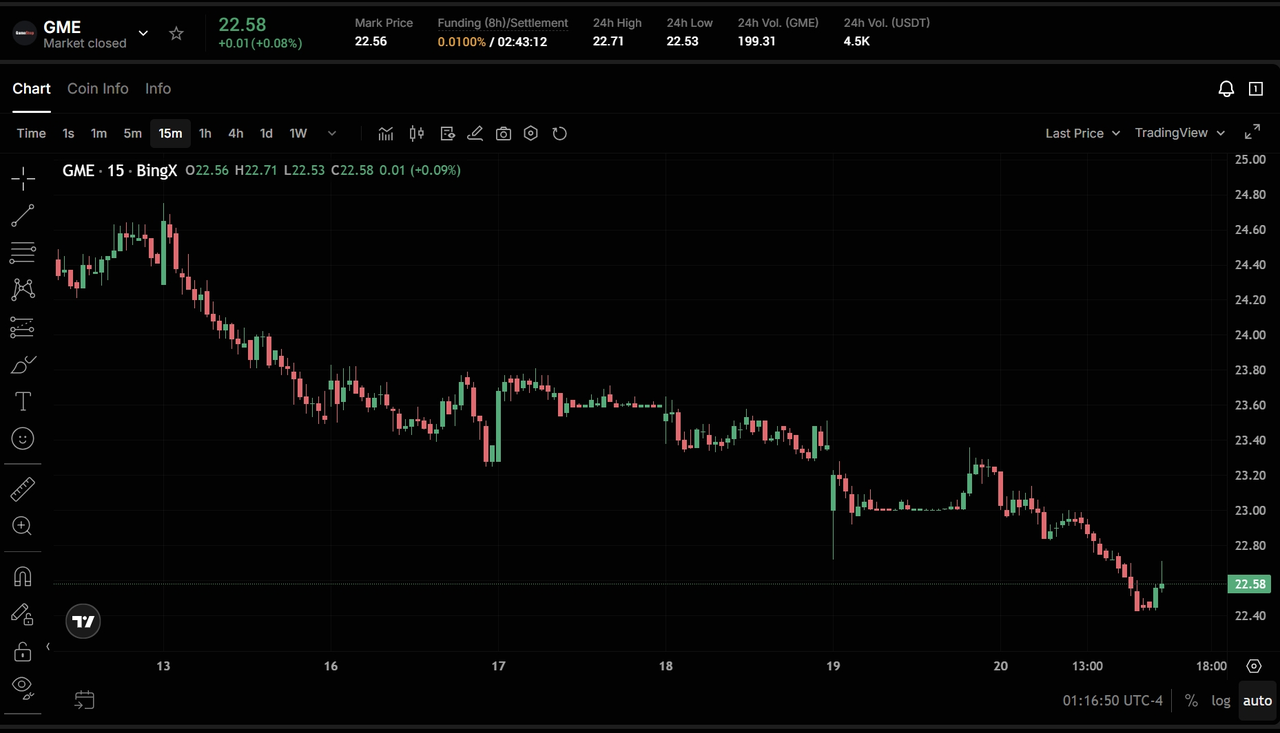
GME/USDT perps on BingX futures market
Utilize leverage to amplify price movements based on the upcoming March 24 earnings volatility.
- Transfer USDT: Move USDT to your Futures Account.
- Select Market: Search for GME/USDT perpetual contracts.
- Set Leverage: Choose 2x–5x leverage (recommended for GME's high volatility).
- Risk Management: Always set a Stop-Loss given the +/- 8.85% expected earnings move.
Conclusion: Should You Trade GameStop (GME) in 2026?
GameStop’s 2026 trajectory represents a calculated shift from a traditional retail model to a capital-allocation vehicle. The stock is no longer tethered to the lifecycle of physical game consoles, but rather to the execution of Ryan Cohen’s Omni-Holding strategy. For value-oriented traders, the $19.65 cash-per-share floor and $8.8 billion liquidity provide a rare safety net in the specialty retail sector. However, the market is currently demanding a transformation premium. To justify a move into the $30+ range, GameStop must prove it can convert its idle treasury into a high-margin revenue stream before the 31% annual decline in legacy hardware sales reaches a point of terminal decay.
For active traders, the March 24 earnings call serves as the primary risk-reward catalyst for the first half of 2026. Practical strategy involves monitoring the $21.10 technical support level; a bounce here, accompanied by a clear M&A roadmap or a profitable holiday report, could signal a fundamental re-rating. Conversely, a failure to deploy capital effectively could see the stock drift toward the $13.50 analyst consensus as the holding company narrative loses steam. Whether you are long or short, GME in 2026 is a play on corporate reinvention, requiring a disciplined approach to position sizing and a keen eye on Ryan Cohen’s next move.
Risk Reminder: GameStop remains a high-beta asset with a volatility profile significantly higher than the S&P 500. Investors should be aware that the $500 million Bitcoin reserve introduces non-operating crypto volatility to the balance sheet, and a failure to execute a successful acquisition could lead to significant capital erosion. Always use stop-losses and maintain a diversified portfolio.
Related Reading
- McDonald's (MCD) Stock Outlook for 2026: Value King or Margin Trap?
- PepsiCo (PEP) Stock Outlook for 2026: Can PEP Cross $220 on Beverage Portfolio and Emerging Markets?
- Apple (AAPL) Stock Outlook for 2026: MacBook Neo Growth or AI Valuation Trap?
- Alibaba (BABA) Stock Forecast for 2026: Can AI and Cloud Growth Push BABA Past $200?