

International Business Machines (IBM) entered March 2026 in the wake of a historic volatility event. In late February, the stock suffered a 13% single-day crash, its worst in over 25 years, triggered by fears that generative AI tools could automate COBOL modernization, threatening IBM’s high-margin consulting business. However, by late March, the narrative began to shift toward resilience as the company reported record AI-related bookings and a surge in infrastructure revenue.
By March 2026, IBM had successfully scaled its Watsonx AI platform, helping 95% of Fortune 500 companies navigate hybrid cloud complexities. While the stock remains roughly 20% below its 52-week high, institutional sentiment is bifurcated. Giants like Morgan Stanley and BMO Capital have adjusted price targets toward the $247–$290 range, while bulls at Wedbush and Evercore ISI maintain targets as high as $345, citing the company’s indispensable role in the AI infrastructure super-cycle.
The IBM stock forecast for 2026 is defined by two competing narratives:
- The Quantum Catalyst: IBM’s roadmap to deliver a large-scale, fault-tolerant quantum computer by 2029 is positioning the firm as a long-term winner in the next era of computation.
- The Consulting Crisis: Advances in AI coding tools like Anthropic’s Claude are commoditizing legacy code maintenance, potentially eroding the 29% of software sales tied to mainframe ecosystems.
For traders, IBM in 2026 offers a unique Growth at a Reasonable Price (GARP) play with a solid 2.8% dividend yield, serving as a defensive tech instrument for those betting on enterprise AI integration.
Top 5 Things for IBM Investors to Know in March 2026
- The $12.5B AI Moat: IBM exited 2025 with a cumulative GenAI book of business exceeding $12.5 billion, proving that enterprise AI is a realized revenue stream, not just hype.
- Quantum Supercomputing: In early 2026, IBM outlined a new architecture combining classical and quantum technologies, targeting sub-1nm process nodes in partnership with Lam Research.
- The Anthropic Overreaction: Bulls argue the 27% February plunge was excessive, noting that IBM’s own Watsonx Code Assistant has been modernizing COBOL for two years with superior business logic context.
- Free Cash Flow Power: Management is guiding for $15.7 billion in free cash flow for 2026, supporting both the 3% dividend yield and continued R&D in quantum labs.
- Valuation Reset: With a Forward P/E of roughly 19.5x, IBM currently trades at a discount compared to its industry average (20.4x) and pure-play AI competitors like NVIDIA.
What Is International Business Machines (IBM)?
Incorporated in 1911, IBM has evolved from a punch-card tabulating company into the Grandfather of Tech, now acting as the architectural backbone for the global B2B economy. Following the 2021 spin-off of its legacy infrastructure unit (Kyndryl), IBM successfully pivoted into a high-margin Hybrid Cloud and AI powerhouse. Today, it centers its value proposition on Red Hat OpenShift, which serves as the universal operating layer allowing 95% of Fortune 500 companies to deploy applications seamlessly across public clouds and on-premise data centers.
In 2026, IBM is distinguished by its Full Stack approach to the AI revolution. Through its watsonx platform, the company provides the digital glue that enables regulated industries, such as global banking and healthcare, to train and deploy generative AI with strict data sovereignty. Beyond software, IBM operates the world’s most sophisticated quantum computing fleet, transitioning from experimental research to a Quantum-Centric Supercomputing model. This integrates quantum processors directly into classical high-performance computing (HPC) environments to solve previously impossible problems in chemistry and logistics.
IBM's Key Growth Milestones: The Road to 2026
- The $34B Red Hat Acquisition (2019): The largest acquisition in IBM's history, establishing its dominant position in open-source hybrid cloud software.
- The Kyndryl Spin-off (2021): A structural separation from its legacy managed infrastructure business, freeing $19 billion in annual revenue to be reinvested into higher-growth AI and cloud R&D.
- Launch of watsonx (2023): The introduction of a dedicated enterprise-grade AI and data platform, which scaled to a $12.5 billion cumulative book of business by the end of 2025.
- The Quantum Roadmap Realization (2024–2025): The deployment of the Eagle (1,121-qubit) and Osprey processors, proving the scalability of IBM's quantum-centric supercomputing architecture.
- 1nm Process Node Alliance (2026): Expansion of its partnership with Lam Research and NVIDIA to pioneer sub-1nm semiconductor manufacturing capabilities, critical for next-generation AI hardware.
IBM Stock Performance in 2025: A Recap
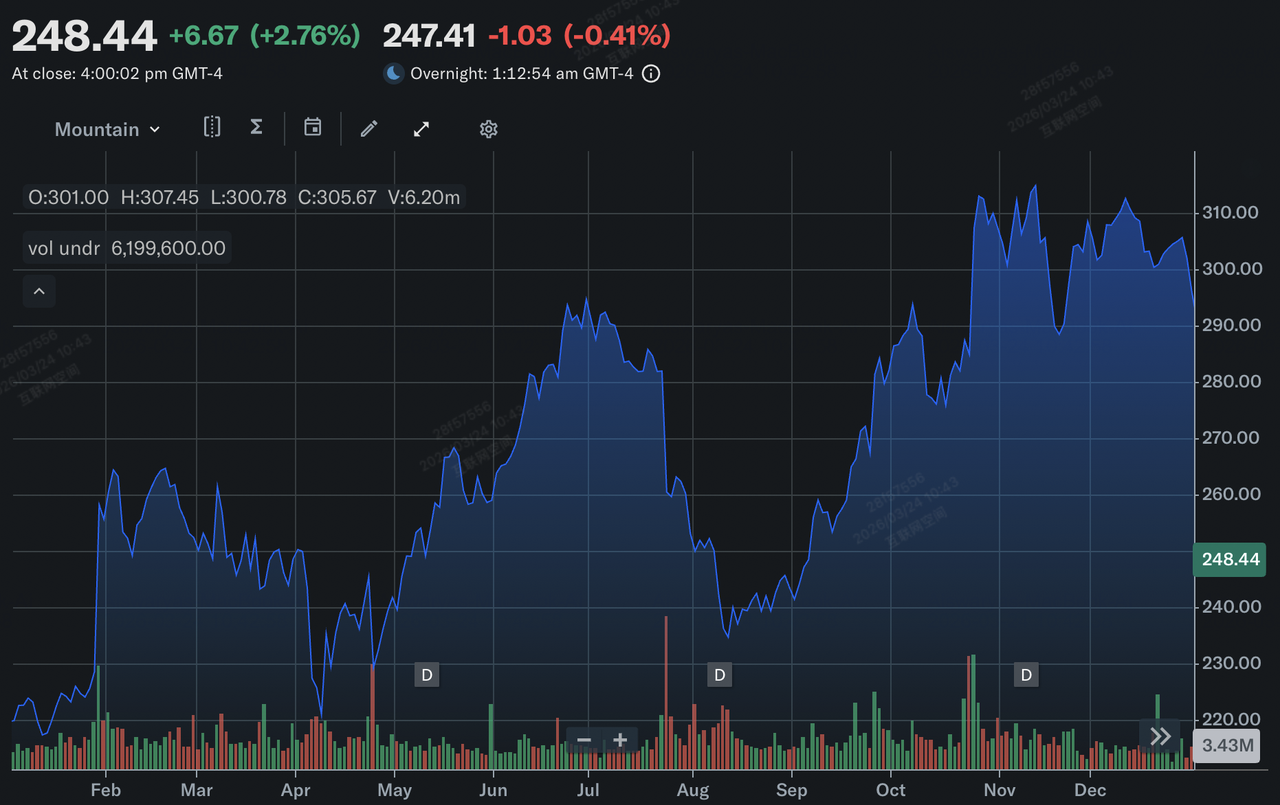
IBM stock performance in 2025 | Source: Yahoo Finance
The year 2025 was a Golden Era for Big Blue before the 2026 correction. The stock gained approximately 35% in 2025, fueled by the successful launch of the z17 mainframe and the rapid adoption of Watsonx. Software margins expanded as the mix shifted toward high-margin recurring revenue, which now represents 45% of the business. This momentum allowed IBM to return nearly $7 billion to shareholders, providing the financial buffer for the Anthropic Shock currently being navigated in early 2026.
IBM vs. NVIDIA: Which AI Play Should You Trade in 2026?
While both are AI leaders, their 2026 risk profiles are worlds apart:
| Feature | IBM (IBM) | NVIDIA (NVDA) |
| Business Model | Enterprise Software/Services | AI Hardware & Chips |
| 2026 Valuation | Forward P/E ~19-21x | Forward P/E ~36x+ |
| Primary Driver | AI Implementation & Quantum | GPU Demand & Data Centers |
| Volatility Profile | Low-Medium (Defensive) | High (Growth) |
In 2026, the trade-off between these two giants centers on valuation vs. velocity. NVIDIA (NVDA) remains the undisputed engine of the AI era, commanding a forward P/E of roughly 36x as it transitions from a chipmaker to a full-stack data center provider. With revenue growth cycles tied to the release of next-generation Blackwell and Rubin architectures, NVIDIA is the high-beta play for traders betting on the continued expansion of global compute capacity. However, with its market cap hovering at record highs, the stock is hypersensitive to any cooling in capital expenditure from Hyperscalers like Microsoft or Meta.
Conversely, IBM offers a GARP alternative, trading at a significant discount with a forward P/E of 19.5x. While NVIDIA provides the raw power, IBM monetizes the implementation layer through its $12.5 billion GenAI book of business and a $32 billion consulting backlog. For traders, IBM serves as a defensive AI instrument with a 2.8%–3% dividend yield and a lower volatility profile, making it the preferred choice for those betting on AI Value and the long-term structural shift toward Quantum-Centric Supercomputing.
Practical Tip: In 2026, IBM is the preferred instrument for traders seeking exposure to AI utility and infrastructure at a discount. NVIDIA remains the high-beta bet for those tracking total compute capacity growth.
IBM (IBM) 2026 Investment Outlook: The Quantum Ramp vs. Debt Risks
The 2026 forecast for IBM is a high-stakes tug-of-war between its emergence as a Quantum-First powerhouse and the structural disruption of its legacy consulting moats. While the market has historically valued IBM as a slow-growth utility, its transition into a specialized AI and Quantum orchestrator has created a wide valuation gap between its current 19.5x Forward P/E and its $321 average analyst price target.
The Bull Case: The $32B GenAI and Software Surge
IBM’s bullish narrative is anchored in its massive $32 billion consulting backlog, where over 25% of new signings are now directly tied to Generative AI implementation. By moving beyond simple maintenance and into high-value AI architecture, IBM is successfully pivoting its workforce toward a software-led model. This shift is reflected in its Software segment’s 10% year-over-year growth, a pace that supports management’s goal of expanding operating margins toward 21.4% by the end of 2026.
Beyond software, the bull case rests on the Quantum-Centric Supercomputing milestone. By integrating quantum processors with classical HPC clusters, IBM is creating an indispensable monopoly for industries requiring massive computational power, such as pharmaceuticals and materials science. If IBM maintains its lead toward a fault-tolerant quantum computer by 2029, its current valuation could be viewed as a significant ground floor opportunity, especially with $15.7 billion in projected free cash flow providing ample fuel for R&D.
The Base Case: Hybrid Cloud Resilience and Yield Support
The base case assumes IBM maintains its steady-state performance as a Growth at a Reasonable Price (GARP) play. In this scenario, the disruption from AI coding tools like Claude Code is largely offset by IBM’s own watsonx Code Assistant, which retains enterprise clients through superior data sovereignty and institutional knowledge. Revenue continues to grow at a consistent 5.2% CAGR, driven by the high-margin Red Hat ecosystem and the tail-end of the z17 mainframe cycle, keeping the stock within its $250–$280 range.
In this middle-ground outlook, IBM remains a defensive cornerstone for institutional portfolios. A robust 2.8%–3% dividend yield, backed by a payout ratio that is well-covered by surging free cash flow, provides a solid price floor even during broader tech volatility. While the stock may not see the parabolic growth of a pure-play AI hardware firm, its $12.5 billion GenAI book of business ensures it remains a relevant, cash-generating leader in the enterprise tech stack.
The Bear Case: The $67B Debt Trap and Legacy Erosion
The bearish perspective centers on IBM’s levered balance sheet, with total debt hitting $67 billion following a string of aggressive AI and hybrid cloud acquisitions. In a higher-for-longer interest rate environment, the cost of servicing this debt, which now represents roughly 45% of total assets, could severely limit IBM’s ability to compete in the capital-intensive quantum arms race. If interest expenses eat into the projected $1.78 EPS growth, the stock risks a de-rating as investors flee toward cleaner balance sheets.
Furthermore, the bear case warns of a structural Commoditization Trap. If general-purpose AI tools can automate COBOL modernization at 1/10th the cost of IBM’s consulting rates, the company’s highest-margin services revenue, which accounts for 29% of software-related sales, could collapse faster than new AI revenue can replace it. If the Consulting segment’s growth continues to stall at the 3% mark seen in late 2025, the stock could face a sharp correction toward the $215 support level, testing its multi-year lows.
IBM Stock Price Forecasts for 2026: Bull vs. Bear Outlook
| Source/Institution | 2026 Price Target | Market Outlook |
| Evercore ISI | $345.00 | Super-Bullish: Outperform rating; AI software driving growth. |
| Wedbush | $340.00 | Bullish: Massive upside in GenAI and enterprise consulting. |
| Wall Street Average | $308.00 | Moderate Buy: Consensus expects a recovery from Feb lows. |
| BMO Capital | $290.00 | Neutral: Target lowered from $350 due to consulting headwinds. |
| Morgan Stanley | $247.00 | Equal-Weight: Cautious on legacy mainframe disruption. |
| Bear Case Target | $215.00 | Bearish: Risk of breakdown if COBOL revenue collapses. |
How to Trade IBM Common Stock (IBM) on BingX
Leverage BingX AI’s real-time sentiment analysis and institutional liquidity tracking to precisely time your entries into IBM’s 2026 quantum and AI growth cycles.
Long or Short IBM Stock Futures on BingX TradFi
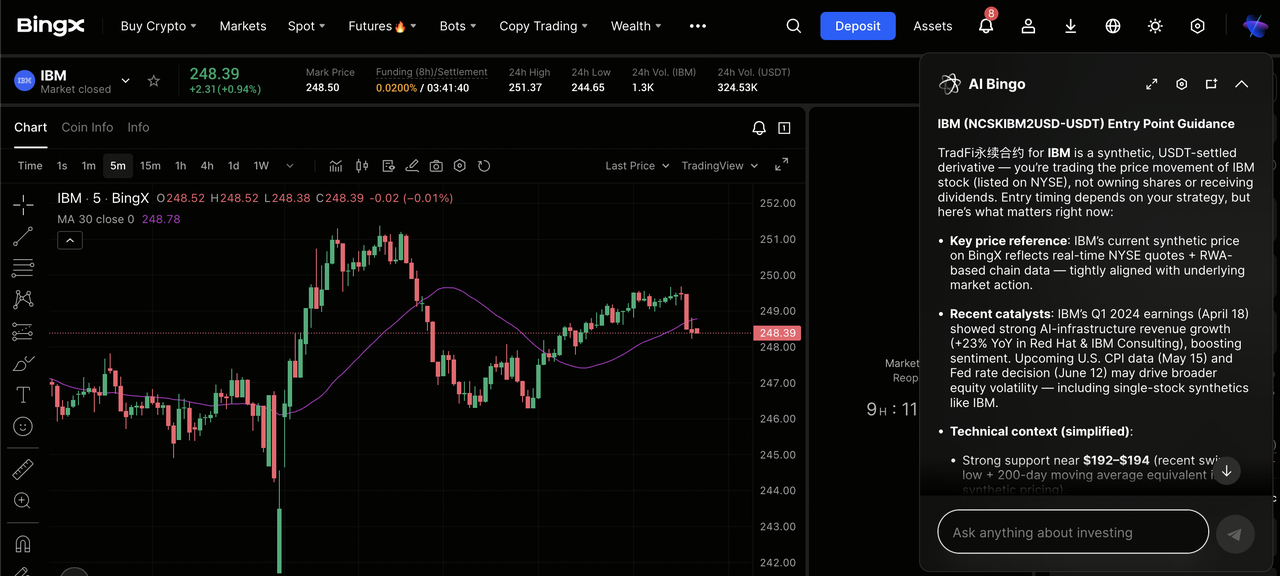
IBM stock perpetual contract on BingX TradFi
Access IBM through USDT-margined perpetual contracts with up to 50x leverage to capitalize on 2026 quarterly earnings beats.
- Transfer Funds: Move USDT to your Futures Account.
- Select Market: Search for IBM/USDT perpetual contract under the TradFi tab.
- Execute: Use limit orders to capture entry points near key support levels.
5 Key Risks for IBM Traders to Monitor in 2026
While IBM’s pivot to high-growth software and quantum computing offers a compelling recovery narrative, traders must navigate several structural and macroeconomic landmines that could challenge its 2026 valuation.
- AI Coding Disruption: Monitor the adoption rates of Claude Code and GitHub Copilot; any acceleration in automated COBOL modernization directly hits IBM’s high-margin consulting moat.
- Quantum Execution Risk: IBM’s valuation is increasingly tied to its 2029 goals. A technical delay in the Condor or Flamingo processor lines would be a major bearish catalyst for long-term investors.
- The $67B Debt Load: With a 31.6% debt-to-equity ratio, IBM’s balance sheet is more levered than the S&P 500 average; watch for interest rate spikes that could squeeze R&D funding.
- Mainframe Cycle Cooling: 2026 marks the late stage of the z16/z17 cycle; infrastructure revenue typically slows during these periods before the next-generation hardware launch.
- Geopolitical Tariffs: As a firm operating in 175 countries, any escalation in global trade barriers or tech nationalism in 2026 could compress international consulting and software margins.
Conclusion: Should You Invest in IBM in 2026?
IBM’s 2026 trajectory represents a calculated bet on innovation over legacy. By transforming from a hardware-centric provider into a tech-centric, AI-optimized ecosystem, Big Blue is attempting to insulate itself from the very disruption that caused its February price crash. For long-term dividend seekers, the record-breaking $15.7 billion free cash flow and leadership in quantum-centric supercomputing provide a solid foundation for growth.
However, active traders should remain agile. The 2026 outlook favors those who monitor GenAI booking growth and consulting backlog conversion with precision. Success will depend on weighing the potential of a $345 Quantum Super-Cycle against the risk of a sideways correction if AI-driven commoditization outpaces new revenue streams.
Risk Reminder: Even defensive mega-cap stocks can experience high-beta volatility. Always utilize BingX AI for real-time sentiment alerts and stay updated on quarterly earnings reports, which serve as the ultimate validation of IBM’s high-stakes transformation.
Related Reading
- Nvidia (NVDA) Stock Price Outlook for 2026: Can Blackwell and Vera Rubin Take NVDA Back to $300?
- Palantir (PLTR) Stock Outlook for 2026: Can the AI-Driven Enterprise Supercycle Take PLTR Stock to $235+?
- Oracle (ORCL) Stock Outlook for 2026: Can the AI Cloud Infrastructure Buildout Take ORCL to $300?
- Alphabet (GOOGL) Stock Outlook 2026: Can Gemini and Google Cloud AI Drive GOOGL Cross $420?