Backpack (BP) is a globally regulated financial institution and high-performance trading ecosystem designed to bridge the gap between professional-grade brokerage tools and self-custodial DeFi. By merging a Centralized Exchange (CEX) with the Backpack Wallet, the platform offers a Unified Account where every dollar, whether in spot, perps, or lending, works together with maximum capital efficiency.
On March 23, 2026, Backpack reached a historic milestone with its Token Generation Event (TGE). Moving away from the era of VC-heavy launches, Backpack distributed 100% of its initial circulating supply to the community, rewarding users who drove over $400 billion in cumulative trading volume during its pre-TGE seasons.
This article examines how Backpack’s unique Equity Hook allows token holders to become true stakeholders, the drivers behind its massive 2026 Solana momentum, what investors should consider before engaging with the $BP token, and how to trade Backpack (BP) on BingX.
What Is Backpack (BP)?
Backpack (BP) is a premier regulated financial gateway that redefines the digital asset experience by merging a high-performance exchange with a multi-chain, self-custodial wallet. Holding prestigious licenses including VARA in Dubai, MiFID II in Europe, and FinCEN registration in the USA, it operates as a 'brokerage in your pocket.' Unlike legacy platforms that fragment user funds, Backpack utilizes a Unified Margin System, allowing traders to execute complex institutional strategies, engage in real-world event predictions, and access global fiat on/off-ramps with unparalleled capital efficiency and real-time transparency via Daily Proof of Reserves.
The massive momentum behind the $BP surge in March 2026 was fueled by a rare convergence of community-first tokenomics and institutional credibility. By launching with a 100% community-owned circulating supply, completely bypassing initial VC or team unlocks, Backpack established a supply-side dynamic that favored organic users and early adopters. This was further amplified by Backpack Exchange's Equity Hook, which incentivized long-term staking by offering a compliant path toward actual corporate ownership in the Backpack entity.
Supported by the iconic Mad Lads NFT community and its robust regulatory standing, Backpack has successfully positioned the $BP token as a structural pillar of the Solana ecosystem. This unique model, balancing the diamond hand loyalty of retail traders with the compliance requirements of smart money, has transformed the Backpack (BP) TGE into a landmark event, proving that a regulated exchange can remain deeply rooted in decentralized community values.
How Does the Backpack Ecosystem Work?
At its core, Backpack is a vertically integrated stack delivered through three primary pillars:
1. The Unified Backpack Account
This is the exchange’s killer app. It allows for cross-margin and multi-collateral trading. Users can use BTC, ETH, and SOL as collateral simultaneously to trade perps and spot. This system ensures that PnL (profit and loss) from open positions immediately contributes to buying power or earns yield.
2. The Backpack Wallet
A multi-chain, self-custodial wallet supporting over 10 networks. It is the native home of the Mad Lads xNFT collection and provides a direct, zero-fee bridge to the Backpack Exchange, allowing users to move assets between cold and hot storage instantly.
3. Lending and Auto-Yield
Backpack features an Auto-Lend mechanism. Idle assets in a user's account are automatically deployed into lending markets to earn passive interest, e.g., 3% on USD, 5.3% on SOL, without locking the capital or preventing it from being used as trading margin.
4. Global Fiat Ramps
Backpack integrates global USD wire transfers with zero fees, allowing users to move from traditional bank accounts into the crypto economy seamlessly.
What Is the BP Token Used For?
The $BP token is the utility and loyalty heart of the ecosystem. Its primary functions include:
- Fee Discounts: Holders receive significant reductions on trading fees for both Spot and Perpetual markets.
- Staking Rewards: Staking $BP grants access to exclusive launchpad allocations and boosted yield on idle USD deposits.
- The Equity Transition: $BP is the exclusive vehicle for users to participate in the future Equity Conversion program, potentially turning crypto tokens into regulated shares.
- Governance: Holders vote on ecosystem grants and future protocol integrations within the Backpack Wallet.
What Is Backpack (BP) Tokenomics?
The $BP token has a hard-capped total supply of 1,000,000,000 (1 billion) tokens, structured to incentivize long-term retention over short-term speculation.
- Community Airdrop (25%): Distributed at TGE to points holders (24%) and Mad Lads (1%).
- Corporate Treasury (37.5%): Reserved for post-IPO corporate stability and long-term liquidity; these tokens are currently locked.
- Growth Reserve (37.5%): Unlocked only when the exchange hits specific Volume and User Milestones, ensuring that new supply only enters the market when there is a corresponding increase in demand.
What Is the Backpack (BP) Airdrop and How to Claim BP Tokens?
The Backpack ($BP) airdrop is a community-focused distribution celebrating the TGE that took place on March 23, 2026. A total of 25% of the 1 billion $BP supply (250 million tokens) has been allocated exclusively to the community, with 24% going to users based on their accumulated Backpack Points from trading activity and 1% reserved for Mad Lads NFT holders. Notably, this launch featured zero insider or investor allocations in the initial circulating supply, prioritizing early adopters and active traders within the Solana-based exchange and wallet ecosystem.
To claim your allocation, you must log in to the official Backpack Exchange website or mobile app and complete the TGE verification process. Once verified, points holders can view their specific token share, while Mad Lads holders will see their automatic allocation after connecting their linked wallet. Be aware that claimed tokens are automatically staked by default; you have a one-week grace period from the launch date to unstake them instantly, after which a standard 7-day unstaking cooldown applies.
Learn more about how to claim the Backpack airdrop in our detailed guide.
Backpack vs. Hyperliquid: How Do the Exchange 2.0 Tokens Differ?
| Feature | Backpack Exchange ($BP) | Hyperliquid (HYPE) |
| Platform Type | Regulated Centralized Exchange (CEX) | Decentralized App-Chain (DEX) |
| Core Blockchain | Solana Ecosystem | Hyperliquid L1 |
| Regulatory Status | Licensed (VARA, MiFID II, FinCEN) | Permissionless / Unregulated |
| Margin System | Unified Margin (Spot, Perps, Yield) | Isolated or Cross-Margin (Perps) |
| Token Utility | Staking, Fee Discounts, Equity Hook | Staking, Governance, Gas |
| KYC Required | Yes (Mandatory for $BP claim) | No (Self-custody only) |
| Fiat Ramps | Direct USD Wire Transfers (Zero Fee) | Third-party only / On-chain native |
While both platforms are leaders in the high-performance trading space, they represent two fundamentally different philosophies: Backpack is a regulated, centralized exchange (CEX) built on Solana, whereas Hyperliquid is a decentralized, app-chain-based perpetual DEX. Backpack’s primary advantage lies in its Unified Margin System and global compliance, making it a brokerage-first experience with seamless fiat on-ramps. In contrast, Hyperliquid excels in permissionless, fully on-chain transparency and its native L1 speed, catering to DeFi purists who prioritize self-custody over regulatory wrappers.
From a data perspective, Backpack's $400 billion cumulative volume by early 2026 and its Daily Proof of Reserves offer a level of transparency rarely seen in CEXs, rivaling the "don't trust, verify" nature of Hyperliquid’s on-chain order book. Practically, Backpack is the superior choice for traders seeking equity-linked utility and integrated stock and crypto portfolios, while Hyperliquid remains the go-to for high-leverage, purely decentralized perpetuals with no KYC requirements.
Read more: Hyperliquid (HYPE) Price Prediction 2026: The $150 Revenue Thesis vs. The $40 Baseline
How to Trade Backpack (BP) Token on BingX
Whether you are a Solana native or a global investor, BingX provides the tools to trade BP with the help of BingX AI to optimize your entry and exit strategies.
Buy, Sell, or Hold BP Tokens on the Spot Market
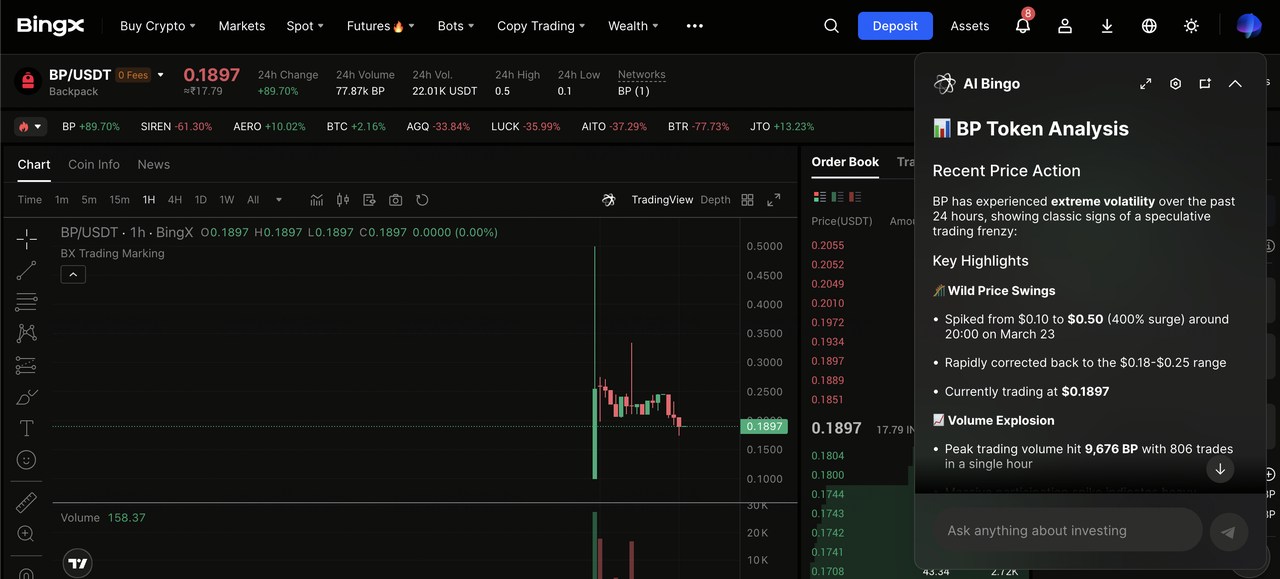
BP/USDT trading pair on the spot market powered by BingX AI insights
- Search for the BP/USDT pair on the BingX Spot Market.
- Use BingX AI to identify support levels, critical for a newly launched token with high volatility.
- Execute a limit order to capitalize on $BP’s initial price discovery phase.
Learn more about how to buy Backpack (BP) tokens in our comprehensive guide.
Long or Short BP Perpetuals on the Futures Market
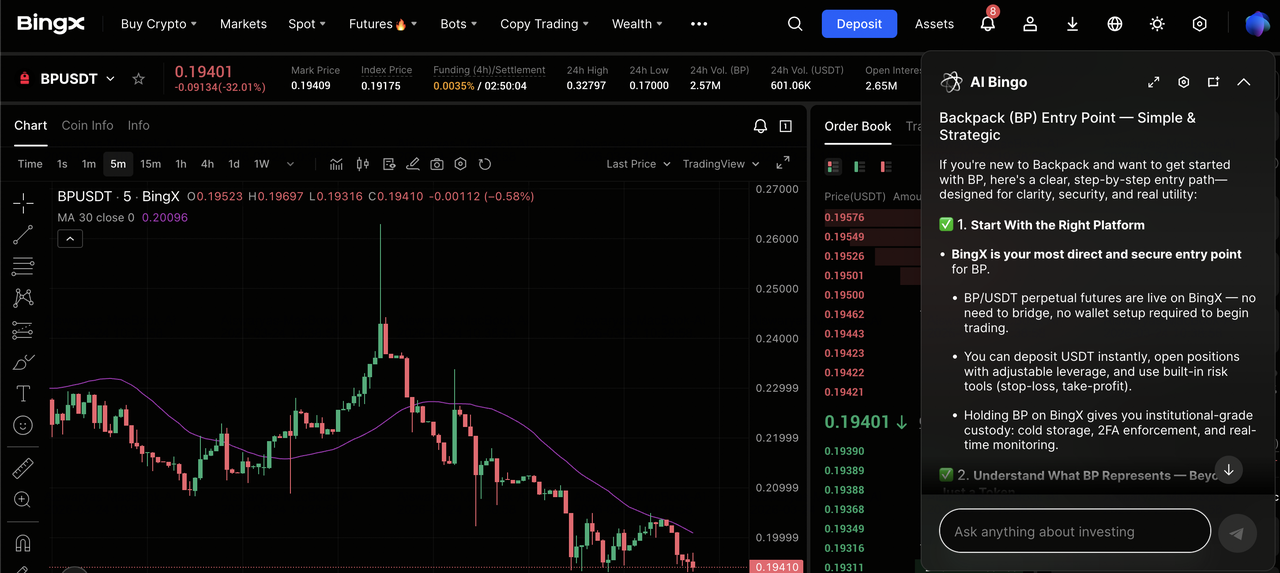
BP/USDT perpetual contract on the futures market featuring BingX AI analysis
For traders looking to hedge their airdrop or profit from $BP’s high launch-day volatility, BingX offers perpetual futures with advanced risk management tools.
- Access the Futures Terminal: Navigate to the Futures tab on BingX and select the BP/USDT Perpetual contract.
- Select Your Direction: Choose Long if you anticipate the $BP price will rise, or Short if you expect a correction following the initial airdrop claim.
- Set Leverage and Margin: Adjust your leverage, e.g., 2x to 10x, and choose between Isolated or Cross Margin modes to define your risk appetite.
- Deploy BingX AI Insights: Use the AI-powered trend analysis to monitor real-time momentum and set precise Stop-Loss and Take-Profit orders to protect your capital.
- Execute the Trade: Enter your position size and click Open Long or Open Short to go live.
5 Key Considerations Before Investing in Backpack (BP) Token
Before engaging with the $BP token, investors should evaluate the specific regulatory and structural factors unique to Backpack’s model.
- Regulatory Sensitivity: As a highly licensed exchange, Backpack must comply with global laws; any sudden shift in UAE's VARA or EU's MiFID crypto regulations could impact the platform’s operations.
- Milestone-Based Inflation: While there is no time-based unlock for the remaining 75% of supply, rapid growth could trigger milestone unlocks earlier than expected.
- Unstaking Cooldown: After the initial 7-day launch window, BP has a 7-day unstaking period. Investors should factor this liquidity delay into their risk management.
- Exchange Competition: Backpack competes directly with titans like BingX; its long-term value depends on its ability to continue capturing market share in the perps and margin space.
- The Equity Conversion Timeline: The Equity Hook is a multi-year vision. Investors should verify the legal roadmap for this conversion, as it involves complex cross-jurisdictional securities laws.
Final Thoughts: Assessing Backpack’s Role in the Solana Evolution
As of late March 2026, Backpack has successfully transitioned from a high-growth points ecosystem into a structural pillar of the Solana economy. By aligning community incentives with the long-term equity of the exchange, $BP represents a new breed of Exchange 2.0 tokens that move beyond simple fee discounts toward true stakeholder ownership. Its success as a practical financial tool depends on Backpack’s ability to maintain its rigorous regulatory standing while continuing to capture market share from legacy platforms through its superior, unified margin architecture.
For the practical investor, the $BP launch offers a unique case study in Real Yield and institutional integration. The token's utility is deeply tied to the exchange's actual volume and the legal feasibility of its future equity conversion. While the Equity Hook provides a compelling reason for long-term retention, users should monitor the milestone-based unlocks of the remaining 75% supply and global regulatory shifts. Success in this ecosystem requires a balanced approach: leveraging the platform’s capital-efficient tools while remaining vigilant about the evolving landscape of compliant decentralized finance.
Risk Reminder: Digital asset investments, particularly in new exchange tokens like $BP, carry high market risk and price volatility. The value of $BP may fluctuate significantly following the TGE and airdrop distribution. Always perform your own research, assess your financial situation, and only trade what you can afford to lose. BingX is not responsible for any trading losses incurred.
Related Reading
- Backpack (BP) Airdrop Guide: How to Claim Your Rewards for the March 23 TGE
- What Is Hyperliquid (HYPE) Decentralized Perpetual Exchange: A Complete Guide
- What Is Aster Perpetual DEX and How Does It Work?
- Aster vs. Hyperliquid: Which One Will Lead the Perpertual DEX Market in 2026?
- What Are the Top Perp DEXs (Perpetual DEXs) to Know in 2026?