
Advanced Micro Devices (AMD) designs high-performance computing products across data centers, personal computers, gaming, and embedded systems. EPYC server processors and Ryzen client processors remain central to its CPU business, while Instinct accelerators, ROCm software, and the Helios rack-scale platform are becoming more important to long-term growth. This shift broadens AMD's exposure to artificial-intelligence infrastructure, but also leaves the stock sensitive to competition, export controls, and advanced packaging and memory supply.
Its latest quarter showed that transition accelerating. AMD Q2 2026 revenue reached $11.536 billion, up 50% year over year and above the roughly $11.2 billion guidance midpoint, while Data Center represented 58% of sales and segment revenue more than doubled. Non-GAAP EPS reached $1.66 versus $1.62 expected, and Q3 revenue guidance rose to $13.0 billion plus or minus $300 million. The investment case depends on whether Instinct and EPYC can sustain that growth without weakening the 56% non-GAAP gross margin.
The AMD stock forecast for 2026 now centers on two competing views:
- The AI platform expansion case: Instinct, EPYC, Helios, and ROCm deepen customer adoption, lift estimates, and support operating leverage.
- The execution and valuation case: deployment delays, customer concentration, export controls, or supply constraints leave earnings below the level required to support a 113% YTD gain.
This guide breaks down the AMD stock forecast, 2026 price scenarios, key risks, and analyst outlooks, drawing on AMD's August 4, 2026 Q2 earnings release, regulatory filing, and market data through September 2, 2026, plus how to trade AMD stock futures on BingX TradFi with USDT collateral.
Top 5 Things for AMD Investors to Know in September 2026
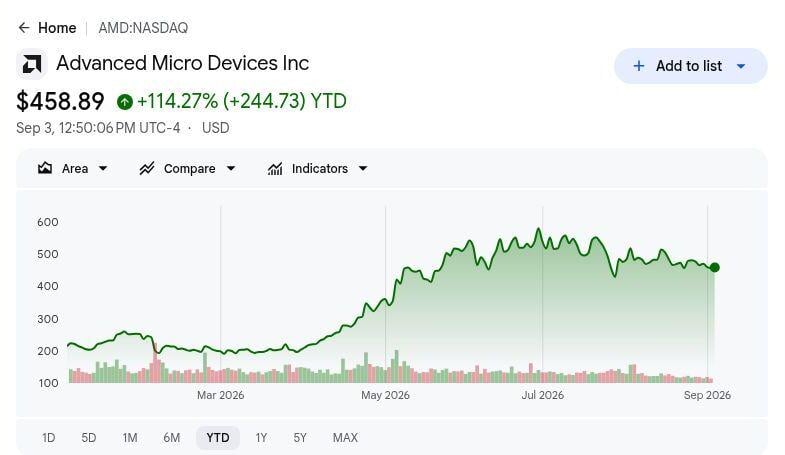
- AMD was up about 113% YTD through September 2: Shares closed at $457.06 after slipping 0.55% that day, showing how aggressively investors had repriced AMD around AI accelerators and server CPUs. That leaves less room for delays in Instinct, EPYC, or rack-scale deployments.
- Q2 revenue reached $11.536 billion, up 50% year over year: The result came about $336 million above the roughly $11.2 billion guidance midpoint and rose 13% sequentially, showing that AI demand was already converting into recognized sales.
- Data Center generated about 58% of total revenue as segment sales more than doubled: EPYC processors provided an established server base while Instinct accelerators expanded AMD’s AI exposure. The mix also increases sensitivity to hyperscaler deployments, packaging capacity, and customer concentration.
- Non-GAAP gross margin expanded to 56%: Non-GAAP EPS reached $1.66 versus the cited $1.62 consensus, while GAAP diluted EPS rose 156% to $1.38. That shows rapid revenue growth was translating into stronger profitability.
- Q3 revenue guidance reached $13.0 billion ±$300 million: The midpoint implies about 41% year-over-year growth and another 13% sequential increase, with non-GAAP gross margin expected near 56%. Delivering both would support the operating-leverage case after the 113% YTD rally.
What Is Advanced Micro Devices (AMD)?
AMD is a fabless semiconductor company that designs high-performance and adaptive computing products. Its portfolio includes EPYC server CPUs, Instinct data-center GPUs, Ryzen client processors, Radeon graphics, embedded products, networking technology, and ROCm AI software. The company serves cloud providers, enterprises, PC manufacturers, gamers, and industrial customers across data centers, personal computers, gaming, and embedded systems. Because AMD does not manufacture leading-edge wafers itself, it concentrates capital on architecture and product design while relying on external foundry, packaging, memory, and manufacturing partners.
AMD's current strategy increasingly spans a complete AI platform rather than a single accelerator. EPYC CPUs coordinate general compute, Instinct GPUs accelerate AI workloads, ROCm supplies the software layer, and Helios extends the portfolio into rack-scale deployments. Major cloud customers and system partners support broader adoption, while advanced foundry capacity, high-bandwidth memory, packaging yields, and networking readiness determine how quickly orders become recognized revenue. That platform approach can deepen customer relationships and spread software investment across a larger installed base, although Nvidia's ecosystem and hyperscaler custom silicon remain important competitive constraints.
Read More: AMD vs. Nvidia Comparison 2026: Which AI Computing Stock Is the Better Buy?
AMD Q2 2026 Earnings Overview: Revenue, EPS and Data-Center Growth
AMD delivered Q2 revenue of $11.536 billion, up 50% year over year and above the roughly $11.2 billion guidance midpoint, while non-GAAP EPS reached $1.66 versus $1.62 expected. Data Center represented 58% of total revenue and more than doubled, GAAP diluted EPS rose 156% to $1.38, and Q3 revenue guidance reached $13.0 billion plus or minus $300 million. The main tension is whether the accelerator ramp can preserve the 56% non-GAAP gross margin as product and customer mix changes.
|
Financial Metric |
Guidance / Consensus |
Reported / Actual |
Surprise |
|
Q2 2026 revenue |
About $11.2B guidance midpoint |
$11.536B |
Beat. About $336M above the midpoint; up 50% YoY and 13% sequentially. |
|
Q2 non-GAAP diluted EPS |
$1.62 consensus |
$1.66 |
Beat. $0.04 above consensus. |
|
Q2 GAAP diluted EPS |
— |
$1.38 |
Improved. Up 156% year over year. |
|
Q2 non-GAAP gross margin |
— |
56% |
Expanded. Up 13 percentage points year over year. |
|
Q2 Data Center revenue mix |
— |
58% of total revenue |
Expanded. Data Center became AMD's principal revenue engine. |
|
Q2 Data Center revenue growth |
— |
More than doubled YoY |
Accelerated. EPYC processors and Instinct accelerators drove the increase. |
|
Q3 2026 revenue outlook |
— |
$13.0B ± $300M |
Raised. The midpoint implies about 41% YoY and 13% sequential growth. |
|
Q3 non-GAAP gross-margin outlook |
— |
About 56% |
Stable. The guide holds margin near Q2 despite a larger accelerator ramp. |
- Q2 revenue of $11.536 billion beat the guidance midpoint by about $336 million: Sales rose 50% year over year and 13% sequentially, confirming that the AI ramp was delivering both scale and acceleration. The stronger base now raises the bar for Q3.
- Non-GAAP diluted EPS of $1.66 beat consensus by $0.04: GAAP diluted EPS also increased 156% to $1.38, showing that rapid revenue growth translated into both adjusted and reported earnings.
- Data Center reached 58% of total revenue as segment sales more than doubled: EPYC and Instinct became AMD’s main growth engines, increasing AI exposure while also making results more sensitive to hyperscaler deployment schedules and large programs.
- Non-GAAP gross margin expanded 13 percentage points to 56%: The improvement shows that product mix and execution strengthened alongside revenue growth. Holding margin near 56% through the next accelerator ramp would support the operating-leverage case.
- Q3 revenue guidance of $13.0 billion implies 41% annual growth: The midpoint also represents about 13% sequential growth, with non-GAAP gross margin expected near 56%. Meeting both targets would confirm continued momentum, while weaker shipments or margins would point to deployment or supply pressure.
AMD 2026 Investment Outlook: $700 Bull Case vs. $350 Bear Case
The central test is whether AMD can scale Instinct accelerators, EPYC processors, Helios systems, and ROCm adoption fast enough to sustain revenue growth and margins after the stock's approximately 113% YTD re-rating.
The Bull Case: Strong AI Chip Demand and Server Growth Push AMD Toward $700
The Bull Case assumes Instinct deployments accelerate, EPYC continues gaining server share, and customers adopt Helios for rack-scale AI systems. Revenue expands faster than platform and supply-chain spending, allowing operating margin to improve even if the accelerator mix creates different gross-margin economics from mature CPU products.
A move toward $700 would require Q3 revenue near or above $13.0 billion, gross margin holding around 56%, and broader ROCm adoption reducing customer switching costs. Timely access to advanced foundry, packaging, and memory capacity, together with continued estimate upgrades, would provide the clearest confirmation.
The Base Case: Steady Data Center Demand Keeps AMD Between $550 and $625
The Base Case assumes AMD delivers near current guidance as Data Center remains the principal growth engine. Instinct expands with hyperscale and sovereign customers, EPYC share gains continue, and ROCm improves steadily, but Nvidia's software ecosystem and hyperscaler custom silicon prevent an immediate closing of the platform gap.
Under this editorial scenario, AMD could trade mainly between $550 and $625. Revenue inside the $12.7 billion to $13.3 billion Q3 range, stable 56% non-GAAP gross margin, and broader accelerator visibility would support the range, while slower deployments or weaker software adoption would cap the upside.
The Bear Case: Slower AI Spending and Margin Pressure Pull AMD Toward $350
The Bear Case assumes AI deployments slip, customer concentration rises, or competitive pressure slows accelerator share gains. Export restrictions and limited foundry, packaging, memory, or substrate capacity would reduce shipment visibility while fixed platform investment continues, weakening the path from revenue growth to earnings leverage.
A move toward $350 would become more likely if Q3 revenue falls below the guided range, gross margin drops materially below 56%, or major customers delay deployment. After an approximately 113% YTD gain, lower forward estimates could combine with multiple compression even if AMD continues posting absolute revenue growth.
AMD Stock Price Forecasts for 2026 By Wall Street Analysts
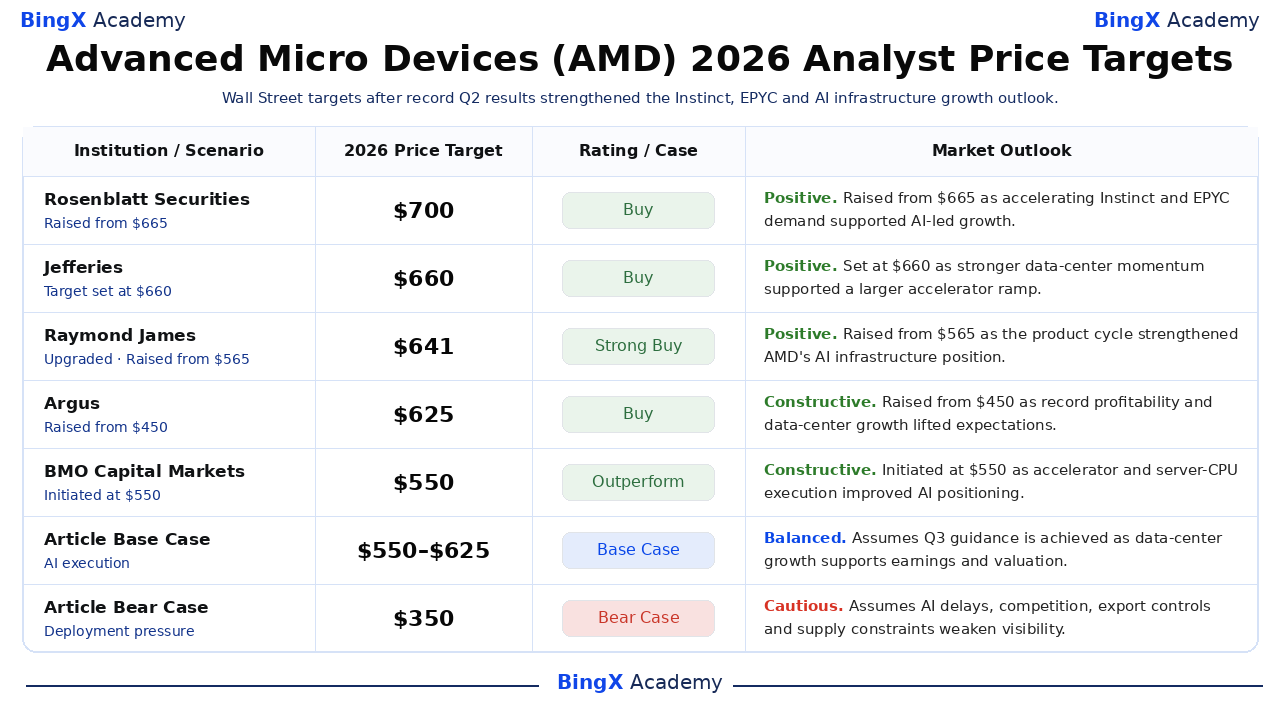
These six dated institutional actions span $550 to $700 and are sorted from highest to lowest. The range reflects different assumptions about Instinct deployment speed, EPYC share gains, ROCm adoption, gross margins, and the durability of AMD's AI re-rating rather than one unified consensus. The final Base and Bear rows are BingX Academy editorial scenarios, not Wall Street forecasts.
|
Institution / Scenario |
2026 Price Target |
Rating / Case |
Market Outlook |
|
Rosenblatt Securities |
$700 |
Buy |
Positive. August 6: raised from $665 to $700. The higher target reflects confidence that accelerating Instinct and EPYC demand can sustain AMD's AI-led growth after record Q2 results. |
|
Jefferies |
$660 |
Buy |
Positive. August 5: Buy-rated target set at $660. The target incorporates stronger Data Center momentum and the prospect of a larger second-half accelerator ramp. |
|
Raymond James |
$641 |
Strong Buy |
Positive. August 25: upgraded, with target raised from $565 to $641. The upgrade signals greater confidence in AMD's product cycle and expanding position across AI infrastructure. |
|
Argus |
$625 |
Buy |
Constructive. August 6: raised from $450 to $625. Record profitability and a stronger Data Center outlook supported a substantial post-earnings target increase. |
|
BMO Capital Markets |
$550 |
Outperform |
Constructive. August 20: initiated with a $550 target. The initiation recognizes AMD's improving AI compute position, with upside tied to continued accelerator and server-CPU execution. |
|
DA Davidson |
$550 |
Buy |
Constructive. August 5: raised from $425 to $550. The revised target reflects the Q2 beat and an improving second-half revenue path, balanced against elevated expectations. |
|
Article Base Case |
$550-$625 |
Base Case |
Balanced. Assumes AMD delivers near current Q3 guidance, data Center growth remains the principal driver, and valuation holds as earnings expand. |
|
Article Bear Case |
$350 |
Bear Case |
Cautious. Assumes AI deployments slip or customer concentration rises, competition slows accelerator share gains, and export and supply constraints weaken revenue visibility. |
How to Trade Advanced Micro Devices (AMD) Stock on BingX
Trade Advanced Micro Devices's Instinct accelerators, EPYC processors, Helios systems, ROCm adoption, and AI margins outlook using BingX TradFi and BingX AI tools. Because AMD can react sharply to earnings, accelerator launches, customer deployments, export controls, and supply updates, traders should define both the catalyst and risk limits before entering a position.
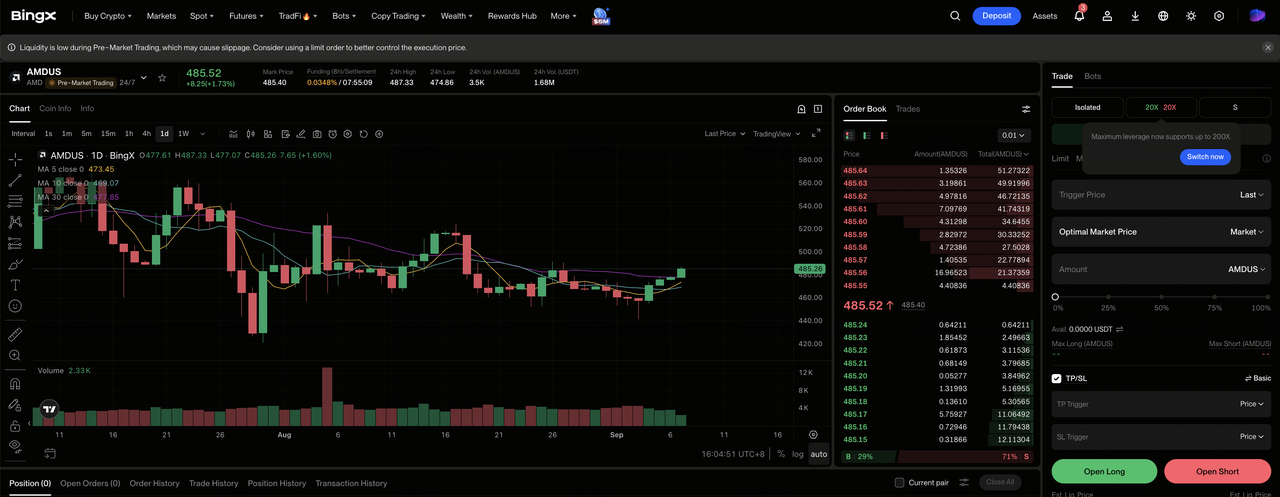
Step 1: Access BingX TradFi. Sign up and navigate to the specialized TradFi section on the BingX exchange dashboard.
Step 2: Select Advanced Micro Devices (AMD). Search for and select the AMDUS-USDT perpetual futures contract. Confirm the current price, fees, and contract specifications before placing an order.
Step 3: Choose your direction. Select Open Long if Instinct and EPYC deployments support the Bull or Base Case. Select Open Short if deployment delays, export restrictions, or margin pressure support the Bear Case.
Step 4: Select leverage and margin mode. Choose Isolated or Cross-Margin based on your risk tolerance. AMD's rapid AI repricing makes conservative leverage and clear position sizing important.
Step 5: Execute strict risk protocols. Set Take-Profit and Stop-Loss (TP/SL) levels before or immediately after entering the trade. AMD can react quickly to earnings, accelerator launches, customer deployments, export controls, and supply updates.
Top 5 Risks to Watch for AMD Investors in 2026
AMD’s outlook depends on valuation, competition, export policy, supply availability, and customer concentration, all of which can affect revenue visibility and margins.
- An approximately 113% YTD gain leaves little room for execution mistakes: The stock already reflects strong Instinct and EPYC growth. A modest guidance miss or deployment delay could lower forward estimates and compress the valuation multiple at the same time.
- Nvidia and custom hyperscaler chips can limit AI accelerator share gains: AMD competes not only on hardware but also against Nvidia’s established software ecosystem and internally designed customer chips. Slower ROCm adoption would weaken repeat deployments and pricing power.
- Export controls can disrupt sales and product planning: Tighter China restrictions or licensing delays could shift revenue across quarters and force product redesigns, adding cost and reducing engineering flexibility.
- Packaging and memory constraints can slow the AI ramp: High-bandwidth memory, advanced packaging, substrates, and networking components all need to scale together. A shortage in any one area could delay shipments despite strong customer demand.
- Large AI deployments increase customer concentration risk: A small number of hyperscale and sovereign programs can represent substantial revenue. If one customer changes its architecture, schedule, or supplier allocation, AMD could miss the $13.0 billion Q3 midpoint and weaken confidence in later accelerator growth.
Final Thoughts: Should You Invest in AMD in 2026?
AMD's Q2 results provide strong operating evidence for the AI thesis: revenue grew 50% to $11.536 billion, Data Center represented 58% of sales, non-GAAP gross margin reached 56%, and non-GAAP EPS of $1.66 exceeded the tracked consensus. Q3 guidance calls for another 13% sequential revenue increase, giving the company a clear test of accelerator scale and profitability.
The $550 to $625 Base Case assumes delivery near guidance, while the $700 Bull Case requires faster Instinct adoption, continued EPYC gains, and broader ROCm use without margin dilution. The $350 Bear Case reflects deployment delays, export limits, supply constraints, and multiple compression. Conservative traders may wait for Q3 revenue, stable 56% margin, and evidence that Helios deployments are broadening beyond a few large customers.
Risk Reminder: These scenarios are conditional research estimates, not investment advice or guaranteed returns. Shares and leveraged contracts can lose value, and leveraged positions may be liquidated.
Related Reading
- AMD vs. Nvidia Comparison 2026: Which AI Computing Stock Is the Better Buy?
- Nvidia (NVDA) Stock Price Outlook for 2026: Can Blackwell and Vera Rubin Take NVDA Back to $300?
- Top High-Performance Computing (HPC) Stocks to Watch in 2026: Accelerated Computing Market Leaders
- Top AI Compute and GPU Stocks to Buy in 2026: The Shift to Inference and Custom Silicon
- Top AI Semiconductor Stocks to Buy in 2026: AI Chips and Supply Chain Complete Guide
- Top AI Data Center Stocks to Buy in 2026: Cloud, Servers, and AI Compute Infrastructure
