
Ferrari (RACE) designs, engineers and sells luxury performance cars, limited-series models and one-off vehicles, while also earning from sponsorship, Formula 1, licensing and branded lifestyle activities. Its economic model relies on scarcity, controlled volumes, pricing and personalization rather than mass-market scale. This produces exceptional margins and brand durability, but leaves the shares sensitive to product mix, wealthy-customer demand, foreign exchange and a valuation that already assumes sustained execution.
Ferrari Q2 2026 showed that pricing and mix can offset lower volume. Revenue rose 8.4% to €1.94 billion (2.23billion),adjustedEBITDAincreased7%to€755million(867 million) and the company raised full-year revenue guidance to €7.6 billion ($8.72 billion). Shipments declined by 128 cars to 3,366, making the investment debate less about unit growth and more about whether F80 deliveries, personalization and the new Luce preserve earnings quality.
The RACE stock forecast for 2026 now centers on two competing views:
- The scarcity and premium-mix case: F80 deliveries, personalization and an order book covering all of 2027 protect pricing power, while the 12Cilindri family and Luce broaden demand without turning Ferrari into a volume manufacturer.
- The product-cycle and valuation case: Limited-series contribution normalizes, Luce adoption proves narrower than expected and slower global luxury spending makes a premium earnings multiple harder to sustain.
This guide breaks down the RACE stock forecast, 2026 price scenarios, key risks and analyst outlooks, drawing on Ferrari's July 30, 2026 Q2 earnings release, regulatory filings and market data through September 24, plus how to trade RACE stock futures on BingX TradFi with USDT collateral.
Top 5 Things for Ferrari Investors to Know in September 2026
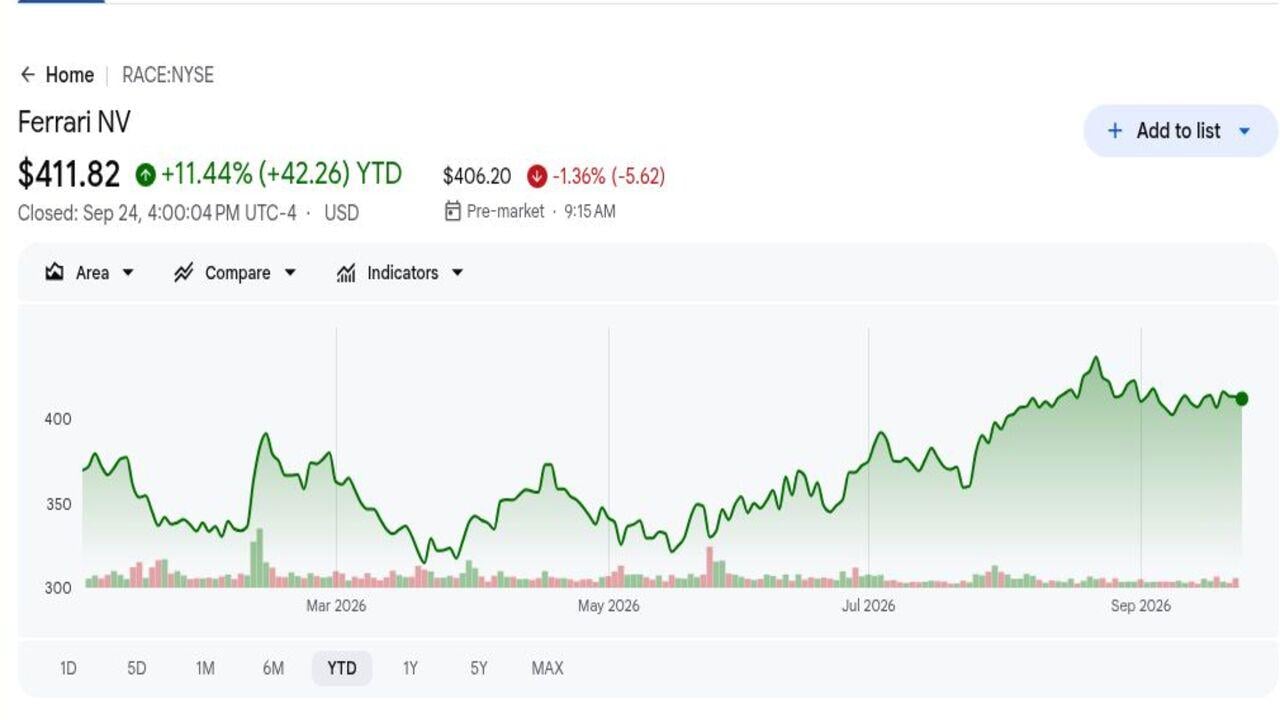
- RACE closed at $411.82 after rising 11.44% YTD: The gain followed a range between a $312.51 52-week low and $504.49 high, showing continued support for Ferrari's scarcity economics alongside sensitivity to valuation, product news and shifts in global luxury demand.
- Q2 revenue reached €1.94 billion ($2.23 billion), up 8.4%: The result exceeded the €1.89 billion (2.17billion)consensusby€50million(57 million), even as shipments declined by 128 cars, confirming that pricing, personalization and mix rather than volume drove the quarter and protected the revenue trajectory.
- Adjusted EBITDA rose 7% to €755 million ($867 million): The figure beat the €729 million (837million)consensusby€26million(30 million), supported by the €3.6 million ($4.13 million) F80 and higher personalization across a deliberately constrained production base, validating the earnings contribution from limited-series cars and bespoke options.
- Shipments fell to 3,366 cars: Ferrari delivered 128 fewer vehicles than a year earlier, yet mix and pricing still raised revenue. That contrast demonstrates the strength of scarcity, though it also increases reliance on limited-series cadence and successful transitions between model families.
- 2026 revenue guidance rose to €7.6 billion ($8.72 billion): The prior target was €7.5 billion (8.61billion),whileadjustedEBITDAguidanceincreasedtoatleast€2.97billion(3.41 billion). The order book covers all of 2027, providing production visibility as new models enter the mix.
What Is Ferrari (RACE)?
Ferrari is an Italian luxury-performance company that controls design, engineering, production and distribution from its Maranello base. Cars and spare parts generate most revenue, supported by sponsorship and commercial income tied to Formula 1, engines, licensing and brand activities. The company deliberately limits supply relative to demand and uses long waiting lists, special-series allocation and personalization to protect exclusivity. Customers pay substantial premiums for bespoke materials, colors and features, allowing mix to drive revenue faster than vehicle volume.
Its long-term strategy combines combustion, hybrid and electric models rather than forcing one powertrain across the portfolio. The F80 limited series and 12Cilindri family serve collectors and traditional clients, while the Luce creates an entry into electric performance at €550,000 ($631,000). Formula 1 remains a global marketing platform, and Ferrari extends the brand through racing, fashion, hospitality and licensing. Management's order book covers all of 2027, giving production visibility while preserving the scarcity that supports pricing and resale values.
Read More: Who Are the Top Sponsors of Scuderia Ferrari in 2026?
Ferrari (RACE) Q2 2026 Earnings Overview: Premium Mix Drives Revenue, EBITDA and Higher Guidance
Ferrari generated €1.94 billion (2.23billion)ofrevenueversus€1.89billion(2.17 billion) expected, while adjusted EBITDA reached €755 million (867million)against€729million(837 million) consensus. Shipments fell 3.7% to 3,366, yet high-margin F80 deliveries and personalization lifted earnings. Management raised annual revenue to €7.6 billion (8.72billion)andadjustedEBITDAtoatleast€2.97billion(3.41 billion). The tension is whether premium mix can keep offsetting softer volumes.
|
Financial Metric |
Guidance / Consensus |
Reported / Actual |
Surprise |
|
Q2 net revenue |
€1.89B ($2.17B) |
€1.94B ($2.23B) |
Beat. €50M ($57M) above consensus; up 8.4%. |
|
Q2 adjusted EBITDA |
€729M ($837M) |
€755M ($867M) |
Beat. €26M ($30M) above consensus; up 7%. |
|
Q2 shipments |
3,494 a year earlier |
3,366 |
Lower. Declined by 128 units. |
|
Q2 adjusted EBITDA margin |
39.4% a year earlier |
38.90% |
Compressed. Down 50 basis points. |
|
FY2026 revenue outlook |
€7.5B ($8.61B) prior |
€7.6B ($8.72B) |
Raised. Increased €100M ($115M). |
|
FY2026 adjusted EBITDA outlook |
€2.93B ($3.36B) prior |
At least €2.97B ($3.41B) |
Raised. Increased €40M ($46M). |
|
FY2026 adjusted EBIT outlook |
€2.22B ($2.55B) prior |
At least €2.26B ($2.59B) |
Raised. Increased €40M ($46M). |
- Revenue of €1.94 billion ($2.23 billion) grew 8.4%: Revenue beat consensus by €50 million ($57 million) despite 128 fewer shipments. Strong pricing, product mix, and personalization helped offset lower volumes during the model transition.
- Adjusted EBITDA of €755 million (867million)beatby€26million(30 million): EBITDA rose 7%, though margin slipped 50 basis points to 38.9% as product and launch costs increased. Margin durability remains an important test for the raised outlook.
- Shipments fell 3.7% to 3,366: Lower deliveries alongside higher revenue support Ferrari's scarcity-based pricing model. The next test is whether new models and personalization can sustain that mix once F80 deliveries mature.
- Annual revenue guidance increased by €100 million ($115 million): Ferrari now expects €7.6 billion ($8.72 billion), supported by personalization and currency effects rather than higher volumes. That keeps product mix and pricing at the center of the growth outlook.
- Adjusted EBITDA guidance increased by €40 million ($46 million): The new target of at least €2.97 billion ($3.41 billion) points to continued earnings growth. An order book covering production through 2027 also provides strong visibility into future demand.
Read More: Uber (UBER) Price Prediction 2026: Can Autonomous Mobility Push UBER Toward $120?
Ferrari (RACE) 2026 Investment Outlook: $525 Bull Case vs. $350 Bear Case
Ferrari's 2026 outlook depends on whether premium pricing, personalization, and new models can keep earnings growing faster than vehicle volumes. The upside comes from strong F80 and 12Cilindri demand, a full order book, and successful expansion into new segments, while weaker luxury demand and product-cycle transitions remain the main risks.
The Bull Case: Strong Pricing and Personalization Push RACE Toward $525
The Bull Case assumes F80 deliveries, personalization, and the 12Cilindri family keep revenue growing faster than shipments. The Luce broadens Ferrari's customer reach without weakening scarcity, while the order book through 2027 supports strong production visibility.
A move toward 525wouldrequirerevenuetomeetorexceed€7.6billion(8.72 billion), adjusted EBITDA to clear €2.97 billion ($3.41 billion), and margin to stay near 39%. Strong Luce demand and continued high personalization would strengthen the case.
The Base Case: Premium Mix Keeps RACE Between $440 and $490
The Base Case assumes the 2027 order book, F80, and personalization continue supporting earnings growth, though the stock's 11.44% YTD gain limits further multiple expansion. Luce demand is healthy but does not become a major new volume driver in 2026.
RACE could trade mainly between $440 and 490ifrevenuereaches€7.6billion(8.72 billion) and EBITDA margin stays near 39%. Guidance cuts or shorter order-book visibility would weaken the upper end.
The Bear Case: Softer Luxury Demand Pulls RACE Toward $350
The Bear Case assumes F80 contribution fades faster than new models replace it, personalization moderates, and global luxury demand softens. Fixed development costs and Luce launch spending would then weigh more heavily on margins and cash generation.
A move toward 350wouldbecomemorelikelyifadjustedEBITDAfallsbelow€2.93billion(3.36 billion), margin drops under 37%, or the order book shortens. Slower mix growth would pressure both earnings and Ferrari's premium valuation.
RACE Stock Price Forecasts for 2026 By Wall Street Analysts
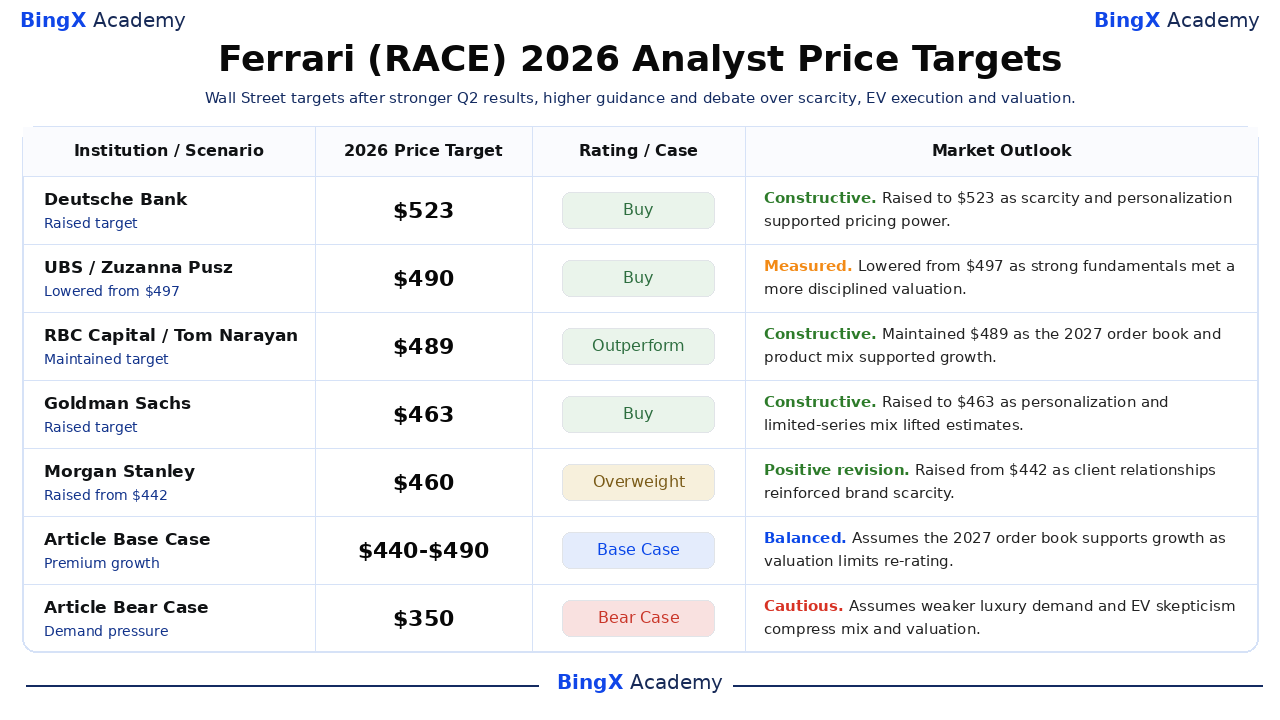
The five recent actions below range from $460 to $523. They reflect confidence in Ferrari's scarcity model alongside different views on valuation and product-cycle durability. The final Base and Bear rows are editorial scenarios rather than Wall Street targets, separating the article framework from institutional research.
|
Institution / Scenario |
2026 Price Target |
Rating / Case |
Market Outlook |
|
Deutsche Bank |
$523 |
Buy |
Constructive. September 3: raised as scarcity and personalization supported pricing power. |
|
UBS |
$490 |
Buy |
Measured. September 18: lowered from $497 as fundamentals met valuation discipline. |
|
RBC Capital |
$489 |
Outperform |
Constructive. September 22: maintained as the 2027 order book supported growth. |
|
Goldman Sachs |
$463 |
Buy |
Constructive. September 3: raised as personalization and limited-series mix lifted estimates. |
|
Morgan Stanley |
$460 |
Overweight |
Positive revision. September 10: raised from $442 as client relationships reinforced scarcity. |
|
Article Base Case |
440-490 |
Base Case |
Balanced. Assumes the 2027 order book supports growth as valuation limits re-rating. |
|
Article Bear Case |
$350 |
Bear Case |
Cautious. Assumes weaker luxury demand and EV skepticism compress mix and valuation. |
How to Trade Ferrari (RACE) Stock on BingX
Trade Ferrari's limited-series mix, personalization and electric-vehicle outlook using BingX TradFi and BingX AI tools. Because RACE can react sharply to guidance, product launches and luxury-demand signals, traders should define both the catalyst and risk limits before entering a position.
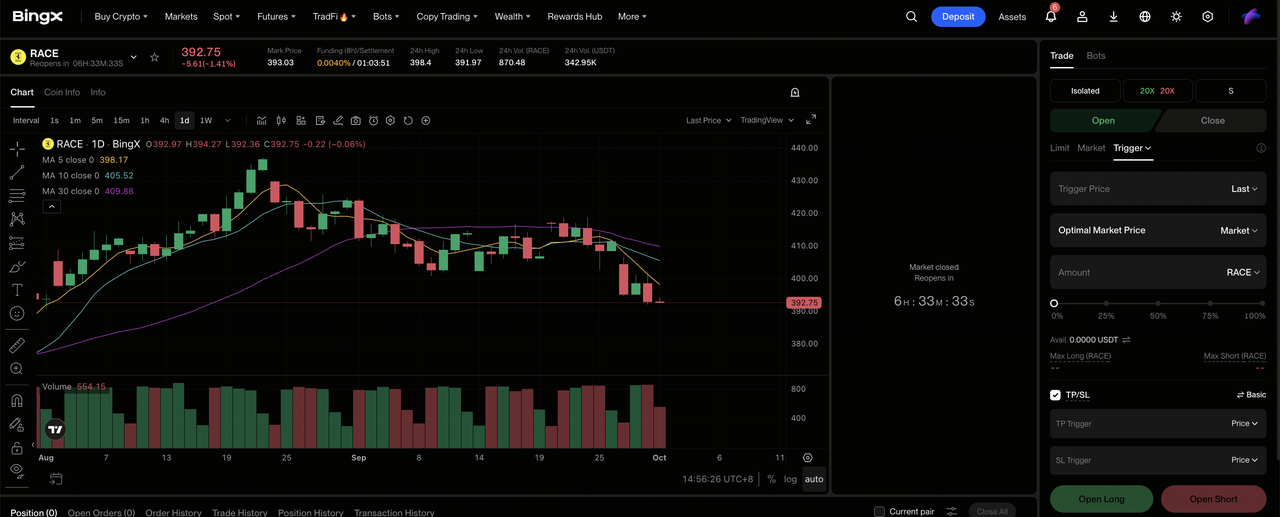
Step 1: Access BingX TradFi. Sign up and navigate to the specialized TradFi section on the BingX exchange dashboard.
Step 2: Select Ferrari (RACE). Search for and select the RACE-USDT perpetual futures contract.
Step 3: Choose your direction. Select Open Long if personalization and premium mix sustain guidance. Select Open Short if EV execution or weaker luxury demand pressures margins.
Step 4: Select leverage and margin mode. Choose Isolated or Cross-Margin based on your risk tolerance. The range between $312.51 and $504.49 shows why conservative leverage and position sizing matter.
Step 5: Execute strict risk protocols. Set Take-Profit and Stop-Loss (TP/SL) levels before or immediately after entering the trade. RACE can react quickly to shipments, product mix, guidance and foreign exchange.
Top 5 Risks to Watch for Ferrari Investors in 2026
Ferrari's premium valuation depends on scarcity, product mix, and brand strength continuing to support steady earnings growth. Each risk below could weaken margins, demand visibility, or the valuation multiple.
- Limited-series mix can normalize: The €3.6 million ($4.13 million) F80 contributed strongly to Q2. A gap before the next high-margin program could slow EBITDA growth and leave fixed development costs spread across a less favorable mix.
- Luce execution can affect Ferrari's EV strategy: The €550,000 ($631,000) model expands the portfolio, but weaker-than-expected demand could raise marketing costs and delay returns on electric investment. That would also pressure confidence in future EV launches.
- Luxury demand remains sensitive to macro conditions: Even wealthy customers can delay purchases during market or geopolitical stress. Lower personalization and a shorter order book would weaken the visibility that supports Ferrari's premium valuation.
- Currency can distort reported growth: Ferrari reports in euros but sells globally. Exchange-rate moves can offset price increases, affect reported margins, and change translated returns for U.S. investors even when vehicle demand remains stable.
- A premium multiple magnifies guidance risk: Revenue below €7.6 billion (8.72billion)oradjustedEBITDAunder€2.97billion(3.41 billion) could pressure both earnings expectations and valuation. Even a modest guidance cut could therefore trigger an outsized share-price reaction.
Final Thoughts: Should You Invest in Ferrari in 2026?
Ferrari's Q2 evidence remained strong. Revenue grew 8.4% despite 128 fewer shipments, adjusted EBITDA beat consensus by €26 million ($30 million), guidance increased and the order book covered 2027. Those numbers demonstrate pricing power more clearly than a simple unit-growth story and support the premium economics embedded in the current valuation.
The path toward $525 requires mix, personalization and Luce demand to preserve margins. The $350 Bear Case reflects product-cycle normalization, weaker luxury spending and multiple compression. Conservative traders may watch personalization, EBITDA margin, order coverage and Luce orders together rather than relying only on shipment volume when evaluating whether earnings growth and valuation remain aligned.
Risk Reminder: Trading and investing in equities like RACE involves a risk of capital loss. Luxury demand, currency changes, valuation and leveraged trading can produce rapid losses. Conduct independent research before allocating capital.
Related Reading
- Tesla (TSLA) Price Prediction 2026: Can Robotaxi and Optimus Push TSLA Stock to $500?
- Uber (UBER) Price Prediction 2026: Can Robotaxi Partnerships Push UBER Toward $120?
- SpaceX (SPCX) Price Prediction 2026: $227 Street-High AI Fusion or Trillion-Dollar Valuation Bubble?
- Firefly Aerospace (FLY) Price Prediction 2026: Can Launch and Defense Growth Push FLY Toward $55?
- GE Aerospace (GE) Price Prediction 2026: Can the $190B Backlog Defy Valuation Fears?
