

Okta (OKTA) provides cloud identity and access-management software for employees, customers, machines and AI agents. Its Workforce Identity and Customer Identity platforms manage authentication, authorization, governance and privileged access across enterprise applications. That independent position gives Okta exposure to rising security spending, though the stock remains sensitive to competition, enterprise contract timing and the valuation investors assign to future AI-agent demand.
The latest quarter strengthened the operating case. Okta Fiscal Q2 2027 revenue reached $805 million, up 11% year over year, current remaining performance obligations rose 14% to $2.585 billion and free cash flow increased 40% to $227 million. The investment question is whether newer governance, privileged-access and AI-agent products can keep contracted growth above reported revenue as the core business becomes larger.
The OKTA stock forecast for 2026 now centers on two competing views:
- The identity-platform and AI-agent case: faster cRPO growth, broader adoption of new security products and operating leverage could extend double-digit expansion as enterprises secure human and AI identities.
- The competition and growth-normalization case: platform rivals could slow bookings before AI-agent revenue becomes material, reducing growth expectations and the software multiple assigned to Okta.
This guide breaks down the OKTA stock forecast, 2026 price scenarios, key risks and analyst outlooks, drawing on Okta's August 26 fiscal Q2 2027 earnings release, quarterly filing and market data through September 18, plus how to trade OKTA stock futures on BingX TradFi with USDT collateral.
Top 5 Things for Okta Investors to Know in September 2026
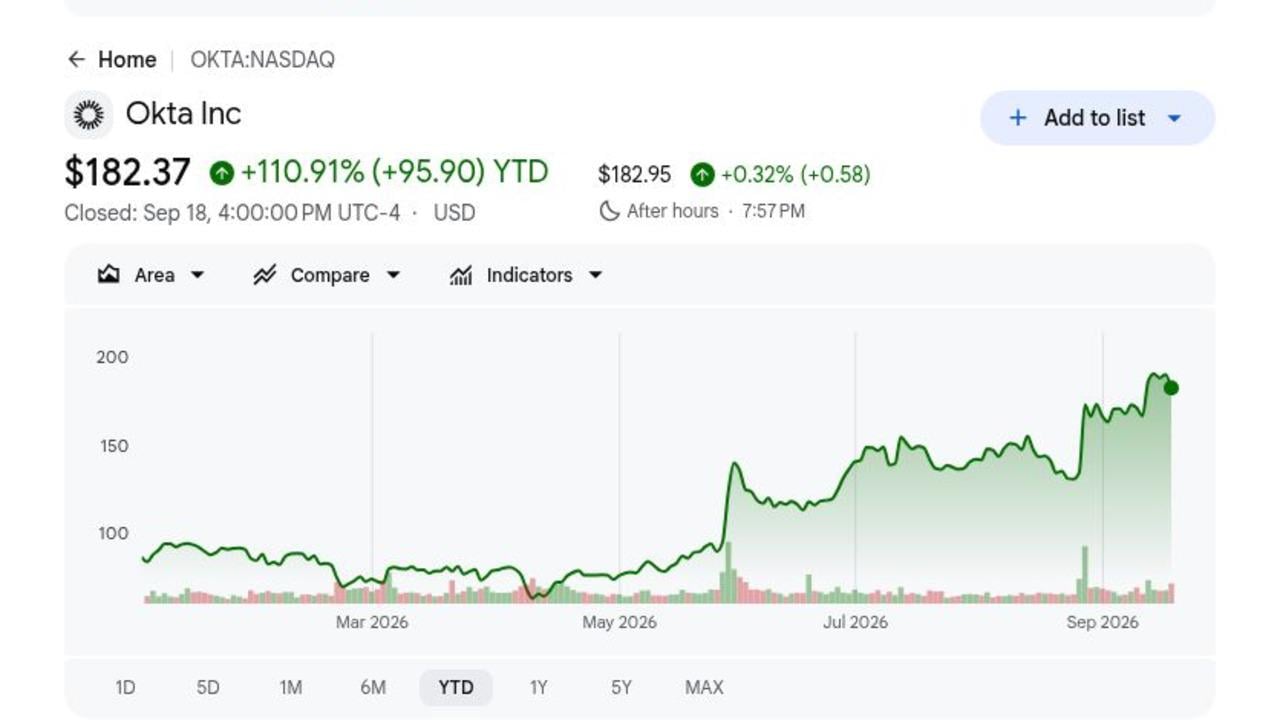
- OKTA closed at $182.37 on September 18 and was up 110.91% in 2026: The rally reflects stronger execution and rising demand for identity controls around AI agents. With shares near the $183.71 analyst consensus, further upside likely requires higher earnings estimates rather than simple recovery.
- Fiscal Q2 revenue reached $805 million, up 11%: Revenue beat the midpoint of Okta's $790 million to $794 million guidance by $13 million. Subscription revenue rose 12% to $793 million and represented 98.5% of total sales.
- Current RPO rose 14% to $2.585 billion: Total RPO increased 17% to $4.858 billion, both faster than the quarter's 11% revenue growth. The spread points to stronger contracted demand, though that backlog still needs to convert into sustained revenue growth.
- Free cash flow rose 40% to $227 million: Free-cash-flow margin expanded six points to 28%, while GAAP operating margin improved from 6% to 13%. Better cash conversion gives Okta more room to fund product development and repurchases.
- Fiscal 2027 revenue guidance rose to $3.216 billion to $3.226 billion: The midpoint increased by $21 million from the prior range despite roughly a one-point growth headwind from shifting more professional services to partners. Full-year free-cash-flow guidance of $910 million to $930 million implies a 28% to 29% margin.
What Is Okta (OKTA)?
Okta is an independent identity-security company whose cloud platform connects users and machines to applications under centrally managed policies. Workforce Identity Cloud includes single sign-on, adaptive multifactor authentication, lifecycle management, identity governance and privileged access. Customer Identity Cloud, built around Auth0, lets developers add authentication and authorization to digital products. Subscription contracts generate nearly all revenue, and the platform's neutral design lets customers connect applications across multiple cloud and software vendors.
The long-term strategy is moving beyond login toward governance and threat protection for every identity, including non-human accounts and autonomous agents. Okta is building discovery, authorization and lifecycle controls for AI agents while expanding Identity Governance and Privileged Access inside existing customers. Named customer examples include McLaren Racing, Wyndham, Hitachi, Booking.com, Mars and FedEx, giving the platform exposure across consumer, industrial and regulated environments. That breadth supports cross-selling, though it also places Okta against bundled identity offerings from larger software platforms.
Read More: CrowdStrike (CRWD) Price Prediction 2026: Can AI Security and Falcon Flex Push CRWD Toward $280?
Okta (OKTA) Q2 FY2027 Earnings Overview: Revenue, cRPO and Cash Flow Accelerate
Okta delivered $805 million of revenue versus a $792 million guidance midpoint, $1.05 of non-GAAP diluted EPS versus a $0.95 to $0.97 outlook, and $2.585 billion of cRPO, up 14%. GAAP operating income reached $107 million and free cash flow reached $227 million. Management raised annual revenue guidance to $3.216 billion to $3.226 billion, though the 10% to 11% growth range shows that stronger bookings still need to produce a durable reacceleration.
|
Financial Metric |
Guidance / Consensus |
Reported / Actual |
Surprise |
|
Q2 FY2027 revenue |
$790M-$794M guidance |
$805M |
Beat. $13M above midpoint; up 11% YoY. |
|
Subscription revenue |
$711M a year earlier |
$793M |
Expanded. Up 12% YoY. |
|
Non-GAAP diluted EPS |
$0.95-$0.97 guidance |
$1.05 |
Beat. Eight cents above the high end. |
|
RPO |
— |
$4.858B; +17% |
Accelerated. Backlog outgrew revenue. |
|
Current RPO |
— |
$2.585B; +14% |
Positive. Near-term contracted demand strengthened. |
|
GAAP operating income |
$41M; 6% margin a year earlier |
$107M; 13% margin |
Improved. Margin expanded seven points. |
|
Free cash flow |
$162M; 22% margin a year earlier |
$227M; 28% margin |
Expanded. Cash flow rose 40%. |
|
FY2027 revenue outlook |
Prior $3.19B-$3.21B |
$3.216B-$3.226B |
Raised. Midpoint increased $21M. |
- Revenue beat the guidance midpoint by $13 million: Sales rose 11%, supported by 12% subscription growth as more services work shifted to partners. Subscription revenue reached $793 million and represented 98.5% of total sales, preserving Okta's recurring-revenue base.
- Non-GAAP EPS reached $1.05, up 15%: The result beat the prior high end by $0.08, while GAAP diluted EPS rose from $0.37 to $0.65. GAAP net income also increased to $116 million from $67 million, showing stronger operating leverage.
- RPO reached $4.858 billion, up 17%: cRPO grew 14%, also faster than reported revenue. The $2.585 billion current balance improves near-term visibility if customers deploy and renew on schedule.
- Free-cash-flow margin expanded to 28%: The six-point improvement came alongside $234 million of operating cash flow and $2.299 billion of cash and short-term investments. Stronger cash generation gives Okta more room to invest and repurchase shares.
- Annual revenue guidance rose to a $3.221 billion midpoint: Management absorbed roughly a one-point services headwind and still raised the range. Q3 guidance of $813 million to $817 million implies about 10% growth, while full-year free-cash-flow guidance of $910 million to $930 million implies a 28% to 29% margin.
Read More: Palo Alto Networks (PANW) Price Prediction 2026: Can Platformization Push PANW Toward $450?
Okta (OKTA) 2026 Investment Outlook: $225 Bull Case vs. $130 Bear Case
Okta's 2026 outlook depends on whether AI-agent security can add a new growth layer while core identity demand and free-cash-flow margins remain strong. The upside comes from faster cRPO and cross-sell growth, while competition and the stock's higher valuation remain the main risks.
The Bull Case: Strong AI Security Demand Pushes OKTA Toward $225
The Bull Case assumes AI-agent discovery, governance and authorization expand Okta's market while Workforce and Customer Identity bookings remain healthy. cRPO stays near or above 14%, and annual free-cash-flow margin remains around the guided 28% to 29% range.
A move toward $225 would require repeated revenue and cRPO beats, stronger cross-selling from governance and privileged access, and evidence that AI-agent products are producing real contracts rather than only pilots. Analyst targets near $219 would provide additional support.
The Base Case: Steady Identity Growth Keeps OKTA Between $175 and $200
The Base Case assumes revenue grows around 10% to 11% and cRPO remains in the low-to-mid teens. Cash generation stays strong, though competition and the higher valuation limit another major re-rating.
Under this scenario, OKTA could trade mainly between $175 and $200. Stable renewals, annual EPS near the $3.90 to $3.94 outlook and free cash flow above $900 million would support the range. cRPO slowing toward reported revenue growth would weaken the upper end.
The Bear Case: Slower Growth and Competition Pull OKTA Toward $130
The Bear Case assumes larger platforms capture more bundled identity spending while AI-agent security takes longer to monetize. Slower bookings push cRPO toward single-digit growth and weaken confidence in a sustained revenue acceleration.
A move toward $130 would become more likely if guidance falls, margins weaken or another material security incident slows sales cycles. Even positive cash flow may not prevent multiple compression after the stock's 110.91% YTD rise.
OKTA Stock Price Forecasts for 2026 By Wall Street Analysts
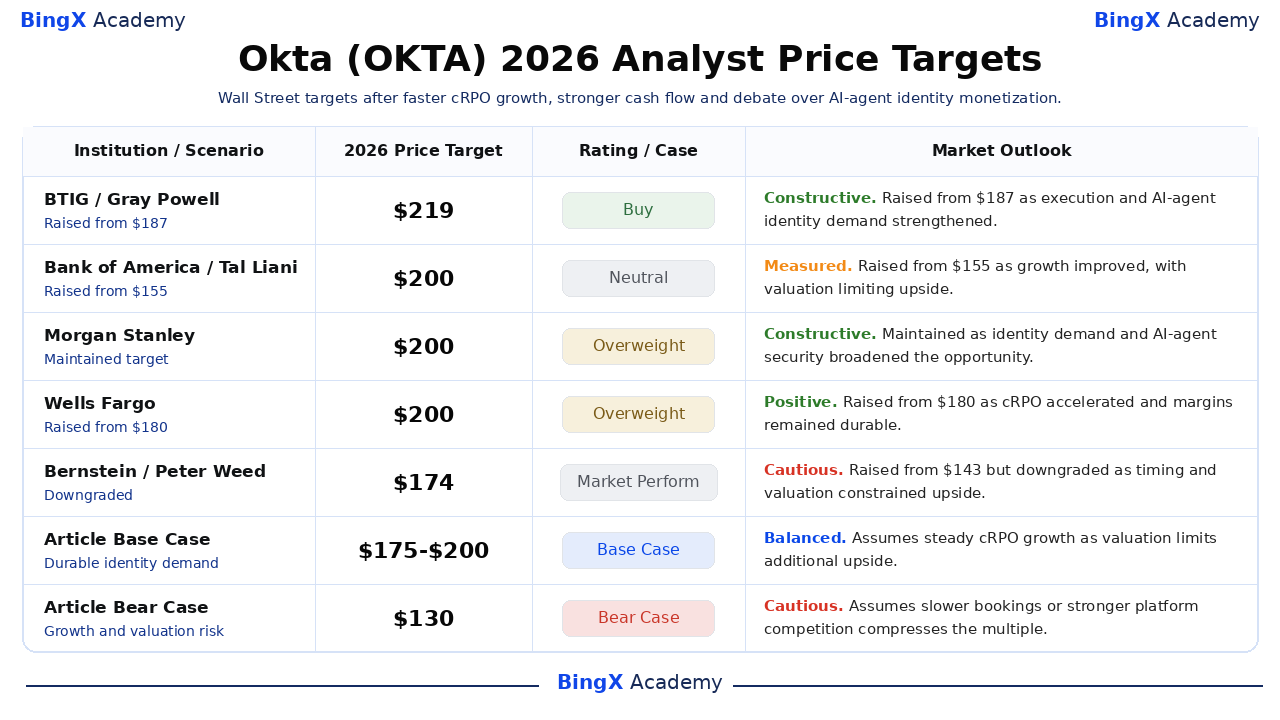
Analyst targets remain divided after Okta's Q2 beat. The selected actions range from $174 to $219, with bullish firms emphasizing cRPO, margins and AI-agent demand and Bernstein highlighting timing and valuation risk. Article scenarios are listed separately and do not represent analyst consensus.
|
Institution / Analyst |
2026 Price Target |
Rating |
Market Outlook |
|
BTIG / Gray Powell |
$219 |
Buy |
Constructive. September 17: raised from $187 as execution and AI-agent identity demand strengthened. |
|
Bank of America / Tal Liani |
$200 |
Neutral |
Measured. September 18: raised from $155 as growth improved, with valuation limiting upside. |
|
Morgan Stanley / Meta Marshall |
$200 |
Overweight |
Constructive. September 18: maintained as identity demand and AI-agent security broadened the opportunity. |
|
Wells Fargo / Andrew Nowinski |
$200 |
Overweight |
Positive. September 14: raised from $180 as cRPO accelerated and margins remained durable. |
|
Bernstein / Peter Weed |
$174 |
Market Perform |
Cautious. September 17: raised from $143 but downgraded as timing and valuation constrained upside. |
|
Article Base Case |
$175-$200 |
Base Case |
Balanced. Assumes steady cRPO growth as valuation limits additional upside. |
|
Article Bear Case |
$130 |
Bear Case |
Cautious. Assumes slower bookings or stronger platform competition compresses the multiple. |
How to Trade Okta (OKTA) Stock on BingX
Trade Okta's identity-security, AI-agent adoption and cash-flow outlook using BingX TradFi and BingX AI tools. Because OKTA can react sharply to cRPO, guidance and cybersecurity news, traders should define the catalyst and loss limit before entering a position.
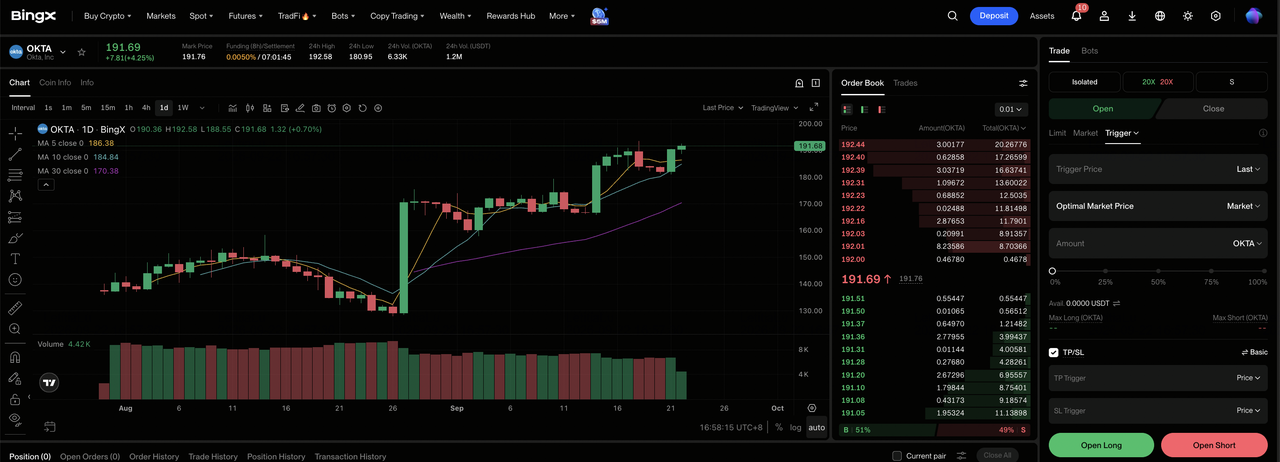
Step 1: Access BingX TradFi. Sign up and navigate to the specialized TradFi section on the BingX exchange dashboard.
Step 2: Select Okta (OKTA). Search for and select the OKTA-USDT perpetual futures contract.
Step 3: Choose your direction. Select Open Long if cRPO remains above revenue growth and AI-agent identity wins expand. Select Open Short if bookings slow or competition weakens guidance.
Step 4: Select leverage and margin mode. Choose Isolated or Cross-Margin based on your risk tolerance. The 110.91% YTD rise shows why conservative leverage and clear position sizing matter.
Step 5: Execute strict risk protocols. Set Take-Profit and Stop-Loss (TP/SL) levels before or immediately after entering the trade. OKTA can move quickly around earnings, guidance, analyst revisions and security incidents.
Top 5 Risks to Watch for OKTA Investors in 2026
Okta's outlook depends on competition, AI monetization, security, deal timing and valuation. These risks can affect bookings, revenue visibility and the multiple assigned to the stock.
- Competition could slow cRPO growth: Bundled identity tools from larger software vendors could lengthen sales cycles and reduce cross-selling. cRPO growth falling below Q2's 14% rate would be an early sign that competitive pressure is affecting demand.
- AI-agent revenue could take longer to scale: Enterprises may test new products without moving quickly into broad deployment. If production contracts remain limited, AI-agent identity could contribute less revenue than expected while Okta continues investing in development and sales.
- Security incidents could damage customer trust: A material breach involving Okta or a key provider could create remediation costs, churn and slower new sales. Large customers could also delay renewals while reviewing access controls and security exposure.
- Large contracts can create quarterly volatility: Enterprise renewals and expansions can move between quarters even when underlying demand remains healthy. A few delayed deals could distort cRPO growth and pressure short-term guidance.
- The higher valuation leaves less room for misses: OKTA gained 110.91% YTD and closed at $182.37, near the $183.71 analyst consensus. Further upside now depends more heavily on higher earnings estimates, making even modest guidance disappointment more important.
Final Thoughts: Should You Invest in OKTA in 2026?
Okta's Q2 results combined 11% revenue growth, 14% cRPO growth, a 13% GAAP operating margin and $227 million of free cash flow. That mix shows a stronger identity platform with improving economics. The remaining debate is whether AI-agent controls and newer governance products can sustain faster bookings after the stock has already more than doubled in 2026.
The Bull Case needs cRPO to remain ahead of revenue and margins to support $225. The Bear Case reflects slower bookings, stronger platform competition and a move toward $130. Conservative traders may watch cRPO, large-customer wins, AI-agent contract disclosures, free-cash-flow margin and annual guidance before treating the current valuation as durable.
Risk Reminder: Trading and investing in equities like OKTA involves a risk of capital loss. Competition, security incidents, contract timing, valuation changes and leveraged trading can produce rapid losses. Conduct independent research before allocating capital.
Related Reading
- Adobe (ADBE) Price Prediction 2026: Can AI Monetization Push ADBE Toward $350?
- UiPath (PATH) Price Prediction 2026: Can Agentic AI Push PATH Toward $23?
- Oracle (ORCL) Price Prediction 2026: Can AI Cloud Growth Push ORCL Toward $260?
- CrowdStrike (CRWD) Price Prediction 2026: Can AI Security and Falcon Flex Push CRWD Toward $280?
- Arm Holdings (ARM) Price Prediction 2026: Can AI Compute Demand Push ARM Toward $350?
