


Snowflake (SNOW) operates a consumption-based Data Cloud used for data storage, analytics, engineering, application development and artificial intelligence. The platform runs across Amazon Web Services, Microsoft Azure and Google Cloud, allowing customers to govern and analyze data without tying every workload to one infrastructure provider. Core data consumption remains central to revenue, while Cortex AI and application workloads are becoming more important to growth. This expansion broadens the opportunity, though the stock remains sensitive to usage trends, competition and valuation.
The latest quarter showed that AI workloads are adding to core growth. Snowflake Q2 FY2027 revenue reached $1.55 billion, product revenue rose 37% to $1.49 billion and adjusted EPS of $0.62 exceeded the $0.45 consensus. Management raised full-year product-revenue guidance from $5.84 billion to $6.07 billion as Cortex Code surpassed 9,100 accounts and CoWork exceeded 5,800, making durable AI consumption and operating leverage the central investment test.
The SNOW stock forecast for 2026 now centers on two competing views:
- The AI-workload and consumption-growth case: Cortex, Snowpark and data-engineering workloads could sustain faster product growth and expand operating margins as enterprise usage scales.
- The consumption and competition case: slower customer usage, Databricks and hyperscaler competition, and heavy stock compensation could limit per-share earnings despite continued revenue growth.
This guide breaks down the SNOW stock forecast, 2026 price scenarios, key risks and analyst outlooks, drawing on Snowflake's September 2, 2026 Q2 FY2027 earnings release, quarterly filing and market data through September 18, plus how to trade SNOW stock futures on BingX TradFi with USDT collateral.
Top 5 Things for Snowflake Investors to Know in September 2026
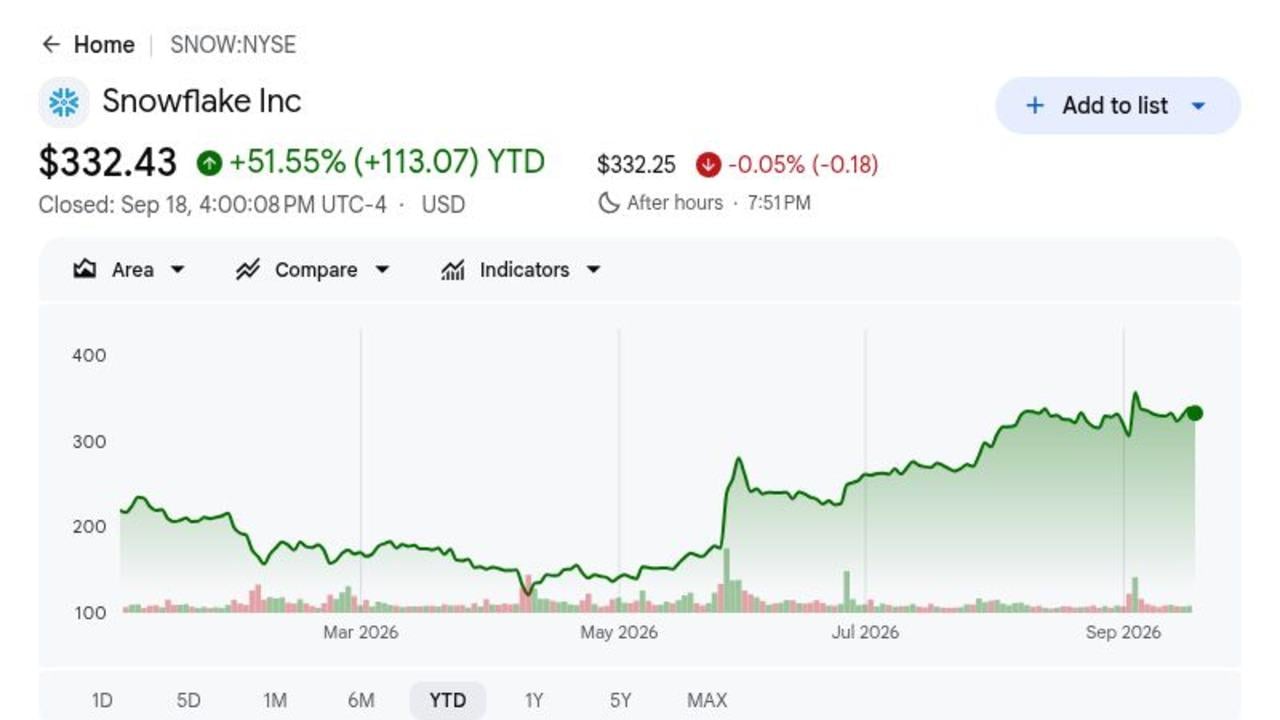
- SNOW closed at $332.43 and was up 51.55% in 2026: The September 18 close followed a 17% post-earnings jump but remained below the $425.19 analyst average. The gap shows investors still want proof that AI adoption can sustain growth after the re-rating.
- Revenue reached $1.55 billion and beat consensus by about $70 million: Total revenue grew 35% year over year, while adjusted EPS of $0.62 beat the $0.45 estimate. The results showed stronger usage growth reaching both revenue and non-GAAP profitability.
- Product revenue rose 37% to $1.49 billion: The result exceeded the $1.415 billion to $1.420 billion outlook by about $70 million. Faster product consumption matters because it is the clearest measure of workload growth on Snowflake's platform.
- FY2027 product-revenue guidance increased by $230 million to $6.07 billion: Management raised the prior $5.84 billion outlook and lifted adjusted operating-margin guidance to 14.5%. Stronger growth and margins together suggest improving operating leverage.
- AI adoption reached 9,100 Cortex Code and 5,800 CoWork accounts: Snowflake also added 692 customers, up 32%, while management said AI products drove about half of the recent growth acceleration. The next test is whether those account gains translate into sustained consumption.
What Is Snowflake (SNOW)?
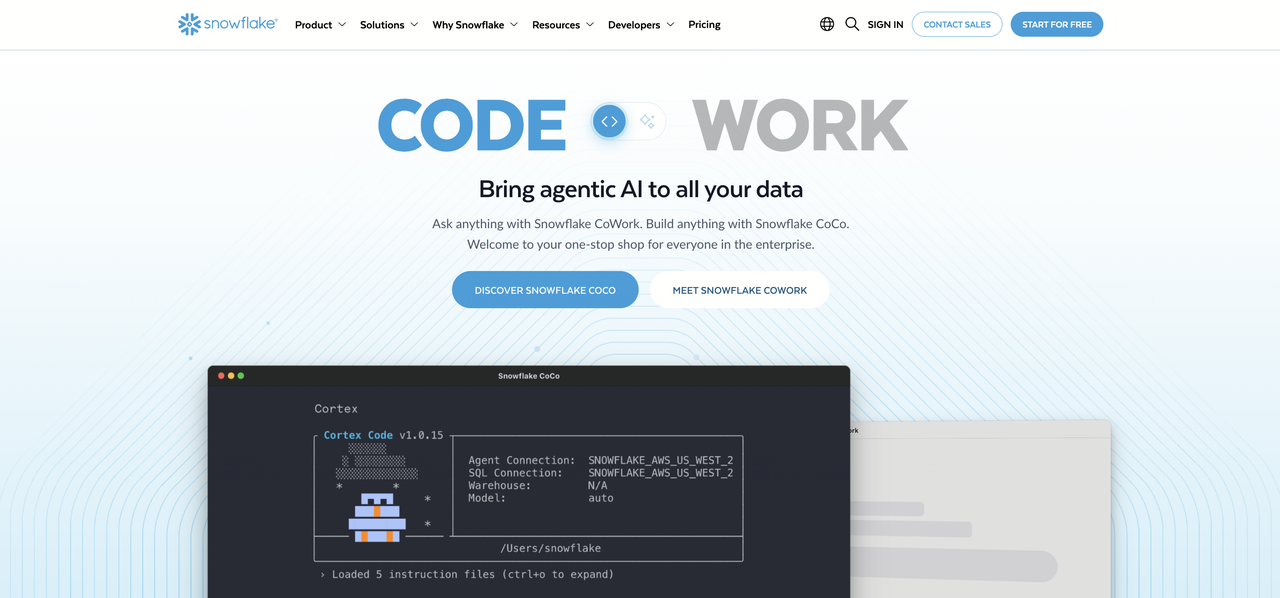
Snowflake is a cloud data platform whose architecture separates computing from storage, allowing customers to scale workloads and pay according to consumption. Its Data Cloud supports data warehousing, engineering, analytics, sharing, application development and machine-learning tasks through one governed platform. Revenue is generated mainly from product consumption rather than fixed seat subscriptions, which ties growth to customer query, storage and AI usage. The platform works across AWS, Microsoft Azure and Google Cloud and serves enterprises, public-sector organizations and software developers.
The long-term strategy is expanding from analytics into a broader enterprise data and AI operating layer. Cortex AI provides generative and agentic tools, Snowpark lets developers run code and machine-learning workloads close to governed data, and Marketplace distributes data sets and applications. Snowflake also signed a five-year, $6 billion partnership with AWS covering Graviton infrastructure, AI development and go-to-market work. Cortex Code and CoWork account growth shows the company is using its installed database to distribute new AI workloads rather than relying on a separate product stack.
Snowflake (SNOW) Q2 FY2027 Earnings Overview: $1.55B Revenue, 37% Product Growth and Higher Guidance
Snowflake reported Q2 FY2027 revenue of $1.55 billion versus $1.48 billion expected, product revenue of $1.49 billion versus a $1.415 billion to $1.420 billion company outlook, and adjusted EPS of $0.62 versus $0.45 consensus. Product revenue grew 37%, the company added 692 customers and AI adoption reached more than 9,100 Cortex Code and 5,800 CoWork accounts. Management raised FY2027 product-revenue guidance to $6.07 billion and adjusted operating margin to 14.5%, leaving valuation and GAAP profitability as the main tradeoffs.
|
Financial Metric |
Guidance / Consensus |
Reported / Actual |
Surprise |
|
Q2 FY2027 total revenue |
$1.48B consensus |
$1.55B |
Beat. Beat by about $70M; up 35% YoY. |
|
Q2 product revenue |
$1.415B–$1.420B outlook |
$1.49B |
Beat. Beat the high end by about $70M; up 37% YoY. |
|
Q2 adjusted diluted EPS |
$0.45 consensus |
$0.62 |
Beat. Beat by $0.17; up from $0.35 YoY. |
|
New customers |
— |
692 |
Expanded. Expanded 32%. |
|
Cortex Code accounts |
— |
More than 9,100 |
Scaled. Scaled AI coding adoption. |
|
CoWork accounts |
— |
More than 5,800 |
Scaled. Scaled enterprise chatbot adoption. |
|
FY2027 product revenue outlook |
$5.84B prior |
$6.07B |
Raised. Raised by $230M. |
|
FY2027 adjusted operating margin |
Prior outlook below 14.5% |
14.50% |
Raised. Raised on stronger usage and leverage. |
- Revenue of $1.55 billion beat consensus by about $70 million: Revenue grew 35% year over year as core data services and AI workloads accelerated. The beat showed customer consumption improved beyond expectations heading into earnings.
- Adjusted EPS of $0.62 beat consensus by $0.17: Earnings rose from $0.35 a year earlier, showing stronger consumption translating into non-GAAP operating leverage. The next test is how quickly that improvement reaches GAAP results after stock-based compensation.
- Product revenue rose 37% to $1.49 billion: The result came in about $70 million above the high end of management's prior range. Product growth remains the clearest measure of expanding workload consumption across Snowflake's platform.
- Snowflake added 692 customers, up 32%: The larger customer base creates more opportunities to expand usage across Cortex, Snowpark and Marketplace. Those additions become more valuable as customers increase consumption after onboarding.
- FY2027 product-revenue guidance increased by $230 million to $6.07 billion: Management raised the prior $5.84 billion outlook and lifted adjusted operating-margin guidance to 14.5%. Higher growth and margin expectations together point to stronger demand and improving efficiency.
Snowflake (SNOW) 2026 Investment Outlook: $500 Bull Case vs. $250 Bear Case
Snowflake's 2026 outlook depends on whether AI workloads can sustain faster product consumption while margins continue improving. The upside comes from durable Cortex and Snowpark usage, while slower enterprise spending and stronger competition remain the main risks.
The Bull Case: Cortex and Snowpark Growth Push SNOW Toward $500
The Bull Case assumes Cortex AI, Snowpark and application workloads keep product growth above 35% while core data consumption remains strong. More than 9,100 Cortex Code accounts and 5,800 CoWork accounts convert into recurring usage, while the $6 billion AWS partnership supports infrastructure efficiency and distribution.
A move toward $500 would require product revenue above the $6.07 billion annual outlook, adjusted operating margin above 14.5% and continued estimate upgrades. A narrowing GAAP loss despite stock-based compensation would provide stronger evidence that AI growth is improving per-share economics.
The Base Case: 30% Product Growth Keeps SNOW Between $380 and $440
The Base Case assumes product growth moderates from 37% toward 30% as comparisons become harder. AI workloads continue adding consumption and customer growth stays healthy, though competition and a premium valuation limit further multiple expansion.
SNOW could trade mainly between $380 and $440 under these conditions. Product revenue near $6.07 billion, a 14.5% adjusted operating margin and steady AI adoption would support the range. Guidance below $6 billion or growth slipping below 30% would weaken it.
The Bear Case: AI Usage Fails to Offset Slower Consumption, Pulling SNOW Toward $250
The Bear Case assumes enterprise optimization returns, AI projects remain experimental and Databricks or hyperscalers capture more workloads. Product growth slows faster than expenses, while stock-based compensation keeps GAAP profitability further away.
A move toward $250 would become more likely if product growth falls below 25%, annual guidance is reduced or adjusted margin expansion stalls below 14.5%. Weak conversion of Cortex accounts into sustained consumption would also challenge the AI growth story.
SNOW Stock Price Forecasts for 2026 By Wall Street Analysts
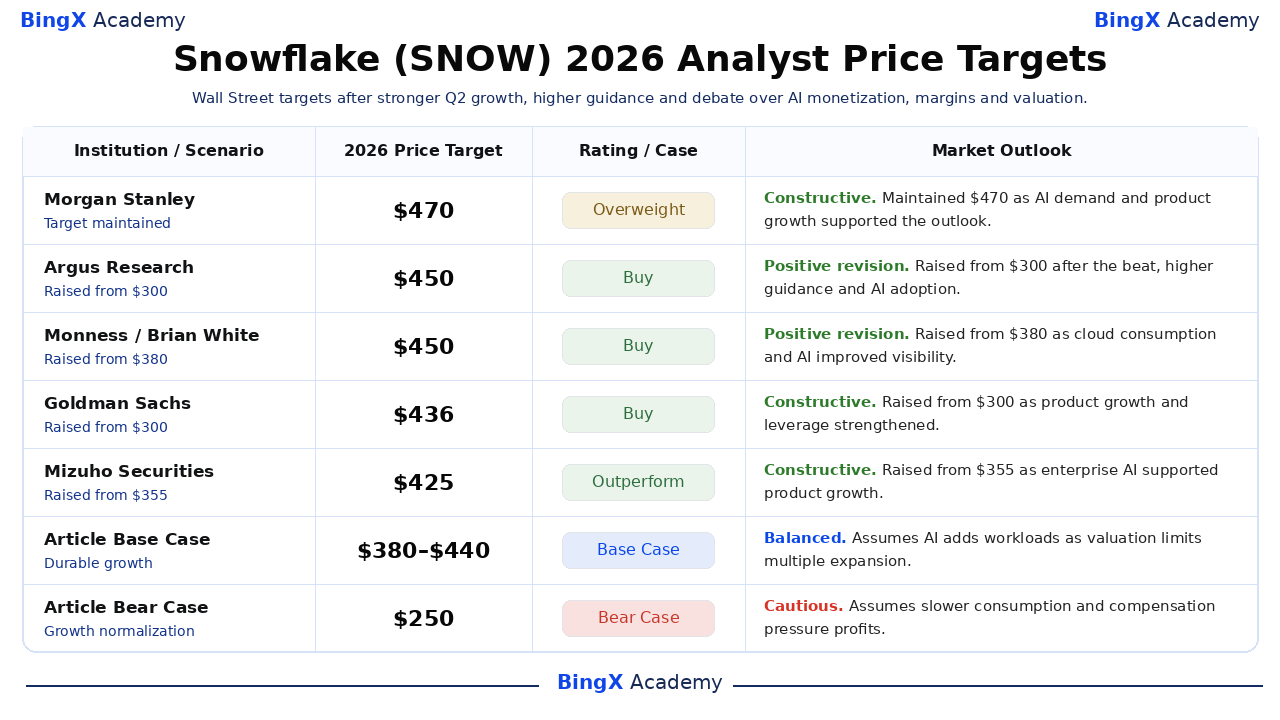
The five dated actions show how analysts weigh current execution against the long-term opportunity. They are third-party reference points rather than a single consensus forecast. The final Base and Bear rows are BingX Academy editorial scenarios and are labeled separately.
|
Institution / Scenario |
2026 Price Target |
Rating / Case |
Market Outlook |
|
Morgan Stanley / Sanjit Singh |
$470 |
Overweight |
Constructive. September 18: maintained a $470 target; AI demand and faster product growth supported the outlook. |
|
Argus Research / Joseph Bonner |
$450 |
Buy |
Positive revision. September 4: cut from $300 to $450; The beat, higher guidance and AI adoption strengthened the view. |
|
Monness / Brian White |
$450 |
Buy |
Positive revision. September 3: cut from $380 to $450; Cloud consumption and AI workloads improved visibility. |
|
Goldman Sachs / Gabriela Borges |
$436 |
Buy |
Constructive. September 3: cut from $300 to $436; Product growth and operating leverage strengthened. |
|
Mizuho Securities / Gregg Moskowitz |
$425 |
Outperform |
Constructive. September 4: cut from $355 to $425; Enterprise AI workloads supported faster product growth. |
|
Article Base Case |
$380–$440 |
Base Case |
Balanced. Assumes AI adds workloads as valuation limits multiple expansion. |
|
Article Bear Case |
$250 |
Bear Case |
Cautious. Assumes slower consumption and compensation pressure profits. |
How to Trade Snowflake (SNOW) Stock on BingX
Trade Snowflake’s product-consumption, AI-adoption and margin outlook using BingX TradFi and BingX AI tools. Because SNOW can react sharply to usage trends, guidance and product announcements, traders should define both the catalyst and risk limits before entering a position.
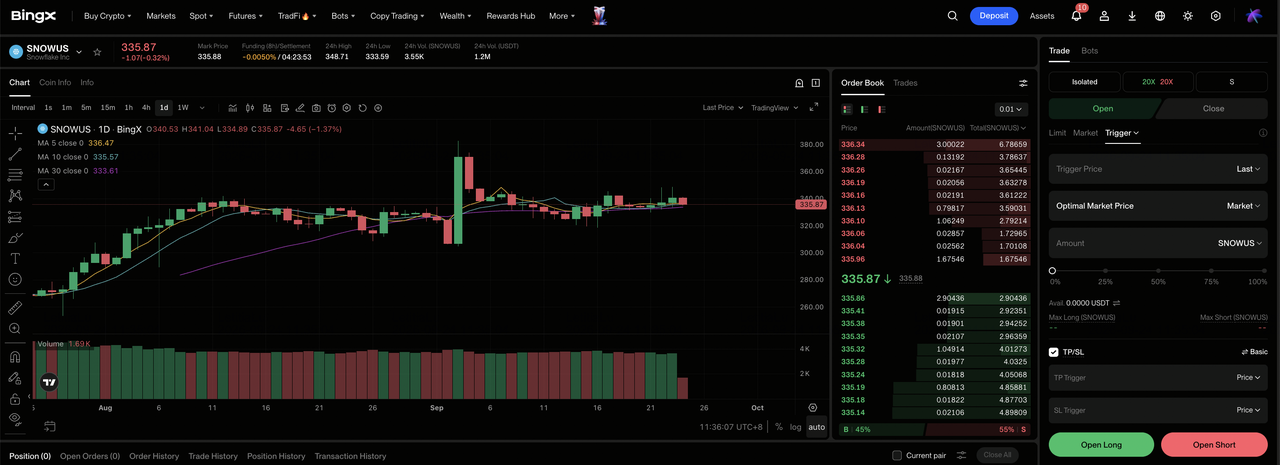
Step 1: Access BingX TradFi. Sign up and navigate to the specialized TradFi section on the BingX exchange dashboard.
Step 2: Select Snowflake (SNOW). Search for and select the SNOWUS-USDT perpetual futures contract.
Step 3: Choose your direction. Select Open Long if AI workloads sustain product growth and margins expand. Select Open Short if consumption slows or valuation compresses.
Step 4: Select leverage and margin mode. Choose Isolated or Cross-Margin based on your risk tolerance. The 17% post-earnings move shows why conservative leverage and clear position sizing are important.
Step 5: Execute strict risk protocols. Set Take-Profit and Stop-Loss (TP/SL) levels before or immediately after entering the trade. SNOW can react quickly to product revenue, remaining obligations, AI adoption, guidance, competition and stock compensation.
Top 5 Risks to Watch for Snowflake Investors in 2026
Snowflake's valuation leaves little room for slower growth. The main risks are weaker consumption, intense competition, stock-based compensation and AI adoption that does not translate into enough revenue.
- A premium valuation magnifies any growth miss: The $332.43 reference close already assumes durable expansion. Product revenue below the $6.07 billion outlook or growth slipping under 30% could pressure the multiple even if revenue still rises.
- Consumption revenue can slow before contracts do: Customers can optimize queries and storage without cancelling Snowflake. Lower usage can therefore hit quarterly product revenue before customer counts or contracts show similar weakness.
- Databricks and hyperscalers compete for the same workloads: AWS, Microsoft, Google and Databricks all offer analytics and AI platforms. Stronger rival tools or pricing pressure could slow workload migration and reduce revenue or margin growth.
- Stock-based compensation weakens GAAP per-share economics: Quarterly stock-based compensation reached $423 million. Continued issuance can expand the share count and delay the point when adjusted operating leverage turns into stronger GAAP profitability.
- AI account growth may not translate into equal consumption: More than 9,100 Cortex Code and 5,800 CoWork accounts show strong adoption, but some may remain low-usage pilots. Weak conversion into recurring consumption would reduce the revenue value of those headline figures.
Final Thoughts: Should You Invest in Snowflake in 2026?
Snowflake’s Q2 FY2027 results showed a business accelerating rather than being displaced by AI. Revenue reached $1.55 billion, product growth improved to 37%, adjusted EPS beat by $0.17 and management raised product-revenue guidance to $6.07 billion. Those facts support stronger earnings power, though the $332.43 reference price already discounts meaningful success.
The Bull Case requires durable AI consumption and margin expansion to support $500. The Bear Case reflects slower usage, competition and stock compensation that could pull SNOW toward $250. Conservative traders may watch product growth, guidance, adjusted operating margin and conversion of Cortex accounts into recurring consumption before assuming the post-earnings acceleration will persist.
Risk Reminder: Trading and investing in equities like SNOW involves a risk of capital loss. Company execution, competition, financing, valuation changes and leveraged trading can produce rapid losses. Conduct independent research before allocating capital.
Related Reading
- Nebius Group (NBIS) Price Prediction 2026: Can AI Cloud Growth Push NBIS Toward $350?
- Oracle (ORCL) Price Prediction 2026: Can AI Cloud Growth Push ORCL Toward $260?
- Palantir (PLTR) Stock Price Prediction 2026: Can 149% U.S. Commercial Growth Push PLTR Toward $255?
- Adobe (ADBE) Price Prediction 2026: Can AI Monetization Push ADBE Toward $350?
- Alphabet (GOOGL) Price Prediction 2026: Can 82% Cloud Growth and AI Push GOOGL Stock to $430?
