
Zilliqa (ZIL) is a Layer 1 blockchain that introduced production sharding and now runs on Proof of Stake with full EVM compatibility following the Zilliqa 2.0 upgrade. Its sharded architecture processes transactions in parallel, while the upgraded network focuses on regulated DeFi, tokenized real-world assets, and enterprise infrastructure.
ZIL is used for gas, staking, and network security, while gZIL supports governance. Zilliqa also supports both Scilla and Solidity development. However, a July 2026 vulnerability affecting its Ledger wallet application led the team to suspend native non-EVM transactions, adding an important security risk. This guide covers how Zilliqa works, ZIL tokenomics, key risks, and how to trade ZIL on BingX.
What Is Zilliqa (ZIL)?
Zilliqa (ZIL) is a permissionless Layer 1 blockchain that was among the first networks to bring sharding into live production. Sharding divides validating nodes into smaller groups, each processing a portion of transactions at the same time, so the network can raise capacity by adding more shards rather than forcing every node to process every transaction. This design was intended to address the throughput limits that constrained earlier blockchains.
What makes Zilliqa distinct in 2026 is the scale of its recent overhaul. The Zilliqa 2.0 upgrade re-architected the network as a modular platform built for verifiable smart contracts, tokenized assets, and next-generation applications. It replaced the original Proof-of-Work consensus with Proof-of-Stake, added full EVM compatibility so Solidity contracts deploy directly, and introduced faster block times and a design oriented toward regulated finance and institutional use. ZIL remains the token that powers gas payments, staking, and network security across this new architecture.
The core idea behind Zilliqa is that a scalable, compliant Layer 1 can support both developers and institutions that need high throughput alongside transparency and flexibility. ZIL coordinates network security and economic activity across the protocol.
Key components of the Zilliqa ecosystem include:
- ZIL token: The native token used for gas fees, staking rewards, and securing the Proof-of-Stake network.
- Sharded architecture: The parallel-processing design that splits the network into shards to raise throughput.
- EVM compatibility: Support for Solidity smart contracts and Ethereum tooling such as MetaMask, added in the Zilliqa 2.0 upgrade.
- Scilla: Zilliqa's original safety-focused smart contract language, still supported alongside EVM.
- gZIL: A governance token issued through the original staking program, used for voting on selected network parameters.
What Is Zilliqa 2.0?
Zilliqa 2.0 is a modular re-architecture of the network that moved Zilliqa from Proof-of-Work to Proof-of-Stake and introduced full EVM compatibility. The upgrade brought faster block times of around 1.5 seconds, lower fees, and a design built around customizable shards, cross-chain communication support, light client functionality, and revised tokenomics intended to support long-term sustainability. The stated aim is to serve developers, enterprises, and institutions that need high-throughput infrastructure with the transparency and compliance features required for real-world adoption.
Read More: What Are the Top Proof-of-Work (PoW) Coins to Mine in 2026?
How Does Zilliqa Work?
Zilliqa is an EVM-compatible Layer 1 secured by Proof-of-Stake validators and powered by the ZIL token. Zilliqa 2.0 replaces mining with staking, preserves compatibility with existing applications, and introduces a more flexible sharding architecture.
- X-shards expand network capacity: Zilliqa 2.0 is designed to support customizable, interconnected X-shards that can process activity separately while communicating with the main network.
- Proof of Stake secures the network: Validators stake ZIL to participate in consensus, while token holders can delegate ZIL through staking pools and earn rewards.
- EVM and Scilla support applications: Developers can use Solidity and Ethereum tools through the EVM environment, while existing Scilla-based applications remain supported through backward compatibility.
- Issuance and burning manage inflation: Validator rewards introduce new ZIL, while transaction processing burns ZIL. The protocol is designed to balance both sides and maintain a lower-inflation token economy.
- gZIL supports community governance: gZIL holders can participate in selected governance proposals and community funding decisions, although its exact role may continue to evolve.
Zilliqa vs. Traditional Layer 1 Blockchains: Key Differences
Layer 1 blockchains are base networks that process transactions and support applications directly. Bitcoin mainly focuses on secure peer-to-peer payments, while Ethereum supports smart contracts, DeFi, NFTs, and a broad developer ecosystem. Zilliqa also supports decentralized applications, but it differs in its sharded architecture, Proof-of-Stake model, and growing focus on regulated DeFi and tokenized real-world assets.
|
Feature |
Zilliqa |
Bitcoin |
Ethereum |
|
Primary focus |
Scalable smart contracts, RWA and regulated DeFi |
Decentralized digital money |
General-purpose smart contracts and applications |
|
Scaling approach |
Sharding and customizable x-shards |
Base-layer block production and secondary networks |
Layer 2 networks and protocol upgrades |
|
Consensus |
Proof of Stake |
Proof of Work |
Proof of Stake |
|
Smart contracts |
EVM and Scilla |
Limited scripting |
EVM and Solidity |
|
Ecosystem maturity |
Smaller and developing |
Highly established payment network |
Large developer, DeFi, and application ecosystem |
Zilliqa offers a more specialized approach built around sharded scaling and institution-oriented applications. Bitcoin and Ethereum have longer operating histories, deeper liquidity, and broader adoption, while Zilliqa may appeal to users interested in its EVM migration, RWA strategy, and customizable network architecture.
Zilliqa Ecosystem in 2026: EVM Migration, RWA Focus, and a Security Incident
- EVM migration: Zilliqa 2.0 moved the network to Proof of Stake with full EVM compatibility, allowing Solidity developers to use familiar Ethereum tools instead of relying only on Scilla. The key challenge is turning that technical upgrade into meaningful developer activity.
- RWA and regulated DeFi focus: Zilliqa is repositioning around tokenized real-world assets, compliant DeFi, and institutional infrastructure. This gives the network a clearer strategic direction, though adoption remains the main test.
- Ledger flaw exposed some native ZIL wallets: Around July 19, 2026, Zilliqa observed activity consistent with exploitation of a vulnerability affecting native, non-EVM transactions signed through its Ledger app. The flaw could expose private keys after several transactions, creating a risk of fund loss. Zilliqa paused legacy transactions, while EVM activity remained operational.
What Are the Zilliqa (ZIL) Tokenomics?
ZIL tokenomics center on a maximum supply of 21 billion tokens, Proof-of-Stake rewards, and a burn mechanism designed to offset issuance. ZIL is the network’s native asset and is primarily used for gas payments, staking, validator rewards, and delegation.
ZIL Token Utility and Supply Mechanisms
- Gas and transactions: ZIL pays transaction fees and smart contract execution costs across Zilliqa’s EVM and native environments.
- Staking and security: Validators stake ZIL to participate in consensus, while holders can delegate tokens through staking pools and receive a share of validator rewards.
- Issuance and burning: Zilliqa 2.0 balances newly issued validator rewards against ZIL burned through transaction processing, aiming to reduce net inflation over time.
- Dynamic staking rewards: Validator rewards can be adjusted to maintain a sustainable staking ratio and protect network security without creating excessive inflation.
- Governance through gZIL: gZIL holders have participated in selected governance proposals, including past decisions related to staking rewards and ecosystem funding. Its role should be treated separately from ZIL’s core utility.
ZIL Token Allocation
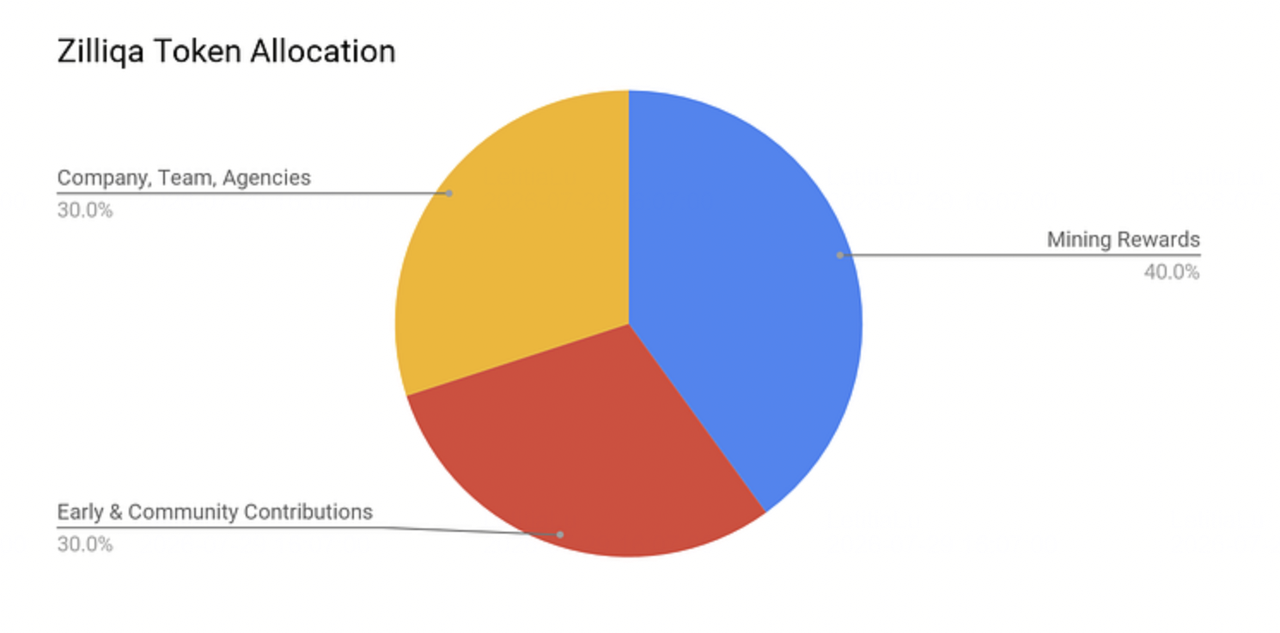
Zilliqa originally allocated its maximum supply of 21 billion ZIL as follows:
Source: Zilliqa Blog
|
Allocation |
Share |
ZIL Amount |
|
Mining and network rewards |
40% |
8.40 billion |
|
Early and community contributors |
Up to 30% |
Up to 6.30 billion |
|
Zilliqa Research |
12% |
2.52 billion |
|
Anquan Capital |
10% |
2.10 billion |
|
Team, agencies, and advisors |
8% |
1.68 billion |
The final 8% consisted of 5% for the Zilliqa team and 3% for agencies and advisors. Tokens allocated to the company, team, agencies, and advisors were originally subject to a three-year quarterly vesting schedule. The 40% network-reward allocation was initially described as mining rewards, but Zilliqa 2.0 has since replaced mining with Proof-of-Stake validators.
This table describes the original allocation, not the current ownership distribution. Most vesting periods have already ended, and network rewards have progressively entered circulation.
How to Trade Zilliqa (ZIL) on BingX
BingX offers ways to gain exposure to Zilliqa depending on whether the goal is direct ownership or short-term trading. Spot trading suits users who want to buy and hold ZIL, while futures trading is designed for active traders who want long or short exposure to ZIL price movements. Because Zilliqa was addressing an active security incident affecting native transactions at the time of writing, always confirm the current deposit and withdrawal status before transferring ZIL.
Spot Trading: Buy and Own ZIL Directly
Spot trading is the most straightforward way to buy Zilliqa on BingX. When users buy ZIL on the spot market, they own the asset directly and can hold it in the BingX spot account, transfer it, or withdraw it to a compatible self-custody wallet.
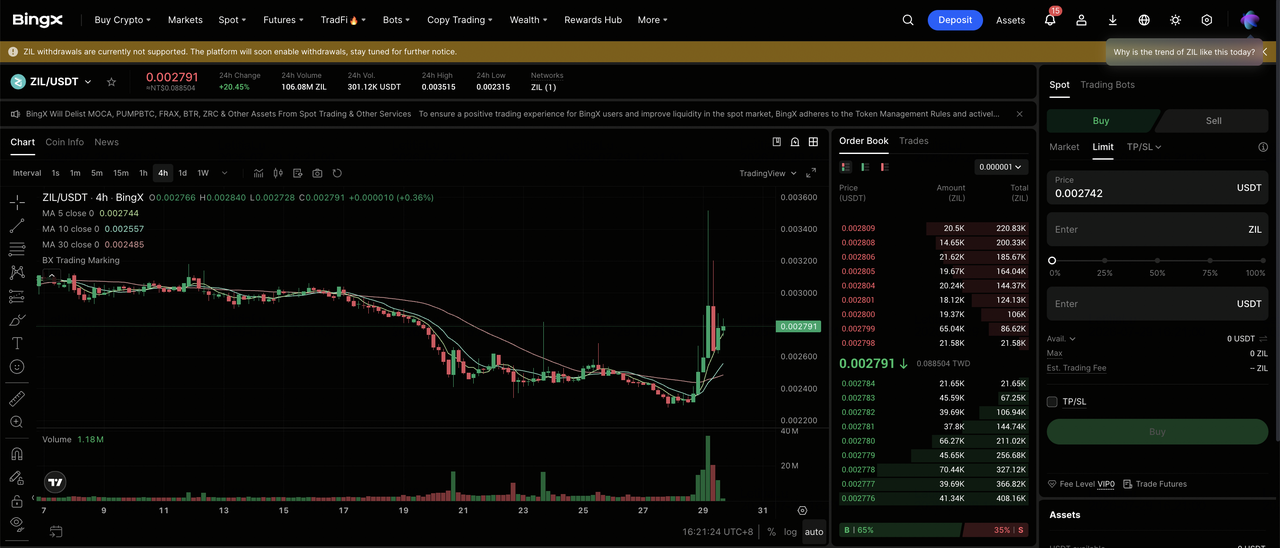
Step 1: Account setup and security. Sign up and log into your BingX account, complete the identity verification (KYC) required in your region, and enable two-factor authentication.
Step 2: Fund your spot account. Deposit USDT or another supported asset into your BingX spot account. Where available, users can also use supported fiat on-ramp options.
Step 3: Navigate to the spot market. Search for the ZIL/USDT trading pair.
Step 4: Place your order. Choose a market order to buy ZIL immediately at the current price, or use a limit order to set the price you want to pay.
Step 5: Manage your ZIL. Once filled, your ZIL appears in your spot account. You can keep it on BingX for convenience or withdraw it to a compatible self-custody wallet, taking care to use EVM-compatible tooling given the native-transaction security incident.
Futures Trading: Trade ZIL Price Movements
For active traders, BingX offers USDT-margined ZIL perpetual futures. Futures allow users to trade ZIL price movements without holding the underlying asset, with the flexibility to open long positions if they expect ZIL to rise or short positions if they expect ZIL to fall.
Because futures involve leverage, they can amplify both gains and losses. This approach is more suitable for traders who already have a clear risk plan and understand liquidation risk, particularly for an asset like ZIL that is sensitive to upgrade progress, security headlines, and broader market sentiment.
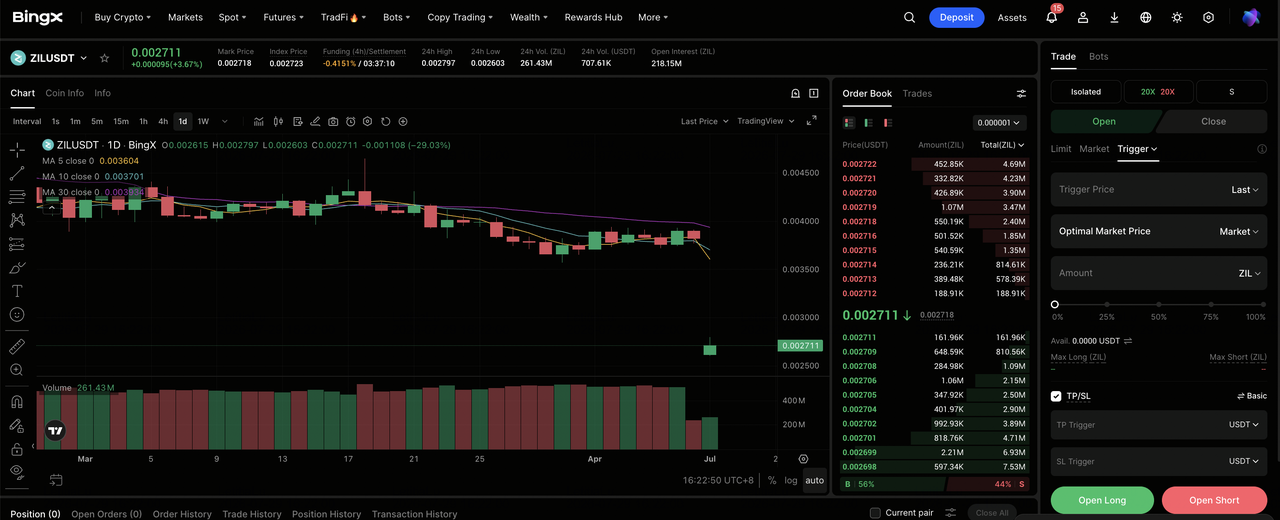
Step 1: Transfer collateral. Move USDT from your spot account into your futures account, where it will serve as margin.
Step 2: Select the contract. Search for the ZIL-USDT perpetual contract.
Step 3: Set direction and leverage. Open long if you expect ZIL to rise, or open short if you expect ZIL to decline. Choose leverage based on your risk tolerance and position size.
Step 4: Execute the trade. Enter the order amount and choose a market or limit order depending on your trading plan.
Step 5: Manage risk. Set stop-loss and take-profit orders before or immediately after entering the position. Profit and loss settle dynamically in USDT.
Risks and Considerations Before Investing in Zilliqa (ZIL)
Zilliqa has a long operating history, a completed technical overhaul, and an institution-oriented direction. However, ZIL still carries risks tied to security, adoption, competition, and market volatility.
- Security incident risk: The July 2026 Ledger vulnerability forced a suspension of native transactions and prompted some exchanges to flag ZIL as cautionary. Users should monitor official remediation updates and confirm deposit and withdrawal status before transacting.
- Adoption risk: EVM compatibility lowers the barrier for developers, but Zilliqa still needs to attract meaningful applications and users to justify its new architecture.
- Competition risk: Zilliqa operates in a crowded Layer 1 market where larger networks have deeper liquidity, more developers, and stronger ecosystems.
- Supply and inflation risk: Dynamic issuance paired with fee burning means net supply changes depend on network usage and staking activity, which can be difficult to predict.
- Smart contract and infrastructure risk: As with any smart contract platform, Zilliqa depends on the reliability of its contracts, validators, and supporting tooling.
- Market volatility: ZIL has shown large swings tied to broader crypto cycles and Bitcoin price movements, and past performance does not guarantee future results.
Final Thoughts: Should You Invest in Zilliqa (ZIL) in 2026?
Zilliqa is an established Layer 1 that pioneered sharding and has completed a major transition to a Proof-of-Stake, EVM-compatible network positioned around regulated DeFi and tokenized real-world assets. Its potential depends on whether the upgraded chain attracts real developer activity and durable usage.
Its sharding heritage and institutional framing set it apart, but ZIL remains exposed to the fallout from the 2026 security incident, adoption uncertainty, intense Layer 1 competition, and market volatility. Investors should monitor the security remediation, EVM ecosystem growth, staking activity, exchange status, and official network disclosures.
This article is for educational purposes only and does not constitute financial advice. Cryptocurrency trading carries significant risk, and you should conduct your own research before making any investment decisions.
Related Reading
- What Are the Top Proof-of-Work (PoW) Coins to Mine in 2026?
- What Is Proof of Stake (PoS): Why This Game-Changing Technology Is Essential to Understand
- What Is MetaMask and How to Set Up a MetaMask Wallet?
- What Are the 10 Best ERC-20 Wallets to Secure and Store Ethereum Tokens? (2026 Guide)
FAQs About Zilliqa (ZIL)
1. What is Zilliqa 2.0?
Zilliqa 2.0 moved the network to Proof of Stake, added EVM compatibility, improved block speeds, and introduced customizable x-shards.
2. What happened in the July 2026 security incident?
Zilliqa found a flaw in its Ledger app affecting legacy non-EVM transactions. Native transactions were paused, while EVM activity was reported unaffected.
3. Which wallets support ZIL?
ZIL can be stored in EVM-compatible wallets such as MetaMask. Users should add the correct Zilliqa 2 network and follow official guidance for legacy accounts.
