


AbbVie (ABBV) is a research-based biopharmaceutical company spanning immunology, neuroscience, oncology, eye care and aesthetics. Skyrizi and Rinvoq anchor its post-Humira transition, while Vraylar, Botox, migraine therapies and the clinical pipeline broaden growth. That diversification improves portfolio durability but leaves the stock sensitive to trial outcomes, regulatory decisions and commercialization.
Its latest quarter showed that transition advancing despite an earnings shortfall. AbbVie Q2 2026 net revenue reached $16.990 billion, up 10.2% reported, as immunology increased 15.1% to $8.786 billion and neuroscience rose 20.3% to $3.228 billion. Adjusted EPS of $3.65 missed the $3.71 consensus, making pipeline investment and acquisition dilution important to valuation.
The ABBV stock forecast for 2026 now centers on two competing views:
- The growth-franchise case: Skyrizi, Rinvoq and neuroscience products sustain double-digit expansion while successful late-stage trials create new revenue streams.
- The execution-risk case: Humira erosion, clinical setbacks or acquisition costs prevent operating gains from supporting a higher valuation.
This guide breaks down the ABBV stock forecast, 2026 price scenarios, key risks and analyst outlooks, drawing on AbbVie's July 31 Q2 2026 earnings release, quarterly filing and market data through September 8, plus how to trade ABBV stock futures on BingX TradFi with USDT collateral.
Top 5 Things for AbbVie Investors to Know in September 2026
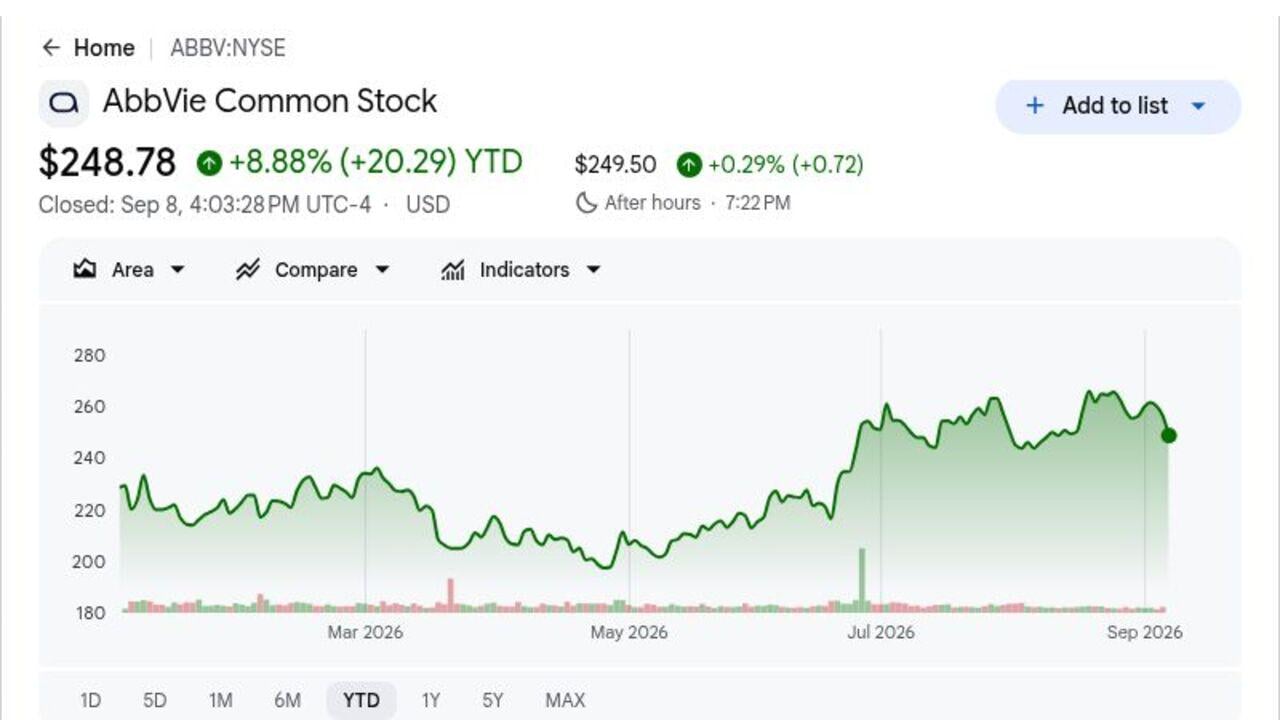
- ABBV closed at $248.78 on September 8 and was up 8.88% YTD: The stock remained below its $267.47 52-week high but well above its $190.75 low. That positioning reflects confidence in the post-Humira transition while leaving room for clinical and commercial results to change expectations.
- Q2 revenue reached $16.990 billion and grew 10.2%: Sales beat the $16.77 billion consensus by about $220 million. Adjusted EPS of $3.65 nevertheless missed the $3.71 estimate by $0.06, showing that strong top-line growth did not eliminate investment and expense pressure.
- Skyrizi and Rinvoq generated a combined $8.030 billion: Skyrizi sales rose 24.4% to $5.505 billion and Rinvoq advanced 24.5% to $2.525 billion. Together they were more than ten times Humira's $756 million, demonstrating how far AbbVie's immunology replacement strategy has progressed.
- Neuroscience revenue increased 20.3% to $3.228 billion: Vraylar contributed $1.071 billion, Botox Therapeutic reached $1.042 billion and Qulipta grew 30.9% to $350 million. The breadth reduces dependence on any one immunology asset and supports a more diversified earnings base.
- CERVINO showed a 74.0% response rate and a 60% lower progression risk: In 393 patients with relapsed or refractory multiple myeloma, etentamig beat the 45.7% response rate for the comparator arm and produced a 0.40 progression-free-survival hazard ratio. Regulatory discussions are the next major test.
What Is AbbVie (ABBV)?
AbbVie is a research-based biopharmaceutical company that discovers, develops and commercializes medicines across immunology, neuroscience, oncology, eye care and other specialty areas, while Allergan Aesthetics supplies Botox Cosmetic and related products. Its revenue model depends on patented therapies prescribed through health systems and reimbursed by public and private payers. Major brands include Skyrizi, Rinvoq, Vraylar, Ubrelvy, Qulipta, Botox and cancer medicines such as Venclexta and Epkinly. Research, regulatory approval, manufacturing scale and physician adoption determine how each asset converts scientific evidence into durable sales.
AbbVie's long-term strategy is to replace Humira's declining contribution with a broader portfolio led by Skyrizi and Rinvoq, expand neuroscience and build the next generation of immunology and oncology products. Its partnerships include Genmab on Epkinly, Roche on Venclexta and Janssen on Imbruvica, linking AbbVie with established oncology development and commercialization networks. The September 2026 Apogee acquisition added zumilokibart and APG273 for inflammatory diseases, while the company's global reach spans more than 175 countries and 19 immune-mediated diseases. These programs make clinical differentiation, label expansion and global access central to long-term growth.
Read More: Top Pharma Stocks to Buy in 2026: Cancer Drugs, Weight-Loss Drugs, mRNA, and New Medicines
AbbVie (ABBV) Q2 2026 Earnings Overview: Revenue, EPS and Growth-Brand Momentum
AbbVie delivered $16.990 billion of Q2 revenue versus $16.77 billion expected, while adjusted EPS of $3.65 fell $0.06 below the $3.71 consensus. Immunology revenue rose 15.1% to $8.786 billion and neuroscience climbed 20.3% to $3.228 billion, but the 2026 adjusted EPS range moved to $13.87-$14.07 from $13.91-$14.11 after Apogee-related dilution. The core tradeoff is strong growth-brand execution against the cost of extending the pipeline.
|
Financial Metric |
Guidance / Consensus |
Reported / Actual |
Surprise |
|
Q2 2026 net revenue |
$16.77B consensus |
$16.990B |
Beat. $220M above consensus; up 10.2% reported. |
|
Q2 adjusted diluted EPS |
$3.71 consensus |
$3.65 |
Missed. $0.06 below consensus; up 22.9% YoY. |
|
Q2 GAAP diluted EPS |
N/A |
$2.03 |
Improved. Up 290.4% from $0.52. |
|
Q2 GAAP net earnings |
N/A |
$3.613B |
Expanded. Increased from $938M a year earlier. |
|
Q2 immunology revenue |
N/A |
$8.786B; +15.1% |
Accelerated. Skyrizi and Rinvoq offset Humira erosion. |
|
Q2 Skyrizi revenue |
N/A |
$5.505B; +24.4% |
Advanced. Growth continued across immune indications. |
|
Q2 Rinvoq revenue |
N/A |
$2.525B; +24.5% |
Advanced. Broad indication uptake supported demand. |
|
Q2 neuroscience revenue |
N/A |
$3.228B; +20.3% |
Expanded. Vraylar, Botox and migraine drugs grew. |
|
Q2 adjusted operating margin |
N/A |
48.30% |
Strong. Supported earnings conversion and investment. |
|
2026 adjusted EPS outlook |
Prior: $13.91-$14.11 |
$13.87-$14.07 |
Lowered. Midpoint fell $0.04 after Apogee dilution. |
- Revenue of $16.990 billion beat consensus by $220 million: Reported growth of 10.2% and operational growth of 9.5% showed that the portfolio was expanding beyond currency effects. The result supports the durability of the transition, even as legacy products decline.
- Adjusted EPS of $3.65 missed by $0.06 but grew 22.9%: GAAP EPS also rose to $2.03 from $0.52, while GAAP net earnings reached $3.613 billion. The mismatch between the consensus miss and year-over-year expansion makes cost discipline a key confirmation signal.
- Immunology revenue of $8.786 billion rose 15.1%: Combined Skyrizi and Rinvoq sales of $8.030 billion more than offset Humira's 35.9% decline to $756 million. Continued label penetration must keep outpacing erosion for the investment case to hold.
- Adjusted operating margin reached 48.3% as sales scaled: GAAP operating margin was 37.9% and adjusted gross margin was 84.7%. Those levels provide room to fund development, although acquired research charges and deal costs can make reported earnings volatile.
- The 2026 adjusted EPS midpoint declined $0.04: AbbVie lowered the range to $13.87-$14.07 because $0.14 of Apogee dilution was only partly offset by $0.10 of operating outperformance. Future deals must produce enough pipeline value to justify near-term dilution.
AbbVie (ABBV) 2026 Investment Outlook: $325 Bull Case vs. $220 Bear Case
The central test is whether growth from immunology, neuroscience and pipeline catalysts can exceed Humira erosion and acquisition-related costs strongly enough to support a higher valuation.
The Bull Case: Strong Immunology Drug Growth and Pipeline Progress Push ABBV Toward $325
The Bull Case assumes Skyrizi and Rinvoq maintain growth above 20%, neuroscience stays strong, and etentamig’s 0.40 progression-free-survival hazard ratio supports a credible regulatory path. Faster revenue growth would help AbbVie absorb pipeline investment without sacrificing earnings momentum.
A move toward $325 would require continued label expansion, stable adjusted margins, and successful regulatory progress. Further estimate upgrades, product-share gains, and stronger evidence from Apogee’s pipeline would provide the clearest confirmation.
The Base Case: Durable Drug Franchises Keep ABBV Between $265 and $295
The Base Case assumes Skyrizi, Rinvoq, Vraylar, and migraine products continue offsetting Humira erosion, while integration and development spending limit margin expansion. Positive clinical progress supports the outlook, but investors wait for more proof from newer pipeline assets.
Under this scenario, ABBV could trade mainly between $265 and $295. Revenue growth near the latest pace, adjusted EPS within the $13.87 to $14.07 range, and stable clinical timelines would support the range.
The Bear Case: Slower Drug Growth and Clinical Setbacks Pull ABBV Toward $220
The Bear Case assumes faster Humira erosion combines with weaker Skyrizi or Rinvoq growth and setbacks in programs such as etentamig or zumilokibart. Higher research and acquisition spending would then deliver less visible commercial payoff.
A move toward $220 would become more likely if adjusted EPS falls below guidance, key filings are delayed, or competition pressures major growth brands. AbbVie could remain profitable, but a shorter visible growth runway would likely compress the valuation.
ABBV Stock Price Forecasts for 2026 By Wall Street Analysts
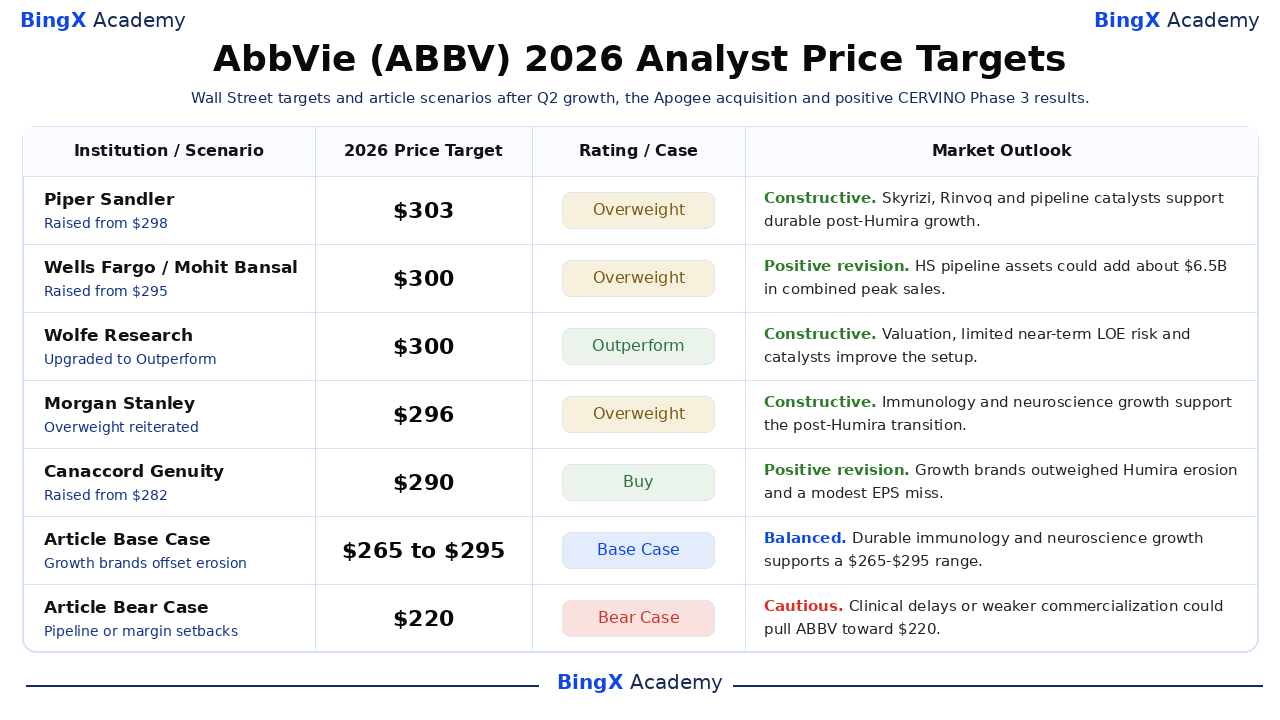
These dated, named third-party actions are reference points rather than price promises. The $223 to $303 range shows uncertainty around pipeline value, product durability and valuation, while the Article Base and Bear rows remain separate editorial scenarios built from operating assumptions, not analyst consensus.
|
Institution / Scenario |
2026 Price Target |
Rating / Case |
Market Outlook |
|
Piper Sandler / David Amsellem |
$303 |
Overweight |
Constructive. August 20: Raised from $298 as immunology durability and pipeline catalysts supported post-Humira growth. |
|
Wells Fargo / Mohit Bansal |
$300 |
Overweight |
Positive revision. August 17: Raised from $295 as HS pipeline assets were assigned about $6.5B in combined peak sales. |
|
Wolfe Research / Alexandria Hammond |
$300 |
Outperform |
Constructive. August 13: Upgraded from Peer Perform on valuation, limited near-term exclusivity loss and catalysts. |
|
Morgan Stanley / Terence Flynn |
$296 |
Overweight |
Constructive. August 3: Reiterated after double-digit growth and continued immunology and neuroscience strength. |
|
Canaccord Genuity / Gary Nachman |
$290 |
Buy |
Positive revision. August 3: Raised from $282 as growth brands outweighed Humira erosion and the EPS miss. |
|
BofA Securities / Geoff Meacham |
$282 |
Neutral |
Measured. September 8: Raised from $276 while retaining a balanced view of momentum, dilution and execution. |
|
Article Base Case |
$265 to $295 |
Base Case |
Balanced. Assumes durable immunology and neuroscience growth offsets Humira erosion and pipeline spending. |
|
Article Bear Case |
$220 |
Bear Case |
Cautious. Assumes clinical delays or weaker commercialization pressure earnings and valuation. |
How to Trade AbbVie (ABBV) Stock on BingX
Trade AbbVie's immunology growth, neuroscience demand and clinical-catalyst outlook using BingX TradFi and BingX AI tools. Because ABBV can react sharply to trial data, regulatory decisions, earnings guidance and prescription trends, traders should define both the catalyst and risk limits before entering a position.
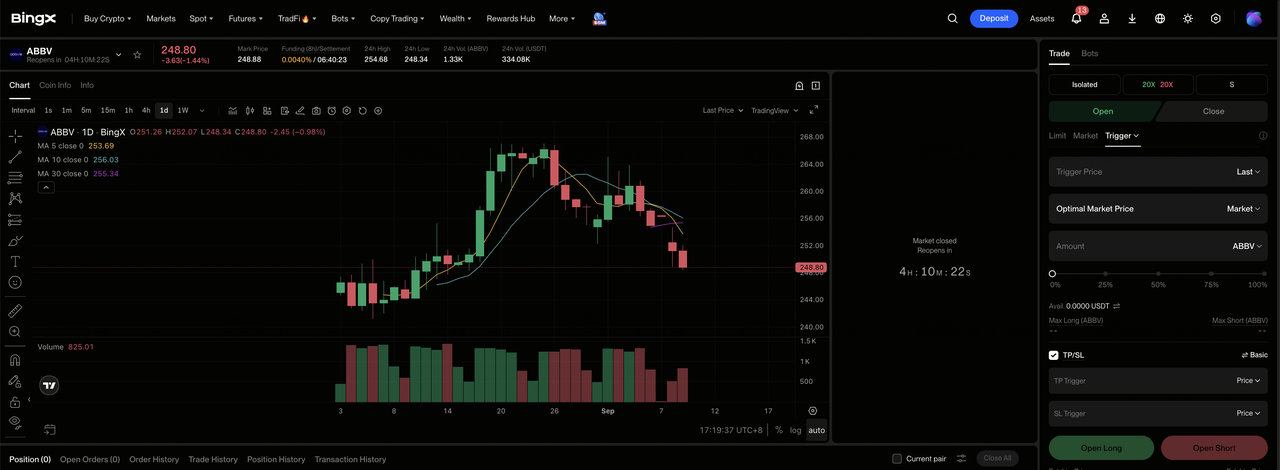
Step 1: Access BingX TradFi. Sign up and navigate to the specialized TradFi section on the BingX exchange dashboard.
Step 2: Select AbbVie (ABBV). Search for and select the ABBV-USDT perpetual futures contract.
Step 3: Choose your direction. Select Open Long if growth brands keep outpacing Humira erosion and pipeline catalysts strengthen. Select Open Short if clinical delays, slower prescriptions or margin pressure weaken the earnings outlook.
Step 4: Select leverage and margin mode. Choose Isolated or Cross-Margin based on your risk tolerance. The $190.75 to $267.47 52-week range shows why conservative leverage and clear position sizing are important.
Step 5: Execute strict risk protocols. Set Take-Profit and Stop-Loss (TP/SL) levels before or immediately after entering the trade. ABBV can react quickly to clinical readouts, FDA decisions, prescription data, guidance and acquisition updates.
Top 5 Risks to Watch for AbbVie Investors in 2026
ABBV's defensive characteristics do not remove company-specific risks that can change revenue, earnings, cash flow and the valuation multiple assigned to the shares.
- Humira revenue fell 35.9% to $756 million: Biosimilar competition remains a structural drag, so Skyrizi, Rinvoq and newer products must add more revenue than the legacy franchise loses. If their growth slows, total sales and earnings estimates could weaken together.
- Clinical success is not the same as approval or commercialization: CERVINO's 74.0% response rate was compelling, but regulators must accept the evidence and physicians must adopt etentamig before it creates meaningful sales. Safety findings or filing delays could erase expected pipeline value.
- The $10.9 billion Apogee acquisition adds execution risk: AbbVie paid $135.11 per share and expects $0.14 of 2026 EPS dilution. Development delays could push the expected 2032 accretion further out and reduce the return earned on invested capital.
- Pricing and reimbursement can pressure high-margin brands: Government negotiations, payer restrictions and competitor rebates can slow prescription growth or reduce realized prices even when patient demand remains healthy. Lower net pricing would transmit directly to margins and forecast revisions.
- A $248.78 share price embeds continued growth execution: A guidance miss, adverse safety signal or slower launch could move expectations toward the $220 Bear Case rather than the $265 to $295 Base Case. Broader interest-rate or market shocks could amplify that compression.
Final Thoughts: Should You Invest in AbbVie in 2026?
What is not in dispute is that AbbVie's post-Humira transition has measurable operating support. Q2 revenue grew 10.2%, Skyrizi and Rinvoq produced $8.030 billion together, neuroscience advanced 20.3%, and etentamig delivered statistically significant Phase 3 efficacy. Those verified results give the company several distinct routes to sustain growth over the coming years.
The Bull Case toward $325 requires growth brands, margins and pipeline milestones to reinforce one another, while the Bear Case toward $220 follows from clinical delays, weaker commercialization or acquisition costs without sufficient payoff. More conservative investors may wait for regulatory clarity on etentamig, evidence of stable adjusted margins and continued prescription momentum before acting.
Risk Reminder: Trading and investing in equities like ABBV involves a high risk of capital loss. Clinical failures, regulatory decisions, patent erosion, pricing pressure, acquisitions and leveraged perpetual-futures exposure can produce rapid losses. Conduct independent research before allocating capital.
Related Reading
- Top Pharma Stocks to Buy in 2026: Cancer Drugs, Weight-Loss Drugs, mRNA, and New Medicines
- Eli Lilly (LLY) Price Prediction 2026: Can Weight-Loss Drug Demand Push LLY Toward $1,600?
- Moderna (MRNA) Price Prediction 2026: Can Cancer Vaccine Momentum Push MRNA Stock Toward $180?
- Merck (MRK) Price Prediction 2026: Can Pipeline Momentum Push MRK Stock Toward $170?
- Novo Nordisk (NVO) Price Prediction 2026: Can Wegovy Growth Push NVO Toward $65?
- Pfizer Stock Price Prediction 2026: High-Yield Value Opportunity or Structural Value Trap?
