
Seagate Technology Holdings PLC (STX) is a global pioneer in mass data storage design and manufacturing, commanding a dominant share of the world's Hard Disk Drive (HDD) market. As of June 11, 2026, Seagate trades at $868.09 USD, reflecting exceptional multi-year momentum. This explosive stock performance is driven by an intense structural upcycle in data center storage demand, severe industry-wide supply constraints, and unprecedented capital expenditures (CapEx) from cloud hyperscalers building out generative artificial intelligence (AI) data economies.
The company is currently scaling its next-generation, heat-assisted magnetic recording (HAMR) platforms to historic volume capacity. By offering unmatched areal density advantages through its specialized manufacturing facilities, Seagate Technology Holdings PLC (STX) is rapidly signing multi-year, build-to-order agreements with premier cloud operators and enterprise data networks, positioning itself as an irreplaceable hardware backbone for high-capacity AI training and data logging. You will also discover how to gain exposure to Seagate Technology Holdings PLC (STX) futures through BingX TradFi.
Read more: Top AI Data Center Stocks to Buy in 2026: Cloud, Servers, and AI Compute Infrastructure
Key Highlights: Top 5 Things for Seagate Investors to Know in 2026
- Mass Storage Market Duopoly: Commands a fiercely protected, dominant global market share alongside its primary competitor, Western Digital, effectively controlling the foundational layers of enterprise cold and nearline cloud tiers.
- Unprecedented Operating Leverage: Boasts a dramatic fundamental transformation, with non-GAAP gross margins reaching 47% and operating margins touching a record-breaking 36% by mid-2026, driven by an aggressive shift toward high-margin enterprise drives.
- The AI and HAMR Catalysts: Deployed its proprietary Mozaic 4+ HAMR architecture at scale, delivering single-drive capacities up to 44 terabytes (TB). This allows data centers to maximize exabyte capacity per rack while drastically slashing power and real estate overhead.
- Explosive Financial Performance: Displaying intense fundamental acceleration. In its latest quarterly earnings print, Seagate delivered a 44.1% year-over-year revenue surge to $3.11 billion, crushing Wall Street consensus with a non-GAAP quarterly earnings per share (EPS) of $4.10.
- Bullish Analyst Sentiment: Approximately 85% of covering analysts maintain a Buy or Strong Buy rating. Major institutional desks have executed rapid target updates, with JPMorgan lifting its target to $920, Bank of America aiming for $1,000, and street-high outlooks peaking at $1,150.
What Is Seagate Technology (STX)?
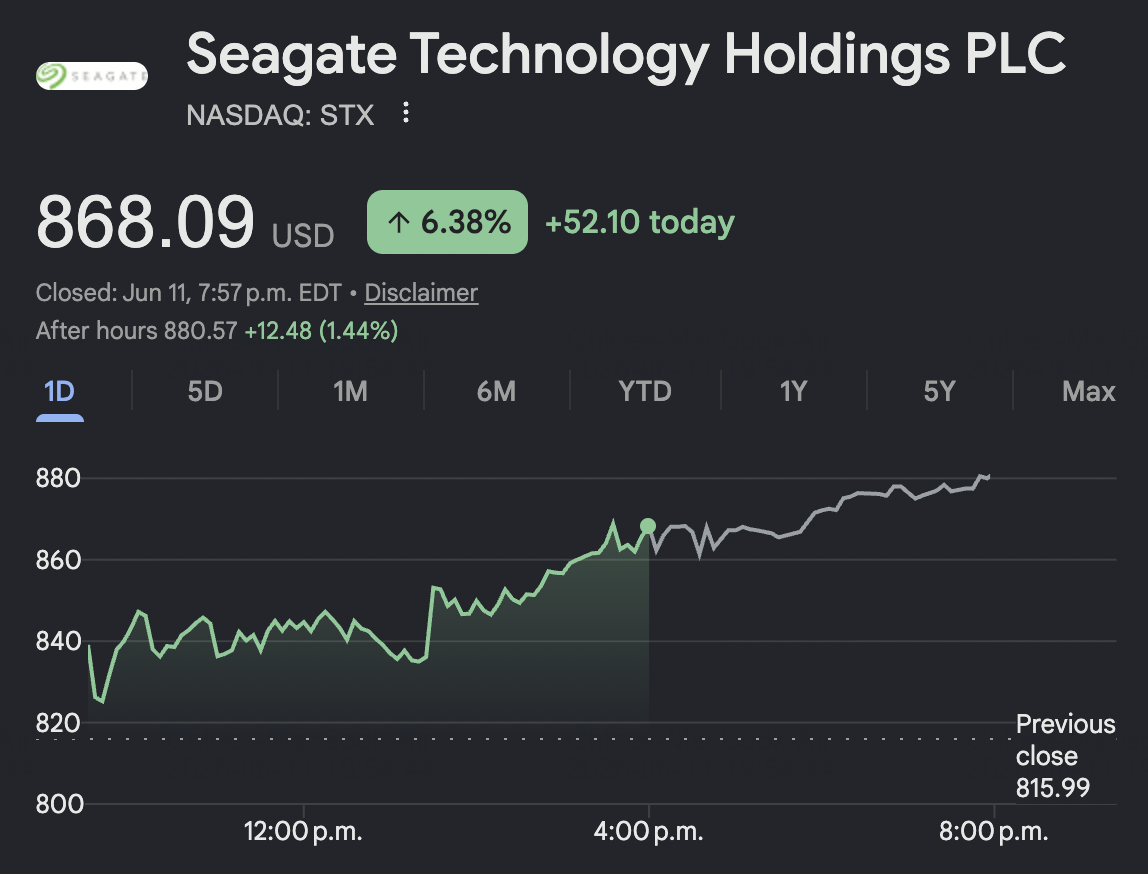
Source: Google
Seagate Technology (STX) is an American multinational data storage engineering firm incorporated in Dublin, Ireland, with its primary operational headquarters situated in Fremont, California. The company designs, builds, and distributes advanced mass data storage technologies engineered to process and preserve massive global data structures.
In 2026, Seagate evolved in the eyes of the market from a cyclical hardware vendor into a vital infrastructure operator for the digital age. Its core value proposition relies on proprietary, capital-intensive manufacturing facilities that create ultra-high-capacity hard drives, directly serving the hyper-scale cloud, enterprise data center, edge computing, and industrial automation markets.
Seagate's Key Growth Phases Over the Years
- The Pioneer and Form-Factor Phase (1978 to 1980s): Founded in 1978 as Shugart Technology by Al Shugart and Finis Conner, the firm launched the historical ST-506 in 1980. Key features included being the first 5.25-inch hard disk drive. This design catalyzed the microcomputer revolution, making Seagate the chief storage supplier for the historic IBM XT architecture.
- The Structural Acquisition Era (1989 to 2011): Achieved immense scale by aggressively consolidating competing hard drive manufacturers. Landmark roll-ups included the purchase of Control Data Corporation's Imprimis division (1989), Conner Peripherals (1996), Maxtor (2006), and Samsung's HDD business (2011), establishing a highly protective manufacturing moat.
- The AI Infrastructure and HAMR Revolution (2016 to 2026): Pushed past the physical limits of traditional magnetic recording by heavily backing HAMR technology. By commercializing the Mozaic platform, Seagate unlocked multi-year volume purchase commitments through 2027 and 2028, embedding its technology directly into the core training pipelines of artificial intelligence (AI) data centers.
Read More: Nvidia (NVDA) Stock Price Outlook for 2026: Can Blackwell and Vera Rubin Take NVDA Back to $300?
Seagate 2025 Performance Overview: The Infrastructure Scale Year
Throughout 2025, Seagate witnessed an intense acceleration in business momentum as legacy client inventory drawdowns cleared completely out, giving way to an insatiable appetite for high-capacity nearline storage. Hyperscale cloud providers, facing immense structural shifts toward generative AI, aggressively integrated Seagate's ultra-dense architectures to handle the massive data footprints required by deep learning algorithms.
Seagate's long-term supply frameworks provided exceptional operational visibility, ensuring full order books and protected pricing power. This powerful combination of operational execution and systemic data growth drove a record turn in profitability, lifting the company to multi-year financial highs and unlocking tremendous shareholder value as the stock expanded structural multiples.
Seagate Stock Navigation: How Has STX Stock Moved in 2026?
Seagate's stock has exhibited substantial upward volatility, logging an extraordinary multi-year run. By mid-2026, the equity firmly established a structural baseline above the $800 level. This capital appreciation is reinforced by a consecutive string of double-digit earnings beats and better-than-expected forward guidance with management projecting Q4 2026 EPS of $4.80 to $5.20 on roughly $3.45 billion in revenue.
The firm's market capitalization reflects a deep institutional re-rating, as Wall Street increasingly prices Seagate as an irreplaceable, high-margin monopoly operator feeding the world's expanding AI hardware footprints.
Seagate's Financial Performance and 2026 Outlook
Seagate delivered exceptional top-line and bottom-line expansion, moving away from previous cyclical lows with remarkable speed. In its fiscal Q3 2026 print, total mass storage shipments surged to 199 exabytes, with the data center ecosystem alone commanding 88% of total volume and drawing $2.5 billion in single-quarter revenue, representing a 55% year-over-year vertical spike.
Crucially, the income statement highlights an exceptional operating leverage story. While quarterly revenue expanded 44.1% year-over-year, fixed operational expenses remained tightly flat at approximately $296 million. This strict overhead containment allowed gross margins to expand to 47% and operating income to surge 146% to $1.11 billion. This phenomenal cash generation translated into $953 million in free cash flow for the single quarter, enabling Seagate to return capital via buybacks while aggressively retiring $641 million in gross debt to optimize its capital structure.
Read More: Amazon (AMZN) Stock Price Prediction 2026: Can AWS AI Re-acceleration Offset a $200B CapEx Gamble?
The Seagate Thesis for 2026: 5 Pillars of STX Stock Valuation
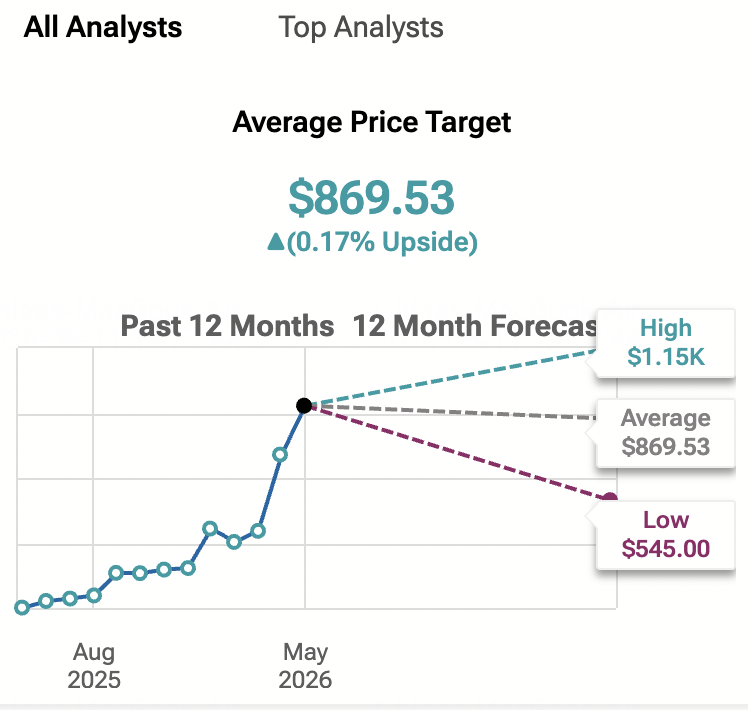
Source: TipRanks
Seagate's valuation in 2026 centers on its position as an essential digital logistics engine, benefiting heavily from deep data accumulation and machine learning expansions.
1. Hard Disk Duopoly Dominance: The Core Pillar
Owning a massive, deeply integrated portfolio of rotating magnetic media patents allows Seagate to capture half of the global enterprise cloud tier infrastructure, creating an unshakeable customer ecosystem with high switching friction.
2. Deep Integration with AI Compute Giants: The Growth Pillar
Strategic placement inside high-performance computing (HPC) nodes enables Seagate's high-capacity drives to feed large-scale training models. Because massive datasets cannot reside cost-effectively on premium flash tiers alone, Seagate's nearline solutions sit right alongside top-tier AI compute arrays like NVIDIA.
3. Areal Density Dominance via Mozaic 4+: The Execution Pillar
Deploying proprietary Mozaic 4+ HAMR technology allows Seagate to fit up to 44TB into a standard form factor, scaling capacities toward a long-term roadmap of 100TB. This provides a 47% infrastructure efficiency gain over standard 30TB setups, delivering an undeniable total cost of ownership (TCO) benefit to cash-conscious hyperscalers.
4. Aggressive Capital Returns and Balance Sheet Optimization: The Financial Pillar
Record-breaking free cash flow has allowed Seagate to rapidly deleverage its balance sheet, return significant capital via its quarterly dividend program, and fund non-dilutive, organic internal R&D to widen its engineering gap over competitors.
5. High-Barrier Intellectual Property Moat: The Defensive Pillar
Operating custom, specialized sub-component fabs including advanced recording heads and custom media chemistries creates an extreme financial barrier to entry, insulating Seagate from outside competitive threats.
Read More: AMD Price Prediction 2026: $525 AI Sovereignty or $300 Valuation Trap?
Seagate Price Forecasts for 2026: Bull vs. Bear Outlook
Institutional analysts maintain an active and highly optimistic stance on Seagate, balancing the incredible pace of HAMR adoption against standard macroeconomic considerations.
|
Institution / Analyst |
2026 Price Target |
Market Outlook |
|
Citigroup / Top Desks |
$1,150 |
Highly Bullish: Perfect execution of Mozaic 4+ volume ramps coupled with structural storage deficits across hyperscale cloud providers through 2030. |
|
Mizuho |
$1,090 |
Bullish: Upgraded based on immense, long-term AI-driven data demand and sustained enterprise pricing power in build-to-order contracts. |
|
JPMorgan Chase & Co. |
$920 |
Overweight: Positive on structural margin expansion and record-shattering free cash flow dynamics. |
|
Market Consensus (Aggregated) |
$798.50 |
Moderate Buy: Balanced expectation of robust pricing power versus temporary near-term consolidation following massive year-to-date equity gains. |
|
UBS Group |
$545 |
Neutral: Cautious on cyclical asset normalization, capital intensity, and general tech-sector valuation multiple tracking. |
Source: Aggregated from MarketBeat, TipRanks, Zacks, and major institutional equity research notes as of June 2026.
The Bull Case: Data Centers and AI Training Drive STX Toward $1,150
Bulls point to the structural extension of the current storage upcycle. With AI models growing exponentially, data accumulation needs are accelerating past a 30% compound annual exabyte growth rate. If Seagate scales its Mozaic 4+ architecture smoothly into broader distribution and maintains its 40%+ operating margin guidance, the stock is poised for an extended valuation re-rating toward its highest institutional targets.
The Bear Case: Cyclical Normalization and CapEx Shocks Pressure the Stock
Bears highlight that despite structural AI demand, the storage market remains inherently cyclical and commodity-influenced. If hyperscalers briefly pause their aggressive infrastructure CapEx outlays or experience data center construction delays, the market could shift from supply deficits back to normalization, compressing rich margins and drawing the stock down toward structural support lines.
5 Critical Risks to Watch for Seagate Investors in 2026
While Seagate presents a high-yielding upside, investors must track capital-intensive realities, execution requirements, and macroeconomic sensitivities.
- Cyclicality and Price-Per-Terabyte Compression: High disk-drive margins remain vulnerable to sudden supply-demand rebalancings. If structural capacity outpaces global intake, pricing compression can occur, impacting gross profit margins.
- HAMR Volume Qualification and Manufacturing Ramps: Transitioning to intricate atomic-level laser recording (HAMR) requires flawless manufacturing precision. Any localized engineering constraints or delays in customer validation phases could slow volume output schedules.
- Hyperscaler Concentration Vulnerabilities: A massive proportion of nearline exabyte revenue originates from a select handful of cloud giants. A localized shift in data storage policies or structural CapEx adjustment by a major customer can instantly affect backlogs.
- Geopolitical Supply Chain and Rare Earth Dependencies: Sourcing specialized substrate metals, custom mechanical components, and navigating international assembly plants exposes operations to trade policies, logistical shocks, or sudden tariff implementations.
- Debt Leverage and Valuation Multiples: Despite retiring significant chunks of liabilities with recent cash flows, Seagate holds a notable debt profile. Trading at premium forward valuation multiples leaves minimal margin for financial execution errors.
Read More: Oracle (ORCL) Stock Price Outlook for 2026: Can AI Cloud Infrastructure Take ORCL Back to Its Highs?
How to Trade Seagate (STX) Stock Futures on BingX TradFi
The TradFi market on BingX provides convenient USDT-settled stock perpetual contracts, enabling traders to express directional market views on global equities without requiring standard legacy brokerage frameworks.
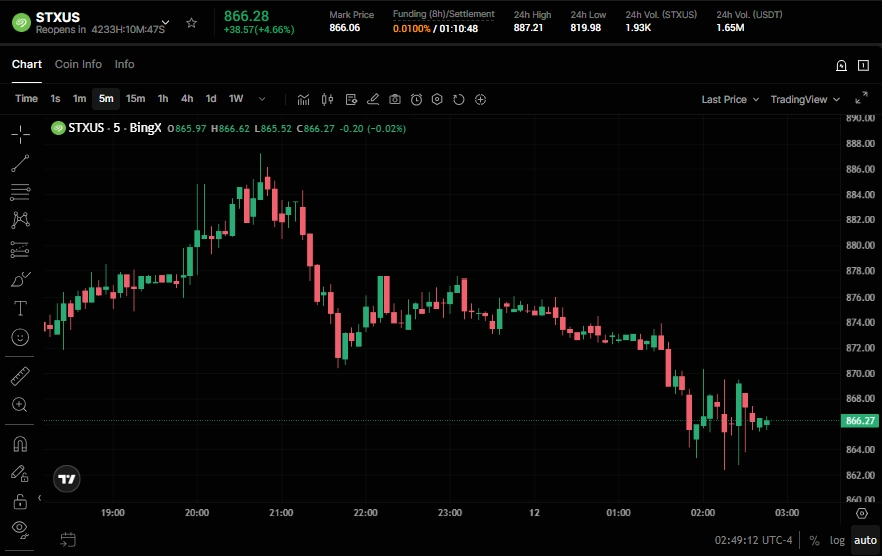
STXUS/USDT perpetual contract on BingX futures market
Long or Short STX Stock Perpetuals with USDT on BingX Futures
- Navigate to the BingX TradFi division and access Stock Futures.
- Input STX into the terminal search interface to call up the STXUS/USDT perpetual contract.
- Verify active trading sessions before submitting order tickets. Spreads and localized volatility may widen during extended-hour sessions due to lower immediate order book density.
- Configure your preferred Margin Mode (Isolated for defined boundary isolation, or Cross for collective portfolio pooling) and select leverage metrics.
- Execute Open Long if you anticipate positive backlog conversions, consecutive earnings outperformance, or strong margin guidance updates. Execute Open Short if you look to hedge against tech sector pullbacks, overextended valuations, or potential manufacturing execution friction.
- Implement protective Take-Profit (TP) and Stop-Loss (SL) boundary parameters immediately upon order entry to shield capital configurations from sudden macro market swings.
Conclusion: Should You Invest in Seagate Technology (STX) in 2026?
Seagate Technology stands as a highly compelling investment vehicle for playing both the structural recovery of mass storage and the fundamental architecture requirements of the global artificial intelligence (AI) boom. For investors seeking direct exposure to dominant, high-barrier manufacturing capabilities, protected cloud market shares, and a software-like margin profile unlocked by advanced HAMR platforms, Seagate represents a premier infrastructure holding.
At the same time, the sharp cyclical nature of mass storage means entry points and operational timing matter. Investors should closely monitor quarterly free cash flow yields, data center exabyte shipment numbers, and hyper-scale build-to-order contract continuations.
Risk Reminder: Trading and investing in equity assets like STX carries substantial capital risk. Market participants are advised to carry out exhaustive independent due diligence and seek registered financial counsel before committing investment capital.
Related Reading
- Top AI Tokenized Stocks to Watch in 2026
- Top 10 AI Infrastructure Stocks to Buy in 2026: Chip Manufacturing and Design Leaders
- Top AI Cloud Infrastructure Stocks to Buy in 2026 Amid Hyperscaler Capex and the Neocloud Boom
- Roundhill Memory ETF (DRAM) Forecast 2026: $1.5B AI Supercycle or 'RAMmageddon' Trap?
- Oracle (ORCL) Stock Price Outlook for 2026: Can AI Cloud Infrastructure Take ORCL Back to Its Highs?
