
In mid-June 2026, Space Exploration Technologies Corp (SPCX) stands as the ultimate epicenter of global financial markets, balancing a record-breaking public listing against intense fundamental skepticism. Following its historic Nasdaq debut on June 12, 2026, the Texas-headquartered conglomerate has witnessed an astonishing multi-day vertical rally, closing at $201.80 and printing active post-IPO gains of nearly 50% against its initial offering price.
While traditional aerospace analysts originally questioned whether public markets could absorb an offering of this magnitude, an immediate series of high-profile corporate maneuvers has supercharged the equity's near-term outlook. Investors are aggressively evaluating a massive influx of retail and passive index capital against deep structural losses and intense governance concentration.
As the international technology landscape transitions toward autonomous infrastructure, SpaceX's unique fusion of reusable heavy-lift orbital architecture, global satellite telecommunications, and hyperscale compute networks has positioned the firm as a primary economic gateway. However, a trailing price-to-sales multiple scaling into triple digits has created a highly controversial valuation debate on Wall Street.
This guide breaks down the SpaceX stock forecast and price prediction for the remainder of 2026, utilizing data from Oppenheimer, Truist, Morningstar, LSEG consensus estimates, and official SEC regulatory disclosures.
You will also discover how to trade SpaceX (SPCX) stock futures on BingX TradFi with USDT collateral.
Top 5 Things for SpaceX (SPCX) Traders to Know in 2026
As SpaceX navigates a high-stakes environment of exponential corporate expansion and aggressive capital deployment, traders must closely monitor these five market-moving factors:
- The $60 Billion Cursor Acquisition: Just four days post-IPO, SpaceX announced an all-stock buyout of Anysphere, the developer of the premier AI coding assistant Cursor, for $60 billion. Paid entirely in premium equity to avoid cash dilution, the deal incorporates Cursor's $2.6 billion in annualized enterprise sales directly into SpaceX's expanding software ecosystem.
- Massive Cloud Leasing Agreements: To monetize its gigawatt-scale Memphis Colossus supercomputer, SpaceX locked in multi-billion dollar terrestrial data center rental contracts. These include a $920 million per month contract with Google and a $1.2 billion per month contract with Anthropic, though both feature highly volatile 90-day termination clauses.
- The June 30 Lockup Expiration Test: While founder Elon Musk is locked into his shares for a full year, early private venture backers and employees face an accelerated lockup schedule. They are permitted to liquidate up to 20% of their private holdings immediately following the release of Q2 earnings on June 30, 2026, creating a massive potential institutional supply shock.
- The $20 Billion Bridge Loan Maturity: Tucked inside the company's first public balance sheet is $30 billion in total debt against $16 billion in cash. Crucially, $20 billion of this liabilities profile is tied to a short-term bridge loan utilized to fund rapid AI infrastructure acquisitions, which matures exactly 15 months post-IPO.
- Extreme Governance Concentration: Through a dual-class equity structure, Elon Musk retains 85% of total voting control despite owning roughly half of the economic shares. Minority public shareholders possess virtually zero capacity to influence board decisions, amplify capital allocation oversight, or challenge potential related-party transactions.
Read more: How the SpaceX IPO on June 12 Is Launching Elon Musk Past the Trillion-Dollar Net Worth Mark
What Is Space Exploration Technologies Corp (SPCX)?
Space Exploration Technologies Corp (SPCX) is a vertically integrated mega-conglomerate spanning commercial aerospace, satellite telecommunications, and advanced artificial intelligence. Originally founded in 2002 to pioneer reusable rocket architectures like the Falcon 9 and the next-generation Starship system, the company has structurally evolved its business model to capture cross-industry tech verticals.
As of mid-2026, SpaceX operates through three distinct commercial engines: Launch Services, which controls over 80% of global orbital payload mass; Starlink, a high-margin low-Earth-orbit (LEO) broadband constellation serving over 10.3 million subscribers; and its newly integrated AI Division, combining the assets of xAI, the Grok LLM and Colossus data center, the social network X, and the newly absorbed Cursor coding platform.
SpaceX's Performance in Early 2026: The Blockbuster Repricing
The company executed the largest initial public offering in Wall Street history on June 12, 2026, pricing 555.5 million Class A common shares at an flat rate of $135.00 to raise an unprecedented $75 billion (expanding to $85.7 billion net via full over-allotment greenshoe exercise). Trading opened on the Nasdaq exchange at $150.00 and immediately encountered intense retail buying pressure that broke historical volume records, pushing the equity to an intraday peak of $225.64 before stabilizing above $200.00.
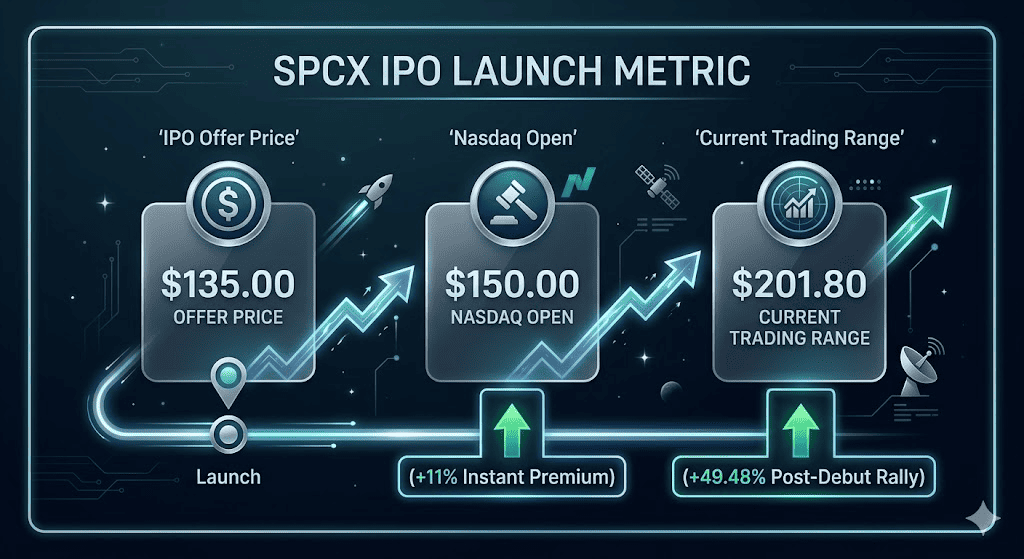
The underlying financials released in the regulatory S-1 filing revealed a stark divergence in operational performance. While total corporate revenue expanded 33% to $18.7 billion in fiscal year 2025, the company posted an overall net loss of $4.9 billion.
This deficit was heavily insulated by Starlink, which generated a spectacular $4.4 billion in operating profit on $11.4 billion in sales, effectively acting as the internal cash engine funding the multi-billion dollar research burn of the Starship program and terrestrial AI data center buildouts.
SpaceX 2026 Trading Strategy: Navigating Volatility Multiples

SpaceX stock performance since IPO | Source: Google Finance
- The $150 - $160 Structural Floor: Technical analysts identify the initial day-one closing range of $150 to $160 as the paramount macro support zone. As long as SPCX holds above this line on high-volume weekly closes, the bullish momentum established during the initial public offering remains structurally intact.
- The Triple-Digit Price-to-Sales Trap: Trading at an annualized trailing Price-to-Sales (P/S) ratio of roughly 130.4x, SPCX commands an unprecedented valuation premium that fundamentally eclipses legacy mega-cap tech hardware giants. Short-sellers are actively targeting this multiple, asserting that the stock is priced for decades of flawless execution.
- Artificial Float Volatility: Because the initial public offering released a tiny float of only 4% of total outstanding shares into the public market, the asset is highly susceptible to massive, supply-constrained price swings. Traders must structure positions defensively to withstand severe after-hours gaps dictated by headlines rather than corporate earnings.
Read more: Musk’s $2.6T AI Rocket: SpaceX Crushes Amazon, Weaponizes IPO Wealth for $60B Cursor Takeover
SpaceX 2026 Stock Forecast: $227 Street-High Peak vs. $63 Fair Value Support
Formulating a definitive price forecast for SpaceX requires balancing its absolute monopoly over global launch economics against highly speculative, unproven software and space-computing monetization models.
The Bull Case for SpaceX Stock: The $227+ Omnipresent Tech Monolith
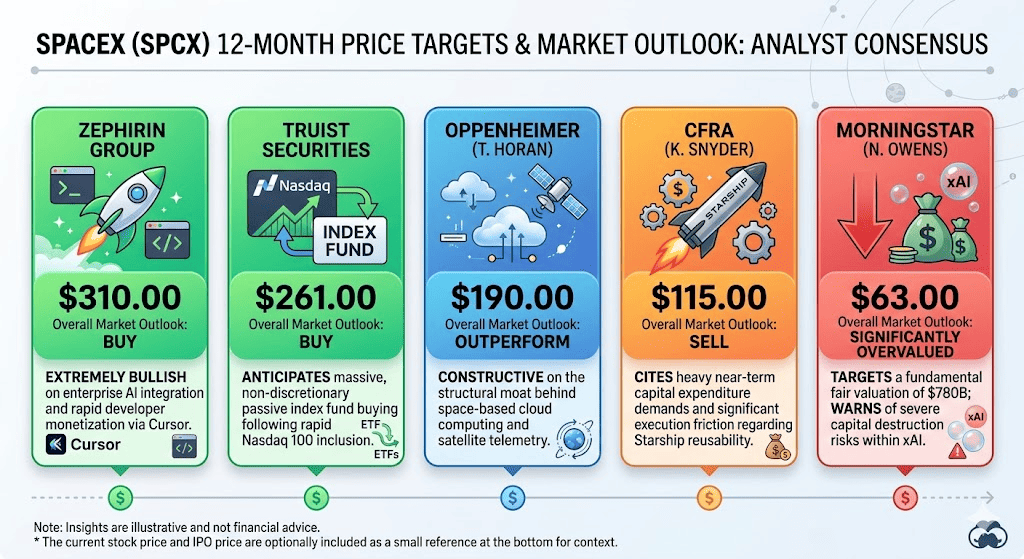
The bullish thesis asserts that SpaceX should not be valued as a capital-intensive aerospace manufacturer, but rather as an all-encompassing infrastructure utility. Championed by institutions like Truist with a $261 target and Zephirin Group's $310 coverage launch, this outlook assumes that accelerated passive ETF tracking inclusions across the Nasdaq 100 will force massive mechanical buying inflows.
In this scenario, the combination of Cursor AI's 100% automated vibe coding software distribution with xAI's infrastructure creates an immediate cash cow. If Starlink maintains its 50% year-over-year subscriber compounding curve and management successfully validates the economic viability of orbital data centers using free solar energy, the equity will easily breach near-term resistance, marching past $227 toward Elon Musk’s public hyper-ambitious projection of $1 trillion in corporate revenue by 2030.
Read more: SpaceX Unveils AI1 Orbital Compute Satellite Ahead of Historic $75 Billion IPO
The Base Case for SPCX Stock: $160 – $195 Valuation Rebalancing
The base case envisions a near-term mean reversion toward the consensus average target of $164.00, representing an orderly rebalancing as initial post-IPO hype cools. Under this framework, the market systematically demands that SpaceX prove it can execute its unproven engineering goals before sustaining a multitrillion-dollar market capitalization.
Operational revenues are expected to scale rapidly, tracking toward consensus estimates of $34.5 billion for late 2026. However, the stock’s upside potential will likely remain capped under $200.00 as institutional investors closely evaluate the real-world execution risks of Starship's reentry heat shields and the highly volatile churn of advertising revenues inside the integrated X social media division.
SPCX's Bear Case: The $63 Valuation Bubble and Capital Burn Trap
The bearish outlook focuses on an extreme disconnect between fundamental performance and market price. Led by Morningstar's fair value appraisal of $63.00, skeptics warn that the current $2.78 trillion valuation represents a dangerous speculative bubble. This thesis points out that outside of Starlink, the core rocket and AI operations remain deeply unprofitable, bleeding billions in negative cash flow.
If the upcoming June 30 lockup expiration triggers widespread institutional selling, or if the upcoming Q2 earnings print highlights rapid margin compression due to rising infrastructure overhead, a break below the $150 structural floor could trigger a severe cascading selloff. This downside risk is heavily exacerbated by the $20 billion bridge loan refinancing bottleneck and a historic 43% failure probability assigned by analysts to the company's unproven space-computing concepts, exposing unhedged traders to an intense descent toward the $63 to $115 bearish target band.
SpaceX (SPCX) Price Forecasts for 2026 by Wall Street Analysts
|
Institution / Analyst |
12-Month Price Target |
Overall Market Outlook |
|
Zephirin Group |
$310.00 |
Buy: Extremely bullish on enterprise AI integration and rapid developer monetization via Cursor. |
|
Truist Securities |
$261.00 |
Buy: Anticipates massive, non-discretionary passive index fund buying following rapid Nasdaq 100 inclusion. |
|
Oppenheimer (T. Horan) |
$190.00 |
Outperform: Constructive on the structural moat behind space-based cloud computing and satellite telemetry. |
|
CFRA (K. Snyder) |
$115.00 |
Sell: Cites heavy near-term capital expenditure demands and significant execution friction regarding Starship reusability. |
|
Morningstar (N. Owens) |
$63.00 |
Significantly Overvalued: Targets a fundamental fair valuation of $780B; warns of severe capital destruction risks within xAI. |
How to Trade SpaceX (SPCX) Stock Futures on BingX TradFi
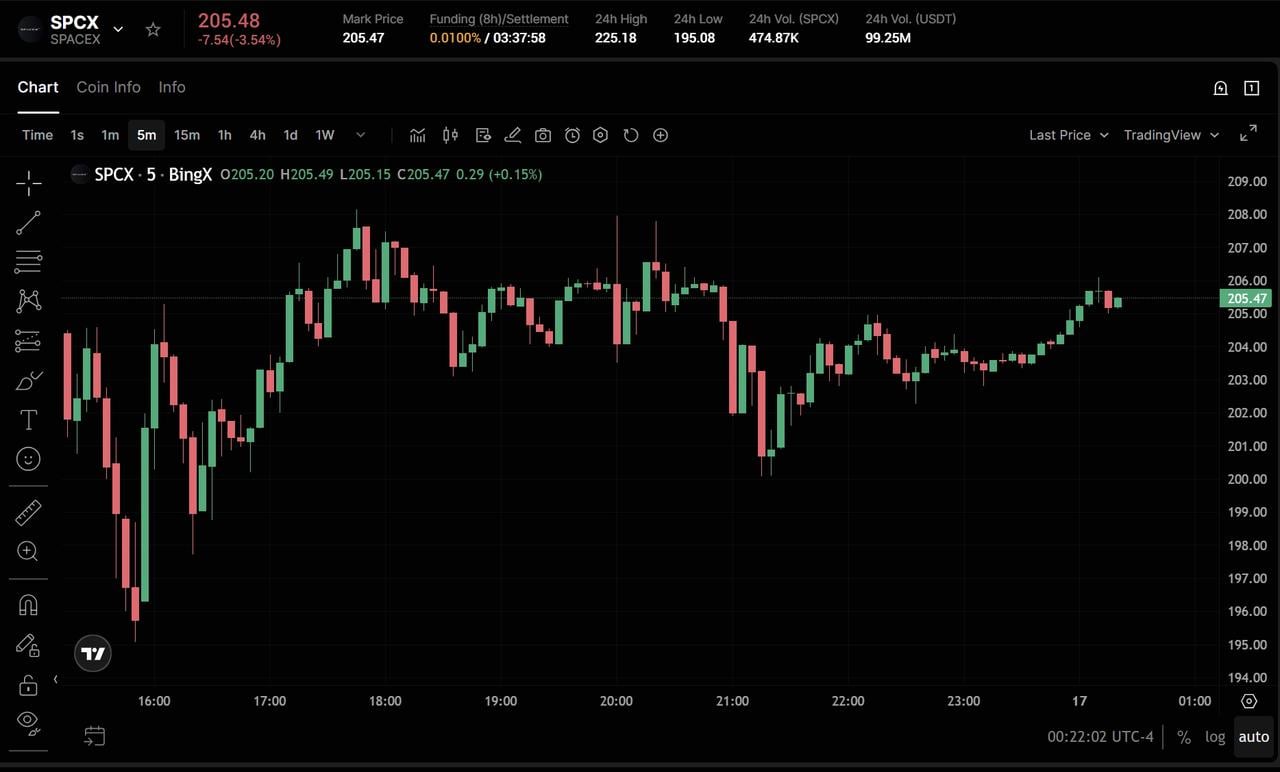
SPCX/USDT perpetual contract on BingX futures market
As SpaceX navigates this historic period of extreme public float volatility and rapid corporate changes, tactical traders can capture two-way daily price action through the BingX ecosystem.
- Access BingX TradFi: Navigate directly to the dedicated TradFi tab on the primary BingX trading dashboard.
- Select SpaceX (SPCX): Locate the specialized SPCX-USDT perpetual futures contract.
- Choose Your Trading Direction: Select Open Long if you believe the index inclusion momentum and Cursor software synergies will drive the equity past the $227 street-high target. Select Open Short to capitalize on overvaluation multiples and potential lockup expiration selloffs.
- Configure Leverage and Margin Parameters: Implement your preferred Isolated or Cross-Margin allocations alongside strict, defensive leverage tiers to maximize capital safety.
- Establish Risk Protocols: Deploy advanced BingX Take-Profit and Stop-Loss (TP/SL) orders to completely insulate your trading balance from unexpected gap moves during highly volatile extended after-hours trading sessions.
How to Buy SpaceX Tokenized Stock (SPCXB) on the BingX Spot Market
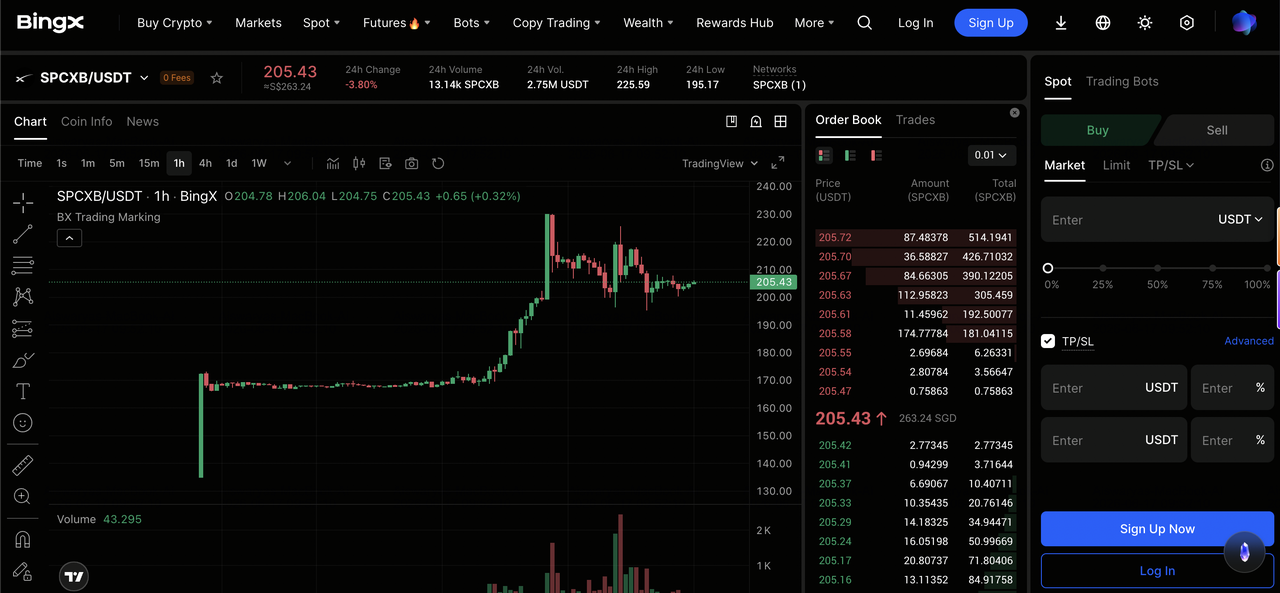
SPCXB/USDT trading pair on BingX spot market
If you prefer holding the underlying asset over trading perpetual contracts, use the SPCXB/USDT spot pair. Here is how to execute your trades quickly:
1. Locate the SPCXB/USDT Trading Pair
- Log into the BingX app or website.
- Go to Markets > Spot from the top menu.
- Search for SPCXB in the top-left asset list and select the SPCXB/USDT pair.
2. Buying SPCXB SpaceX Tokenized Stock
- Switch the order widget on the right to the Buy tab.
- Select Order Type: Choose Market to buy instantly at the current price, or Limit to set a specific lower entry price.
- Enter Amount: Input the amount of USDT you want to spend or use the percentage slider.
- Execute: Click Buy SPCXB. Your tokens will settle instantly in your Spot Account.
3. Selling SpaceX bStocks (SPCXB)
- Switch the order widget to the Sell tab.
- Select Order Type: Choose Market to liquidate instantly at the immediate market rate, or Limit to set a higher target price to lock in profits automatically.
- Enter Amount: Select the total number of SPCXB tokens you wish to sell.
- Execute: Click Sell SPCXB to return liquid USDT straight to your wallet.
Read more: What Is SpaceX Tokenized Stock (SPCXB) and How to Buy It?
Top 5 Risks to Consider Before Investing in SPCX Stock
While SpaceX's undisputed global dominance presents an alluring long-term growth narrative, entering this asset requires a rigorous understanding of its unique operational landmines:
- Massive Post-IPO Institutional Liquidation: The expiration of early insider release windows starting June 30 allows early private venture funds to lock in paper gains, creating severe downward pressure.
- Refinancing and Maturity Bottlenecks: Resolving the $20 billion short-term bridge loan within the next 15 months will demand additional debt issuance or share dilution under volatile interest rate conditions.
- Unproven Space-Computing Physics: The commercialization of orbital data centers demands unproven engineering feats, including sinking intense processor heat into a complete vacuum.
- Severe Revenue-to-Cash Disconnect: Multi-billion dollar terrestrial data center leases with Anthropic and Google remain vulnerable to abrupt 90-day cancellation notices, threatening projected software sales.
- Key-Person Dependency and Governance Risk: Elon Musk's divided operational commitments across multiple corporate entities, combined with an absolute voting monopoly, isolates minority investors from structural corporate control.
Final Thoughts: Is SpaceX (SPCX) a Good Stock to Buy in 2026?
As of June 2026, Space Exploration Technologies Corp stands as one of the most polarizing, highly valued, and captivating financial instruments in modern market history. Fundamentally, the firm's capacity to weaponize its massive aerospace cost advantages to subsidize a global satellite telecom network and an enterprise AI powerhouse confirms its structural relevance to the modern global economy.
However, trading a mega-cap equity carrying a triple-digit sales multiple and an asymmetric voting structure requires absolute operational precision. For short-term tactical traders, the asset provides an ideal arena for high-beta volatility extraction via BingX futures. Long-term investors, conversely, may find it highly advantageous to sidestep the immediate post-IPO retail mania, waiting for the June 30 lockup expirations to clear before deploying large capital allocations.
Risk Reminder: Trading high-growth technology and aerospace equities involves immense capital risk due to extreme valuation multiples, capital-intensive deployment timelines, and concentrated corporate governance. Always implement strict risk management, appropriate position sizing, and automated stop-loss protocols.
Related Reading
- The Passive Inflow Wave: Decoding the $32.5B Structural Squeeze and Liquidity Shock Facing SpaceX (SPCX)
- Top 10 Things to Know About the SpaceX IPO: Pricing, Valuation, and How to Trade It
- What Is SpaceX Tokenized Stock (SPCXB) and How to Buy It?
- Top Space Stocks to Buy Ahead of SpaceX IPO
- Should You Participate in SpaceX IPO: Pros and Cons
