By June 12, 2026, SpaceX has fundamentally reshaped the global capital markets. While traditional tech equities faced localized headwinds following recent macroeconomic jobs data, the launch of SPCX under a fixed $135 pricing structure has concentrated institutional and retail capital alike. Backed by its massive Starlink satellite internet engine, accelerating Starship development, and the newly absorbed xAI infrastructure, the stock is debuting with a targeted valuation of approximately $1.77 trillion.
The SPCX price prediction for 2026 is sharply divided into two distinct camps: the Momentum Bulls who view the aerospace giant as an unassailable tech monopoly, and the Value Bears who warn that a price-to-sales ratio hovering near 94x is entirely detached from current revenue. For active traders, this friction introduces unprecedented short-term volatility, fueled by historic oversubscription and structural index inclusion mechanics.
This guide explores SpaceX forecasts from CoinCodex, Oppenheimer, Morningstar, and other leading institutions, alongside the key fundamental metrics driving the market. You will also learn how to navigate these historic macro shifts on BingX.
Top 5 Things to Know About the SpaceX (SPCX) IPO in June 2026
- Historic Scale: SpaceX's public offering at $135 per share targets a $1.77 trillion valuation, aiming to raise $75 billion through 555 million shares outstanding, instantly making it the largest IPO on record.
- Overwhelming Demand: Institutional order books reached over $250 billion in bids, leaving the IPO roughly 3x to 4x oversubscribed heading into its first day of live trading.
- The Index Fast-Track: Modified Nasdaq-100 Fast Entry rules could force passive ETFs to mechanically purchase billions of dollars in SPCX stock within just 15 trading days of listing.
- The AI & Space Conglomerate: Following its $250 billion acquisition of xAI in February 2026, SpaceX now directly controls the Grok LLM, the 2 GW Colossus supercomputing data center cluster, and the social platform X.
- Extreme Valuation Divergence: Wall Street targets exhibit an unprecedented spread, ranging from Oppenheimer’s bullish $190 target to Morningstar’s conservative fundamental fair value of $63.
What Is SpaceX (SPCX)?
Space Exploration Technologies Corp. (SpaceX) is a vertically integrated aerospace and satellite communications conglomerate that dominates the global space economy. Founded in 2002, the company pioneered reusable rocketry via its workhorse Falcon 9 and Falcon Heavy platforms. This structural cost advantage has allowed SpaceX to capture more than 80% of the global market share for mass delivered to orbit, driving down launch costs per kilogram by over 95%.
A massive pillar of the company's valuation is Starlink, its low-Earth orbit (LEO) satellite constellation. Operating as an internal engine of cash generation, Starlink provides high-speed, low-latency broadband globally, serving an addressable market of nearly 2 billion people residing in low-density or unserved regions. As of mid-2026, Starlink operates two-thirds of all active items orbiting the earth, translating its unmatched launch access into a highly profitable telecommunications moat.
The company reached a pivotal corporate turning point in February 2026 by fully acquiring xAI in a equity-based transaction. This merger folded Elon Musk's advanced artificial intelligence lab directly into SpaceX's balance sheet. By combining xAI’s gigawatt-scale terrestrial computing infrastructure (Colossus 1 and 2) with SpaceX’s manufacturing capabilities, the firm intends to pioneer commercial orbital data centers by 2028, utilizing the solar energy efficiency and natural vacuum cooling of space to run next-generation AI workloads.
Read more: How to Trade SpaceX Pre-IPO on BingX Pre-IPO: SPACEX (VNTL), SPACEX (PreStocks), and SPCX
An Overview of SPCX Corporate Structure and Financial Health
The financial blueprint of SpaceX represents a high-leverage, aggressive expansion phase backed by robust structural moats.
- Balance Sheet Dynamics: As of Q1 2026, SpaceX holds approximately $16 billion in cash against $30 billion in debt. This includes a $20 billion bridge loan utilized for rapid AI data center expansion, which matures 15 months post-IPO and is expected to be managed via the equity proceeds raised in this public offering.
- Revenue Moats: The company generated approximately $18.67 billion in revenue last year, anchored by Starlink’s explosive 50% year-over-year growth to $11.3 billion. Starlink’s operating margins exceed 39%, generating over $4.4 billion in positive operating income, which effectively subsidizes the heavy R&D required for deep-space initiatives.
- Governance and Voting Rights: SpaceX utilizes a dual-class share structure. Founder Elon Musk retains an estimated 80% to 85% of total voting rights despite holding a 40% economic stake. Minorities have limited governance input, rendering the stock a direct referendum on Musk's long-term operational execution.
Read more: How the SpaceX IPO on June 12 Is Launching Elon Musk Past the Trillion-Dollar Net Worth Mark
What Makes SpaceX Different From Traditional Equities?
SpaceX distinguishes itself through vertical integration and an absolute monopoly over its supply chain. Unlike traditional aerospace firms, such as United Launch Alliance or Arianespace, that operate on cost-plus government models and rely on third-party manufacturing, SpaceX controls every facet of rocket fabrication, payload design, and satellite deployment. In 2025 alone, SpaceX conducted 165 launches, representing 51% of the global total, and lifted 83% of all global payload mass into space.
From a tech-infrastructure standpoint, SpaceX functions as a frontier computing play rather than a pure defense or telecom stock. While traditional tech hyperscalers like Google, Microsoft, and Meta face steep terrestrial energy and cooling costs to scale their AI clusters, SpaceX's planned space-based data networks aim to bypass these limits entirely. By building custom hardware designed to operate in heliosynchronous polar orbits, the company plans to utilize 30% brighter, uninterrupted solar radiation for power, using the reverse surfaces of satellite panels as massive heat radiators.
Read more: Top 10 Things to Know About the SpaceX IPO: Pricing, Valuation, and How to Trade It
How SpaceX Compares to Megacap Tech and Aerospace Peers
|
Feature / Metric |
SpaceX (SPCX) |
Megacap Tech (e.g., Google / Nvidia) |
Traditional Aerospace (ULA / Boeing) |
|
Launch Infrastructure |
100% In-house / Fully Reusable |
N/A |
Subcontracted / Expendable |
|
P/S Multiple (at IPO) |
94x 2025 Revenue |
20x - 30x (Nvidia) |
1x - 3x |
|
Core Synergy Play |
Launch + Telecom + Orbital AI |
Terrestrial Cloud + Software |
Defense Contracts + Aviation |
|
Voting Control |
80%+ Concentrated via Founder |
Standard Institutional Floating |
Dispersed Board Governance |
|
Capital Reinvestment |
100% Organic R&D Focus |
Mix of Buybacks & Dividends |
High Dividend Payouts / Debt |
While commercial competitors like Jeff Bezos' Blue Origin or Rocket Lab intend to scale competing reusable launch architectures, they remain hundreds of cumulative launches behind SpaceX in operational cadence. This massive head start gives SPCX a formidable cost-learning curve advantage that traditional equity valuations struggle to model accurately.
SpaceX (SPCX) 2026–2027 Outlook: Index Mechanics vs. Valuation Gravity
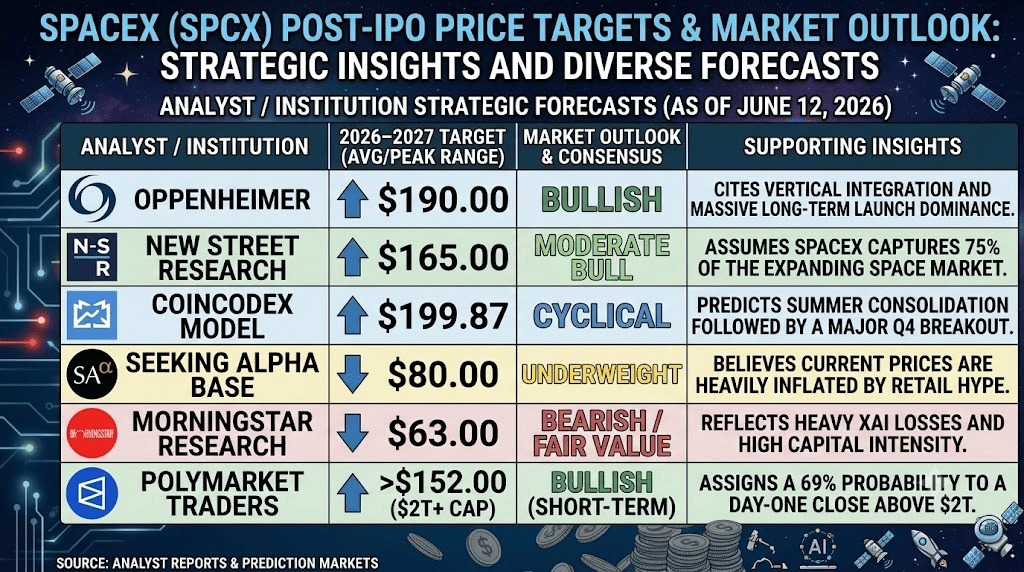
SpaceX (SPCX) forecasts after the IPO
The near-term trajectory for SpaceX stock is shaping up to be a fierce battle between unprecedented institutional passive buying and structural post-IPO selling pressures.
SpaceX's Bull Case: Index Fast-Entry and the $2 Trillion Cap Breakout to $155 – $190
The near-term bull case relies on mechanical market structures. Because Nasdaq modified its Fast Entry rules, SPCX is positioned to enter the Nasdaq-100 within approximately 15 trading days of its debut, with potential inclusion in the Russell indexes within five sessions. Because passive index funds and ETFs are legally mandated to replicate these benchmarks, they will be forced to buy billions of dollars of SPCX stock regardless of valuation.
This immediate structural demand, coupled with a highly constrained initial public float, could easily ignite a short-term pop. Pre-IPO perpetual futures on decentralized platforms like BingX and Hyperliquidalready reflect a 20% premium, hinting at an immediate move past $165. Over a 12-to-18-month horizon, institutional bulls like Oppenheimer maintain a $190 target, betting that Starlink’s direct-to-cellular add-on services will capture billions in high-margin mobile roaming revenue, while Starship successfully moves out of testing into full commercial cadence by late 2026.
The Base Case: SPCX Stock's Post-Hype Consolidation and Gradual Climb to $120 – $145
The base case projects a pattern typical of historic mega-IPOs. Algorithmic and cycle models, such as CoinCodex's SpaceX prediction, forecast that after an initial opening burst, enthusiasm will likely give way to a cooling-off period during the summer months of 2026. Projections point to average prices dipping slightly to the $118–$123 range through July and August as the market adjusts to the massive $75 billion capital absorption.
However, the base case models a powerful structural breakout starting in September 2026. As initial lockup volatility settles and Q3 earnings reports validate Starlink's cash generation capabilities, momentum is projected to return. This model targets a steady climb up to $182 in October, eventually stabilizing between $200 and $208 by the first quarter of 2027, representing a healthy, sustainable 50% appreciation from the IPO floor rather than an unchecked speculative bubble.
The Bear Case: SpaceX Valuation Correction and Lockup Max Q to $63 – $75
The bear case centers on the absolute gravity of fundamental metrics. Skeptics, including financial commentators like Jim Cramer, warn that a $1.77 trillion valuation priced at nearly 100x sales leaves zero room for operational error. If SpaceX experiences unexpected engineering delays in its fully reusable Starship upper-stage thermal shields, or if capacity constraints over available radio spectrum slow down Starlink’s adoption in dense urban markets, a steep multiple compression could occur.
Historically, mega-IPOs like Meta (Facebook) and Saudi Aramco suffered drawdowns of 30% to 50% within their first six months as early lockup windows expired. Independent research firms like Morningstar value the fundamental core of the business at $780 billion, implying an intrinsic fair value of $63 to $75 per share. Under a risk-off macro environment, the opening of early insider and employee release windows throughout late 2026 could trigger severe technical downside, forcing the stock to seek a firm floor at its $75 structural support before any long-term recovery can manifest.
Read more: Should You Participate in SpaceX IPO: Pros and Cons
SpaceX Price Forecasts After the IPO: Institutional and Market Outlook
Global market analysts and prediction tools display a wide dispersion of targets reflecting the intense debate around SPCX.
|
Entity / Source |
2026–2027 Price Target |
Overall Market Outlook |
|
Oppenheimer |
$190.00 |
Bullish: Cites vertical integration and massive long-term launch dominance. |
|
New Street Research |
$165.00 |
Moderate Bull: Assumes SpaceX captures 75% of the expanding space market. |
|
CoinCodex Model |
$199.87 |
Cyclical: Predicts summer consolidation followed by a major Q4 breakout. |
|
Seeking Alpha Base |
$80.00 |
Underweight: Believes current prices are heavily inflated by retail hype. |
|
Morningstar Research |
$63.00 |
Bearish / Fair Value: Reflects heavy xAI losses and high capital intensity. |
|
Polymarket Traders |
>$152.00 ($2T+ Cap) |
Bullish (Short-Term): Assigns a 69% probability to a day-one close above $2T. |
How to Trade SpaceX (SPCX) on BingX
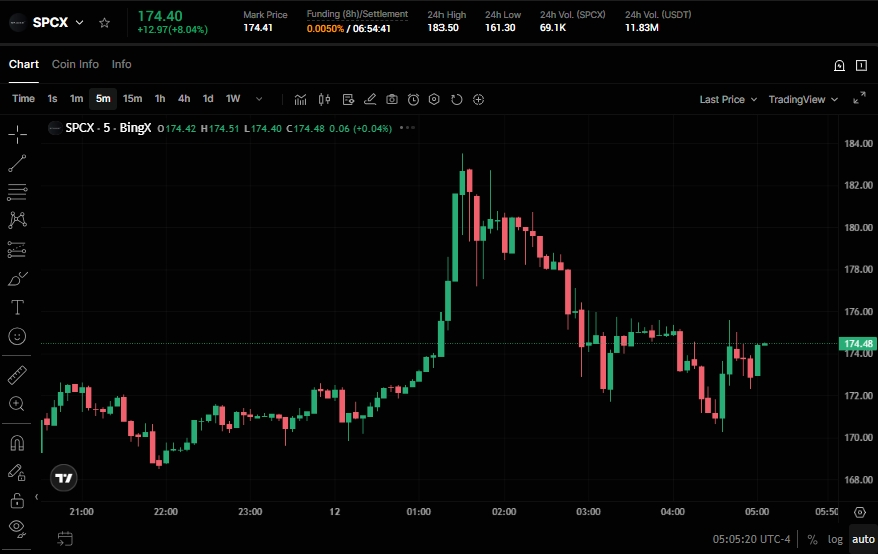
SPCX/USDT perpetual contract on BingX futures market
If you are looking to long or short SpaceX following its historic June 12 trading debut, follow this step-by-step framework to navigate the asset on BingX:
- Locate Your Preferred Instrument: Log in to your BingX app or desktop terminal. Navigate to the Futures Market or the dedicated Pre-IPO Zone. Use the search bar to input your target ticker based on your strategy:
- Search SPCX-USDT perpetual contract for direct tracking of the Nasdaq-listed public vehicle.
- Search SpaceX(VNTL) or SpaceX(PreStocks) for structural stock futures exposure.
- Fund Your Trading Account: Ensure you have sufficient USDT in your account balance. Use the internal Transfer interface to instantly move your capital from your Spot wallet into your Perpetual Futures account.
- Configure Margin and Leverage Parameters:
- Isolated Margin Mode: Highly recommended for risk-averse strategies, limiting your potential downside exposure exclusively to the margin assigned explicitly to that single trade.
- Cross Margin Mode: Utilizes your broader account balance as collateral to buffer against intense short-term volatility and avoid unwanted liquidation.
- Leverage Note: Select a conservative leverage multiplier ranging from 2x to 5x and up to a maximum of 20x for advanced strategies to safely account for the heightened double-digit price swings expected during the listing week.
- Execute Your Market Thesis:
- Click Open Long: If you believe the intense forced buying from passive index funds, structural compute revenue from Anthropic, and retail demand will create an explosive post-listing rally.
- Click Open Short: If you anticipate that the aggressive 94x price-to-sales multiple, steep annual net losses, and cross-holding governance issues will lead to a post-IPO cooling period.
- Implement Tight Risk Controls: Post-IPO equity derivatives operate under extreme sentiment shifts and are highly sensitive to regulatory announcements, production updates, and launch milestones. Always deploy clear Stop-Loss (SL) and Take-Profit (TP) parameters immediately upon opening your position to protect your collateral.
5 Crucial Risk Factors SPCX Investors Must Monitor After the SpaceX IPO
While the institutional oversubscription and mechanical index inclusion provide a powerful short-term tailwind, navigating the post-IPO landscape of SpaceX requires a careful evaluation of the structural, technical, and governance hazards that could impact your capital.
- Key-Person Dependency: The corporate structure leaves absolute voting control with Elon Musk. His split focus across multiple mega-ventures and the explicit charter clause stating he is not legally bound to prioritize SpaceX creates unique governance risks.
- The "Max Q" Supply Pressure: While the initial circulating float is small, multiple early insider release windows open consecutively throughout 2026 and 2027. This oncoming wave of private equity liquidity could easily overwhelm market buy walls.
- Technical Reusability Stalls: The economics of both the orbital AI centers and Starlink expansions rely entirely on the full, unhindered reusability of the massive Starship rocket. Complex engineering hurdles, like developing heat-shields capable of surviving 1,800°F atmospheric reentry without costly remanufacturing, remain unproven at multi-launch scale.
- Systemic AI Capital Burn: The newly absorbed xAI segment carried a notable operating loss of $6.36 billion prior to the merger. If commercial monetizations of the Grok LLM stall, the division could act as a multi-billion-dollar cash drag on the core launch business.
- Macroeconomic Multiples Compression: Trading at an institutional multiple near 100x sales means SPCX is priced for absolute perfection. A broader macroeconomic shift toward high interest rates or risk-off sentiment could trigger sharp technical adjustments.
Conclusion: Is SpaceX (SPCX) a Buy at Its IPO Price?
Deciding whether to allocate capital to SpaceX immediately after its IPO requires a clear boundary between short-term momentum trading and long-term value investing. In the near-term, SPCX functions as a high-conviction structural momentum play. The immense institutional oversubscription and mechanical ETF index buying provide a powerful programmatic tailwind, making an early breakout toward the $155–$165 range highly probable for active market participants.
For long-term investors, however, the core investment thesis requires Execution over Hype. At $135 per share, you are paying a massive premium that fully prices in technological milestones that are still years away from commercial scale. The most disciplined approach for market watchers is one of structured patience: monitoring early earnings reports and insider lockup expirations to identify high-volume technical entry points near key structural floors, while utilizing on-chain and spot market derivatives to capitalize on the localized volatility waves in the interim.
Risk Reminder: Investing in high-profile IPOs involves an exceptional degree of risk. The extreme valuation multiples mean the stock is highly vulnerable to swift, deep corrections if initial growth metrics underperform. Always employ meticulous risk parameters, avoid over-allocating capital, and do your own thorough research.
Related Reading
- How to Trade SpaceX Pre-IPO on BingX Pre-IPO: SPACEX (VNTL), SPACEX (PreStocks), and SPCX
- Top 10 Things to Know About the SpaceX IPO: Pricing, Valuation, and How to Trade It
- How the SpaceX IPO on June 12 Is Launching Elon Musk Past the Trillion-Dollar Net Worth Mark
- SpaceX Unveils AI1 Orbital Compute Satellite Ahead of Historic $75 Billion IPO
- Should You Participate in SpaceX IPO: Pros and Cons
- Top Space Stocks to Buy Ahead of SpaceX IPO
- What Is SpaceX Tokenized Stock (SPCXB) and How to Buy It?
