



Defense has become one of the strongest structural investment themes in 2026. Record military budgets, global rearmament, and lessons from recent conflicts are driving higher spending on missiles, aircraft, drones, cybersecurity, and battlefield technology. At the same time, AI, autonomous systems, and software are changing how militaries detect threats, make decisions, and operate on the battlefield.
This guide covers the key stocks behind the 2026 defense theme, from major contractors building missiles, aircraft, and combat systems to faster-growing companies focused on defense software, drones, and autonomous technology. It explains how each company fits into the modern defense cycle and how global traders can gain exposure to selected stocks on BingX TradFi through USDT-margined perpetual contracts.
2026 Defense Market Trend: Record Budgets, Missiles, Drones, and AI
The 2026 defense cycle is being shaped by two forces at once: record military spending and a technology shift toward drones, autonomy, and AI. Large prime contractors are benefiting from years of contracted orders, while newer defense technology companies are growing faster as spending moves toward unmanned systems and software. Four forces explain where the strongest demand is emerging.
- Record budgets are creating years of demand for Lockheed Martin (LMT) and RTX (RTX). Global rearmament is driving higher spending on aircraft, missiles, air defense, and other military systems. Lockheed reported a record backlog of about $230 billion, while RTX reached roughly $289 billion, giving both companies strong revenue visibility.
- Missile and air-defense demand is accelerating. Governments are rebuilding inventories and expanding systems such as THAAD, Patriot, and AMRAAM. Lockheed secured a multiyear THAAD interceptor contract worth about $35 billion, while RTX continues to receive major missile and air-defense awards.
- AeroVironment (AVAV), Red Cat (RCAT), and Ondas (ONDS) are gaining from the shift toward drones. Military spending is expanding across tactical drones, loitering munitions, autonomous systems, and counter-drone technology as unmanned platforms take a larger role in modern conflict.
- Palantir (PLTR) shows how AI is becoming part of battlefield infrastructure. AI is increasingly used for intelligence analysis, targeting, sensor fusion, battlefield coordination, and autonomous systems, creating a distinct growth category alongside traditional defense hardware.
The key trend in 2026 is that defense spending is expanding across both established weapons programs and newer technologies. Prime contractors provide exposure to long-term government demand, while software and drone companies offer more direct exposure to the modernization of warfare.
2026 Defense Companies Overview and Comparison by Role
Defense stocks span the full spectrum, from prime contractors building missiles and aircraft to software and drone companies enabling autonomous warfare. This comparison shows how each company fits the 2026 defense buildout.
|
Company |
Ticker |
Primary Role |
Key Advantages |
What to Watch in 2026 |
|
Lockheed Martin |
LMT |
Defense prime |
The largest Western defense contractor, maker of the F-35 |
Record $230B backlog; $35B THAAD missile contract |
|
RTX |
RTX |
Defense and aerospace prime |
A missiles and aerospace giant behind Patriot and AMRAAM |
Record $289B backlog; raised full-year guidance |
|
Palantir Technologies |
PLTR |
Defense AI software |
Leading AI software platform for military decision-making |
Revenue up 93%; AI coordinating drone operations |
|
AeroVironment |
AVAV |
Drones and loitering munitions |
Leading maker of tactical drones and Switchblade munitions |
Army contract wins; BlueHalo counter-drone expansion |
|
Red Cat Holdings |
RCAT |
Small tactical drones |
U.S. maker of small military drones such as Black Widow |
Revenue up over 400%; Drone Dominance program progress |
|
Ondas Holdings |
ONDS |
Autonomous drone systems |
Fast-scaling multi-domain autonomy and counter-drone platform |
Revenue guidance raised to $525M+; $450M+ backlog |
|
Rocket Lab |
RKLB |
Space launch and systems |
End-to-end space company spanning launch, satellites, and defense |
Record $2.36B backlog; Neutron rocket debut; Space Force wins |
|
Redwire |
RDW |
Space infrastructure and autonomy |
Space components and autonomous systems maker for defense |
Edge Autonomy integration; national security demand |
What Are the Top Defense Stocks in 2026?
Eight companies stand out across the major parts of the defense sector:
- Prime contractors and missiles: Lockheed Martin (LMT) and RTX (RTX)
- Defense AI software: Palantir Technologies (PLTR)
- Drones and autonomous systems: AeroVironment (AVAV), Red Cat Holdings (RCAT), and Ondas Holdings (ONDS)
- Space and defense infrastructure: Rocket Lab (RKLB) and Redwire (RDW)
Together, these eight stocks span traditional defense spending and the technologies reshaping modern warfare, from missiles and aerospace to AI, drones, autonomy, and space systems.
A. Defense Primes
The prime contractors are the backbone of the defense industry, building the missiles, aircraft, and combat systems that militaries depend on. With record backlogs and multi-year contracts, they offer the most stable, established exposure to rising defense budgets.
1. Lockheed Martin (LMT)
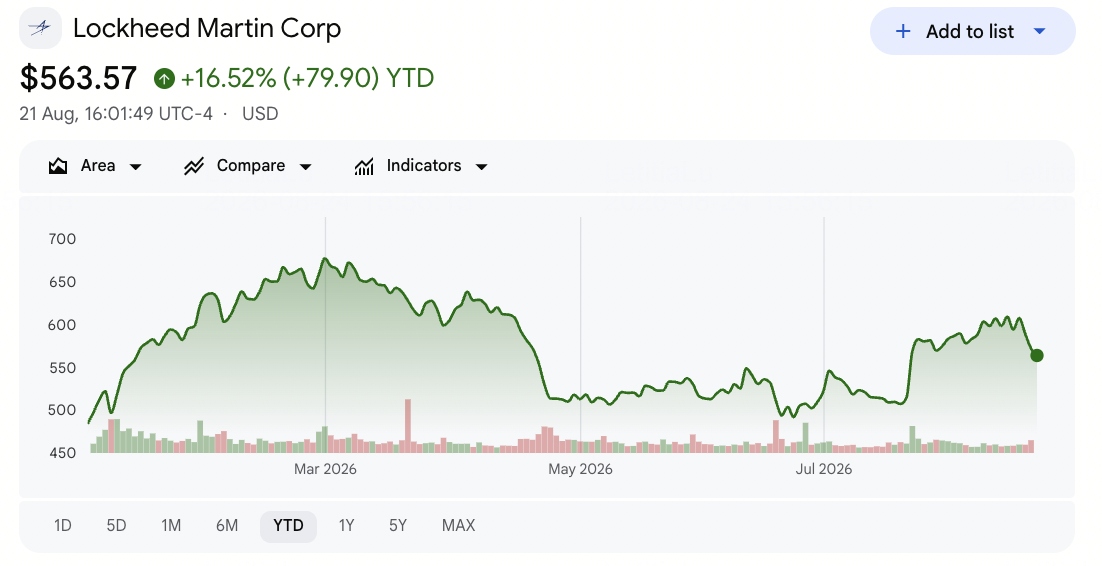
Core Role: Largest Western defense prime and missile maker
Lockheed Martin is the largest Western defense contractor, best known for the F-35 fighter jet, missile systems like THAAD and PAC-3, and a broad portfolio spanning aeronautics, missiles, rotary systems, and space. As global rearmament accelerates, Lockheed sits at the center of missile defense and military modernization, and management has increasingly framed the company as a "defense technology leader," pushing toward lower-cost, higher-quantity solutions including drones to match how modern conflicts have changed.
LMT Q2 2026 was strong, with revenue of $20.06 billion, up 10.5% year over year, and EPS of $7.94 beating estimates, while the company generated $2.9 billion in free cash flow and raised full-year revenue guidance to about $80.75 billion. Backlog swelled to an all-time high of $230 billion, boosted by a $35 billion multiyear THAAD interceptor contract and $65 billion of new orders booked in the quarter. The main risks are program execution, dependence on the passage of the defense budget, and the stock's already large appreciation, but Lockheed offers the most established, backlog-backed exposure to rising defense spending.
LMT Price Trend (2020-2026 YTD)
|
Year |
Yearly High |
Yearly Low |
Annual Return |
Market Conditions |
|
2020 |
$442.00 |
$320.00 |
-6% |
Pandemic disruption; steady defense demand |
|
2021 |
$396.00 |
$321.00 |
3% |
Budget stability; program execution focus |
|
2022 |
$498.00 |
$324.00 |
37% |
Ukraine war; missile restocking demand |
|
2023 |
$508.00 |
$415.00 |
-4% |
Backlog builds; margin normalization |
|
2024 |
$618.00 |
$393.00 |
11% |
Global rearmament; missile demand surges |
|
2025 |
$520.00 |
$410.00 |
-12% |
Program charges; F-35 delivery timing |
|
2026 YTD |
~$570 (Aug) |
~$420 (Jan) |
+18% YTD |
Record $230B backlog; $35B THAAD; guidance raised |
2. RTX (RTX)
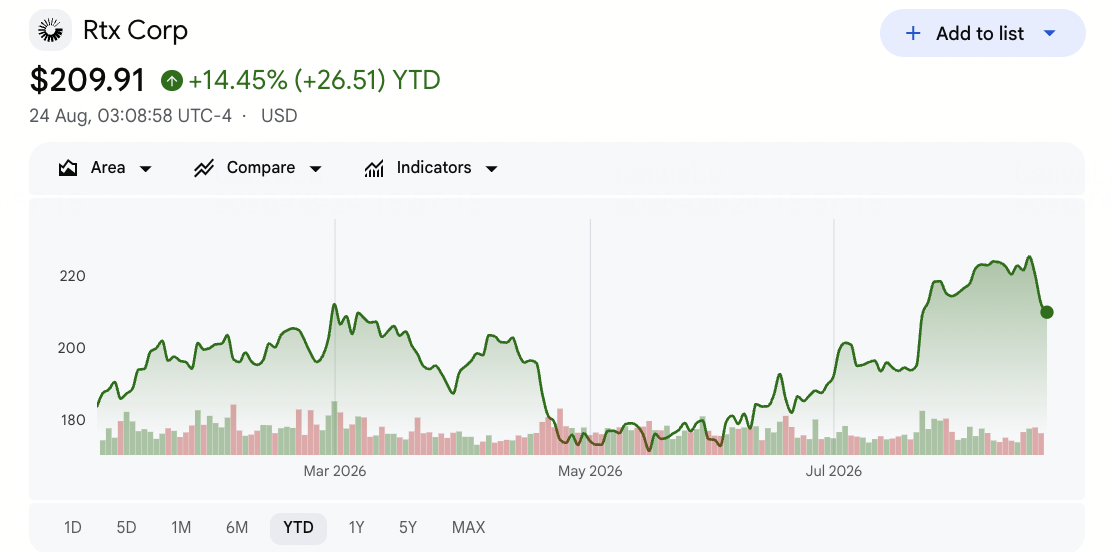
Core Role: Missiles and aerospace prime
RTX is a defense and aerospace giant combining three businesses: Raytheon, which makes missiles and air defense systems like Patriot and AMRAAM; Collins Aerospace; and Pratt & Whitney, which builds jet engines. This mix gives RTX exposure to both surging defense demand and a strong commercial aviation recovery, making it one of the most diversified names in the sector, with missile and effector demand especially strong amid global rearmament.
Q2 2026 revenue reached $24.7 billion, up 16% organically, with EPS of $1.89 beating estimates in its fifth consecutive beat, and management raised full-year revenue guidance to 95-96 billion. Backlog hit a record $289 billion, up 22% year over year, split between $170 billion in commercial orders and $119 billion in defense, with Raytheon booking nearly $20 billion of awards in the quarter including over $5 billion of GEM-T Patriot effectors. The main risks are commercial-aerospace exposure to fuel prices and airline capacity, and dependence on defense budget passage, but RTX offers diversified, record-backlog exposure across defense and aerospace.
RTX Price Trend (2020-2026 YTD)
|
Year |
Yearly High |
Yearly Low |
Annual Return |
Market Conditions |
|
2020 |
$80.00 |
$40.00 |
-19% |
Pandemic hits commercial aerospace |
|
2021 |
$92.00 |
$65.00 |
20% |
Aviation recovery; defense stability |
|
2022 |
$107.00 |
$80.00 |
17% |
Ukraine war; missile demand; aviation rebound |
|
2023 |
$105.00 |
$68.00 |
-6% |
Pratt & Whitney engine recall overhang |
|
2024 |
$125.00 |
$84.00 |
40% |
Recovery; missile restocking; backlog builds |
|
2025 |
$165.00 |
$115.00 |
30% |
Global rearmament; commercial aviation strength |
|
2026 YTD |
~$210 (Aug) |
~$150 (Jan) |
+25% YTD |
Record $289B backlog; guidance raised to $95-96B |
B. Defense AI and Software
Software has become a defense category of its own, with AI platforms now central to targeting, intelligence, and autonomous coordination. This layer represents the fastest-growing, most technology-driven part of the sector.
3. Palantir (PLTR)
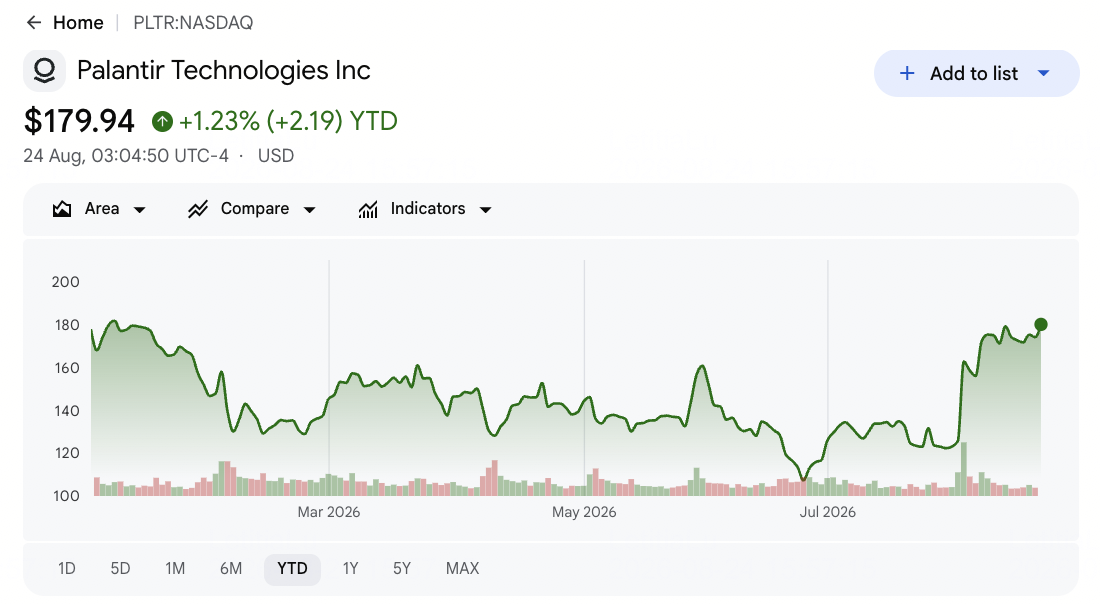
Core Role: AI software for defense and intelligence
Palantir develops the data-integration and artificial intelligence software that militaries and intelligence agencies use for mission planning, targeting, and decision support. Its Gotham platform handles real-time intelligence fusion and targeting for U.S. and allied forces, while its AIP platform now coordinates autonomous systems, including drone swarms operating with minimal human oversight, making Palantir a critical software layer beneath the shift to autonomous warfare, alongside a fast-growing commercial business.
Palantir Q2 2026 revenue reached $1.94 billion, up 93% year over year, with U.S. commercial revenue up 149% and the company's domestic business more than doubling over twelve months. Palantir's Maven Smart System became a program of record, and government contracts continue to make up a substantial part of its backlog, reflecting sustained defense and intelligence demand. The main risks are an extremely high valuation that prices in years of growth and sensitivity to government contract timing, but Palantir offers the most direct exposure to the AI software layer of modern defense.
Read More: Palantir (PLTR) Stock Price Prediction 2026: Can 149% U.S. Commercial Growth Push PLTR Toward $255?
PLTR Price Trend (2020 IPO-2026 YTD)
|
Year |
Yearly High |
Yearly Low |
Annual Return |
Market Conditions |
|
2020 |
$30.00 |
$9.00 |
+238% (partial) |
Direct listing; early government software growth |
|
2021 |
$45.00 |
$18.00 |
-23.00% |
Post-IPO volatility; commercial expansion |
|
2022 |
$19.00 |
$6.00 |
-64.74% |
Tech sell-off; unprofitability concerns |
|
2023 |
$21.00 |
$6.00 |
167.45% |
AIP launch; AI narrative; first GAAP profits |
|
2024 |
$85.00 |
$16.00 |
340.48% |
AI demand surges; S&P 500 inclusion |
|
2025 |
$190.00 |
$75.00 |
135.03% |
Government and commercial AI adoption scales |
|
2026 YTD |
~$207 (Feb) |
~$110 (Apr) |
-15% YTD |
Revenue +93%; US commercial +149%; Maven program |
C. Drones and Autonomous Systems
Unmanned systems have moved to the center of modern warfare, from tactical reconnaissance drones to loitering munitions and counter-drone defenses. These companies are scaling rapidly as militaries prioritize affordable, autonomous platforms, though they carry higher risk than the primes.
4. AeroVironment (AVAV)
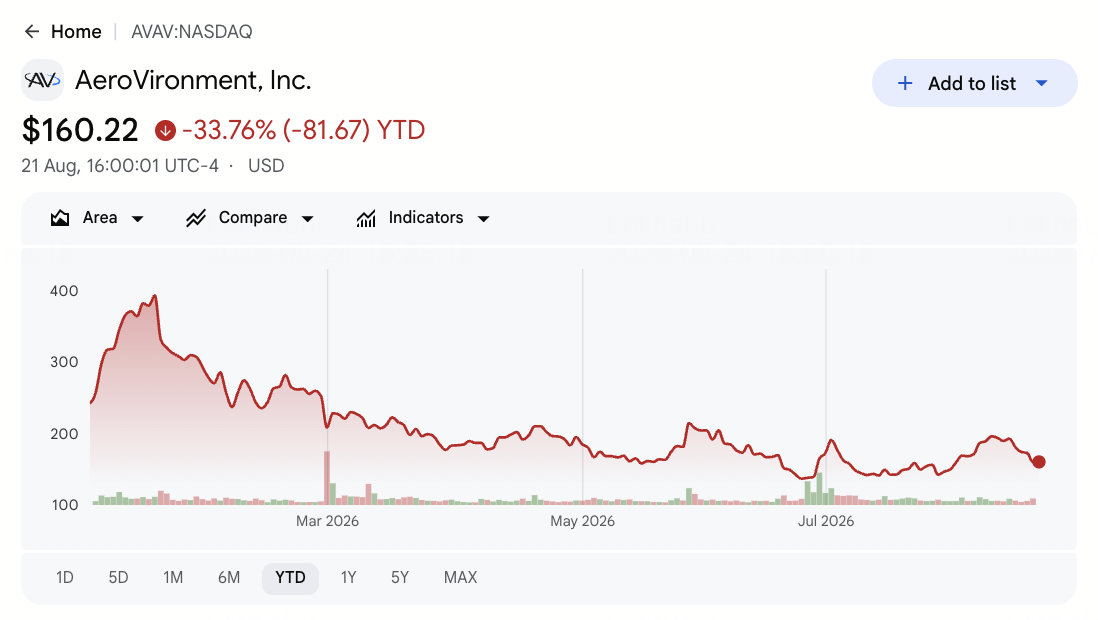
Core Role: Tactical drones and loitering munitions
AeroVironment is a leading maker of unmanned aircraft, loitering munitions, and counter-drone systems for military customers. Its Switchblade loitering munitions and small reconnaissance drones serve U.S. and allied ground forces, and its BlueHalo acquisition added laser counter-drone systems, space technology, and electronic warfare, broadening it into a diversified defense-technology company where government and defense customers account for essentially all business. This positions AeroVironment as the mid-cap bridge between established primes and smaller drone startups.
AeroVironment delivered record fiscal 2025 revenue of $820.6 million, up 14.45% year over year, fueled by Department of Defense procurement, and won a $117.3 million U.S. Army contract for 82 P550 drones. Demand tailwinds include the Pentagon's Replicator initiative to field thousands of autonomous systems and a broad shift toward unmanned warfare. The main risks are lumpy contract timing, integration of large acquisitions, and defense-budget dependence, but AeroVironment offers battlefield-deployable autonomy at meaningful scale.
AVAV Price Trend (2020-2026 YTD)
|
Year |
Yearly High |
Yearly Low |
Annual Return |
Market Conditions |
|
2020 |
$75.00 |
$45.00 |
12% |
Pandemic disruption; tactical drone demand |
|
2021 |
$140.00 |
$65.00 |
-18% |
Post-pandemic volatility; program timing |
|
2022 |
$105.00 |
$63.00 |
5% |
Ukraine war; Switchblade demand surges |
|
2023 |
$140.00 |
$84.00 |
40% |
Loitering munitions demand; backlog builds |
|
2024 |
$240.00 |
$110.00 |
60% |
Drone warfare narrative; BlueHalo acquisition |
|
2025 |
$290.00 |
$120.00 |
85% |
Unmanned systems demand; Replicator program |
|
2026 YTD |
~$300 (est.) |
~$130 (est.) |
-8% YTD |
Army contract wins; BlueHalo counter-drone expansion |
5. Red Cat Holdings (RCAT)
Core Role: Small tactical military drones
Red Cat Holdings is a U.S.-based provider of small and tactical unmanned aircraft systems for defense, national security, and commercial applications, with products including the Black Widow short-range reconnaissance drone built to operate in GPS-denied environments. Through subsidiaries such as Teal Drones and FlightWave Aerospace, Red Cat is positioned as a domestic drone manufacturer at a time when U.S. procurement rules increasingly favor American-made systems, and it is expanding into unmanned surface vehicles to broaden its addressable market.
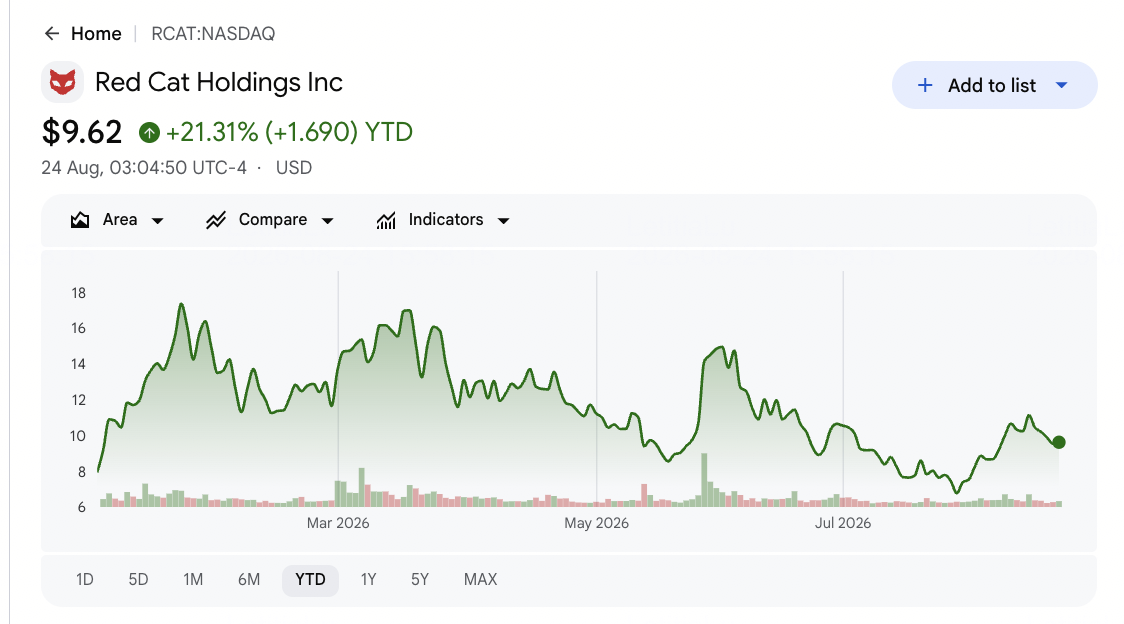
Red Cat's 2025 revenue reached $40.73 million, up roughly 460% year over year, and it reaffirmed a full-year target of 150-180 million while progressing through the Pentagon's Drone Dominance program. The company ended a recent quarter with about $325 million in cash, giving it runway to scale production. The main risks are significant: Red Cat remains unprofitable with a widening operating loss, faces production-scaling and execution risk, and has seen leadership disputes, making it one of the highest-risk, highest-volatility names in the group.
RCAT Price Trend (2021-2026 YTD)
|
Year |
Yearly High |
Yearly Low |
Annual Return |
Market Conditions |
|
2021 |
$6.00 |
$1.50 |
120% |
Early drone platform assembly |
|
2022 |
$5.00 |
$1.00 |
-60% |
Micro-cap volatility; pre-revenue scaling |
|
2023 |
$2.00 |
$0.40 |
-50% |
Cash constraints; Teal Drones ramp |
|
2024 |
$15.00 |
$0.50 |
680% |
Army SRR contract win; drone narrative |
|
2025 |
$18.00 |
$4.00 |
-20% |
Revenue +460%; Black Widow production |
|
2026 YTD |
$18.78 (52-wk) |
$5.77 (52-wk) |
-25% YTD |
Revenue +527% in Q2; Drone Dominance progress |
6. Ondas Holdings (ONDS)
Core Role: Autonomous drone systems and secure networks
Ondas Holdings has transformed from a niche drone-software company into a multi-domain autonomy platform spanning intelligence, surveillance, counter-drone systems, loitering munitions, unmanned ground vehicles, and secure wireless networks. Through its Ondas Autonomous Systems and Ondas Networks businesses, and a series of acquisitions including World View, Mistral, and DZYNE Technologies, Ondas has built a broad defense-technology portfolio positioned around the growth in autonomous systems and secure battlefield communications.
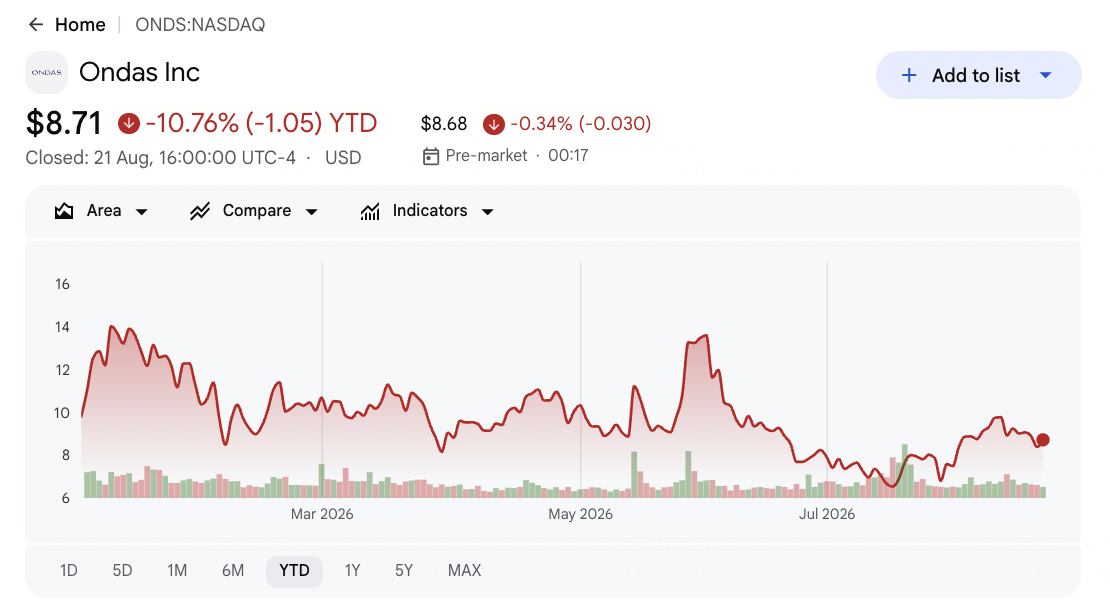
Ondas raised its 2026 revenue guidance to at least $525 million, up from a prior $390 million, following its acquisitions, and accumulated a backlog exceeding $450 million with substantial cash and minimal debt. It is targeting large defense initiatives including counter-drone and loitering-munition programs, and has reported more than $70 million in new defense orders across unmanned systems and border security. The main risks are heavy reliance on acquisition integration, a rich valuation embedding aggressive growth, and defense-budget dependence, but Ondas offers fast-scaling exposure to multi-domain autonomy.
ONDS Price Trend (2020-2026 YTD)
|
Year |
Yearly High |
Yearly Low |
Annual Return |
Market Conditions |
|
2020 |
$9.00 |
$3.00 |
50% |
Early wireless networks business |
|
2021 |
$14.00 |
$6.00 |
-35% |
Drone platform expansion |
|
2022 |
$8.00 |
$1.50 |
-80% |
Tech sell-off; micro-cap pressure |
|
2023 |
$3.00 |
$0.50 |
-70% |
Cash constraints; restructuring |
|
2024 |
$3.00 |
$0.50 |
40% |
Autonomous systems pivot begins |
|
2025 |
$11.00 |
$0.60 |
900% |
Tripled on defense platform transformation |
|
2026 YTD |
~$11 (Aug) |
~$4 (Jan) |
+30% YTD |
Guidance raised to $525M+; DZYNE acquisition |
D. Defense, Space and Aerospace
Space has become a defense frontier, from launch and satellites to autonomous systems and secure orbital networks. These companies give exposure to national security space demand, though as growth-stage names they carry higher execution and funding risk than the primes.
7. Rocket Lab (RKLB)
Core Role: End-to-end space launch and systems
Rocket Lab is an end-to-end space company delivering rockets, satellites, and spacecraft components for commercial, government, and defense missions. Built around its small-lift Electron rocket and its HASTE suborbital variant used for hypersonic and missile-defense testing, Rocket Lab is transitioning to a vertically integrated space platform, with its upcoming reusable Neutron medium-lift rocket targeting larger payloads and repeat government missions. Its growing Space Systems business, which designs and builds satellites and subsystems, has become the larger part of revenue and deepens its national security exposure.
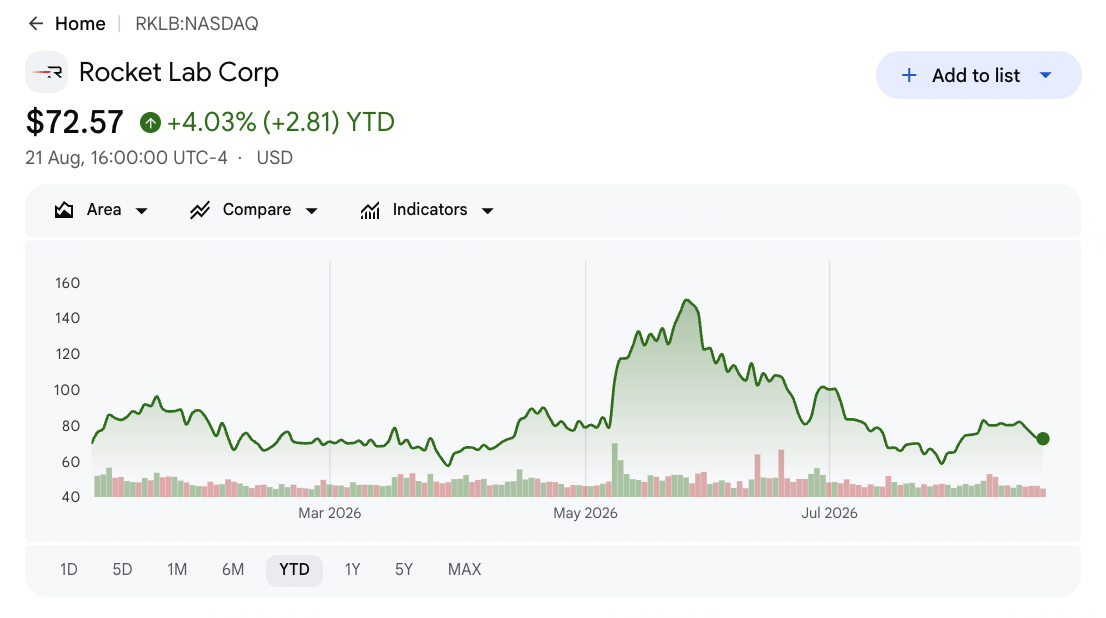
Rocket Lab Q2 2026 was a record, with revenue of $234.1 million, up 62% year over year, and backlog reaching a record $2.36 billion, up 137%, with more than $1 billion in new contracts entered in Q3 across launch and space systems. Recent wins include a $397 million U.S. Space Force award and a $266 million missile-defense contract, while the company closed the Mynaric and Motiv acquisitions and announced a deal to acquire Iridium Communications. The main risks are that Rocket Lab remains loss-making and reliant on external funding, the unproven Neutron launch timeline, and integration risk from large acquisitions, but Rocket Lab offers direct exposure to the defense and national security space buildout.
Read More: Rocket Lab Stock Forecast 2026: Can RKLB's Space Infrastructure Play Break $150 After Its 400% Run?
RKLB Price Trend (2021-2026 YTD)
|
Year |
Yearly High |
Yearly Low |
Annual Return |
Market Conditions |
|
2021 |
$21.00 |
$10.00 |
5% |
SPAC listing; Electron launch cadence |
|
2022 |
$15.00 |
$4.00 |
-55% |
Growth sell-off; pre-revenue scaling |
|
2023 |
$7.00 |
$3.50 |
-20% |
Space Systems growth; Neutron development |
|
2024 |
$30.00 |
$4.00 |
330% |
Launch cadence; defense wins; Neutron progress |
|
2025 |
$55.00 |
$19.00 |
85% |
Space Force awards; missile-defense contracts |
|
2026 YTD |
~$80 (Aug) |
~$18 (Jan) |
+45% YTD |
Record Q2 rev +62%; $2.36B backlog; Iridium deal |
8. Redwire (RDW)
Core Role: Space infrastructure and autonomous systems
Redwire is a space infrastructure company specializing in the essential components that keep satellites running, alongside autonomous systems and multi-domain operations for national security and civil markets. It builds solar arrays, structures, and subsystems for spacecraft, serves agencies like NASA, and through its acquisition of Edge Autonomy has expanded into uncrewed aerial systems, positioning itself at the intersection of space hardware and battlefield autonomy, with national security accounting for nearly half of its revenue.
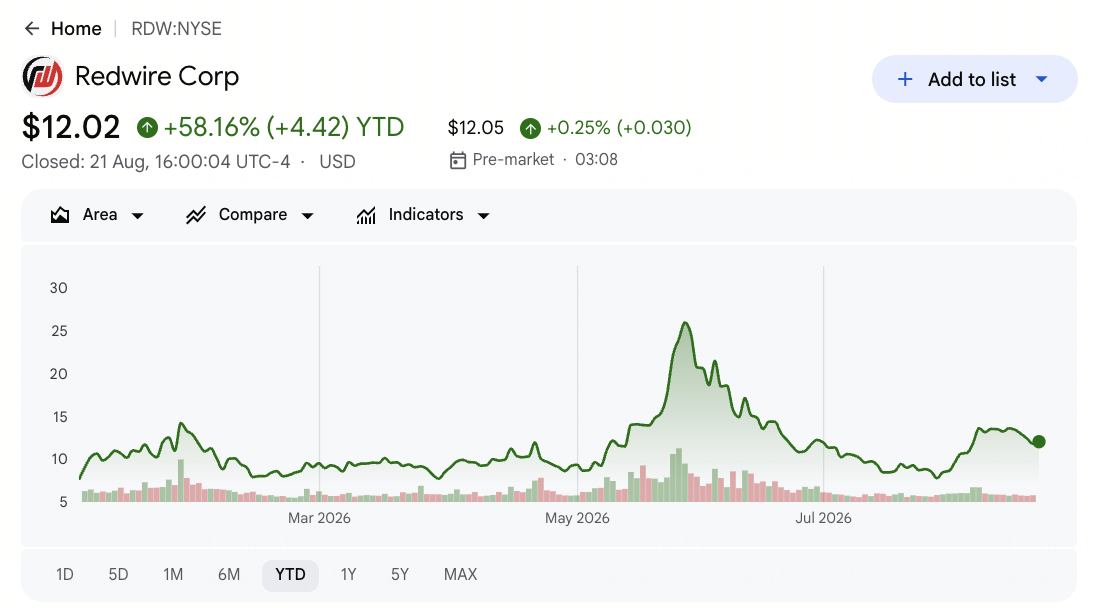
Redwire has grown through acquisitions and rising national security demand, moving toward becoming a broader defense-technology and space-infrastructure platform. However, the company remains loss-making, and faces integration work from acquisitions like Edge Autonomy, ongoing fixes for financial-control weaknesses, and a shareholder-lawsuit settlement requiring governance reforms. The main risks are significant: consistent net losses, customer concentration in national security, and potential dilution from a large equity offering, making Redwire one of the higher-risk names in the group, but it offers exposure to both space infrastructure and defense autonomy.
Read More: Redwire Price Prediction 2026: Can Space and Defense Momentum Help RDW Extend Its 220% Rally?
RDW Price Trend (2021-2026 YTD)
|
Year |
Yearly High |
Yearly Low |
Annual Return |
Market Conditions |
|
2021 |
$16.00 |
$6.00 |
-40% |
SPAC listing; space infrastructure focus |
|
2022 |
$8.00 |
$2.00 |
-55% |
Growth sell-off; funding pressure |
|
2023 |
$5.00 |
$2.00 |
80% |
Space demand recovery; acquisitions |
|
2024 |
$26.00 |
$2.50 |
550% |
National security demand; Edge Autonomy deal |
|
2025 |
$30.00 |
$9.00 |
-15% |
Integration work; dilution concerns |
|
2026 YTD |
~$20 (est.) |
~$9 (est.) |
+10% YTD |
Edge Autonomy integration; national security demand |
How to Trade Defense Stocks on BingX
BingX offers a crypto-native way to gain exposure to leading defense stocks without using a traditional brokerage account. The main execution path is through USDT-margined perpetual contracts on BingX TradFi, which allow active traders to go long or short and trade around earnings, contract awards, budget announcements, and broader defense-cycle trends.
Long or Short Defense Stock Futures with USDT on BingX TradFi
For active traders looking to capitalize on short-term momentum, earnings volatility, or defense catalysts, BingX TradFi allows users to trade defense-linked stock futures with USDT. These USDT-settled perpetual contracts mirror the price movements of underlying equities, offering flexible long and short exposure without requiring users to hold the physical stock.
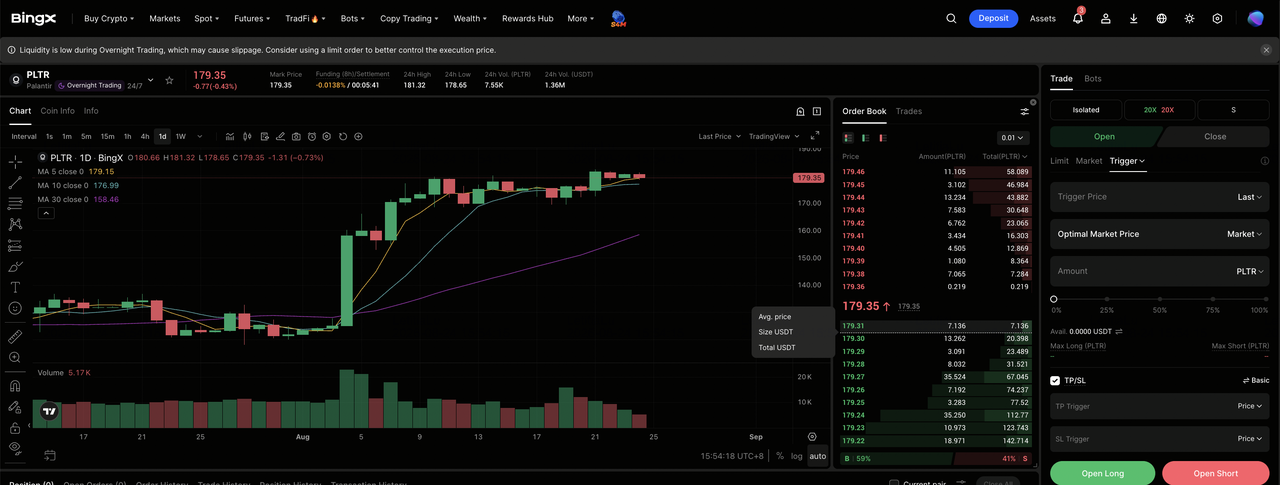
Step 1: Account setup and security. Sign up and log into your BingX account, complete the identity verification (KYC) required in your region, and enable two-factor authentication.
Step 2: Allocate trading capital. Transfer USDT from your spot wallet into your futures account, where it will serve as collateral.
Step 3: Select your contract. Navigate to the TradFi markets page or the futures trading section. Choose defense-linked perpetual contracts such as LMTUS-USDT, RTXUS-USDT, PLTR-USDT, AVAV-USDT, RCAT-USDT, ONDS-USDT, RKLB-USDT, or RDW-USDT.
Step 4: Set direction and leverage. Open long if you expect the stock price to rise, or open short if you expect a pullback. Choose leverage based on your risk plan.
Step 5: Execute and manage risk. Set stop-loss and take-profit orders before submitting the trade. PnL settles dynamically in USDT.
Risks and Core Considerations When Trading Defense Stocks
Defense stocks offer exposure to rising military budgets and battlefield modernization, but they also carry risks tied to politics, valuation, execution, and volatility.
- Defense budget and political risk: Much of the sector depends on government procurement and defense spending approvals. Budget delays or changes in procurement priorities can slow contract awards and affect future revenue.
- Valuation risk after strong rallies: Several defense technology names, especially Palantir and smaller drone companies, trade at high valuations that assume continued rapid growth. Weaker revenue, margins, or contract momentum could trigger sharp corrections.
- Execution and production risk: Smaller companies such as Red Cat and Ondas still need to convert contracts, guidance, and backlogs into large-scale production. Manufacturing delays or slower delivery can quickly pressure results.
- Supply chain and sourcing risk: Tighter U.S. restrictions on Chinese-made drone components create opportunities for domestic suppliers, but they can also raise costs and complicate sourcing during the transition.
- Leverage and stock volatility: Defense stocks can move sharply on earnings, contract awards, geopolitical events, or budget headlines. Traders using USDT-margined futures should manage position size carefully and use clear risk controls.
Final Thoughts: Should You Add Defense Stocks to Your 2026 Portfolio?
The eight stocks above offer different ways to gain exposure to the 2026 defense theme. Lockheed Martin and RTX provide the most established exposure through missiles, aerospace, and large government backlogs. Palantir represents the AI software layer, AeroVironment, Red Cat, and Ondas provide exposure to drones and autonomous systems, and Rocket Lab and Redwire extend the theme into space and defense infrastructure.
The main difference is risk. Large defense primes generally offer greater revenue visibility but slower growth, while Palantir, drone companies, and space names offer higher growth potential alongside richer valuations, execution risk, and greater volatility. For traders using BingX TradFi, position sizing, leverage control, and stop-loss orders remain important when trading defense stock futures through USDT-margined perpetual contracts.
Related Reading
- Top 10 AI Infrastructure Stocks to Buy in 2026: Chip Manufacturing and Design Leaders
- Top Space Stocks to Buy Ahead of SpaceX IPO
- Top Pharma Stocks to Buy in 2026: Cancer Drugs, Weight-Loss Drugs, mRNA, and New Medicines
- Top AI Networking Stocks 2026: AI Fabric, Switches, Copper, Fiber, and Optics Connectivity
- Top AI Energy Stocks to Buy in 2026: Nuclear, Gas, Fuel Cells, and the AI Power Buildout
- Top 10 Quantum Computing Stocks to Watch in 2026: Companies Driving Next-Gen Computation
