

USDe, Ethena's synthetic dollar and the foundation of what the protocol calls the Internet Bond, is undergoing its most significant structural evolution since launch. The original model was elegant in its simplicity: hold long spot ETH (or BTC), short an equivalent notional on perpetual futures, and let funding-rate payments from leveraged longs flow through to sUSDe holders as yield. At its peak in Q1 2024, that mechanism generated APYs above 35%. By late April 2026, yield had compressed to around 3.5%, close enough to the U.S. T-bill rates that the structural advantage of holding a synthetic dollar over a fiat-backed stablecoin became harder to justify for many holders.
Ethena's response is a multi-front diversification: adding tokenized gold (PAXG and XAUT) as a new backing layer with its own independent funding-rate stream, deepening institutional custody infrastructure through Kraken, and expanding demand through banking partnerships, including Singapore Gulf Bank. Together, these moves represent a deliberate pivot from a single-strategy yield product toward what the protocol is positioning as a multi-strategy reserve architecture that is less dependent on any one market regime and more capable of sustaining yield across the full crypto cycle.
This guide explains what that pivot means mechanically, how the gold-based trade works, whether the yield floor is recoverable, and what the evolution of custody signals about where USDe is headed.
Ethena (USDe) at a Glance (June 2026)
|
Metric |
Current Value |
Notes |
|
USDe Supply |
~$3.9B |
Down from ~$5.6B peak; post-$1.6B redemption wave |
|
sUSDe 7-Day APY |
~9.4% |
As of Apr 25, 2026, compressed to ~3.5% in late April |
|
sUSDe 90-Day APY |
~11.8% |
Reflects broader cycle; all-time low 4.1%, high 35.2% |
|
Reserve Fund |
$61M (~1.1% of supply) |
Cushions negative funding windows; floor signal at <0.7% |
|
Custodian |
Kraken Custody |
Appointed January 23, 2026; off-exchange settlement model |
|
New Backing Assets |
PAXG, XAUT (proposed) |
Gold-basis trade; PAXG 5.8% / XAUT 12.4% avg annual funding |
|
Banking Partner |
Singapore Gulf Bank |
USDe adopted as an institutional reserve/settlement asset |
Beyond Funding Rates: The Pivot to Multi-Strategy Hedging
Ethena's original reserve model was almost entirely dependent on a single trade: delta-neutral basis positions in ETH and BTC perpetual futures. The protocol holds spot collateral (mostly liquid-staked ETH and spot BTC) and opens equivalent short positions on centralized exchanges. When perpetual funding rates are positive, the normal regime in a bull market, where leveraged longs pay shorts to hold positions, yields flows to sUSDe holders. When funding turns negative, the reserve fund absorbs the shortfall.
The structural vulnerability of that single-strategy model became visible in two distinct ways during 2025–2026. First, the October 2025 depeg event: USDe briefly dropped to $0.97 during a $19 billion liquidation cascade on October 11, 2025, recovering within hours but serving as a stress-test of the protocol's redemption mechanics under real systemic pressure.
Second, yield compression in Q1–Q2 2026: as crypto markets entered a lower-leverage, range-bound phase, funding rates compressed dramatically, pulling sUSDe APY from double digits toward a ~3.5% floor close enough to T-bill yields that the case for holding a synthetic dollar over a fiat-backed one weakened materially, triggering $1.6B in redemptions.
The diversification pivot addresses both vulnerabilities. By adding backing assets whose funding-rate streams are structurally uncorrelated with ETH/BTC perp markets, Ethena reduces both the amplitude of yield compression during bear phases and the concentration of peg risk on any single exchange or asset class.
The revised reserve framework now draws from at least three independent revenue streams: the original ETH/BTC basis trade, a new gold-basis trade, and traditional credit/lending allocations, including T-bill-backed RWAs.
|
Revenue Stream |
Backing Asset |
Typical Yield |
Correlation with Crypto Cycle |
|
ETH/BTC Basis Trade |
stETH, spot BTC |
Variable; ~5–15% in active markets |
High — compresses in bear phases |
|
Gold Basis Trade |
PAXG, XAUT (proposed) |
PAXG ~5.8% / XAUT ~12.4% avg annual |
Low — driven by gold futures demand |
|
RWA / T-Bills |
BUIDL, T-bill-backed stablecoins |
~4–5% (tracks Fed funds rate) |
Very low — traditional macro driver |
|
DeFi Lending |
Overcollateralized lending protocols |
Variable; 3–12% depending on utilization |
Medium — follows DeFi TVL cycles |
Why USDe Is Adding PAXG and XAUT to Its Reserve Fund
In April 2026, Ethena's governance forum published a four-part evaluation of tokenized gold assets as potential backing for USDe. The proposal's core argument is that PAXG and XAUT perpetual futures maintain consistently positive funding rates that are structurally independent of crypto market conditions, providing a natural yield floor during periods when ETH/BTC funding compresses.
- PAXG perpetuals: Average annual funding rate of ~5.8%, driven by institutional and retail demand for leveraged gold exposure in crypto-native venues. The PAXG market has grown substantially, with tokenized gold crossing $5.55B total market cap in Q1 2026, up 289% year-on-year, with PAXG and XAUT together holding roughly 97% of that market.
- XAUT perpetuals: Average annual funding rate of ~12.4% — significantly higher than PAXG, reflecting Tether Gold's tighter liquidity on derivatives venues and stronger speculative demand. Higher funding also means higher potential yield, but thinner markets carry greater slippage risk for large hedging positions.
- Low correlation with crypto cycles: Gold perpetual funding rates are driven by geopolitical demand, central bank buying, and inflation expectations dynamics, with minimal overlap with BTC or ETH leverage cycles. During the Q1–Q2 2026 period, when ETH/BTC funding compressed toward zero, gold remained in strong demand (spot gold trading above $3,200/oz at peak), keeping PAXG/XAUT perpetual funding in positive territory.
- Reserve Fund strengthening: Gold-basis revenue is proposed to flow not only to sUSDe yield but also directly to the Reserve Fund, adding a buffer layer that is uncorrelated with the conditions most likely to trigger the fund's drawdown (i.e., simultaneous crypto bear markets and negative funding).
The Internet Bond vs. U.S. Treasuries in a 2026 Macro Environment
Ethena markets sUSDe as the Internet Bond, a yield-bearing dollar instrument for the on-chain economy, analogous to a T-bill for the DeFi ecosystem. The comparison is useful but not equivalent, and the 2026 macro environment has sharpened the contrast in ways that matter for holders evaluating the two.
|
sUSDe (Internet Bond) |
U.S. 3-Month T-Bill |
|
|
Current Yield |
~9.4% (7-day trailing, Apr 2026) |
~4.3% (Fed funds range, 2026) |
|
Yield Volatility |
High — ranges from 4% to 35%+ historically |
Low — tracks Fed policy rate |
|
Yield Source |
Crypto funding rates + staking yield |
U.S. government credit |
|
Liquidity |
7-day cooldown to unstake; secondary market via Curve |
Near-instant via secondary market or maturity |
|
Custody / Counterparty Risk |
Smart contract + exchange counterparty + custodian risk |
U.S. sovereign credit risk only |
|
Regulatory Status |
DeFi protocol; exited EU market (MiCA constraints) |
Regulated government instrument |
|
Composability |
Usable as DeFi collateral (Aave, Morpho, Pendle) |
Not natively composable in DeFi |
|
Best Environment |
Bull crypto markets with high leverage and positive funding |
Rising/stable rate environments; risk-off periods |
The Internet Bond framing works well when sUSDe yields are 2–3x above T-bill rates — a rational basis for the additional complexity and risk. The 2026 yield compression episode, where sUSDe compressed to ~3.5% against a T-bill rate of ~4.3%, flipped that equation temporarily.
That inversion is precisely what drove the $1.6B redemption wave and is the backdrop against which Ethena's diversification pivot must be understood: the multi-strategy reserve model is an attempt to structurally prevent yield from ever dipping below the T-bill rate again, by adding non-correlated revenue streams that maintain positive yield even when crypto funding is near zero.
Yield Sustainability: Can USDe Recover from the 3.5% Yield Floor?
The short answer is yes, with conditions. The 3.5% compression in late April 2026 reflected a specific set of converging factors: a range-bound crypto market with low leverage demand, the aftermath of the KelpDAO exploit (April 18, 2026), which triggered a broad flight from synthetic structures, and a broader rotation toward T-bills as Fed rates remained elevated. None of these is a permanent condition.
Historically, the sUSDe yield floor has proven to be a cycle phenomenon rather than a structural floor. The all-time low was 4.1% during the August 2024 funding inversion — a period that preceded the Q4 2024 bull run and a return to double-digit yields. The reserve fund, at $61M (~1.1% of supply), is sized to bridge short- to medium-term negative-funding windows without letting yield go to zero.
The diversification pivot strengthens this recovery path in a specific way: if gold-basis yields (~5.8–12.4% annually on PAXG/XAUT perps) are added as a structural yield floor, then even in a zero-crypto-funding environment, sUSDe holders receive gold-derived yield on the allocated reserve portion. This doesn’t eliminate the cycle, but it raises the practical minimum yield toward the level of T-bills or above, restoring the Internet Bond value proposition even in bear-market conditions.
Institutional Custody: Kraken and Singapore Gulf Bank
Two partnerships announced in the first half of 2026 reflect the same underlying imperative: USDe needs institutional-grade infrastructure to attract and retain the capital base that makes a multi-billion-dollar supply sustainable.
Kraken Custody: Bankruptcy-Remote, Off-Exchange Settlement
Kraken Custody was appointed as USDe’s institutional custodian on January 23, 2026, following a strategic review by Ethena’s independent Risk Committee. The arrangement provides segregated cold storage with regular attestation reports, a structure that addresses one of USDe’s most cited counterparty risks: the concentration of collateral on centralized exchanges.
The core risk the Kraken appointment mitigates is the FTX precedent. Ethena's delta-neutral model requires posting margin on perpetual futures venues, historically Binance, Bybit, OKX, and Deribit. If any of those venues fails, Ethena's hedge position becomes a creditor claim rather than a liquid position, and the corresponding spot collateral cannot fully cover the gap. The mitigation Ethena uses Off-Exchange Settlement (OES) keeps the majority of assets at a custodian like Kraken rather than on the exchange balance sheet, with intra-day margin for the residual on-exchange exposure.
What this means for holders: Kraken custody doesn’t eliminate counterparty risk, but it changes the nature of it. The bulk of USDe collateral now sits in a regulated, audited, segregated account rather than on an exchange that could rehypothecate it. For institutional allocators assessing USDe for treasury use, this is the specific structural feature that separates USDe from algorithmically-backed stablecoins that collapsed in previous cycles.
Singapore Gulf Bank: The Real Economy Integration Thesis
Singapore Gulf Bank’s adoption of USDe as a reserve and settlement asset represents a materially different demand vector than DeFi protocol integrations. Where DeFi integrations (Aave, Morpho, Pendle) create yield-loop demand from crypto-native users, banking-channel integrations create baseline demand from institutions that hold stablecoins for settlement purposes rather than yield. This demand is less sensitive to yield compression — a bank holding USDe for cross-border settlement doesn’t rotate out at 3.5% the way a yield-farming DeFi user does.
The Singapore Gulf Bank partnership is also part of Ethena’s Stablecoin-as-a-Service white-label model — an emerging business line where Ethena’s infrastructure powers institution-branded stablecoins on top of USDe’s reserve mechanics. This directly expands the use case from a DeFi yield product toward programmable settlement infrastructure, a market with longer-duration demand characteristics than yield farming.
Key Risks to Understand
- Funding-rate regime risk: Extended negative crypto funding (months, not days) depletes the reserve fund and can pressure the peg. The diversification to gold and RWAs reduces but does not eliminate this risk — it depends on the gold-basis trade also remaining in positive funding territory.
- Exchange counterparty concentration: The majority of Ethena’s perp hedges sit on Binance, Bybit, OKX, and Deribit. An FTX-style failure at any of these would crystallize a partial loss on the hedge position, with the OES/Kraken structure providing a partial buffer, not a guarantee.
- Peg stress under redemption pressure: October 2025 depeg to $0.97 demonstrated that large concurrent redemptions can temporarily pressure the peg. The 7-day cooldown on sUSDe unstaking is designed to prevent redemption runs, but it also means sUSDe holders cannot exit instantly during a crisis.
- Governance execution risk (gold allocation): The PAXG/XAUT backing proposal is a governance initiative, not a live deployment. Market makers need to develop adequate hedging infrastructure for gold perps before Ethena can deploy at scale. Implementation delays are possible.
- Regulatory uncertainty: Ethena exited the EU market under MiCA constraints. U.S. regulatory treatment of synthetic stablecoins remains unresolved. Institutional adoption (Singapore Gulf Bank model) could be constrained in jurisdictions with restrictive stablecoin frameworks.
How to Trade the Ethena USDe Ecosystem on BingX
USDe and sUSDe are DeFi-native products that operate primarily through Ethena’s own protocol and integrated DeFi venues (Aave, Morpho, Pendle, Curve). Direct USDe/sUSDe trading is not available on BingX at the time of writing. However, BingX does offer exposure to the key assets that underpin or intersect with Ethena’s model:
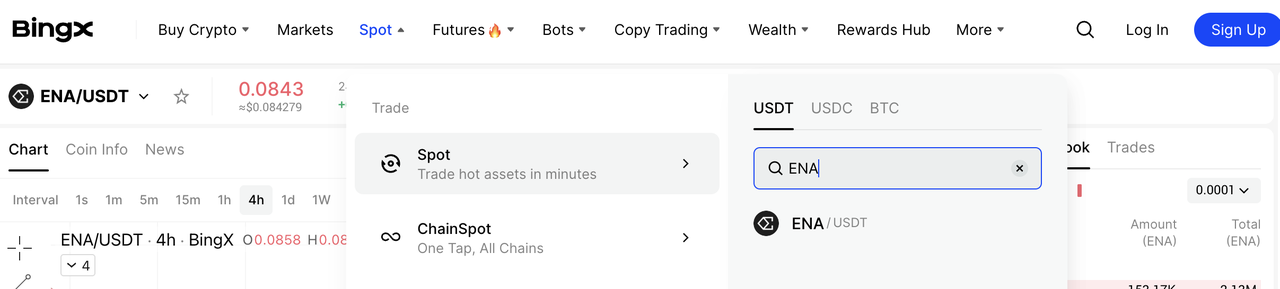
- ENA (Ethena governance token): Tracks protocol growth, USDe supply expansion, and the success of the diversification thesis. If the gold-based trade and Stablecoin-as-a-Service business lines gain traction, ENA will capture the upside. Check BingX’s current listings for ENA/USDT availability.
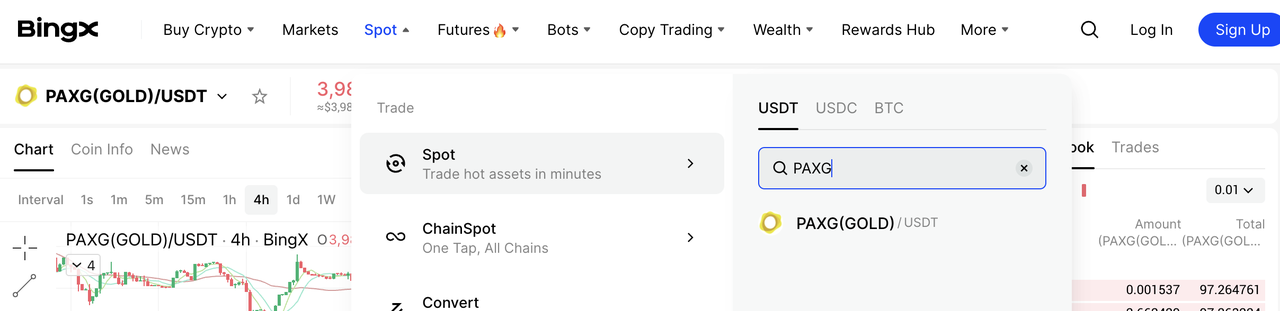
- PAXG: The tokenized gold asset at the center of USDe’s diversification proposal. As institutional demand for gold exposure grows and Ethena’s governance approves the allocation, PAXG supply and DeFi utility are both likely to expand. PAXG is available on BingX to check current spot listings.
- BTC and ETH: The core collateral assets for USDe’s existing basis trade. BTC and ETH are available on BingX across spot and perpetual futures markets. Monitoring their perpetual funding rates on BingX gives a real-time proxy for sUSDe yield direction; rising funding rates on BTC/ETH perps are a leading indicator of rising sUSDe APY.
Conclusion: USDe's Bet on Resilience Over Simplicity
The original USDe model was a single trade dressed up as a protocol. That's not a criticism; the delta-neutral basis trade is genuinely elegant, and at peak efficiency, it delivered yields that no T-bill could touch. But a model that generates 35% in a bull market and 3.5% in a bear market isn't an Internet Bond. It's a cycle bet with a stable name on it.
The 2026 pivot materially changes that proposition. Adding gold-basis trades with structurally uncorrelated funding rates, Kraken's bankruptcy-remote custody, and banking-channel demand through Singapore Gulf Bank aren't cosmetic changes; they're an architectural shift from a single-point-of-failure yield product toward something that can reasonably claim to function across market regimes. Whether Ethena executes on that architecture is a question of governance velocity, market maker depth in gold perp markets, and whether institutional demand through channels like Singapore Gulf Bank proves durable or opportunistic.
The metric that answers all of those questions in real time is the one Ethena itself flags: sUSDe yield relative to the 3-month T-bill rate. When the Internet Bond yields more than the original bond, the thesis is working. When it doesn't, the diversification model is being tested. Watching the reserve fund balance alongside the yield, a fund holding above 1% of supply with yield above T-bills is the sign that the pivot is delivering. A reserve below 0.7% with a yield below T-bills is a sign that it isn't yet.
Related Articles
- What Is Ethena’s USDe Yield‑Bearing Stablecoin and How Does It Work?
- What is Demo Trading on BingX and How to Get Started
- Resolv Protocol Airdrop Guide: How to Qualify and Claim $RESOLV Tokens
- How to Buy Bitcoin and Crypto on BingX with SEPA, Apple Pay & Google Pay
- How to Use BingX AI? A Beginner’s Guide to Trading Crypto with AI Assistant
FAQs on Ethena USDe 2.0
1. What is USDe?
USDe is a synthetic dollar stablecoin issued by Ethena Labs. It maintains its $1 peg through a delta-neutral strategy that holds long spot crypto collateral and shorts an equivalent notional amount in perpetual futures, rather than through fiat reserves or overcollateralized vaults.
2. What is the Internet Bond?
The Internet Bond is Ethena's term for sUSDe — the staked, yield-bearing version of USDe. Holders deposit USDe into Ethena's staking contract and receive sUSDe, which accumulates yield from funding-rate payments and staking rewards over time.
3. Why is Ethena adding PAXG and XAUT to USDe?
To add a yield stream that is uncorrelated with crypto perpetual funding rates. Gold-basis trades (PAXG and XAUT perps) have averaged annual returns of 5.8% and 12.4%, respectively, driven by gold market dynamics rather than crypto leverage cycles. Adding these assets reduces USDe's dependence on positive crypto funding to sustain yield.
4. What happened to USDe's yield in 2026?
sUSDe yield compressed to 3.50% by the end of April 2026 (with 30-day and 90-day averages also around 3.49–3.50%), driven by persistently soft perpetual funding rates, reduced crypto market leverage, a broad flight from synthetic and DeFi structures following the KelpDAO exploit (~$292M rsETH drain on April 18 via a compromised LayerZero bridge), and competition from T-bill yields above 4%. This triggered approximately $1.6B in redemptions toward the end of the month, causing sUSDe supply to fall to ~$1.71B and the staking ratio to drop to ~44%.
The pressure accelerated Ethena’s pivot to a multi-strategy backing model that incorporates real-world assets and T-bills for greater yield stability. The 7-day trailing APY recovered to approximately 9.4% around April 25 amid short-term funding improvements, before moderating again through Q2 (reaching ~7.1% by mid-June 2026).
5. Who is USDe's custodian?
Kraken Custody was appointed as USDe's institutional custodian on January 23, 2026. The arrangement provides segregated cold storage and regular attestation reports, addressing the exchange counterparty concentration risk that exists when collateral is held on perpetual futures venues.
6. Is USDe safe?
USDe is not risk-free. Material risks include prolonged negative crypto funding that could deplete the reserve fund, exchange counterparty concentration on major perp venues, smart contract risk, and peg stress during large simultaneous redemptions (as seen in October 2025 depeg to $0.97). The diversification of gold backing and improved custody reduces some of these risks but does not eliminate them.
