
The Web3 narrative has decisively shifted from human-centric speculative assets to automated, value-bearing machine workflows. NEAR Intelligence represents the foundational infrastructure for this transition, establishing what founders term the Agentic Web, an ecosystem where autonomous AI programs act as the primary interface layer for the internet. Instead of humans wrestling with complex blockchain infrastructure, self-custody wallets, and gas optimization, NEAR AI agents act on intent, turning public blockchains into the back-end settlement rail for machine-to-machine commerce.
Driven by a structural 2026 tokenomics overhaul that halved maximum annual inflation from 5% to 2.5% and introduced an Intents Fee Switch, where protocol revenues are channeled directly into $NEAR buybacks, the network has scaled to handle millions of daily active addresses. By combining hardware-enforced cryptographic security with universal chain abstraction, NEAR Protocol allows private AI models to execute complex multi-chain transactions seamlessly. This guide outlines how to leverage the NEAR Intelligence ecosystem, utilize its core technology stack, navigate its unified dashboard, and deploy specialized agents into production.
What Are AI Agents on NEAR Intelligence and How Do They Work?
At the core of the NEAR Intelligence thesis is a mandatory rule: AI agents will be the primary users of blockchains. As artificial intelligence handles scheduling, data analysis, asset allocation, and cross-border operations, it requires a neutral financial layer.
Centralized cloud architectures are fundamentally incompatible with this future because they expose private credentials and proprietary weights to server operators. NEAR solves this by introducing a decentralized, hardware-secured environment optimized for autonomous commerce.
The IronClaw Framework: Private-by-Default Enclaves
To run autonomous workflows without risk of data leaks or front-running, developers deploy agents using IronClaw, NEAR’s open-source agent framework. IronClaw builds secure micro-environments inside hardware-enforced Trusted Execution Environments (TEEs), utilizing silicon-level isolation via Intel TDX gateways and NVIDIA Confidential Computing architectures.
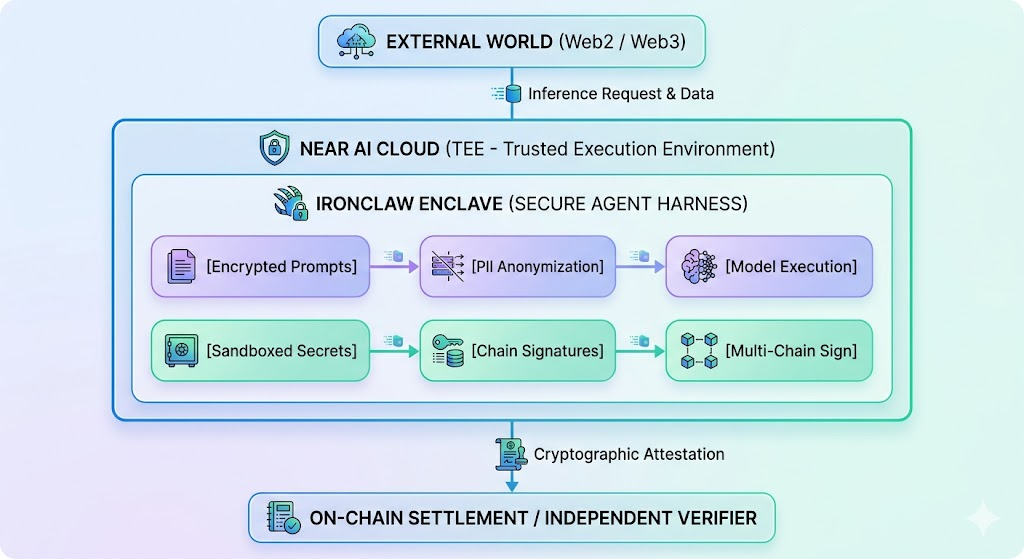
When an IronClaw agent executes a workflow, the host operating system, GPU operator, and even the NEAR AI core protocol are cryptographically locked out of the execution context. This Triple Lockout design ensures that sensitive API keys, enterprise data, and private seeds remain sealed.
Furthermore, every completed inference cycle generates an independent, hardware-signed attestation certificate, proving the model ran exactly as intended without baseline tampering.
Shade Agents and Multi-Chain Autopilot
While regular bots are restricted to single-chain scripts, NEAR’s Shade Agents operate as multichain smart contracts. They pair on-chain logic with off-chain TEE processing, utilizing NEAR Chain Signatures for decentralized key management.
Instead of generating individual keys for every protocol, a Shade Agent uses a single NEAR account identity to sign transactions across 35+ non-native blockchains, including Bitcoin, Ethereum, and Solana. This eliminates manual gas bridging and wallet juggling, enabling an agent to rebalance a cross-chain yield portfolio or execute corporate remittances automatically through high-level user commands.
How to Access and Navigate the NEAR Intelligence Dashboard: Step-by-Step Guide
The control center for deploying and managing user-owned AI assets is the NEAR Intelligence Unified Dashboard, accessible via near.ai or the integrated NEAR super-app portal. The interface bridges consumer-facing private assistants with complex developer infrastructure, organizing compute allocations, agent nodes, and multi-chain settlement rails into a single clean environment.
Step 1: Secure Authentication and Web3 Connection
Navigate to the official NEAR AI portal. Click on Connect Wallet in the upper-right corner. The dashboard natively supports advanced chain-abstracted accounts. You can authenticate using a standard NEAR account, a hardware wallet, or an abstracted login that enables gasless transactions.
Step 2: Activating Confidential Mode and Tuning PII Scrubbing
Before running private workflows, enter the Settings menu to configure your data privacy rules. Turn on Confidential Mode to route all prompt routing through secure hardware shards.
Toggle the Automatic PII Anonymization switch. This May 2026 software suite update automatically scrubs personally identifiable information, e.g., specific names, corporate account IDs, tax registries, at the local client layer before sending raw vector data to the LLM cloud enclave.
Step 3: API Key Provisioning and Model Selection
For automated programmatic access, navigate to the Developer Settings tab and select Create New API Secret. The NEAR AI Cloud utilizes an OpenAI-compatible API schema, meaning existing Python or TypeScript agent stacks can be adapted to secure enclaves by modifying a single line of base code.
Step 4: Allocating Gas and Managing Computational Credits
The dashboard includes a built-in balance ledger. While external decentralized execution traditionally requires acquiring diverse native gas tokens, NEAR utilizes NEAR Intents to handle backend conversions. You load your operational balance with $NEAR, and the network’s decentralized solvers automatically settle computing costs behind the scenes.
What Are the Verified AI Agent Templates in the NEAR Ecosystem?
The NEAR Intelligence ecosystem is explicitly built for practical utility across five core domains: Finance, Corporate Operations, Research, Governance, and Security. The table below represents the active directory of verified agent templates, open-source building kits, and enterprise frameworks deployed on the network as of June 2026.
Ecosystem Infrastructure Matrix
|
Agent / Framework Name |
Developer / Primary Partner |
Primary Functional Domain |
Core Core Underlying Technology |
Core Use Case Target |
|
IronClaw Core |
NEAR AI open-source |
Operations / Automation |
TEE Intel TDX & Sandbox |
Always-on background workflows, document reading, tool connection without human supervision |
|
Shade Workers |
Shade Protocol Core |
Multi-Chain Finance |
Chain Signatures & AITP |
Cross-chain automated trading, decentralized asset custody, multi-protocol rebalancing |
|
Venice Inference |
Venice AI |
Secure Communications |
NVIDIA Confidential GPU |
Private, un-logged text and image generation inside sealed hardware enclaves |
|
Abound Agent Suite |
Abound / Times of India Group |
Cross-Border Commerce |
IronClaw Execution Layer |
Automated cross-border financial services and compliant data handling for global remittances |
|
Bermuda Assistant |
Government of Bermuda |
Public Administration |
TEE Private Inference Shard |
Secure, automated processing of highly sensitive citizen data and municipal registries |
|
Brave Nightly Node |
Brave Software |
Consumer Privacy |
Client-Side API + TEE Gateways |
Hyper-private local data search, ad filtering, and wallet intent matching |
|
Allora Predictor |
Allora Network |
Predictive Intelligence |
Sharded Modular L1 Layer |
Feeding continuous machine-learning predictions and technical metrics to on-chain apps |
What Are NEAR Intelligence's Top 3 AI Agent Offerings?
1. IronClaw Core Framework
Designed for enterprises buried in repetitive administration, IronClaw connects directly to legacy data silos like Slack, email servers, Notion databases, and internal APIs, and builds an ongoing contextual picture of operations. It automates scheduling, report aggregation, and data parsing without sending unencrypted information back to an external web server.
2. Shade Financial Autopilot
The financial flagship of the directory, Shade Workers use the Agent Interaction and Transaction Protocol (AITP) to interact with other agents in a marketplace environment. They manage automated liquidity portfolios, evaluate lending yields across disparate protocols, and settle digital assets with instant finality.
3. Abound Cross-Border Remittance Agents
Deployed in production within India's massive remittance corridors, these specialized agents handle high-volume financial workflows. By running within audited TEEs, they process compliance checks, analyze exchange rates, and route cross-border transactions safely, mitigating counterparty risks and reducing operator overhead.
How to Trade NEAR Protocol (NEAR) on BingX
Trading $NEAR on BingX is highly optimized for both retail and institutional market participants, leveraging the platform's advanced AI-driven liquidity matching engines to minimize execution slippage.
Buy, Sell, or HODL NEAR on BingX Spot Market
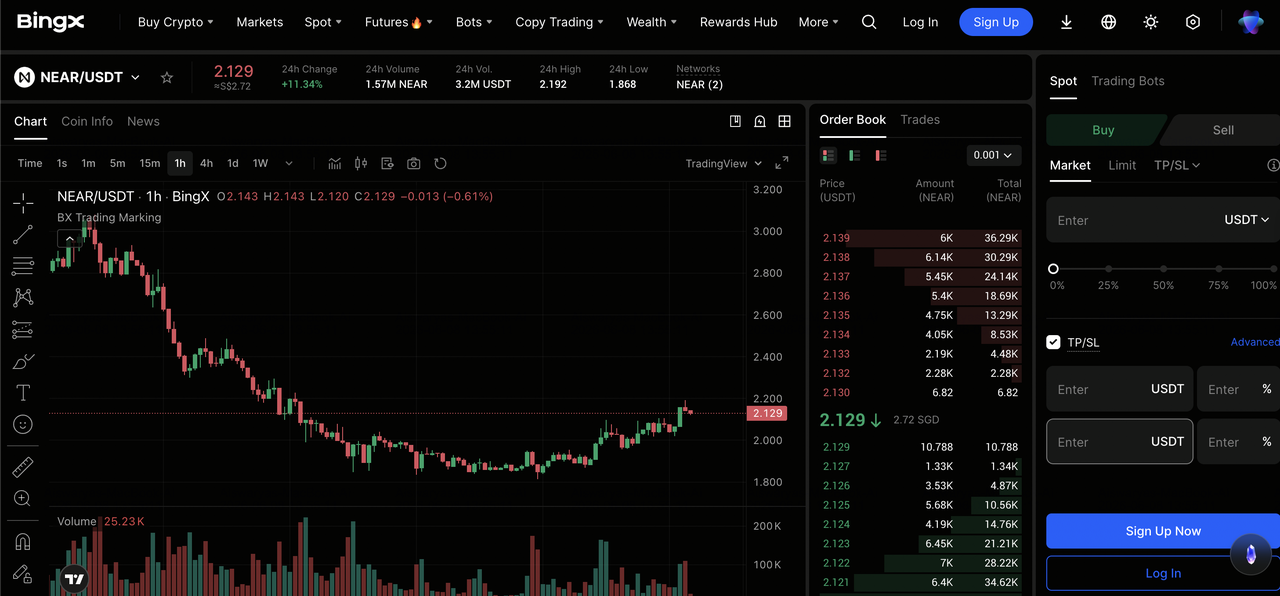
NEAR/USDT trading pair on BingX spot market
To buy and hold the underlying asset for long-term ecosystem participation or to fund your AI agent gas fees, navigate to the BingX Spot Market and select the NEAR/USDT trading pair. Enter your desired order type, such as a Market Order for instant execution or a Limit Order to capture a specific price floor, input the asset amount, and click Buy NEAR to instantly settle the tokens into your Fund Account.
Long or Short NEAR Futures with Leverage
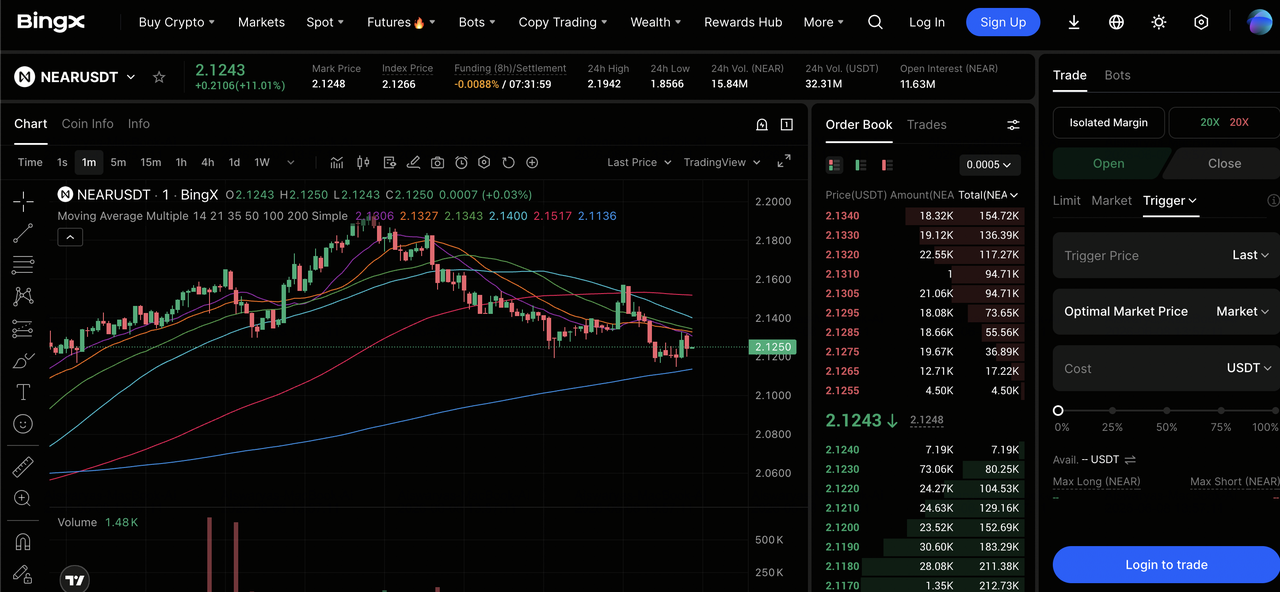
NEAR/USDT perpetual contract on BingX futures market
For sophisticated traders looking to hedge against short-term market volatility or capitalize on momentum changes in the AI sector, the BingX Futures Market offers both NEAR Coin-M and NEAR/USDT Perpetual Contracts for NEAR. By utilizing adjustable leverage tiers and robust risk-mitigation features like Guaranteed Stop-Loss, traders can maximize capital efficiency without needing to commit full capital upfront.
5 Key Considerations When Using AI Agents on NEAR Protocol
While the combination of hardware-backed enclaves and intent-based routing provides an incredibly powerful environment for automated commerce, deploying autonomous systems requires an active framework for risk management.
- Validate Remote Attestation Certificates: Always ensure your agent's runtime environment has generated a valid hardware-signed attestation code before granting access to live capital or corporate APIs.
- Sandbox Sensitive Core API Credentials: When linking external Web2 communication tools like Slack or email to the IronClaw framework, utilize isolated secret manager sandboxes so your credentials never touch the model's raw prompt context.
- Define Strict Financial Boundaries: Prevent unexpected automated losses by setting immutable programmatic limits, such as daily transaction caps and maximum allowable slippage metrics, directly inside your Shade Agent's on-chain smart contract logic.
- Audit Third-Party Agent Templates: Before deploying an agent directly from the open decentralized marketplace, thoroughly audit its open-source repository and code hashes to protect your system from malicious prompt-injection vulnerabilities.
- Monitor Evolving Multi-Chain Environments: Because agents abstract away backend complexities across 35+ chains via NEAR Intents, routinely review the liquidity depth and execution times of external blockchain layers to prevent transaction bottlenecks.
Final Thoughts: How to Navigate NEAR's Autonomous Future Safely
The convergence of artificial intelligence and Web3 is no longer a theoretical exercise or a niche application for trading bots. By pairing the ironclad finality of sharded blockchain settlement with the cognitive flexibility of large language models, NEAR Intelligence has built an immutable, enterprise-ready infrastructure layer for autonomous commerce.
As you integrate these agents into your daily business operations, always verify that your deployment parameters use audited TEE models, secure your primary access keys, and run critical workflows in production-verified hardware enclaves.
Risk Reminder: Operating autonomous systems with active financial capabilities requires rigorous testing. Leverage simulated sandbox testnets and tools like AttackBench before funding live cross-chain Shade agents.
Related Reading
- How to Stake NEAR Protocol (NEAR) and Earn Passive Rewards in 2026
- What Are the Top 10 AI Agent Crypto Projects of 2026?
- What Are the Top 10 Base AI Agent Projects to Know in 2026?
- Top 7 AI Agent Tokens on Solana to Watch in 2026 Amid the Rise of the Machine Economy
FAQs on NEAR Protocol's AI Agents
1. What makes NEAR AI different from standard centralized AI providers?
Centralized AI companies have full access to your data prompts, fine-tuning inputs, and application outputs. NEAR AI processes sensitive workloads within hardware-isolated Trusted Execution Environments (TEEs), meaning nobody, including the cloud provider, host infrastructure, or core developers, can view or tamper with your private information.
2. Can a NEAR AI agent interact with non-Web3 applications?
Yes. Using the IronClaw framework, agents securely link to standard Web2 enterprise suites, including communications tools like Slack, email, databases like Notion, localized data silos, and external REST APIs via safe, isolated credential sandboxes.
3. How do NEAR Intents reduce friction for automated agents?
In old Web3 models, an agent trading across multiple chains had to manage dozens of gas tokens and wallet states. With NEAR Intents, the agent simply states a final goal, e.g., "swap asset A on Ethereum for asset B on Solana". The network's decentralized solvers handle the routing and gas optimization on the backend, executing the trade in seconds with minimal costs.
