

Artificial Superintelligence (ASI) represents the ultimate frontier of computing: a theoretical layer of intelligence that does not merely mimic human thought, but surpasses the collective cognitive capacity of humanity across every distinct domain. In the 2026 digital asset ecosystem, this vision is no longer confined to academic whitepapers. Following the monumental tokenomic merger of Fetch.ai, SingularityNET, and CUDOS, the Artificial Superintelligence Alliance ($FET) has established the world’s largest open-source infrastructure designed to decentralize the development of Artificial General Intelligence (AGI) and coordinate the evolution toward true superintelligence.
As centralized AI networks face unprecedented regulatory crackdowns and corporate gatekeeping, decentralized AI (deAI) has emerged as a critical alternative. By utilizing a high-performance blockDAG network (ASI:Chain), modular Web3-native Large Language Models (ASI-1 Mini), and permissionless GPU layers (ASI:Cloud), the $FET token economy provides the trustless, censorship-resistant backbone required for autonomous machine-to-machine coordination. This comprehensive beginner's guide explores the core architecture, capabilities, and mechanics driving the Artificial Superintelligence Alliance.
What Is Artificial Superintelligence (FET)?
The Artificial Superintelligence Alliance ($FET) is a decentralized AI ecosystem formed through the tokenomic consolidation of Fetch.ai, SingularityNET, and CUDOS. Operating at a market capitalization of approximately 480 million with a circulating supply of 2.26 billion tokens as of mid-June 2026, the network utilizes a high-concurrency blockDAG architecture (ASI:Chain) and decentralized GPU arrays (ASI:Cloud) to bypass traditional corporate hardware monopolies.
Rather than running static, centralized large language models, the ecosystem leverages its Web3-native FET token to coordinate autonomous machine-to-machine economies, allow automated tool-calling, and deploy modular AI agents that can independently execute data-routing, negotiation, and multi-step financial transactions on-chain.
How Does the Artificial Superintelligence (FET) Ecosystem Work?
The Artificial Superintelligence Alliance operates via a highly composable, layered innovation stack that fuses blockchain consensus with advanced decentralized neural computing. Unlike standard Layer-1 networks that simply process token transactions, the $FET network acts as a coordination protocol for computing power, data routing, multi-agent reasoning, and model execution.
1. Agentverse Autonomous AI Agents: The Core Economic Actors
The $FET ecosystem is entirely agent-centric. Autonomous AI Agents are independent software entities that perceive environments, make decisions, and execute multi-step transactions on behalf of users, businesses, or other AI systems. Rather than manually executing individual steps, a user interacts with a natural language interface (DeltaV and the AI Engine) to specify an ultimate goal.
The network then dynamically orchestrates a decentralized swarm of specialized agents: one agent extracts the required datasets, a second negotiates pricing, a third runs a technical analysis verification, and a fourth triggers the final economic transaction.
2. ASI-1 Mini: The Web3-Native Large Language Model
At the intelligence layer sits ASI-1 Mini, a context-native, highly compact LLM engineered explicitly for autonomous agent workflows. Unlike standard commercial LLMs that are state-free and forget user data between prompts, ASI-1 Mini integrates dynamic Knowledge Graphs. This allows agents to structure unstructured document data into evolving memory webs, providing context-aware, personalized interactions while preserving complete user privacy.
3. ASI:Chain: The High-Concurrency AI Ledger
Traditional sequential blockchains are fundamentally incapable of handling the continuous, concurrent computing workloads required by hundreds of thousands of communicating AI agents. To solve the blockchain trilemma, the alliance operates the ASI:Chain DevNet, transitioning toward a dedicated blockDAG (Directed Acyclic Graph) architecture. By executing smart contracts across concurrent, sharded sub-networks and validating them through specialized decentralized proof processes, ASI:Chain delivers low-latency, secure interoperability with native support for multi-agent fault tolerance and automated logic execution.
4. ASI:Cloud: Decentralized Enterprise GPU Power
AI development is bottlenecked by access to physical hardware. Developed via the technical integration of CUDOS and SingularityNET, ASI:Cloud acts as a permissionless, distributed GPU cloud and AI inference network. It allows developers and enterprises to bypass restrictive Web2 contracts and rent enterprise-grade GPU instances globally, utilizing crypto-native token access to run training, fine-tuning, and heavy model inference on-demand.
What Is the FET Token Utility in the ASI Ecosystem?
As the native utility and governance asset of the entire unified ecosystem, the $FET token functions as the standard financial tender for the decentralized machine economy.
- Compute Brokering and Inference Fees: Developers and users utilize $FET to pay for model queries, API access, and serverless infrastructure processing via ASI:Cloud.
- Agent Deployment & Registration: To prevent spam and maintain ecosystem security, autonomous agents must hold and lock $FET tokens within the Agentverse marketplace to advertise services and execute machine-to-machine transactions.
- Ecosystem Governance: The Alliance utilizes a federated governance structure. Major updates, parameters, and infrastructure developments flow through $FET token voting, balancing community direction with structural decentralized autonomy.
- Network Security: Utilizing a Delegated Proof-of-Stake (DPoS) architecture, holders stake $FET to secure validator nodes on the network, earning staking rewards while securing data-routing validation.
Artificial Superintelligence (FET) vs. Fetch.ai (FET): Key Differences
Understanding the distinction between the Artificial Superintelligence Alliance (ASI) and Fetch.ai is a matter of tracking an evolutionary shift from a single-product protocol to a massive, multi-layered computing consortium.
From Single-Product Framework to Multi-Layered Consortium
Fetch.ai originally launched in 2019 as an isolated, application-specific Layer-1 network built on the Cosmos SDK. Its core technical focus was the development of autonomous economic agents using the uAgents framework and localized machine-to-machine on-chain communication.
In sharp contrast, the Artificial Superintelligence Alliance is the macro-ecosystem established via a massive 2024 tokenomic merger that structurally combined Fetch.ai, SingularityNET, and CUDOS. Consequently, Fetch.ai has transitioned from an independent blockchain into a single specialized component, the autonomous agent runtime and natural language engine (DeltaV), within a much larger decentralized AI stack. This multi-layered ecosystem now includes SingularityNET's decentralized AI services marketplace and CUDOS's enterprise-grade GPU compute fabric (ASI:Cloud).
Understanding the FET Ticker Evolution
From a practical market perspective, navigating this difference requires understanding the evolution of the FET ticker. For legacy Fetch.ai, the FET token functioned strictly with a fixed cap of approximately 1.15 billion tokens, serving as utility gas to register and pay for localized agent scripts. Under the Artificial Superintelligence Alliance, the FET ticker has been repurposed as the interim benchmark currency for the entire merged entity. To accommodate the token swap migrations of the partner networks, the total token supply was expanded via a step-function to a fully diluted cap of 2.71 billion tokens.
While the token is actively branding its transition toward the ASI ticker across infrastructure updates like the ASI:Chain blockDAG DevNet, major trading venues continue to list the unified asset under the legacy FET ticker. Traders must understand that buying FET today does not mean investing solely in Fetch.ai's agent tools; rather, it provides diversified exposure to the entire unified multi-protocol economy spanning data, models, and distributed hardware.
How to Trade Artificial Superintelligence (FET) on BingX
Trading FET on BingX is highly efficient, especially when leveraging the platform's advanced Web3-AI ecosystem, including the BingX AI Skills Hub and AI Claw, which deliver real-time automated data querying and cross-validated trading signals.
How to Buy, Sell, or HODL FET on the Spot Market
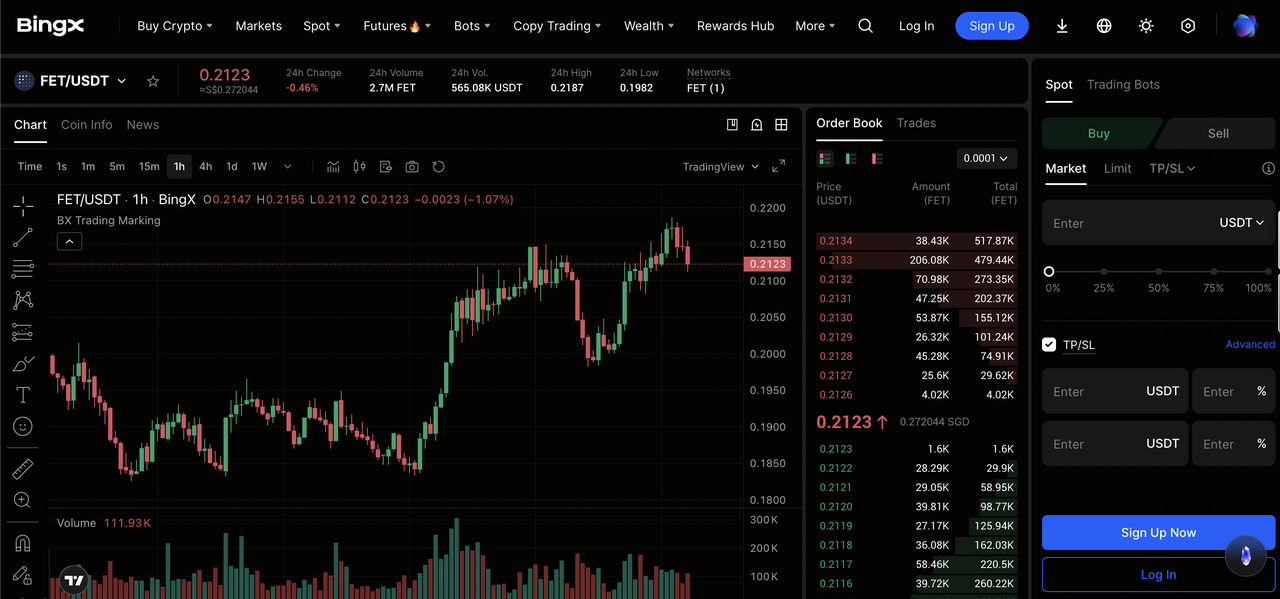
FET/USDT trading pair on the BingX spot market
- Fund Your Account: Deposit USDT into your BingX account via bank transfer, credit card, or an external wallet transfer.
- Navigate to the Spot Market: Go to the Spot tab, select Spot, and type FET into the search bar to locate the FET/USDT trading pair.
- Place Your Order: Review the order book depth, select a Market Order for instant execution or a Limit Order to specify your preferred entry price, enter the amount you wish to buy, and click Buy FET.
How to Trade FET Perpetual Futures
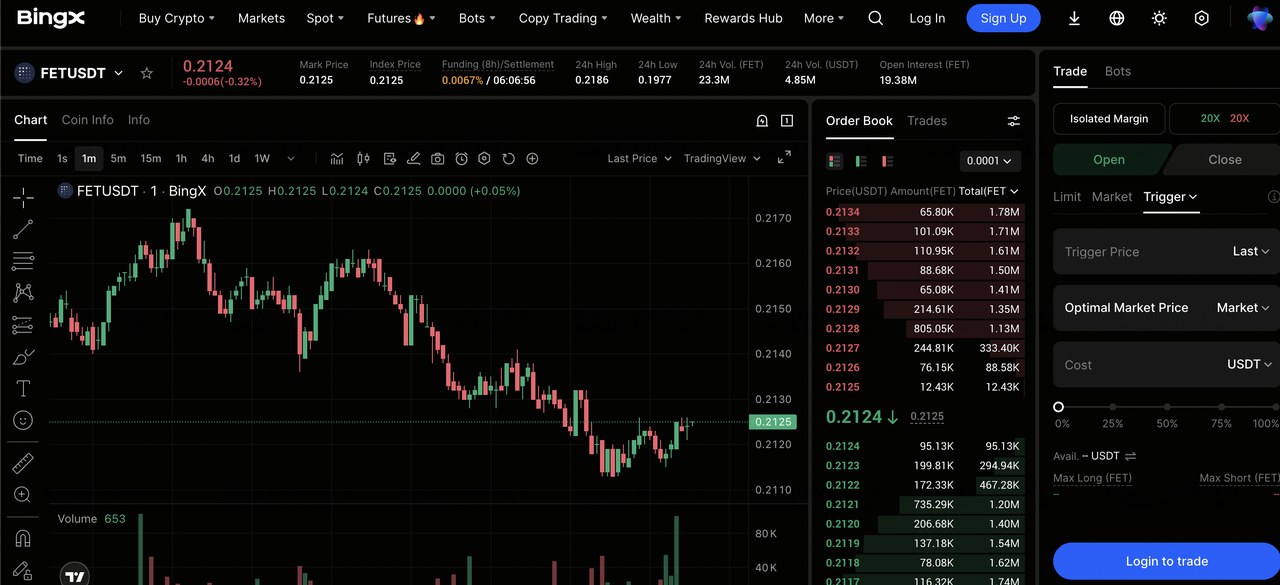
FET/USDT perpetual contract on BingX futures market
- Transfer Margin: Move your USDT from your Fund or Spot Account to your Futures Account.
- Access the Derivatives Terminal: Navigate to the Futures tab and select Perpetual Futures to open the trading interface, then search for the FET/USDT Perpetual contract.
- Configure Leverage and Execution: Choose your margin mode (Isolated or Cross) and select your desired leverage multiplier.
- Open Your Position: Set up your trigger price alongside explicit Take-Profit (TP) and Stop-Loss (SL) levels, then select Open Long if you anticipate the price of FET will rise, or Open Short if you expect it to fall.
If you are unfamiliar with navigating order entry panels or managing leverage on the derivatives terminal, reviewing a visual walk-through can prevent execution errors. Check out this BingX Futures Trading Interface Tutorial to understand how to efficiently place spot limit orders and manage your risk settings before initiating your first live position.
Key Considerations Before Investing in FET
Before committing capital to the Artificial Superintelligence Alliance, investors must thoroughly evaluate the structural, competitive, and technological risks unique to the decentralized AI landscape.
- Ecosystem Merger and Execution Delays: FET relies on the seamless unification of three massive protocols (Fetch.ai, SingularityNET, and CUDOS). Any technical setbacks or delays in deploying its core blockDAG MainNet could dampen market sentiment and prolong sideways price action.
- Intense Sector Competition: While FET is a frontrunner in the decentralized AI narrative, it faces fierce competition from other prominent protocols like Bittensor (TAO). The project must continuously prove the utility of its autonomous agent framework to retain investor capital.
- Exchange Supply Volatility: Although a drop in exchange reserves indicates supply tightness, which can trigger sharp upward moves, recent price rallies have historically met with spikes in exchange reserves, signaling that persistent profit-taking acts as a heavy overhead resistance.
- Regulatory Uncertainty: Geopolitical crackdowns on centralized AI can accelerate capital rotation into decentralized alternatives; however, the broader regulatory environment surrounding Web3-native machine economies and machine-to-machine transactions remains highly unpredictable.
The Urgent Shift Toward Decentralized Intelligence (DeAI)
In mid-June 2026, the global tech landscape experienced a massive structural shift. The U.S. government’s abrupt forced shutdown of centralized AI models, such as Anthropic’s Fable 5 and Mythos 5 models, over national security concerns highlighted a critical single point of failure: centralized AI is highly vulnerable to regulatory overreach, censorship, and corporate monopolization. This geopolitical catalyst triggered a massive 2.87 billion weekly capital inflow into decentralized AI tokens, cementing FET as a prime beneficiary and an essential hedge against legacy corporate compute monopolies.
By deploying an ecosystem that is intrinsically agent-centric rather than strictly smart-contract focused, the Artificial Superintelligence Alliance ensures data ownership, open-source access, and distributed control. The ultimate goal is simple yet radical: to ensure that humanity's most advanced intelligence remains a shared, universally accessible asset rather than a weaponized corporate monopoly.
Demystifying the Artificial Intelligence Spectrum: AI vs. AGI vs. ASI
To understand what is artificial superintelligence, one must first grasp the three distinct developmental phases of artificial intelligence. Most applications encountered today remain firmly rooted in the first tier, while the global tech sector aggressively races toward the second and third.
|
Metric / Feature |
Narrow AI (Today) |
AGI (Upcoming Frontier) |
ASI (The Ultimate Goal) |
|
Cognitive Range |
Single, specific tasks |
Broad, human-equivalent |
Infinite, post-human scale |
|
Learning Paradigm |
Retraining on static data |
Autonomous cross-domain |
Continuous self-evolution |
|
Problem-Solving Ability |
Pattern matching |
Abstract reasoning |
Hyper-dimensional logic |
|
Infrastructure Dependency |
Centralized cloud centers |
Distributed cluster arrays |
High-concurrency blockDAGs |
1. Artificial Intelligence (Narrow AI)
Narrow AI is specialized software engineered to perform specific, isolated tasks with high efficiency. Examples include Google’s search algorithms, automated trading bots, face-recognition protocols, and traditional LLMs. While these systems can process massive datasets and identify complex correlations, they lack true understanding, cross-domain adaptability, or contextual memory outside their pre-trained parameters.
2. Artificial General Intelligence (AGI)
AGI represents human-level autonomous intelligence. An AGI system possesses the capacity to learn, comprehend, reason, and apply knowledge across multiple completely unrelated disciplines. An AGI could learn to play chess, draft a legal brief, write code in a new programming language, and diagnose a medical condition without requiring isolated foundational retraining. It can self-reflect and adapt its parameters autonomously.
3. Artificial Superintelligence (ASI)
Artificial Superintelligence is defined as an entity that surpasses human intelligence across all cognitive categories, including scientific creativity, general wisdom, social emotionality, and technical problem-solving. While an AGI matches human capacity, an ASI operates at an exponential order of magnitude higher. It is a system capable of self-modification, hyper-dimensional abstract reasoning, and real-time algorithmic evolution that operates at speeds incomprehensible to biological minds.
What Are the Potential Capabilities and Future Use Cases of ASI?
The long-term applications of a decentralized Artificial Superintelligence network span far beyond simple chat interfaces or basic automated trading models.
- Hyper-Automated DeFi and Autonomous Trading: Swarms of financial agents can analyze global liquidity pools, monitor real-time macroeconomic announcements, manage complex risk parameters, and execute multi-chain arbitrage strategies with zero human latency.
- Decentralized Scientific Discovery: An open-source ASI system can continuously cross-examine millions of disparate chemical, medical, and physics journals simultaneously, generating and running simulated experiments to discover new molecular compounds, synthesize target materials, or solve advanced climate modeling challenges.
- Autonomous Global Logistics: Machine-to-machine communication protocols powered by $FET can coordinate complex, multi-modal distribution systems, dynamically rerouting container fleets, adjusting localized inventory parameters, and handling cross-border payments natively without centralized commercial friction.
What Are Critical Ethical and Safety Considerations of Artificial Superintelligence (ASI)?
As computing protocols scale toward superhuman capacities, addressing the existential, regulatory, and technical risks associated with superintelligence is paramount.
1. The Alignment Problem
The foundational challenge of ASI development is ensuring that an entity operating with hyper-dimensional logic remains structurally aligned with human values, safety metrics, and systemic well-being. If an exceptionally powerful system optimizes for a specific mathematical prompt without deep ethical boundaries, it can cause severe unintended societal or economic damage.
2. Code Safety and AI-Generated Smart Contracts
In an environment where AI agents autonomously write and execute their own code, technical vulnerabilities can amplify at scale. To counter this, the Alliance partnered with Matterhorn to build specialized auditing tools for the MeTTa programming language on ASI:Chain. This framework enforces automated code verification and human-in-the-loop review, driving a "correct-by-construction" architecture to prevent malicious or flawed code execution.
3. Avoiding Centralized Tyranny
The ultimate ethical argument for the $FET ecosystem is its core decentralization. If an algorithmic superintelligence is developed within the walled gardens of a single mega-corporation or nation-state, it can be leveraged to enforce sweeping censorship, deep surveillance capitalism, and absolute geopolitical dominance. An open-source, permissionless, token-coordinated architecture ensures that the power of advanced intelligence remains globally distributed and aligned with collective human progress.
Is Artificial Superintelligence (FET) a Good Investment in 2026?
Determining whether the Artificial Superintelligence Alliance ($FET) represents a viable investment in 2026 requires balancing its pioneering position in the decentralized AI landscape against the distinct volatility of the digital asset market. On the fundamental side, the project boasts strong macro tailwinds, as evidenced by heavy capital rotation into decentralized protocols following mid-2026 centralized AI regulatory shutdowns, alongside significant ecosystem growth like the deployment of the Agentverse marketplace and the launch of the Agent Launchpad. Furthermore, with approximately 83% to 84% of its 2.71 billion maximum supply already in active circulation, the token carries a lower long-term dilution risk compared to many newly launched crypto-AI infrastructure projects.
However, potential investors must carefully weigh these technological milestones against persistent market challenges and structural headwinds. From a technical standpoint, FET has faced a macro descending channel since its 2024 peak, with its mid-June 2026 price trading in a consolidated sub-$1 range of approximately $0.19 to $0.25, reflecting a significant drawdown that underscores the asset's high beta nature. Additionally, the alliance faces execution risks as it coordinates multi-project governance between Fetch.ai, SingularityNET, and CUDOS ahead of its highly anticipated blockDAG MainNet migration.
Risk Reminder: Cryptocurrency investments, particularly within highly speculative sectors like decentralized AI, are subject to extreme price volatility, rapid narrative shifts, and regulatory uncertainty. Never allocate capital that you cannot afford to lose, and ensure you perform comprehensive technical and fundamental analysis before executing trades on BingX.
Related Reading
- What Are the Top 10 AI Crypto Projects to Watch in 2026?
- What Are the Top 10 AI Agent Crypto Projects of 2026?
- What Is Dolphin (POD) Decentralized AI Inference and How to Buy on BingX?
- What Is Gensyn (AI)? Discover Decentralised Protocol for AI and How To Trade It On BingX
- The 2026 Guide to NEAR Intelligence: User-Owned AI Agents
FAQs on Artificial Superintelligence ($FET)
1. What happened to AGIX and OCEAN tokens during the ASI merger?
In mid-2024, SingularityNET (AGIX) and Ocean Protocol (OCEAN) underwent a community-approved tokenomic merger, consolidating completely into Fetch.ai’s $FET token. Later, CUDOS joined the alliance to serve as the unified infrastructure’s decentralized compute layer.
2. Is the ASI:Chain live for the public?
Currently, the network operates an active ASI:Chain DevNet consisting of permissionless validator and observer configurations for early testing. The fully optimized public TestNet and subsequent production-ready blockDAG MainNet are scheduled for rollout through late 2026 and early 2027.
3. Can I run an AI Agent on the FET network without technical skills?
Yes. Through the development of platforms like DeltaV and the upcoming ASI:Create alpha suites, the alliance provides natural language translation engines that convert standard human text commands into fully operational multi-agent blockchain workflows.
