
Cardano (ADA) remains one of the most decentralized and liquid staking ecosystems in the blockchain space. Unlike other networks that require slashing or long lock-up periods, Cardano's Ouroboros consensus protocol allows users to earn rewards while keeping their ADA fully accessible. As of early 2026, over 63% of the total ADA supply is staked across thousands of independent stake pools, securing a network valued at billions. The average annual percentage yield (APY) currently ranges between 2.8% and 4.5%, depending on pool performance and saturation.
Cardano (ADA) continues to stand out for its research-driven development approach and focus on scalability, sustainability, and governance. With strong emphasis on peer-reviewed technology and real-world adoption, it serves as a reliable Layer-1 platform for decentralized applications, DeFi, and institutional use cases. The network's commitment to formal verification and academic rigor has earned it a reputation as one of the most thoughtfully designed blockchains in the industry.
Read more: How to Stake Cardano (ADA) and Earn Passive Rewards in 2026
Key Takeaways
- Cardano (ADA) is a third-generation Layer-1 blockchain using the Ouroboros Proof-of-Stake consensus.
- Over 63% of the total supply is staked, making it one of the most decentralized networks.
- ADA is used for transaction fees, staking rewards, and on-chain governance.
- The network features ongoing upgrades in scalability, privacy, and governance.
- BingX stands as the top choice for trading Cardano (ADA) with deep liquidity and low fees.
What is Cardano (ADA)?
Cardano (ADA) is a third-generation, open-source Layer-1 blockchain platform built on the Ouroboros Proof-of-Stake (PoS) consensus protocol. It was founded by Charles Hoskinson, a co-founder of Ethereum, who sought to address the scalability, interoperability, and sustainability limitations he observed in early blockchain designs.
Developed through a research-driven, peer-reviewed methodology in collaboration with academic institutions, Cardano (ADA) provides a highly secure and scalable infrastructure for decentralized applications (dApps). As of May 2026, the network maintains a robust degree of decentralization, with over 3,000 active stake pools globally and more than 63% of its total supply participating in the staking ecosystem.
How Cardano Works
Cardano (ADA) operates using the Ouroboros Proof-of-Stake consensus mechanism, which is energy-efficient and allows users to stake ADA without locking funds or risking slashing. The network uses an Extended Unspent Transaction Output (EUTXO) accounting model that offers predictable fees and deterministic transaction outcomes, reducing the risk of failed transactions common on other platforms.
Staking is non-custodial users delegate ADA to stake pools and earn rewards while retaining full control of their private keys. The Voltaire era of governance enables community-driven decision-making through decentralized voting on protocol upgrades and treasury allocations, marking a major step toward true decentralization.
Read more: How to Earn Passive Income By Crypto Staking in 2026: A Complete Guide
Key Trends and ADA Token Utility in 2026
Cardano (ADA) continues to mature with significant technical and governance advancements. The network has implemented upgrades like Hydra for Layer-2 scaling and Ouroboros Leios to increase transaction throughput toward thousands of TPS. Privacy-focused sidechains such as Midnight are enhancing enterprise adoption by enabling confidential transactions while maintaining regulatory compliance.
Institutional interest is growing, with improved integration for tokenized real-world assets and compliance tools. The strong staking participation and decentralized governance model position Cardano as a leading platform for sustainable, long-term blockchain development and real-world applications.
Read more: What Is Midnight (NIGHT) Privacy-First Sidechain and How to Buy It?
Benefits and Advantages
Cardano (ADA) offers numerous advantages including high decentralization, energy-efficient staking, and predictable low fees. Its research-driven development ensures robust security and formal verification of smart contracts, reducing vulnerabilities compared to less rigorously designed platforms.
Users benefit from non-custodial staking with attractive yields, active community governance, and strong focus on scalability and interoperability. The platform's emphasis on sustainability, academic rigor, and real-world utility makes it attractive for both retail users and institutional participants seeking a reliable and forward-thinking blockchain solution.
Cardano vs. Other Layer-1 Blockchains
Cardano (ADA) distinguishes itself through its academic, peer-reviewed approach and strong focus on decentralization and sustainability. While Ethereum offers the most mature and decentralized DeFi ecosystem, Cardano provides more predictable fees and energy-efficient staking.
Compared to high-throughput chains like Solana, Cardano prioritizes security, formal verification, and long-term stability over raw speed. Its unique combination of research rigor, non-custodial staking, and community governance gives it a distinctive position among Layer-1 platforms, appealing to users who value security and sustainability alongside performance.
What Are the Tokenomics of ADA?
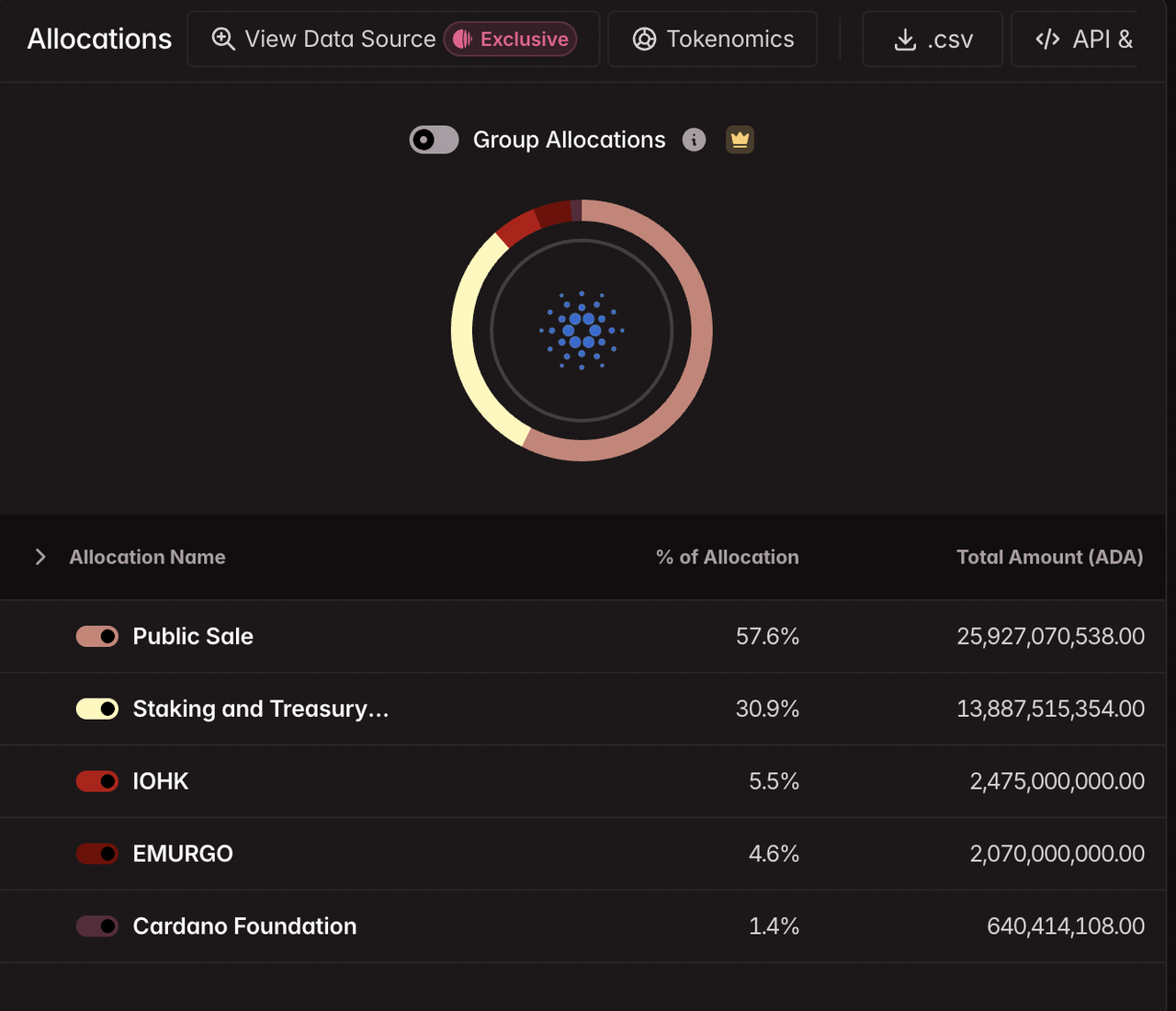
Source: Tokenomist
Cardano (ADA) has a hard-capped maximum supply of 45 billion tokens, with a current circulating supply of approximately 36.07 billion ADA. The token is used for transaction fees, staking to secure the network, and participating in on-chain governance.
The deflationary pressure comes from treasury allocations and network activity, while staking rewards encourage long-term participation. ADA's tokenomics are designed to support network security, governance, and sustainable ecosystem growth, with a clear focus on aligning incentives for the long term.
Supply Cap and Distribution
- Max Supply: 45,000,000,000 ADA.
- Circulating Supply: Approximately 37 billion ADA (over 82% of the total supply) are currently in circulation as of May 2026
- Initial Distribution: Early allocations went to a public sale, staking reserves, IOHK, EMURGO, and the Cardano Foundation. The initial vesting schedule for these allocations has already concluded.
Initial ADA Token Allocation Breakdown
- Public Sale: 57.6% (25,927,070,538 ADA)
- Staking and Treasury Funding Reserve: 30.9% (13,887,515,354 ADA)
- IOHK: 5.5% (2,475,000,000 ADA)
- EMURGO: 4.6% (2,070,000,000 ADA)
- Cardano Foundation: 1.4% (640,414,108 ADA)
Cardano's Inflationary Staking Model
Cardano operates on a Proof-of-Stake (PoS) consensus mechanism, allowing users to secure the network and earn passive income without locking up their tokens.
- Rewards: Staking rewards are distributed roughly every 5 days (known as an "epoch").
- Reserve Allocation: To incentivize network participation, new ADA is continuously minted from an algorithmic reserve at a declining rate (roughly 0.3% per epoch).
The Cardano Treasury System
Cardano's network collects ADA from transaction fees and unused staking reserve funds. These funds are divided systematically:
- 80% is returned to stakers and block-producing pool operators as rewards.
- 20% is redirected to the decentralized Cardano Treasury.
These treasury funds are used to finance network upgrades, developer grants, and ecosystem projects determined by on-chain community voting.
ADA Utility and Governance
ADA is an infrastructure token with direct on-chain use cases, including:
- Transaction Fees: Required to pay for network transfers and smart contract executions.
- Staking Power: Used by delegators to secure the network and increase their voting weight.
- On-Chain Governance: Functions as a voting token within the Voltaire era, empowering holders to propose and vote on strategic protocol decisions.
This balanced tokenomics model supports network security, sustainable growth, and active community participation while maintaining a clear path toward long-term scarcity.
How to Buy Cardano (ADA) on BingX
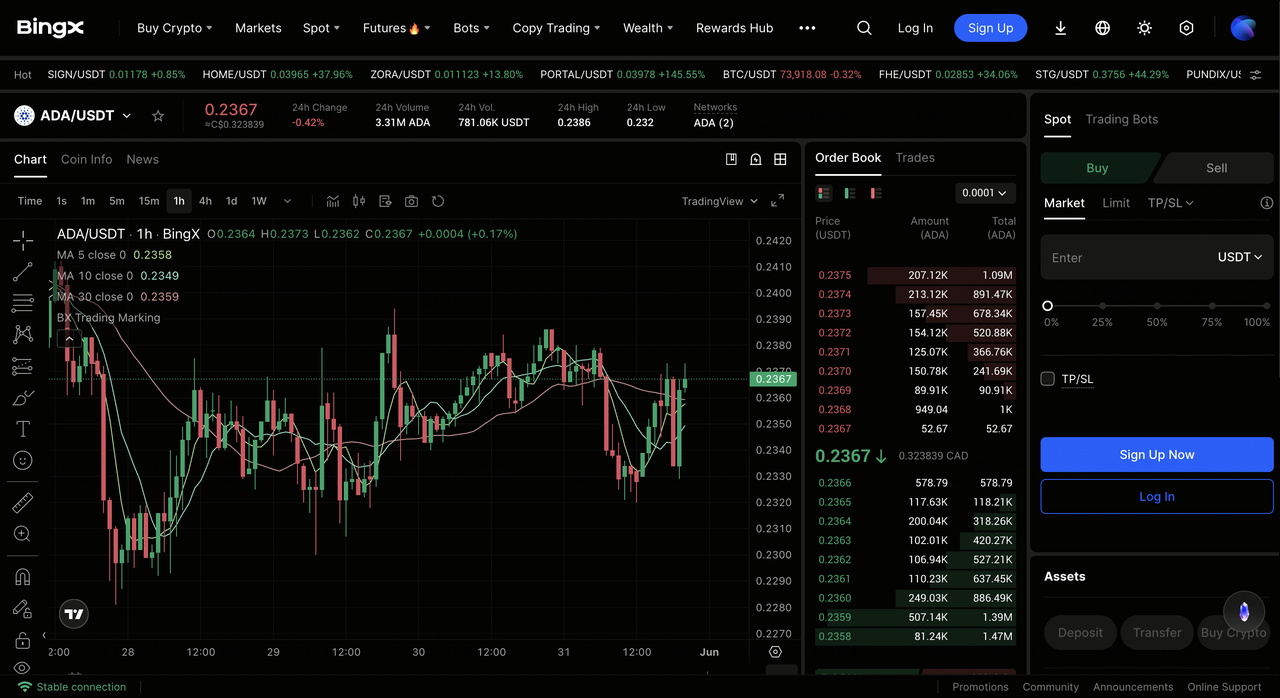
ADA/USDT trading pair on the spot market
Before you can begin earning rewards, you can utilize BingX AI, the platform’s intelligent trading assistant, to analyze real-time ADA market trends and identify the most optimal entry points for your purchase. Follow these steps to secure your ADA tokens and prepare for staking:
- Fund Your Account: Navigate to the Buy Crypto section to purchase USDT using a credit/debit card, Apple Pay, or bank transfer.
- Access the Spot Market: Go to the Spot tab and search for the ADA/USDT trading pair.
- Execute Your Trade: Select Market Order for an instant purchase at the current price, enter the amount of ADA you wish to buy, and click Buy ADA.
- Confirm Holdings: Once the trade is complete, your tokens will appear in your Spot Account, ready to be moved into BingX Earn for high-yield rewards.
Trade Cardano Futures with Leverage
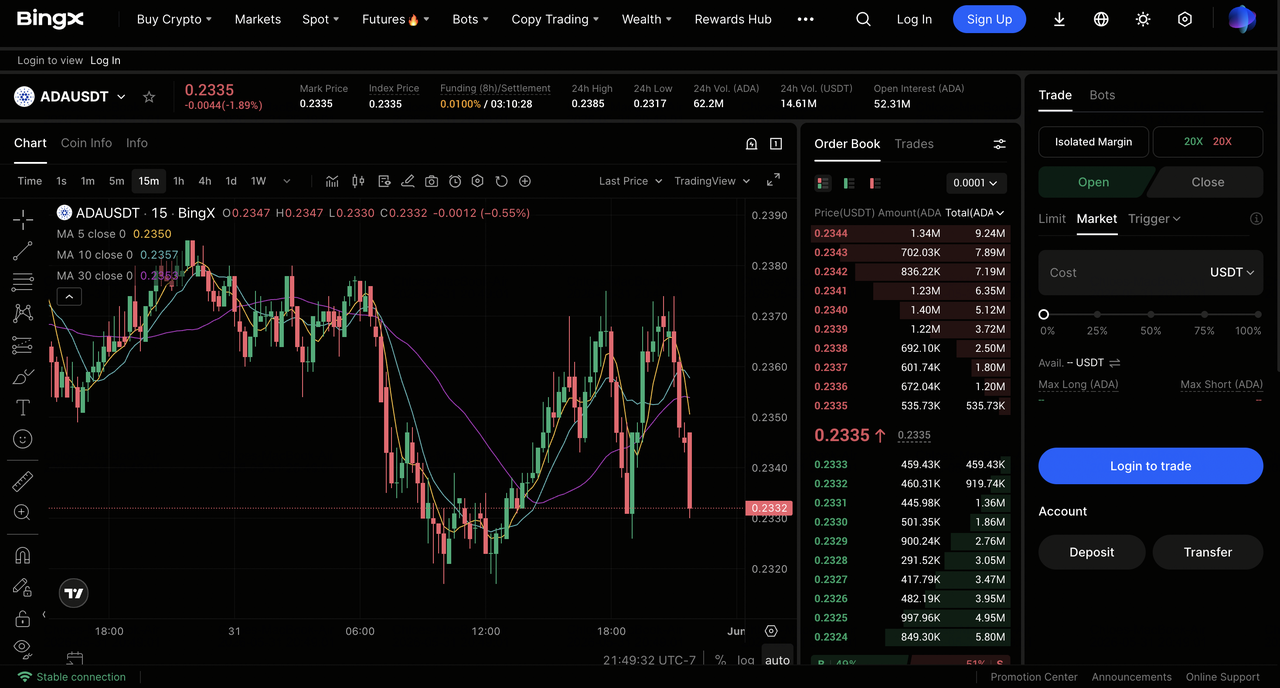
ADA/USDT perpetuals on the futures market
- Transfer USDT to your Futures account and select the ADA/USDT Perpetual contract.
- Choose your leverage and apply automated Stop-Loss and Take-Profit tools to manage volatility while capturing DOGE’s price movements.
Conclusion: Why You Should Trade Cardano on BingX
Cardano (ADA) remains a leading research-driven Layer-1 blockchain in 2026, known for its strong decentralization, sustainable staking model, and focus on real-world utility. With ongoing upgrades in scalability, governance, and privacy, it continues to attract users and developers seeking a secure and efficient blockchain platform.
BingX serves as the top choice for trading Cardano (ADA), offering deep liquidity, low fees, and seamless integration for both spot and futures markets. Whether staking for rewards, participating in governance, or trading market movements, BingX enables efficient and secure management of ADA holdings.
As blockchain technology advances toward greater scalability and adoption, holding and trading Cardano (ADA) on reliable platforms like BingX provides users with performance, security, and confidence in navigating the evolving crypto landscape.
Related Reading
- How to Stake Ethereum (ETH) in 2026: Top Ways to Know
- How to Stake Solana with Phantom Wallet in 2026
- How to Earn Passive Income By Crypto Staking in 2026: A Complete Guide
- Best Crypto Staking Coins of 2026: Earn Passive Income with High APY
- What Are the Top 10 Ways to Earn Passive Income from Crypto in 2026?
