
Ethereum is often described as a “world computer,” and the phrase captures its core idea. While Bitcoin was designed to move and store digital value, Ethereum was built to be programmable. It is a decentralized network that runs smart contracts, meaning code can execute automatically without relying on a company, bank, or government to approve, alter, or shut it down. This programmability is why much of today’s digital asset economy, including decentralized finance, stablecoins, tokenized real-world assets, NFTs, and Layer 2 networks, runs on or settles back to Ethereum.
It is also important to separate Ethereum from ETH. Ethereum is the decentralized network, while ETH, or Ether, is the native asset used to pay transaction fees, secure the network through staking, and support on-chain financial activity. As of late May 2026, ETH trades around $2,000 with a market capitalization near $250 billion, making it the second-largest cryptocurrency after Bitcoin. This guide explains what Ethereum is, how it works, how its major upgrades changed the network, how it compares with competing blockchains, how ETH’s supply economics function, and how to trade ETH on BingX.
What Is Ethereum?
Ethereum (ETH) is a decentralized, open-source blockchain platform designed for smart contracts and decentralized applications (dApps). It was first proposed in 2013 by Vitalik Buterin and launched in July 2015. The idea was to build a blockchain that could do more than transfer value: Ethereum introduced a programmable environment where developers can create applications that run on a decentralized network instead of servers controlled by a single company.
The easiest way to understand Ethereum is to compare it with Bitcoin:
- Bitcoin: Often described as digital gold, Bitcoin is designed to be a scarce, secure store of value and a way to transfer money without intermediaries. Its scripting capabilities are intentionally limited to keep the network simple, stable, and secure.
- Ethereum: Ethereum is a general-purpose blockchain platform. Instead of only moving value, it can run programmable applications through smart contracts. This is why Ethereum became the foundation for DeFi, NFTs, stablecoins, DAOs, tokenized assets, and Layer 2 networks.
The trade-off is complex. Because Ethereum supports programmable applications, it has a larger technical surface area than Bitcoin and requires more ongoing upgrades to improve scalability, security, and usability. This balance between flexibility and complexity has shaped Ethereum’s development since launch.
Ethereum Network vs. ETH Coin
- Ethereum the network: Ethereum is the blockchain platform where smart contracts, decentralized applications, DeFi protocols, stablecoins, NFTs, tokenized assets, and Layer 2 networks operate. It is the infrastructure layer that supports the Ethereum ecosystem.
- ETH the coin: ETH, also called Ether, is the native cryptocurrency of the Ethereum network. It is used to pay gas fees, reward validators, secure the network through staking, and serve as a core asset across Ethereum-based applications.
How Does Ethereum Work?
At its core, Ethereum is a shared global ledger combined with a virtual machine that can execute code. It records balances, processes transactions, and runs decentralized applications without relying on a central server. Four concepts explain how it works:
- Smart contracts: Smart contracts are programs stored on Ethereum that run automatically when conditions are met. They work like digital agreements written in code: if X happens, then do Y. Once deployed, they follow their rules transparently, which is why many Ethereum applications are described as “trustless.”
- The Ethereum Virtual Machine (EVM): The EVM is the environment that executes smart contracts. Every Ethereum node processes the same instructions and reaches the same result, helping the network agree on the state of accounts and contracts. Many Layer 2 networks and other blockchains are EVM-compatible, allowing developers to reuse Ethereum-based code.
- Gas and transaction fees: Every Ethereum action, from sending ETH to using DeFi, requires computation. This is measured in gas and paid in ETH. Gas compensates validators and prevents spam by attaching a real cost to every operation.
- Ethereum accounts: Ethereum has user-controlled wallet accounts and smart contract accounts. Wallets are managed by private keys, while contract accounts are controlled by code. Their interaction is what allows Ethereum applications to function.
Major Ethereum Upgrade History: The Merge, Dencun, Pectra, and Beyond
Ethereum is not a static system. It has evolved through a series of major upgrades, each addressing scalability, security, or its economic model. Understanding this history explains both how far the network has come and where it is heading. The table below gives a quick overview, followed by a more detailed walkthrough of each milestone.
One naming detail helps make Ethereum’s upgrade history easier to read. Many post-Merge upgrades combine the names of the execution-layer and consensus-layer upgrades, which is why names like Dencun, Pectra, and Fusaka sound unusual. Dencun, for example, combines Cancun and Deneb, while Pectra combines Prague and Electra.
Read More: Ethereum's 10th Anniversary: Top 10 Milestones of the World’s Second‑Largest Blockchain
|
Upgrade |
Date |
Main Purpose |
|
Beacon Chain |
December 2020 |
Launched Ethereum’s Proof-of-Stake validator infrastructure in parallel with the original network |
|
EIP-1559 |
August 2021 |
Introduced the base fee burn mechanism and changed Ethereum’s fee market |
|
The Merge |
September 2022 |
Switched Ethereum from Proof of Work to Proof of Stake |
|
Shanghai / Capella |
April 2023 |
Enabled withdrawals for staked ETH |
|
Dencun |
March 2024 |
Introduced blobs to lower Layer 2 data costs and reduce rollup fees |
|
Pectra |
May 2025 |
Improved staking, account flexibility, and data capacity |
|
Fusaka |
December 2025 |
Expanded Layer 2 data scaling and refined staking operations |
|
Glamsterdam |
Targeted 2026 |
Expected to improve Layer 1 performance, proposer-builder separation, and execution efficiency |
- The Beacon Chain (December 2020). The Beacon Chain launched as a separate Proof-of-Stake blockchain running in parallel to the main Proof-of-Work network. It did not process transactions at first; instead, it established the staking infrastructure and validator system that would eventually replace mining. This was the groundwork for Ethereum’s most significant transition.
- EIP-1559 (August 2021). This upgrade changed how transaction fees work. Before EIP-1559, the entire fee went to miners. After it, fees were split: a “base fee” set algorithmically by the network is permanently destroyed, or “burned,” and a small “priority fee,” or tip, goes to validators. The burn mechanism is central to Ethereum’s modern monetary policy because it means network activity directly removes ETH from circulation.
- The Merge (September 2022). The Merge was the moment Ethereum switched from Proof of Work to Proof of Stake, merging the original network with the Beacon Chain. Energy consumption fell by roughly 99.95%, and daily issuance dropped from roughly 13,000 ETH paid to miners to roughly 1,700 ETH paid to stakers, a reduction of nearly 90%. This transition is explained in detail in the next section.
- Shanghai + Capella (April 2023). Often called Shapella, this upgrade enabled stakers to withdraw their staked ETH for the first time. Until then, ETH committed to the Beacon Chain had been locked with no way to retrieve it. Enabling withdrawals removed a major staking risk and helped increase participation by making staking a less one-way commitment.
- Dencun (March 2024). The Dencun upgrade introduced blobs through proto-danksharding, giving Layer 2 networks a cheaper way to post data to Ethereum. This dramatically reduced transaction fees on Layer 2s and accelerated the migration of activity to rollups. Dencun was a turning point for Ethereum’s scaling strategy, though it also affected supply economics discussed later in this guide.
- Pectra (May 2025). Pectra combined improvements to Ethereum’s execution and consensus layers, including staking experience, account flexibility, and data capacity. It was one of Ethereum’s more feature-dense upgrades, but less narrative-defining than The Merge or Dencun.
- Fusaka (December 2025). Fusaka focused on further data-scaling improvements for Layer 2s and staking-related refinements. It continued Ethereum’s effort to make rollups cheaper and more efficient while improving validator operations.
- Glamsterdam and Beyond (2026). Looking ahead, Glamsterdam is targeted for 2026 and is expected to improve Layer 1 performance through features such as proposer-builder separation, block-level access lists, and parallel execution. Further upgrades on the roadmap aim to address long-term state growth.
What Is the Ethereum Proof of Stake?
Ethereum is secured by Proof of Stake (PoS), the consensus mechanism adopted after The Merge in September 2022. Before that, Ethereum used Proof of Work, where miners competed with specialized hardware to add new blocks. Under Proof of Stake, there is no mining. Instead, validators lock up ETH as collateral to help propose, verify, and secure blocks.
To run a validator directly, a participant must stake 32 ETH, though users can also participate with smaller amounts through staking pools or services. Validators are randomly selected to propose blocks or attest that blocks are valid. In return, they earn ETH rewards. If a validator acts dishonestly or fails to perform properly, part of its staked ETH can be destroyed through a penalty known as slashing.
The move to Proof of Stake changed Ethereum in three major ways:
- Lower energy use: Ethereum’s energy consumption dropped by roughly 99.95%, removing one of the biggest criticisms of its earlier mining model.
- Lower ETH issuance: Ethereum now creates far less new ETH to reward validators than it previously issued to miners, making ETH’s monetary policy tighter.
- Broader staking participation: ETH holders can help secure the network and earn staking rewards without buying mining hardware, either by running their own validator or using a staking service.
The main trade-off is that staking introduces new risks. Validators can be penalized for poor performance, users must trust staking providers if they do not run their own validator, and large staking services can create concerns around validator concentration.
Read More: How to Stake Ethereum (ETH) in 2026: Top Ways to Know
Ethereum Ecosystem and Adoption: DeFi, Layer 2 Networks, and Real-World Assets
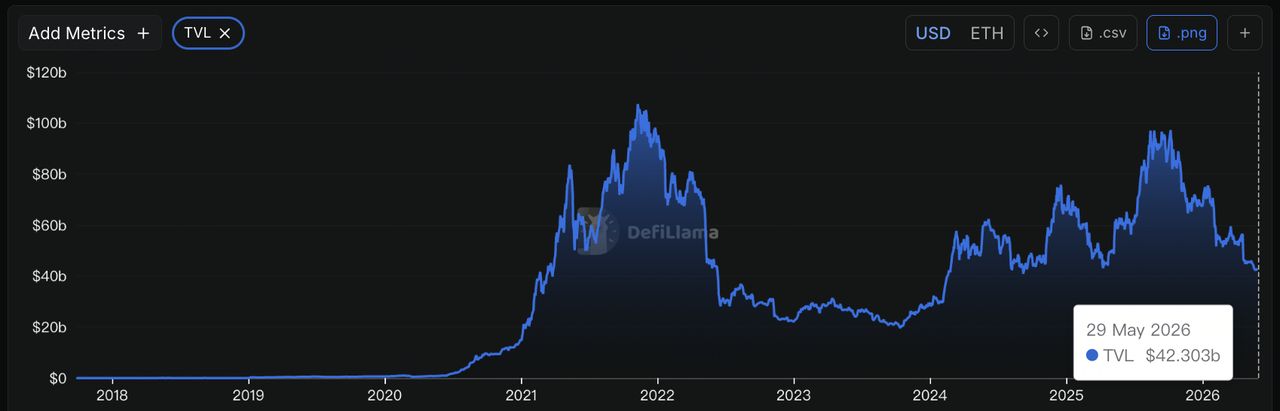
Ethereum’s importance is best measured by what is built on top of it. Beyond ETH’s market price, Ethereum remains the largest smart contract ecosystem by total value locked (TVL), developer activity, DeFi liquidity, stablecoin settlement, and Layer 2 adoption. In early 2026, Ethereum Layer 1 holds roughly $55 billion in DeFi TVL, representing about 68% of the global DeFi market. When Layer 2 networks are included, Ethereum’s broader ecosystem remains one of the most important infrastructure layers in crypto.
Source: DefiLlama
Ethereum’s role is increasingly centered on settlement, liquidity, and application infrastructure. DeFi protocols, stablecoins, tokenized assets, NFTs, and Layer 2 networks all rely on Ethereum either directly or as a settlement layer. This is why Ethereum remains central to the on-chain economy even as activity becomes more distributed across Layer 2s.
1. Layer 2 Networks and Rollups
Ethereum’s scaling strategy is rollup-centric. Instead of processing every transaction directly on the main chain, Layer 2 networks bundle many transactions together and post compressed data back to Ethereum. This gives users lower fees and faster transactions while still benefiting from Ethereum’s security.
The largest Layer 2 networks include Base, Arbitrum, and Optimism, with Base and Arbitrum accounting for much of Layer 2 DeFi activity. Layer 2 value peaked near $49 billion in late 2025 before settling in the high-$30-billion range. Together, Ethereum and its Layer 2 ecosystem allow the network to support far more activity than Ethereum Layer 1 alone.
2. DeFi, Stablecoins, NFTs, and RWAs
Ethereum’s adoption is driven by several major application categories:
- Decentralized finance (DeFi): Lending protocols, decentralized exchanges, and yield platforms allow users to borrow, lend, trade, and earn yield without traditional intermediaries.
- Stablecoins: Dollar-pegged tokens such as USDC and USDT settle large volumes on Ethereum and its Layer 2s, making the network a core settlement layer for on-chain finance.
- NFTs: Non-fungible tokens represent unique digital ownership of art, collectibles, game assets, memberships, and other digital or real-world claims.
- Real-world assets (RWAs): Tokenized money market funds, treasury products, credit instruments, stocks, and other traditional assets are increasingly being issued on Ethereum, bringing more institutional finance on-chain.
Together, these use cases explain why Ethereum remains central to the crypto economy. It functions as a settlement layer, liquidity hub, developer platform, and infrastructure base for much of the on-chain financial system.
Read More: Top 7 Ethereum DeFi Projects to Watch in 2026
Ethereum Tokenomics Explained: ETH Supply, Burn, and Staking
Ethereum’s tokenomics work differently from Bitcoin’s fixed-supply model. Bitcoin has a hard cap of 21 million coins, while ETH has no fixed maximum supply. Instead, ETH supply changes based on the balance between validator rewards, transaction fee burns, and staking participation. In 2026, this makes Ethereum mildly inflationary during quieter periods, but still capable of becoming deflationary when network activity and fee burns rise.
ETH supply is shaped by three main mechanisms:
- Validator issuance: New ETH is created to reward validators who stake ETH and help secure the network. After The Merge, issuance fell sharply because Ethereum no longer pays miners.
- Fee burn: Since EIP-1559, part of every Ethereum transaction fee is permanently burned. When network activity rises, more ETH is removed from circulation.
- Staking lock-up: A large share of ETH is staked to secure the network. Staked ETH is not destroyed, but it is less liquid and often held by long-term participants, which can reduce near-term sell pressure.
The key point is that Ethereum’s monetary policy is usage-sensitive. ETH is not fixed-supply like Bitcoin, but it is also far less inflationary than before The Merge. Its supply can expand slowly when activity is low and contract when demand rises.
How to Trade Ethereum (ETH) on BingX
BingX offers three practical ways to gain exposure to Ethereum, depending on whether the goal is direct ownership, short-term trading, or steady accumulation over time. Spot trading is better suited for users who want to buy and hold ETH directly. Futures trading is designed for active traders who want long or short exposure to ETH price movements. Dollar-cost averaging (DCA) is useful for users who want to build an ETH position gradually without trying to time every market move.
Spot Trading: Buy and Own ETH Directly
Spot trading is the most straightforward way to buy Ethereum on BingX. When users buy ETH on the spot market, they own the asset directly and can hold it in the BingX spot account, transfer it, or withdraw it to a self-custody wallet.
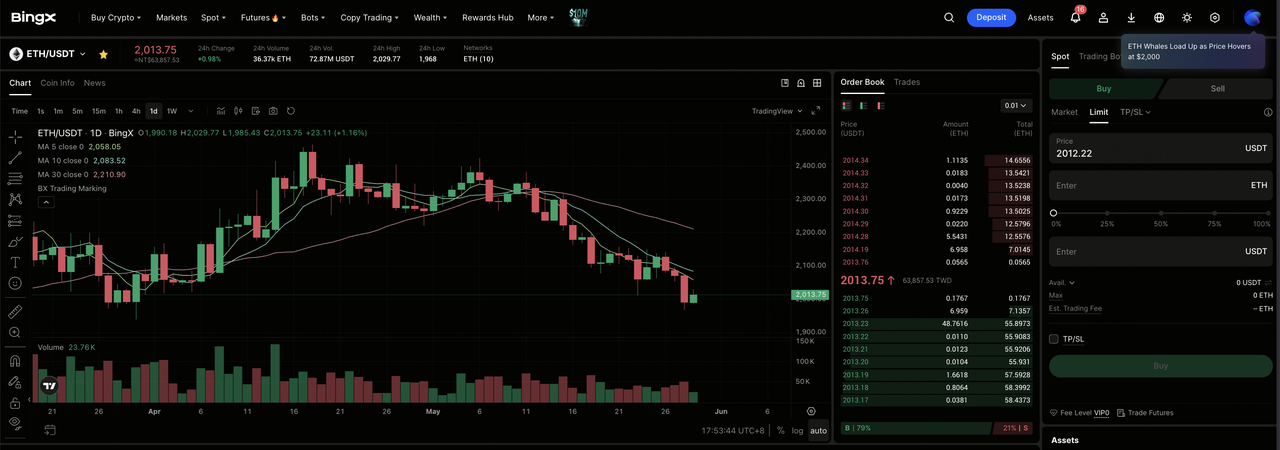
Step 1: Account setup and security. Sign up and log into your BingX account, complete the identity verification (KYC) required in your region, and enable two-factor authentication.
Step 2: Fund your spot account. Deposit USDT or another supported asset into your BingX spot account. Where available, users can also use supported fiat on-ramp options.
Step 3: Navigate to the spot market. Search for the ETH/USDT trading pair.
Step 4: Place your order. Choose a market order to buy ETH immediately at the current price, or use a limit order to set the price you want to pay.
Step 5: Manage your ETH. Once filled, your ETH appears in your spot account. You can keep it on BingX for convenience or withdraw it to a personal wallet for self-custody.
Futures Trading: Trade ETH Price Movements
For active traders, BingX offers USDT-margined ETH perpetual futures. Futures allow users to trade ETH price movements without holding the underlying asset, with the flexibility to open long positions if they expect ETH to rise or short positions if they expect ETH to fall.
Because futures involve leverage, they can amplify both gains and losses. This approach is more suitable for traders who already have a clear risk plan and understand liquidation risk.
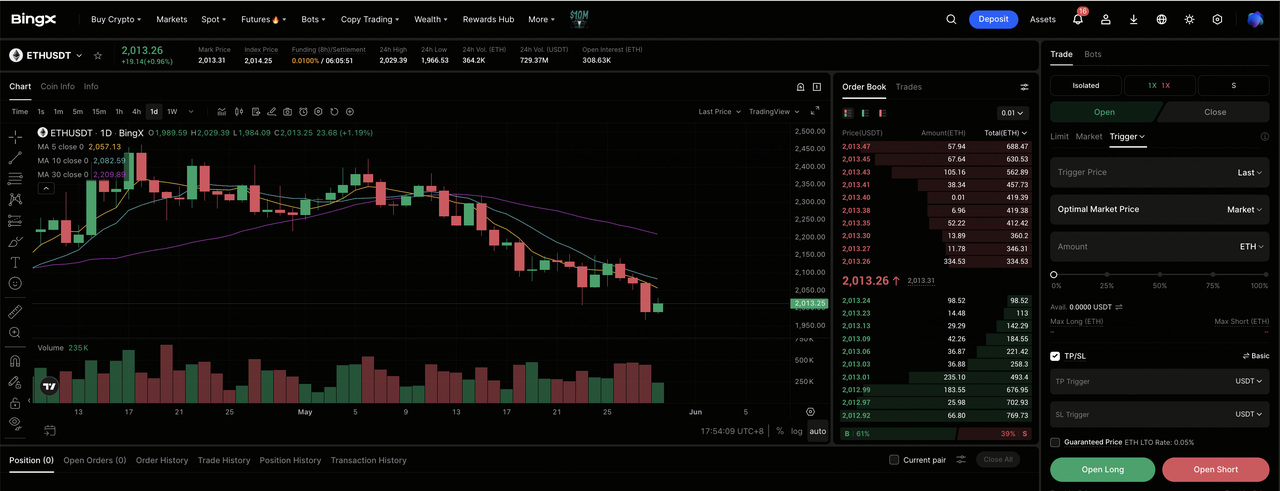
Step 1: Transfer collateral. Move USDT from your spot account into your futures account, where it will serve as margin.
Step 2: Select the contract. Search for the ETH-USDT perpetual contract.
Step 3: Set direction and leverage. Open long if you expect ETH to rise, or open short if you expect ETH to decline. Choose leverage based on your risk tolerance and position size.
Step 4: Execute the trade. Enter the order amount and choose a market or limit order depending on your trading plan.
Step 5: Manage risk. Set stop-loss and take-profit orders before or immediately after entering the position. Profit and loss settle dynamically in USDT.
Dollar-Cost Averaging (DCA): Build an ETH Position Over Time
Dollar-cost averaging (DCA) means buying a fixed amount of ETH at regular intervals, regardless of short-term price movement. Instead of trying to find the perfect entry, users can gradually build exposure over time. This approach is often used by long-term investors who want ETH exposure but prefer to reduce emotional decision-making during volatile markets.
BingX’s recurring-buy feature can help automate this process by purchasing a set amount of ETH on a schedule chosen by the user, such as weekly, biweekly, or monthly.
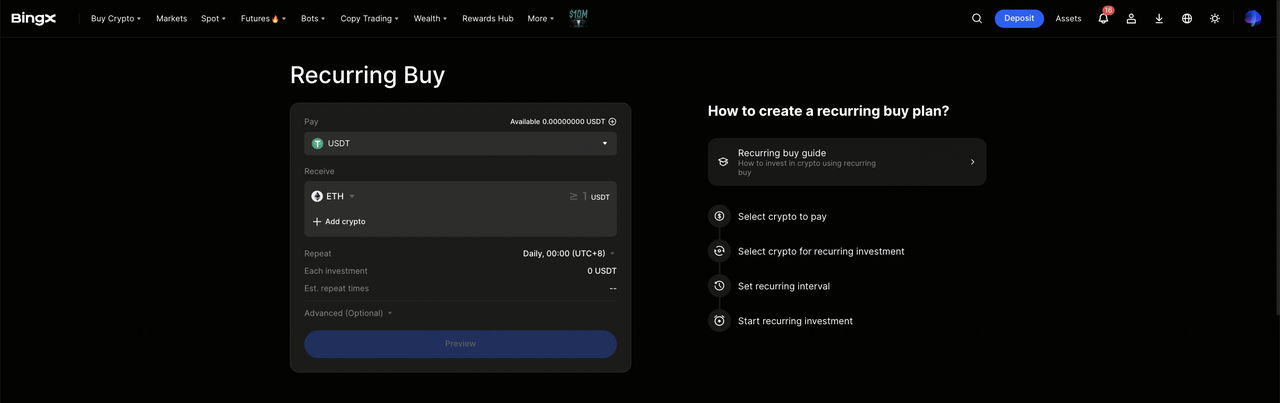
Step 1: Select ETH as the target asset. Open the recurring buy or DCA feature on BingX and choose ETH as the cryptocurrency to accumulate.
Step 2: Set amount and frequency. Enter the fixed amount to invest each time and choose the purchase schedule, such as weekly or monthly.
Step 3: Confirm the funding source. Make sure your selected wallet or payment source has enough balance to support the recurring purchases.
Step 4: Review and activate the plan. Check the asset, amount, frequency, and execution details, then confirm the DCA plan.
Step 5: Monitor and adjust when needed. Review the plan periodically and adjust the amount or frequency based on your budget, market outlook, or investment goals.
Final Thoughts: Should You Invest in Ethereum in 2026?
Ethereum has grown from a 2015 experiment in programmable blockchain applications into the settlement layer for much of the on-chain economy. Its core idea, a decentralized network that runs code without intermediaries, has remained durable across multiple market cycles, while upgrades like Proof of Stake, EIP-1559, Dencun, and Layer 2 rollups have reshaped how Ethereum scales and how ETH functions economically.
For anyone evaluating ETH in 2026, the key is to understand it as more than a tradable token. ETH pays gas fees, secures the network through staking, and supports activity across DeFi, stablecoins, tokenized assets, NFTs, and Layer 2 ecosystems. Ethereum still faces competition, Layer 2 fee questions, and supply-economics uncertainty, so whether users buy ETH through spot, build a position with DCA, or trade futures, understanding the network behind the asset is essential.
Related Reading
- How to Stake Ethereum (ETH) in 2026: Top Ways to Know
- What Are the Top Ethereum Layer-2 Projects of 2026?
- Ethereum's 10th Anniversary: Top 10 Milestones of the World’s Second‑Largest Blockchain
- What Is Ethereum Glamsterdam Upgrade in H1 2026 and What Changes Does the Hard Fork Bring?
- Who Is Vitalik Buterin? The Ethereum Founder Who Changed the Crypto Space
- Top 7 Ethereum DeFi Projects to Watch in 2026
