
Gensyn (AI) represents a transformative decentralized protocol designed to democratize artificial intelligence infrastructure. By connecting global idle GPU resources with AI developers, it creates an open marketplace for compute, data exchange, and verifiable machine learning.
Backed by prominent investors including a16z crypto, Gensyn has raised over $78 million in funding and launched its mainnet with Delphi, its flagship information market platform. As of late April 2026, the $AI token trades actively on BingX, with both spot and futures markets available, offering traders liquidity and opportunities in the rapidly growing decentralized AI sector.
Read more: What Is OpenGradient (OPG) EVM Blockchain-Native AI Agents on Base Network?
Key Takeaways
- Gensyn provides decentralized infrastructure for AI training, verification, and information markets through its core primitives: AXL, Chain, and REE.
- The $AI token has a fixed total supply of 10 billion, with approximately 1.3 billion in circulating supply and a market cap around $60-70 million shortly after launch.
- Key mechanisms include a 70% buy-and-burn from on-chain revenue, staking for verification, and governance.
- The project addresses centralization in AI enabling trustless, reproducible execution across global hardware.
Read more: What Is Gitcoin (SM) Marketplace for Open-Source Development and ERC-20 Governance?
What Is Gensyn (AI)?
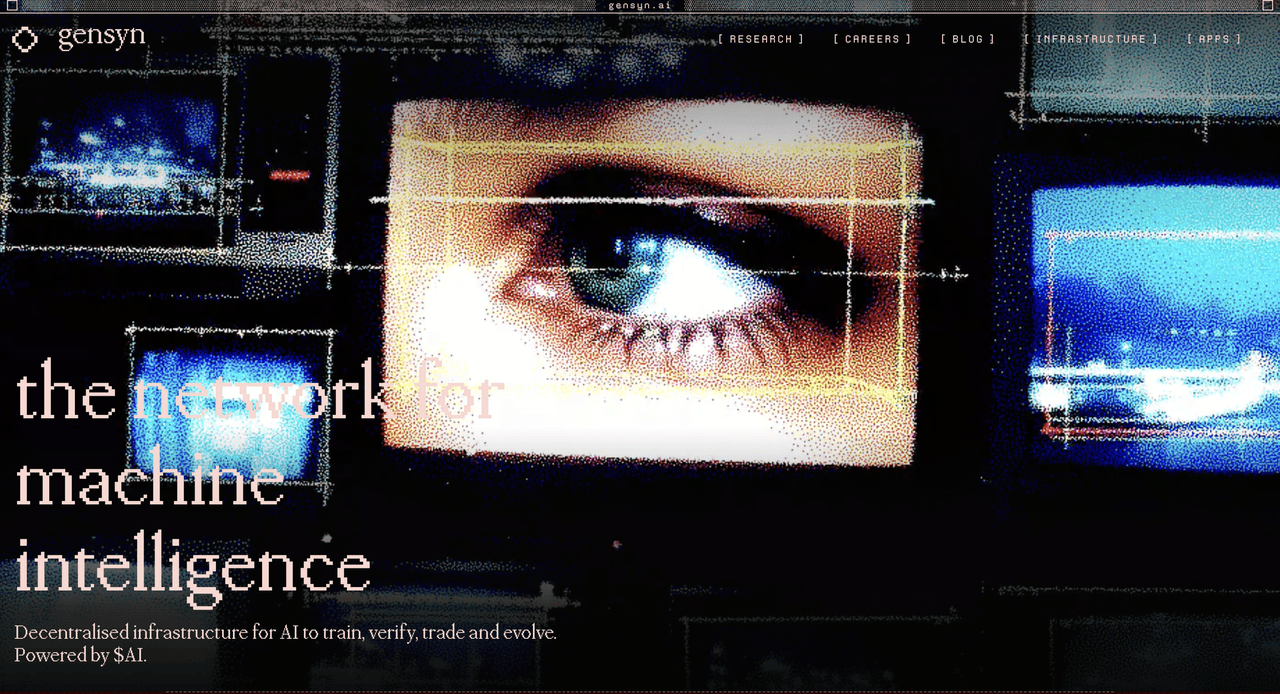
Gensyn is a decentralized network for machine intelligence that aggregates compute, data, and information exchange into an open, permissionless layer. It functions as the "TCP/IP of AI," allowing humans and AI agents to interact without relying on centralized providers like major cloud services. The protocol tackles core challenges in AI development: centralized control of compute resources, non-reproducible computations across hardware, and lack of native peer-to-peer communication for AI agents.
Founded in London, Gensyn operates on a custom EVM-compatible Layer 2 built with the OP Stack, leveraging Ethereum's security. Its live application, Delphi, enables on-chain prediction and information markets where AI models and humans trade predictions with automated, verifiable settlement. This creates a self-optimizing ecosystem where better models earn more and improve the network.
Read more: What Is Smart Tools (SM) Ultimate Web3 Utility Suite and How to Buy It on BingX?
What are the Key Features of Gensyn (AI)?
Gensyn stands out through several innovative components:
- AXL (Agent eXchange Layer): A peer-to-peer communication protocol for encrypted exchange of weights, gradients, and signals between AI models and agents, eliminating central servers.
- Chain: An on-chain identity system on its EVM L2, enabling reputation and staking to accumulate for all participants (humans, models, agents).
- REE (Reproducible Execution Environment): A toolchain ensuring bitwise-identical AI execution across diverse hardware, enabling trustless verification via cryptographic proofs. It supports 40+ models across major GPU architectures.
- Delphi Information Markets: A dynamic platform for trading predictions with AI-oracle settlement, automatic liquidity, and creator fees.
- Buy-and-Burn Mechanism: 70% of on-chain revenue buys and permanently burns $AI, linking usage directly to token scarcity.
Additional features include support for distributed training, cost-effective fine-tuning, and integrations like Uniswap V3 and lending protocols on its L2.
What Are the Tokenomics of AI Token?
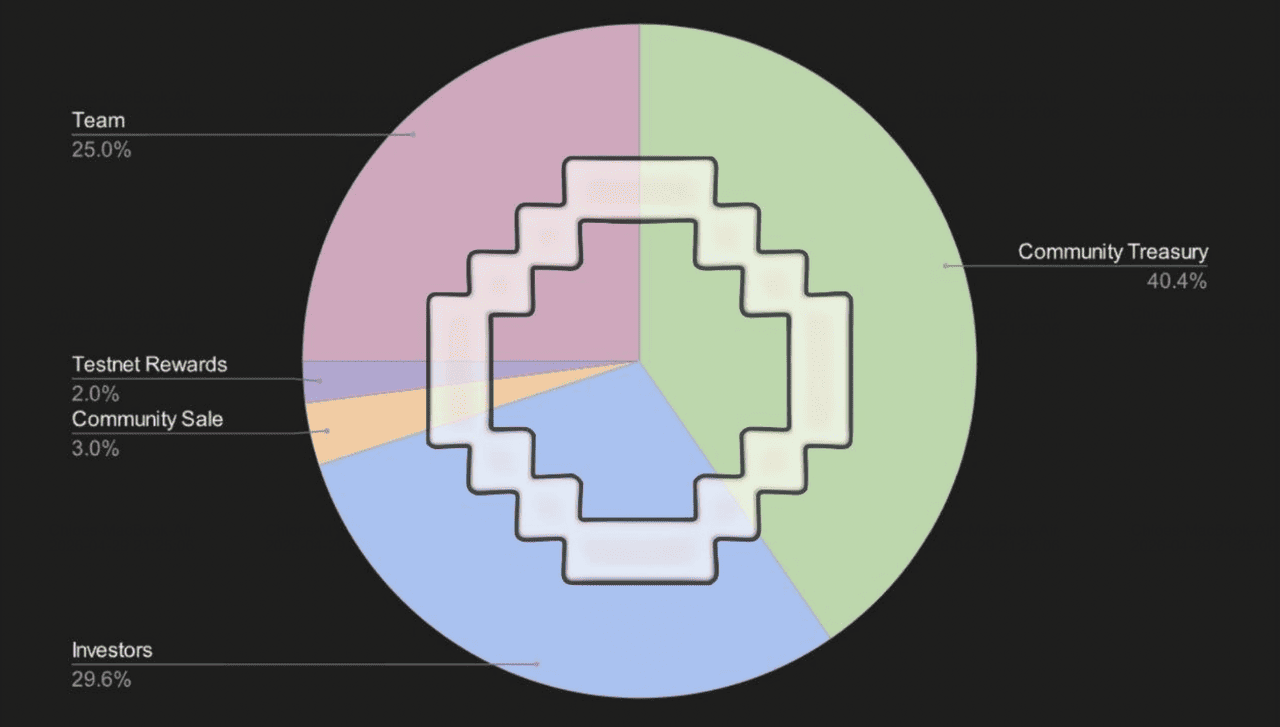
The $AI token powers the Gensyn ecosystem as an ERC-20 token deployed on Ethereum and its L2 with a fixed total supply of 10 billion tokens. No additional minting is possible.
Gensyn Token Distribution Breakdown
- Community Treasury: 40.4% (ecosystem growth, grants, liquidity).
- Investors: 29.6% (12-month cliff + 24-month linear unlock).
- Team: 25% (same vesting as investors).
- Community Sale: 3%.
- Testnet Rewards: 2%.
Key Functions of $AI Token
- Staking: Validators stake $AI to secure ML computations, with slashing for misconduct.
- Payments: Native currency for network transactions, queries, and services.
- Governance: Progressive voting on upgrades and treasury use.
- Value Accrual: Revenue-driven buyback vault burns 70% of purchased tokens.
As of late April 2026, circulating supply stands at approximately 1.3 billion tokens, with a fully diluted valuation reflecting strong interest in decentralized AI.
Read more: What Are the Top 10 AI Crypto Projects to Watch in 2026?
How to Buy Gensysn (AI) on BingX Spot Market: Step-By-Step Guide
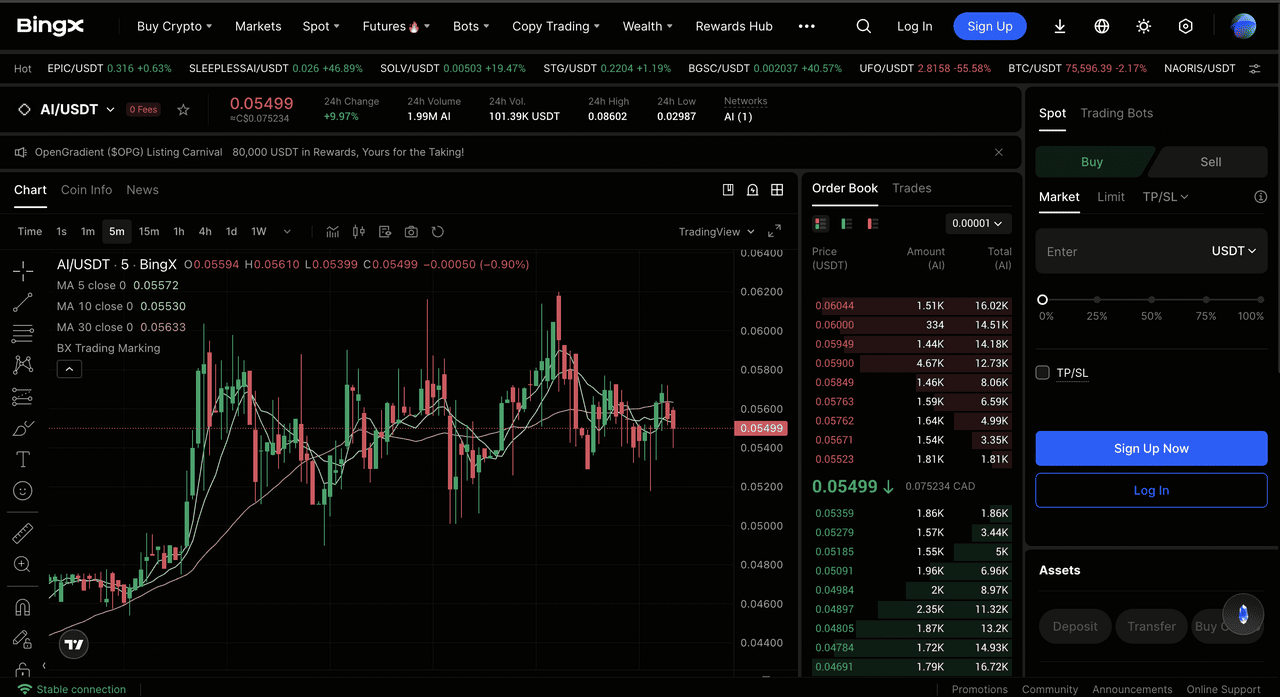
AI/USDT on BingX Spot Market
You can access AI through the spot market and use them within their respective ecosystems. Here's a step-by-step guide on how to buy AI BingX Spot Market:
Step 1: Log in or Create a BingX Account
Log in to your BingX account. If you don't have one, you can register using an email or mobile number. Completing identity verification (KYC) is required for full access to trading features.
Step 2: Deposit Funds
Go to the Buy Crypto section to deposit funds into your account. BingX supports several payment options such as bank transfer, credit or debit card, and peer-to-peer (P2P) transactions.
Step 3: Find the AI/USDT Pair
Navigate to the Spot trading section and search for AI/USDT and select the pair to view the trading interface. Use BingX AI tools to analyze AItrends and make smarter trading decisions.
Step 4: Place Your Order
Choose between a Market Order to buy at the current price or a Limit Order to set your preferred entry. Enter the amount and confirm the order.
How to Trade AI Perpetuals on BingX Futures: Step-By-Step Guide
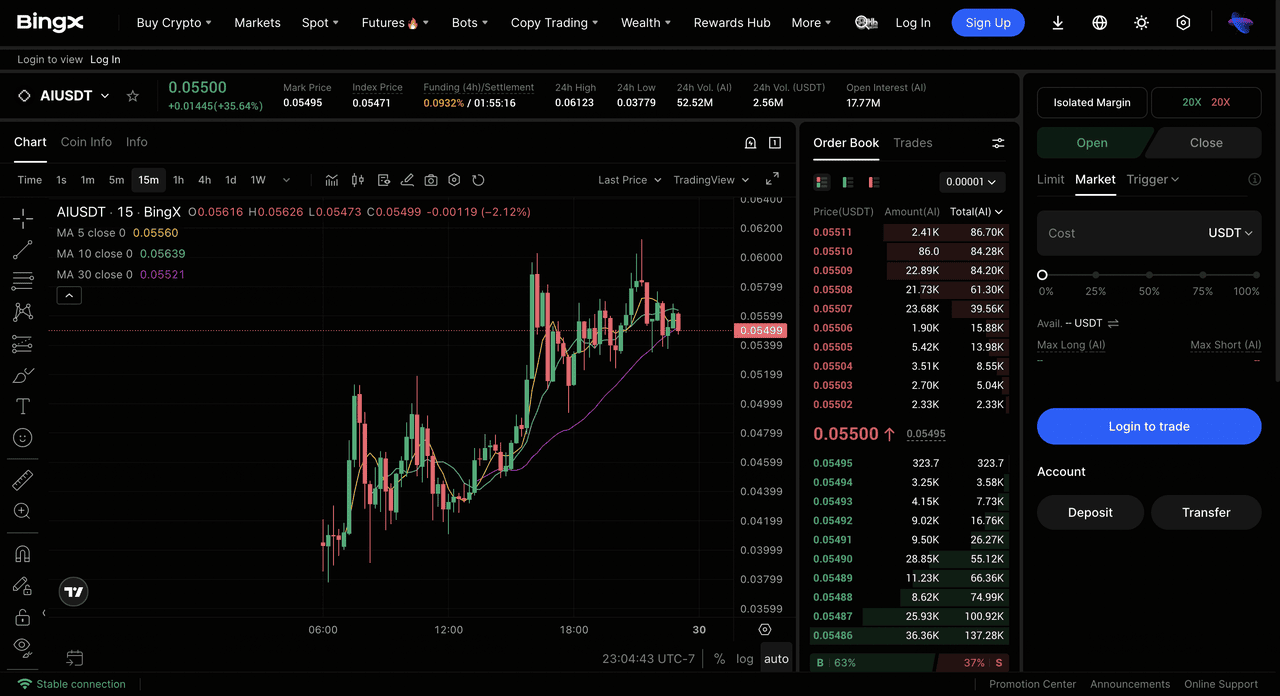
AI-USDT perpetuals on BingX Futures
BingX, a user-friendly centralized exchange, supports AItrading with pairs like AI/USDT and offers tools for efficient purchases. Amid the hype, the token is already listed on major centralized exchanges, including BingX, where users can trade AI-USDT perpetuals in the futures market. Follow these steps to trade AI securely:
Step 1: Create and Fund Your BingX Futures Account
Sign up on BingX and complete identity verification. Deposit USDT into your account and transfer your funds into your Futures Wallet.
Step 2: Open the Futures Trading Interface
Navigate to the Futures trading section and search for AI or the AI/USDT perpetual contract trading pair. Review the current price, chart, and market data for informed decision-making.
Step 3: Choose Long or Short
- Go long if you expect AI's price to rise
- Go short if you expect AI's price to decrease
Step 4: Set Leverage and Order Type
Adjust leverage based on your risk tolerance. Choose market order for instant execution or limit order for a specific price entry.
Step 5: Manage Risk
Always use stop-loss (SL) and take-profit (TP) to manage downside risk. Monitor margin levels to avoid liquidation. This approach mirrors traditional gold futures trading, but with crypto-native speed, leverage, and flexibility. Monitor your position using BingX's advanced charting tools, set price alerts, and manage risk with stop-loss orders given the high volatility of memecoins. Always consider exchange fees, market conditions, and your risk tolerance before trading.
Read more: Risk Management in Crypto Trading: 7 Rules Every Trader Must Know
Conclusion: Why You Should Trade Gensyn (AI) on BingX
Gensyn (AI) positions itself at the forefront of decentralized AI, solving critical bottlenecks in compute accessibility and verification while fostering open information markets. With real utility, deflationary mechanics, and strong backing, $AI offers both long-term potential and short-term trading opportunities amid the AI crypto narrative.
BingX stands out as a top choice due to its reliable liquidity, user-friendly interface, competitive fees and support for both spot accumulation and leveraged futures trading. Whether you are a developer participating in the network or a trader capitalizing on volatility, BingX provides a secure, efficient platform to engage with Gensyn. Always conduct your own research and manage risks appropriately in this dynamic market.
Related Reading
- What Is Monad (MON), the EVM-Compatible Layer-1 Blockchain?
- What Are the Best Ways to Convert Ethereum (ETH) to USD in 2026?
- What Are the 10 Best ERC-20 Wallets to Secure and Store Ethereum Tokens? (2026 Guide)
- What Is Linea, the Ethereum Layer‑2 Network by ConsenSys?
- What Are the Top Ethereum Layer-2 Projects of 2025?
- What Are the Top 10 Base AI Agent Projects to Know in 2026?