

As global digital economies expand toward the multi-trillion-dollar horizon, the structural architecture of internet native currencies faces an unprecedented transformation. For the first decade of digital fiat, the stablecoin industry operated under a winner-take-all balance sheet dynamic. Dominant single-entity issuers pocketed billions in interest revenue generated by underlying short-term US Treasury reserves, leaving payment processors, networks, and fintech platforms to bear the operational cost of moving money without capturing the asset's economic upside. Open USD (OUSD) alters this paradigm by establishing a shared, open financial utility that aligns protocol incentives with the very institutions driving transactional volume.
Announced on June 30, 2026, Open USD is governed and operated by Open Standard, an independent company formed by a massive coalition of more than 140 market leaders across traditional finance, global digital networks, and crypto-native rails. Backed by industry heavyweights such as Visa, Stripe, Mastercard, BlackRock, Google Cloud, BNY, and Coinbase, OUSD moves the digital currency conversation away from single-issuer monopolies and toward an open operating system for programmable internet money.
What Is Open USD (OUSD) Stablecoin?
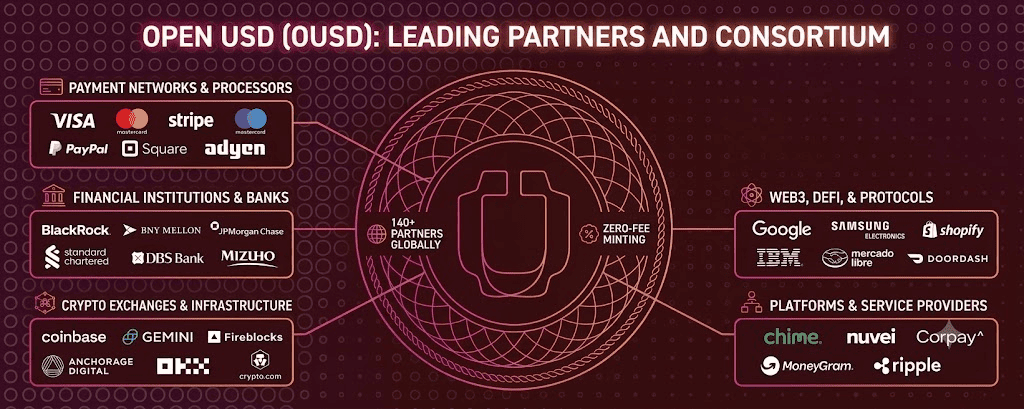
Open USD (ticker: OUSD) is a fully reserved, dollar-pegged stablecoin designed to work as global payment infrastructure rather than a proprietary corporate asset. While its surface mechanism mirrors traditional stablecoins, maintaining a strict 1-to-1 peg to the US dollar backed by audited, high-quality liquid assets, its operational framework directly challenges established single-issuer dominance.
At its core, Open USD solves three critical pain points hampering institutional payment adoption:
- Yield Retention Disconnect: Traditional issuers retain 100% of the interest float generated by user balances; OUSD returns the vast majority of reserve economics directly to the businesses building network adoption.
- Frictional Capital Costs: Moving capital at institutional scale frequently incurs volatile minting, redemption, or tier-based volume fees; OUSD strips out entry and exit costs entirely for its partners.
- Centralized Issuer Dependence: Traditional assets remain vulnerable to the strategic drift, regional friction, or unilateral technical roadmaps of isolated corporate issuers; OUSD is bound to collective interest via neutral, multi-party governance.
The Compliance Layer: Built directly inside the post-GENIUS Act regulatory framework signed into US law in July 2025, Open USD manages its reserves at premier, audited banking institutions, providing corporate treasuries with the regulatory confidence needed to clear industrial-scale transaction volumes.
How Does Open USD Work?
The Open USD ecosystem coordinates money movement across three operational pillars: the Core Infrastructure Architecture, the Revenue-Sharing Distribution Layer, and the Collaborative Governance Network.
Core Infrastructure Architecture
Every unit of OUSD in circulation is backed 1-to-1 by cash reserves and short-term US sovereign obligations. When an institutional partner initiates a mint command, it deposits hard dollars into Open Standard's audited custodial vaults, managed by regulated institutional heavyweights like BNY, triggering the automated cryptographic issuance of OUSD on partner blockchains. Redemptions operate in reverse: businesses return OUSD to the smart contract surface, burning the tokens and freeing real-world dollar assets back to their corporate bank routing lines. For consortium partners, this entire pipeline carries zero minting or redemption fees and no volume caps.
The Revenue-Sharing Distribution Engine
OUSD's primary competitive innovation is the structural inversion of the net interest margin model. Instead of hoarding the interest revenue derived from billions of dollars in Treasury assets, the protocol distributes its reserve earnings back into the ecosystem.
The underlying mechanism works like a programmatic volume incentive:
- Open Standard collects the yield generated by short-term US Treasury reserves.
- A fixed, minimal operational management fee is deducted to fund technical development, compliance auditing, and network upkeep.
- The remaining net interest spread is returned directly to distribution partners like Stripe, Adyen, Shopify, etc., based on the rolling Time-Weighted Average (TWA) transaction volume and balances they bring into the network.
This transformation turns stablecoins from a technical overhead liability into a new balance sheet revenue stream for global payment providers.
Collaborative Governance Network
Rather than running on top of a loose decentralized autonomous organization (DAO) or a single corporate boardroom, Open USD utilizes a joint corporate governance structure. Open Standard functions as an independent operational entity, but its board is composed entirely of its constituent network partners. Decisions surrounding reserve asset allocation parameters, security baselines, and cross-chain pipeline expansions are voted on collectively, preventing any single corporation from forcing arbitrary framework adjustments. OUSD is slated to go live across high-throughput networks, including Solana, Stellar, Base, and Polygon, before the end of 2026.
Open USD vs. Traditional Stablecoins: Key Differences
|
Feature |
Open USD (OUSD) |
Circle (USDC) |
Tether (USDT) |
|
Corporate Architecture |
Open Standard (140+ Partner Consortium) |
Circle Internet Financial (Single Issuer) |
Tether Limited (Single Issuer) |
|
Primary Economics |
Yield-sharing model (distributes earnings to partners) |
Issuer-retained float (kept entirely by Circle) |
Issuer-retained float (kept entirely by Tether) |
|
Minting & Redemption Cost |
Zero fees and no volume caps for partners |
Variable processing fees / tier gates |
0.1% fee ($1,000 minimum fee threshold) |
|
Governance Structure |
Collaborative partner board veto model |
Centralized corporate board control |
Centralized corporate board control |
|
Core Distribution Target |
Embedded payment rails & PSP networks |
Institutional DeFi & US compliant crypto |
Global emerging market liquidity & trading |
|
Regulatory Grounding |
Federal GENIUS Act framework aligned |
Dual state trust & MiCA regulated profiles |
Offshore banking & reserve portfolio structures |
Traditional single-issuer stablecoins like USDT and USDC operate on a proprietary "issuer-keeps-the-float" economic model, where companies like Tether and Circle retain 100% of the net interest margin generated by their underlying fiat and US Treasury reserves. Open USD (OUSD) structurally disrupts this framework by introducing an open infrastructure model that shifts competition from individual tokens to an entire ecosystem. Instead of hoarding yield, OUSD distributes nearly all reserve earnings, minus a minimal management fee, back to the payment networks, fintech platforms, and distribution partners, such as Stripe, Visa, and Adyen, in direct proportion to the volume and balances they bring into the network.
Operationally, traditional stablecoins subject high-volume commercial users to variable tier-gates and redemption fees, such as Tether’s 0.1% fee structure, while keeping governance tightly concentrated within their own corporate boardrooms. Conversely, OUSD offers institutional partners zero-fee minting and redemption with no artificial volume caps, backed by a collaborative corporate board model composed of its 140-plus member companies. By aligning the balance-sheet incentives of global payment networks with the underlying rail, OUSD transforms stablecoins from an expensive operational overhead liability into a shared, revenue-generating utility for global internet commerce.
Read more: USDC vs. USDT: Key Differences and Which Stablecoin to Choose in 2026?
Open USD (OUSD) vs. Ripple USD (RLUSD) vs. PayPal USD (PYUSD)
While Open USD (OUSD) enters the market as a high-throughput consortium asset, it competes directly with a new class of highly regulated, institutionally backed corporate stablecoins. The table below outlines how OUSD stacks up against its closest corporate counterparts: Ripple USD (RLUSD) and PayPal USD (PYUSD).
|
Feature |
Open USD (OUSD) |
Ripple USD (RLUSD) |
PayPal USD (PYUSD) |
|
Issuer & Model |
Open Standard (140+ Partner Consortium) |
Ripple Labs Inc. (Single-Entity Enterprise) |
Paxos Trust Company (Distributed via PayPal) |
|
Market Capitalization |
Emerging (Launch Phase, Late 2026) |
$1.63 Billion |
$2.77 Billion |
|
Primary Economic Split |
Partner-Focused: Yield shared with volume-driving partners. |
Corporate-Focused: Retained by Ripple to fund enterprise payment rails. |
Consumer-Focused: Up to 3.7% yield distributed to retail holders. |
|
Target Audience |
Global B2B networks, merchants, & PSPs. |
Institutional cross-border settlement & FX. |
Retail consumers, peer-to-peer, & e-commerce. |
|
Primary Chains |
Solana, Stellar, Base, Polygon |
XRP Ledger (XRPL), Ethereum |
Ethereum, Solana (Across 15+ networks) |
|
Regulatory Guardrails |
Federal GENIUS Act compliance framework. |
NYDFS limited-purpose trust charter approved. |
NYDFS regulated (Paxos issued), GENIUS Act aligned. |
The core divergence between these three digital assets lies in how they leverage their underlying net interest margins to capture market share. Open USD focuses entirely on B2B network distribution, weaponizing its yield-sharing engine to turn payment giants like Stripe and Adyen into active sales loops by boosting their corporate balance sheets. Conversely, Ripple’s RLUSD concentrates capital within its own enterprise cross-border payment network, using the token as a stable liquidity bridge alongside XRP to settle high-value institutional foreign exchange (FX) corridors.
PayPal’s PYUSD operates on an entirely different plane, functioning primarily as a retail consumer acquisition tool. By passing up to 3.7% APY directly to everyday wallet holders within the PayPal and Venmo networks, PYUSD acts as an onboarding ramp for consumer commerce and peer-to-peer payments. For builders and corporate treasuries, the choice is highly functional: select OUSD to optimize platform payment revenues, RLUSD for high-speed institutional cross-border clearing, or PYUSD to tap into retail consumer spending loops.
5 Key Considerations Before Adopting Open USD
Before integrating OUSD into corporate workflows or crypto allocation strategies, market participants should weigh these essential points:
- Consortium Coordination Realities: Managing the competing commercial interests of over 140 corporate giants, including traditional arch-rivals like Visa and Mastercard, could create governance friction during critical network forks or unexpected market adjustments.
- Pre-Launch Operational Horizon: As of mid-2026, Open USD is in its final deployment and technical integration testing phase. Live circulating supply data, network liquidity velocity, and true historical peg resilience remain unproven until the coin fully deploys later this year.
- Variable Yield Realities: Because OUSD's partner incentives rely entirely on short-term US Treasury rates, macro shifts in Federal Reserve interest rate policies could contract the underlying revenue-sharing pool, dampening distribution margins.
- Ecosystem Integration Velocities: The ultimate success of OUSD hinges completely on the speed at which partners transition their actual transaction paths, B2B payout grids, and merchant acquisition pipelines to the new stablecoin rail.
- Counterparty Tracking Constraints: While OUSD utilizes institutional banking custodians, assets remain exposed to standard bank clearing delays and localized settlement venue performance across the multi-chain ecosystem.
Can Open USD's Adoption Drive Mainstream Adoption of Stablecoins?
Open USD marks a major structural shift in the lifecycle of digital currencies. By replacing proprietary corporate control with a transparent network model, Open Standard relocates the primary point of industry competition. Businesses are no longer fighting over who owns the base dollar token itself; instead, they are competing to build the most efficient, user-centric payment services, programmatic credit platforms, and automated commerce tools on top of a shared public rail. As the launch date approaches later in 2026, OUSD stands poised to establish a highly integrated, compliant, and cost-efficient operating framework for global corporate value movement.
Risk Reminder: Digital assets and enterprise stablecoin networks are subject to smart contract vulnerabilities, changing cross-jurisdictional compliance mandates, and clearing infrastructure counterparty risks. Always conduct independent research, evaluate protocol governance updates, and never deploy more capital than your operational parameters can afford to lose. BingX assumes no operational responsibility for independent capital allocations or external third-party technical networks.
Related Reading
- Top Payment Finance (PayFi) Crypto Projects to Watch in 2026
- What to Know About the U.S. GENIUS Act as Stablecoins Soar Above $260 Billion
- What Is the Crypto CLARITY Act? Explore U.S. Digital Asset Regulation and Its Market Impact
- A Beginner's Guide to Stablecoins and How They Work (2026)
- What Are the Best Stablecoins to Have in Your Portfolio in 2026?
- What Is RLUSD? A Beginner's Guide to Ripple's USD-backed Stablecoin
- Everything You Need to Know About PayPal USD (PYUSD): A Beginner's Guide (2026)
FAQs on Open USD (OUSD) Stablecoin
1. Is Open USD live yet?
No. Open USD was announced on June 30, 2026, and is scheduled to officially launch later this year. The initial network implementation will deploy natively on high-speed chains like Solana and Stellar, alongside prominent Layer 2 networks like Base and Polygon.
2. Can retail users buy Open USD directly from the issuer?
No. Open Standard's zero-fee minting and redemption features are specifically calibrated for commercial partner institutions moving capital at scale. However, retail users will be able to trade OUSD across supported crypto exchanges and interact with it natively through payment apps like Stripe and Shopify once the asset goes live.
3. How is OUSD different from the old Origin Dollar (OUSD)?
The Open USD project launched by the Open Standard consortium in 2026 is completely unrelated to the older, decentralized finance yield-bearing stablecoin known as Origin Dollar, despite sharing the same alphabetical ticker symbol.
4. Does Visa own Open USD?
No. Visa does not own or issue OUSD. Visa is one of the 140-plus founding member institutions participating in the Open Standard network, committing to apply its risk guidelines and network parameters to help guide the stablecoin's operational reliability.
