
Shiba Inu began as a meme coin, but its long-term story is about whether a retail-driven token can turn community attention into a real crypto ecosystem. Launched in August 2020 as an Ethereum-based token inspired by the Shiba Inu dog breed, SHIB grew from a near-zero starting price into one of the most widely held meme coins in crypto. Its rise was powered by a large retail community, but the project has since tried to expand beyond meme speculation through Shibarium, ShibaSwap, and related ecosystem tokens such as BONE, LEASH, and TREAT.
Shiba Inu and SHIB refer to different things. Shiba Inu is the broader ecosystem, including Shibarium, ShibaSwap, related tokens, community initiatives, and the project’s roadmap. SHIB is the main ERC-20 token at the center of that ecosystem, originally launched on Ethereum and later integrated with Shibarium. This guide explains what Shiba Inu is, how it works, how the ecosystem evolved, how SHIB tokenomics function, the main risks to consider, and how to trade SHIB on BingX.
What Is Shiba Inu (SHIB)?
Shiba Inu (SHIB) is a decentralized, community-driven crypto ecosystem built around SHIB, an Ethereum-based meme coin launched in August 2020. It was created by an anonymous founder known as Ryoshi, who described SHIB in the project’s WoofPaper as an experiment in decentralized community building. The project started as a Dogecoin-inspired meme token, but later expanded into a broader ecosystem that includes Shibarium, ShibaSwap, BONE, LEASH, and TREAT.
SHIB launched with a deliberately massive supply of one quadrillion tokens and no presale or founder allocation. Half of the supply was sent to Ethereum co-founder Vitalik Buterin, who later burned about 410 trillion SHIB and donated part of the remaining tokens to charity. This early supply event became a defining part of Shiba Inu’s history and helped shape its community-driven identity.
The easiest way to understand Shiba Inu is to compare it with Dogecoin:
- Dogecoin: Dogecoin is the original meme coin, launched in 2013 with its own independent blockchain. It remains simple by design, mainly functioning as a proof-of-work payment and meme asset.
- Shiba Inu: Shiba Inu started as an Ethereum ERC-20 token but has since expanded into a multi-token ecosystem with its own Layer 2 network, decentralized exchange, governance and gas token, and additional ecosystem tokens.
This is what separates Shiba Inu from many other meme coins. Its central debate is whether the ecosystem can generate enough real usage to support SHIB beyond meme-driven demand.
The Shiba Inu Ecosystem vs. SHIB the Coin
- The Shiba Inu ecosystem: Shiba Inu refers to the broader project, including Shibarium, ShibaSwap, BONE, LEASH, TREAT, community initiatives, and planned applications around metaverse, AI, and privacy.
- SHIB the coin: SHIB is the main ERC-20 token at the center of the ecosystem. It is the primary tradable asset, can be used across Shiba Inu applications, and represents the community-driven identity of the project.
How Does Shiba Inu Work?
At its core, Shiba Inu is a multi-token ecosystem built across Ethereum and its own Layer 2 network, Shibarium. SHIB began as an ERC-20 token, but the broader project now includes a Layer 2 chain, companion tokens, a decentralized exchange, and planned applications across NFTs, metaverse, AI, and privacy.
- SHIB token: SHIB is an ERC-20 token originally launched on Ethereum, which means it is compatible with Ethereum wallets, exchanges, and DeFi infrastructure. It can also be bridged to Shibarium for use within the Shiba Inu ecosystem.
- Shibarium Layer 2: Shibarium is Shiba Inu’s Ethereum-based Layer 2 network, launched in August 2023. It is designed to make ecosystem transactions faster and cheaper. Unlike Ethereum, Shibarium uses BONE as its gas token and validator reward token, not SHIB.
- Companion tokens: Shiba Inu uses several related tokens with different roles. BONE is used for Shibarium gas and governance, LEASH is a low-supply token for community rewards and limited ecosystem utility, and TREAT is tied to newer ecosystem functions such as the Shib Alpha Layer and governance.
- ShibaSwap and ecosystem apps: ShibaSwap is the ecosystem’s decentralized exchange, supporting swaps, liquidity provision, and reward mechanisms across SHIB, BONE, LEASH, and related assets. The broader roadmap also includes applications around NFTs, metaverse, AI, and privacy.
Major Shiba Inu Developments: From Meme Coin to Layer 2 Ecosystem
Shiba Inu’s evolution has been a steady attempt to move beyond its memecoin origins and build a broader crypto ecosystem. The table below gives a quick overview, followed by a short walkthrough of each milestone.
|
Milestone |
Date |
Main Purpose |
|
SHIB Launch |
August 2020 |
SHIB launched as an Ethereum ERC-20 token by Ryoshi |
|
Vitalik Burn |
May 2021 |
Vitalik Buterin burned 410 trillion SHIB and donated the rest |
|
ShibaSwap Launch |
July 2021 |
Native DEX launched with BONE, LEASH, and yield programs |
|
Ryoshi Departure |
May 2022 |
Founder deleted social posts and stepped away from the project |
|
Shibarium Mainnet |
August 2023 |
Ethereum-based Layer 2 went live with BONE as gas token |
|
Shib Alpha Layer (L3) |
Early 2026 |
Modular framework for custom rollups using TREAT |
|
ETF Inclusion |
February 2026 |
SHIB added to T. Rowe Price-managed crypto products |
- SHIB Launch (August 2020). Shiba Inu launched as an Ethereum-based ERC-20 token created by the anonymous founder Ryoshi. The original WoofPaper described SHIB as an experiment in decentralized community building, with no presale, no founder allocation, and a one-quadrillion token supply.
- Vitalik Burn (May 2021). Half of the original SHIB supply had been sent to Ethereum co-founder Vitalik Buterin. In May 2021, Buterin burned about 410 trillion SHIB by sending them to a dead wallet and donated part of the remaining tokens to charity. This removed roughly 40% of the original supply in one event.
- ShibaSwap Launch (July 2021). Shiba Inu launched ShibaSwap, its native decentralized exchange, alongside BONE and LEASH. This introduced swaps, liquidity provision, and staking-style rewards, helping the project expand beyond a single meme token.
- Ryoshi Departure (May 2022). Founder Ryoshi deleted their public social media history and stepped away from the project. Since then, Shiba Inu has been led by the community and key contributors, including lead developer Shytoshi Kusama.
- Shibarium Mainnet (August 2023). Shibarium, Shiba Inu’s Ethereum-based Layer 2 network, launched on mainnet. It uses BONE as its gas and validator-reward token and was built to support cheaper, faster transactions for SHIB ecosystem applications.
- Shib Alpha Layer (Early 2026). The Shib Alpha Layer introduced a Layer 3 framework for developers to launch custom rollups on Shibarium using TREAT token stakes. It also added privacy-focused technology such as Fully Homomorphic Encryption for confidential smart contracts.
- ETF Inclusion (February 2026). SHIB was added to T. Rowe Price-managed crypto products, marking a notable institutional milestone for a token that began as a memecoin.
Shibarium Explained: How Shiba Inu’s Layer 2 Works
Shibarium is Shiba Inu’s Ethereum-based Layer 2 blockchain, launched on mainnet in August 2023. It was built to make SHIB ecosystem transactions faster and cheaper by processing activity on Shibarium and settling data back to Ethereum. In the modern Shiba Inu ecosystem, Shibarium is the infrastructure layer for apps, token transfers, and future ecosystem expansion.
A key design choice is that Shibarium uses BONE, not SHIB, as its gas token. Validators stake BONE to help secure the network, process transactions, and earn rewards. This gives BONE a direct network role, while SHIB remains the primary community and tradable asset at the center of the ecosystem.
Shibarium works in three main ways:
- BONE-based gas and validation: Transactions on Shibarium are paid in BONE, and validators are rewarded in BONE. If Shibarium activity grows, demand for BONE as the gas and validator token can increase.
- Automatic SHIB burn mechanism: A portion of Shibarium base transaction fees is converted into SHIB and burned. This creates ongoing deflationary pressure on SHIB when the network is used, though the impact depends on whether burn volume becomes meaningful relative to SHIB’s large supply.
- Custom rollups and privacy roadmap: The Shib Alpha Layer, announced in early 2026, expands Shibarium with a Layer 3 framework for custom rollups using TREAT token stakes. It also introduces privacy-focused technology such as Fully Homomorphic Encryption for confidential smart contracts.
The main caveat is adoption depth. Shibarium has processed a large number of transactions since launch, but its DeFi TVL has remained relatively low compared with major Layer 2 ecosystems. This creates the central question for Shibarium: the network has activity, but it still needs deeper liquidity, stronger applications, and more sustained capital usage to fully support the long-term SHIB ecosystem thesis
Shiba Inu Ecosystem and Adoption: Shibarium, ShibaSwap, and Multi-Token Roadmap
Shiba Inu’s adoption story is a long-running attempt to turn a memecoin community into a broader Web3 ecosystem. Beyond SHIB’s price, the project is built around Shibarium, ShibaSwap, companion tokens, and roadmap items across NFTs, metaverse, AI, and privacy. Its community remains one of the largest in crypto, with roughly 1.58 million SHIB holders.
The main question is whether Shiba Inu can translate community attention into sustained usage. SHIB still benefits from strong brand awareness, but the gap between ecosystem ambition and on-chain adoption remains visible.
1. Shibarium Activity and Burn Performance
Shibarium has processed more than 1.5 billion transactions since its August 2023 launch, with around 175 million addresses interacting with the network. Its burn mechanism also continues to operate, with some short-term SHIB burn spikes attracting community attention.
The caveat is scale. Absolute burn volume remains small compared with SHIB’s roughly 589 trillion circulating supply, and Shibarium’s TVL has stayed near $1 million to $2 million for much of 2025 and 2026. This makes liquidity depth one of the key challenges for the ecosystem.
2. ShibaSwap, Companion Tokens, and Roadmap
Shiba Inu’s ecosystem includes several products and tokens:
- ShibaSwap: The native decentralized exchange supports swaps, liquidity provision, and yield mechanisms across SHIB, BONE, LEASH, and related assets.
- BONE: BONE is used as Shibarium’s gas token and ShibaSwap’s governance token through Doggy DAO.
- LEASH and TREAT: LEASH is a low-supply community and rewards token, while TREAT is tied to newer ecosystem functions, including the Shib Alpha Layer.
- Roadmap items: Ongoing development includes Shibarium privacy upgrades, the Alpha Layer for custom rollups, AI-related initiatives, NFTs, and metaverse plans.
3. Shiba Inu vs. Other Memecoin Ecosystems
Shiba Inu’s closest comparison is Dogecoin, the original memecoin. Dogecoin remains a simple proof-of-work coin, while Shiba Inu has built a broader ecosystem around Layer 2 infrastructure, companion tokens, and decentralized applications.
Newer memecoins on Solana and other chains have attracted major speculative flows in 2025 and 2026, sometimes pulling attention away from SHIB. Still, Shiba Inu remains more developed than most memecoin projects because it combines a large holder base with a functioning Layer 2, DEX, and multi-token roadmap.
Shiba Inu Tokenomics Explained: SHIB Supply, Burn, and Multi-Token Design
Shiba Inu’s tokenomics are defined by two opposing forces: an extremely large token supply and an ongoing burn strategy. SHIB originally launched with a supply of one quadrillion tokens. In May 2021, Ethereum co-founder Vitalik Buterin burned roughly 410 trillion SHIB, removing about 40% of the original supply and leaving around 589 trillion SHIB in circulation today.
SHIB supply is shaped by three main mechanisms:
- Vitalik burn baseline: The 2021 Vitalik burn remains the largest supply-reduction event in SHIB history. It created the current supply baseline, but no comparable one-time burn has happened since.
- Ongoing Shibarium burn: Shibarium includes an automatic burn mechanism where part of base transaction fees is converted into SHIB and burned. Community-led burns and burn campaigns can add to this, but the total impact depends on actual Shibarium activity.
- Multi-token ecosystem design: Shiba Inu separates different ecosystem roles across multiple tokens. SHIB remains the primary community and tradable asset, while BONE is used for Shibarium gas and governance, LEASH provides limited-supply utility, and TREAT supports newer ecosystem functions such as the Shib Alpha Layer.
The key point is that SHIB’s supply remains very large even after years of burns. Burn activity can reduce supply over time, but with hundreds of trillions of SHIB still circulating, burns alone are unlikely to drive meaningful price appreciation without stronger demand, deeper Shibarium usage, and broader ecosystem adoption.
How to Trade Shiba Inu (SHIB) on BingX
BingX offers two practical ways to gain exposure to Shiba Inu: spot trading for users who want to buy and hold SHIB directly, and futures trading for active traders who want long or short exposure to SHIB price movements.
Spot Trading: Buy and Own SHIB Directly
Spot trading is the most straightforward way to buy Shiba Inu on BingX. When users buy SHIB on the spot market, they own the asset directly and can hold it in the BingX spot account, transfer it, or withdraw it to a self-custody wallet.
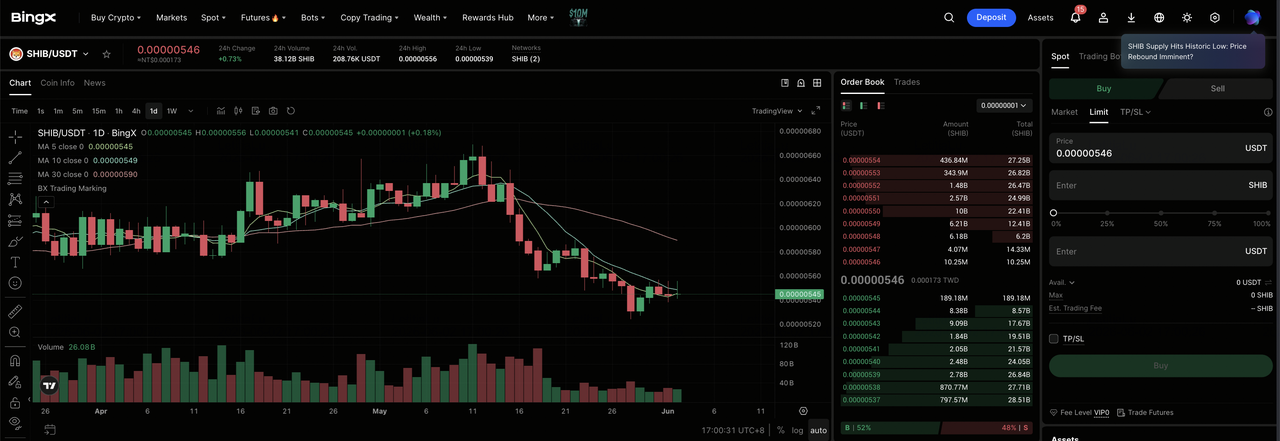
Step 1: Account setup and security. Sign up and log into your BingX account, complete the identity verification (KYC) required in your region, and enable two-factor authentication.
Step 2: Fund your spot account. Deposit USDT or another supported asset into your BingX spot account. Where available, users can also use supported fiat on-ramp options.
Step 3: Navigate to the spot market. Search for the SHIB/USDT trading pair.
Step 4: Place your order. Choose a market order to buy SHIB immediately at the current price, or use a limit order to set the price you want to pay.
Step 5: Manage your SHIB. Once filled, your SHIB appears in your spot account. You can keep it on BingX for convenience or withdraw it to a personal wallet for self-custody.
Futures Trading: Trade SHIB Price Movements
For active traders, BingX offers USDT-margined SHIB perpetual futures. Futures allow users to trade SHIB price movements without holding the underlying asset, with the flexibility to open long positions if they expect SHIB to rise or short positions if they expect SHIB to fall.
Because futures involve leverage, they can amplify both gains and losses. This approach is more suitable for traders who already have a clear risk plan and understand liquidation risk, particularly for a token like SHIB that can move sharply on community sentiment and burn-event news.
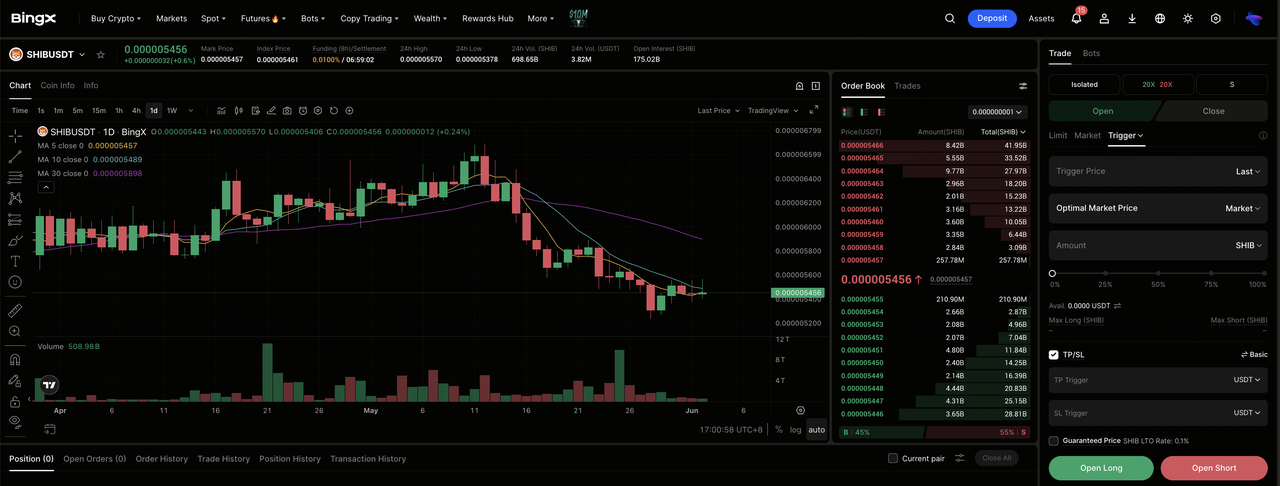
Step 1: Transfer collateral. Move USDT from your spot account into your futures account, where it will serve as margin.
Step 2: Select the contract. Search for the SHIB-USDT perpetual contract.
Step 3: Set direction and leverage. Open long if you expect SHIB to rise, or open short if you expect SHIB to decline. Choose leverage based on your risk tolerance and position size.
Step 4: Execute the trade. Enter the order amount and choose a market or limit order depending on your trading plan.
Step 5: Manage risk. Set stop-loss and take-profit orders before or immediately after entering the position. Profit and loss settle dynamically in USDT.
Risks and Considerations Before Investing in Shiba Inu
Shiba Inu has one of the largest communities in crypto and a growing ecosystem around Shibarium, ShibaSwap, and companion tokens. However, SHIB remains a high-volatility asset with risks tied to supply size, memecoin cycles, roadmap execution, and ecosystem adoption.
- Massive token supply: SHIB still has roughly 589 trillion tokens in circulation. Burns reduce supply over time, but the burn rate remains small relative to the total float, making demand growth essential to any long-term price thesis.
- Memecoin volatility: SHIB began as a memecoin and remains highly sensitive to social media activity, community sentiment, and broader memecoin rotations. Price moves can be sharp and narrative-driven.
- Shibarium adoption gap: Shibarium has processed a large number of transactions, but its TVL has remained low compared with major Layer 2 ecosystems. This raises questions about whether activity is translating into deeper liquidity and real utility.
- Roadmap and leadership risk: Key initiatives such as Shibarium privacy upgrades, the Shib Alpha Layer, AI projects, and metaverse plans are still developing. The project also relies on pseudonymous leadership, which can make accountability less clear than in corporate-led projects.
- Competition and leverage risk: Newer memecoins on Solana and other chains continue to compete for attention and liquidity. For users trading SHIB futures, leverage can amplify losses quickly, so conservative position sizing and stop-loss discipline are especially important.
Final Thoughts: Should You Invest in Shiba Inu in 2026?
Shiba Inu has grown from a 2020 meme experiment into one of the largest community-driven crypto ecosystems. Its holder base, Shibarium Layer 2, ShibaSwap, companion tokens, burn mechanism, and recent institutional exposure give SHIB a more developed profile than many memecoins.
For anyone evaluating SHIB in 2026, the key question is whether ecosystem activity can grow enough to support the token beyond community momentum. SHIB has strong brand awareness and infrastructure, but its massive supply and Shibarium’s low TVL remain major challenges. Whether users buy SHIB through spot trading or trade futures, understanding Shibarium, BONE, LEASH, TREAT, and SHIB’s supply math is essential.
Related Reading
- What Is Dogecoin (DOGE) in 2026? Complete Beginner's Guide to the Original Memecoin
- What Are the Top Ethereum Layer-2 Projects of 2026?
- What Is the Dogecoin ETF (DOJE) and How to Buy It: A Beginner's Guide
- How to Mine Dogecoin in 2026: A Complete Guide
- What Are the Top Proof-of-Work (PoW) Coins to Mine in 2026?
