

The U.S. CHIPS and Science Act (Creating Helpful Incentives to Produce Semiconductors) is a landmark $280 billion federal statute enacted in August 2022 to revitalize domestic semiconductor manufacturing, reduce reliance on foreign supply chains (particularly China), and boost technological innovation across multiple sectors. By 2026, the Act has become one of the most significant pieces of U.S. industrial policy in decades, driving tens of billions in private investment, new fab construction, and advanced R&D.
It addresses critical vulnerabilities exposed during the global chip shortage and geopolitical tensions, ensuring America maintains leadership in technologies that power everything from consumer electronics and defense systems to cryptocurrency mining, AI agents, and blockchain infrastructure. The legislation not only strengthens national security but also creates long-term tailwinds for the crypto and Web3 ecosystem by improving access to high-performance semiconductors.
At the same time, access to these leading semiconductor stocks is becoming more flexible through crypto-native trading rails. BingX TradFi lets users trade leading U.S. stock futures with USDT, while tokenized stocks provide another way to gain equity price exposure without a traditional brokerage account.
Read more: Top 10 AI Infrastructure Stocks to Buy in 2026: Chip Manufacturing and Design Leaders
Key Takeaways
- The CHIPS Act provides $39 billion in direct manufacturing grants and a 25% investment tax credit to build and expand semiconductor fabs in the United States.
- It aims to enhance national security by reducing reliance on foreign (especially Chinese) chip production.
- Significant funding supports R&D, workforce training, and new technology centers.
- The Act has broad implications for crypto through increased domestic chip supply for mining, AI agents, and blockchain infrastructure.
- BingX remains a leading platform for trading crypto assets that benefit from semiconductor and AI advancements.
What Is the U.S. CHIPS and Science Act?

Source: McKinsey. Semiconductor shortages last 18 months
The CHIPS and Science Act is a comprehensive U.S. industrial policy designed to restore American leadership in semiconductor manufacturing and scientific research. It combines direct financial incentives with long-term investments in research and education to counter growing geopolitical risks in the global chip supply chain.
The Act was passed with strong bipartisan support to address supply chain vulnerabilities exposed during the COVID-19 pandemic and escalating tensions with China. By incentivizing domestic production, it seeks to ensure a secure supply of chips essential for everything from consumer electronics and automobiles to defense systems, data centers, cryptocurrency mining operations, and high-performance computing required for blockchain networks and AI development.
Read more: Top AI Semiconductor Stocks to Buy in 2026: AI Chips and Supply Chain Complete Guide
Key Components of the CHIPS Act
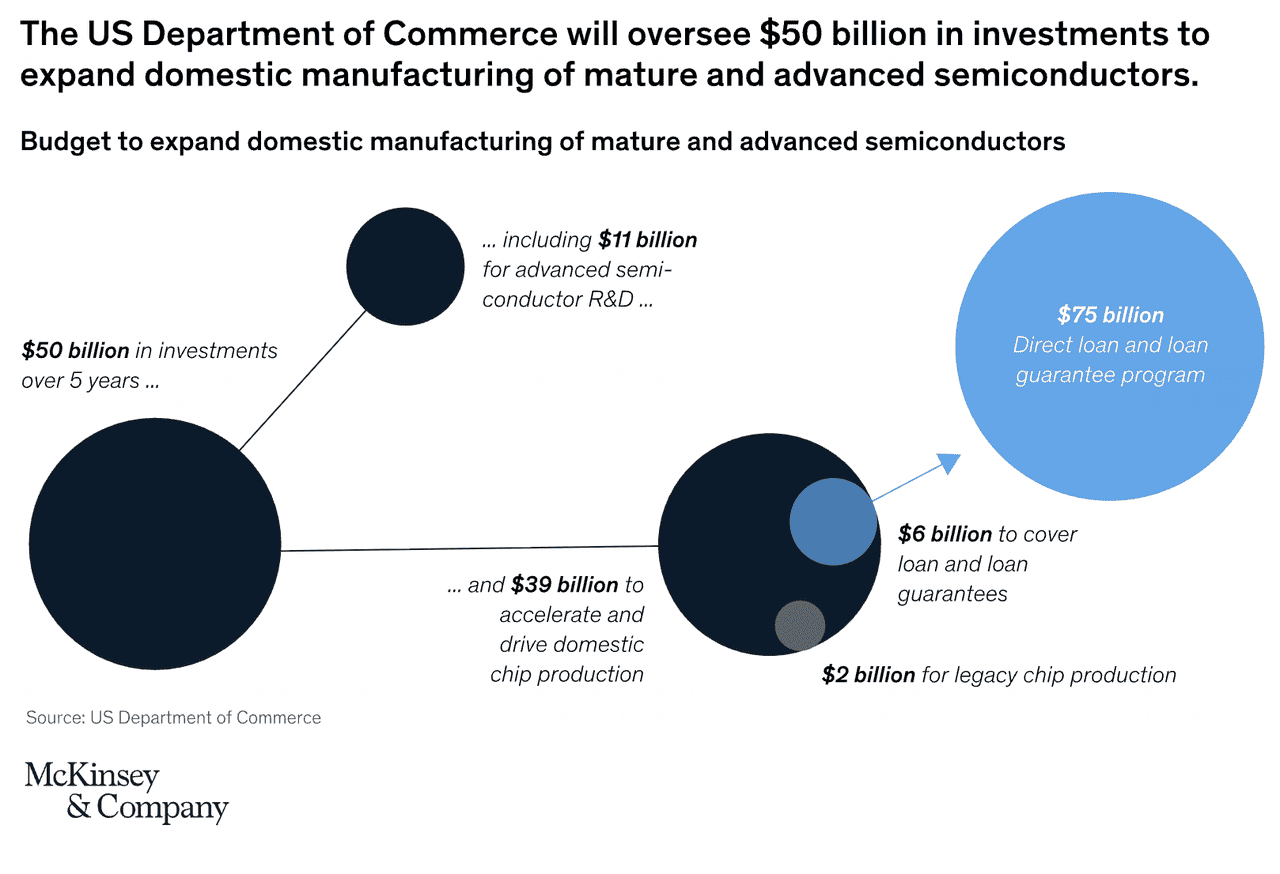
Source: McKinsey
The legislation includes several major pillars that are actively shaping the semiconductor industry in 2026:
- Manufacturing Grants: $39 billion in direct subsidies to companies building, expanding, or modernizing semiconductor fabrication plants (fabs) in the United States. This has already led to major projects by Intel, TSMC, Samsung, and GlobalFoundries.
- Investment Tax Credits: A 25% tax credit for capital expenses related to semiconductor manufacturing equipment and facilities, significantly improving project economics and encouraging private capital deployment.
- R&D and Workforce Development: $13 billion allocated for semiconductor research, new National Semiconductor Technology Centers, and workforce training programs to address the skilled labor shortage in the industry.
These incentives have triggered over $450 billion in announced private investments across the U.S., creating thousands of high-tech jobs and strengthening domestic supply chains.
Core Objectives and Restrictions
The primary goals of the CHIPS Act are national security and economic resilience. It includes strict guardrails preventing recipients from expanding advanced manufacturing in China or other countries of concern for 10 years. This aims to prevent U.S. taxpayer funds from indirectly supporting adversaries while strengthening domestic supply chains.
By bringing advanced chip production back to American soil, the Act reduces risks from geopolitical tensions, natural disasters, or trade disruptions, benefiting critical sectors including cryptocurrency mining rigs, AI hardware, and blockchain infrastructure.
Read more: Nvidia (NVDA) Stock Price Outlook for 2026: Can Blackwell and Vera Rubin Take NVDA Back to $300?
Global Context and Impact of the CHIPS Act on Cryptocurrencies
The CHIPS Act has triggered a global response, with the European Union launching its own European Chips Act and other nations introducing similar subsidies. This international competition is accelerating semiconductor innovation and investment worldwide.
For the crypto industry, the Act is highly relevant. Increased domestic chip production can lower costs and improve availability of GPUs and ASICs used in mining and AI training. Stronger U.S. semiconductor capabilities also support the growth of decentralized AI agents, Layer-1 blockchains, and high-performance computing infrastructure essential for scaling Web3 applications.
Read more: Micron (MU) Stock Price Forecast 2026: Can AI Memory and DRAM Demand Push MU to $500?
How Does the CHIPS Act Affect the Crypto Market?
The semiconductor industry is the backbone of cryptocurrency and blockchain technology through:
- Mining and Hardware: Greater domestic production of advanced chips can reduce reliance on foreign suppliers, potentially lowering costs and increasing availability of mining equipment.
- AI and DeFi Infrastructure: Enhanced semiconductor capacity supports the growth of AI agents and high-throughput blockchain networks that power modern DeFi applications.
- Technological Sovereignty: A stronger U.S. chip industry helps ensure that critical crypto infrastructure remains resilient against global supply chain disruptions and geopolitical risks.
Overall, the Act contributes to a more robust technological ecosystem that can accelerate innovation across crypto, AI, and decentralized technologies. The CHIPS Act indirectly benefits the crypto sector in several important ways:
1. The Looming Quantum Computing Threat
The Act has injected billions into domestic quantum infrastructure. Recently, the U.S. Commerce Department committed over $2 billion in federal incentives directly to a portfolio of quantum foundries like IBM and GlobalFoundries and hardware developers to fast-track the engineering of utility-scale, fault-tolerant quantum systems.
This aggressive acceleration drastically shortens the runway to "Q-Day", the threshold where quantum computers gain enough processing power to break legacy public-key encryption (such as RSA and ECC). Because these cryptographic algorithms secure Bitcoin, Ethereum, and the vast majority of digital wallets, blockchain networks face an increasingly urgent timeline to transition to post-quantum cryptography (PQC).
2. Geopolitics and Mining Equipment
A core objective of the Act is to reshore advanced chip fabrication to the U.S. while enforcing strict 10-year guardrails that restrict funding recipients from expanding semiconductor manufacturing in nations of concern, primarily China.
These stringent geographic manufacturing and export controls directly impact the production of Application-Specific Integrated Circuits (ASICs). Because crypto mining is entirely dependent on cutting-edge, highly specialized silicon, supply chain fragmentation and hardware tariffs are shifting the cost structure, availability, and geographic distribution of global mining rigs, forcing operations to look toward domestic U.S. hardware alternatives.
3. The AI-Crypto Hardware Intersection
Massive federal subsidies for state-of-the-art domestic microchip manufacturing have heavily fortified the physical infrastructure needed for high-performance computing (HPC) and Artificial Intelligence.
The boundaries between AI and crypto have largely blurred, particularly with the rise of decentralized AI computing networks and autonomous AI agent economies. Because both fields fight for the same high-tier silicon (GPUs and advanced accelerators), the local availability and cost of these subsidized chips dictate the computational power, scalability, and economic viability of next-generation Web3 protocols.
Read more: Top AI Compute and GPU Stocks to Buy in 2026: The Shift to Inference and Custom Silicon
How to Trade AI Semiconductor Stocks on BingX
BingX offers two distinct paths to gain exposure to these names without a traditional brokerage account. Tokenized stocks on the spot market track underlying shares on a 1:1 economic basis, while USDT-margined perpetual contracts on BingX TradFi provide leveraged exposure to price movement around the clock.
Buy, Sell, or HODL AI Semiconductor Tokenized Stocks on BingX Spot
For long-term investors seeking direct equity price exposure without leverage, the BingX Spot market offers access to fully backed tokenized stocks issued through regulated asset frameworks such as Backed Finance and Ondo Finance. These digital assets are designed to track real-world stock prices on a 1:1 economic basis and can be traded directly with stablecoins like USDT.
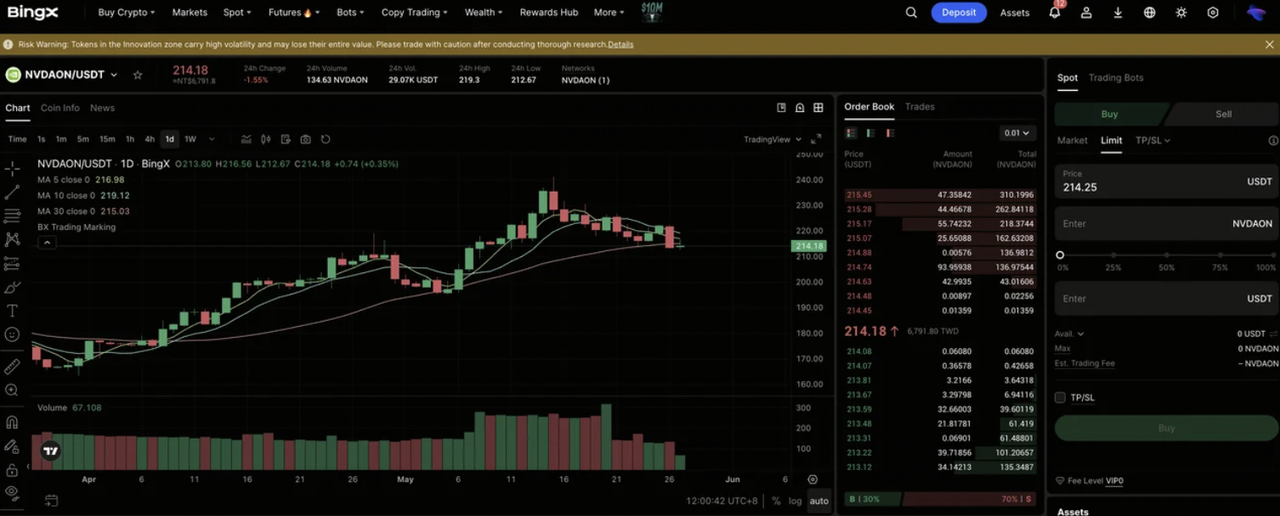
Step 1: Account setup and security. Sign up and log into your BingX account, complete the identity verification (KYC) required in your region, and enable two-factor authentication.
Step 2: Fund your spot wallet. Deposit USDT using your preferred network, e.g., TRC-20, ERC-20, or Arbitrum are common choices. Confirm minimum deposit and network fees before transferring.
Step 3: Navigate to the spot market. Search for tokenized stock pairs such as NVDAON/USDT or NVDAX/USDT for fully backed, non-leveraged exposure.
Step 4: Use BingX AI Analyst. The embedded BingX AI tool surfaces support and resistance levels, moving averages, and volatility indicators directly on the chart to help refine entries.
Step 5: Execute and settle. Select a market or limit order, enter your USDT amount, and confirm. The tokenized stock balance populates your spot wallet immediately on fill.
Trade AI Semiconductor Stock Futures with USDT on BingX TradFi
For active traders looking to capitalize on short-term market momentum, earnings volatility, or hedging strategies, BingX TradFi allows users to trade leading U.S. stock futures with USDT. These USDT-settled perpetual contracts mirror the price movements of underlying equities, offering flexible long and short exposure without requiring users to hold the physical stock or tokenized asset.
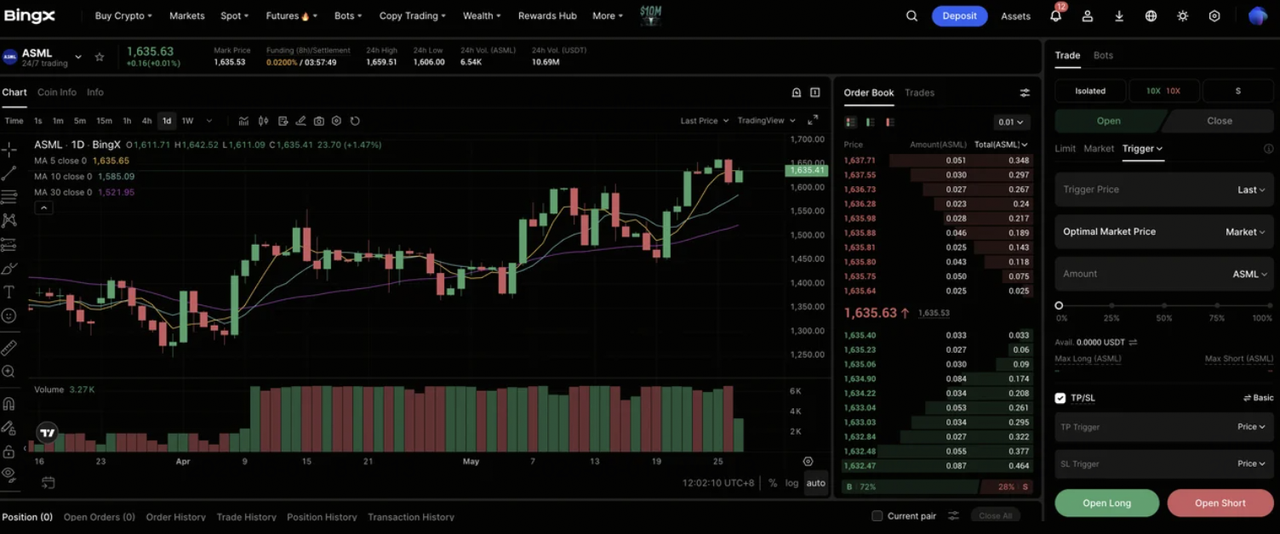
Step 1: Access the BingX TradFi interface. Sign up, log in and navigate to the TradFi markets page or the futures trading section.
Step 2: Capital allocation. Transfer USDT from your spot wallet into the futures account, where it serves as collateral.
Step 3: Select your contract. Choose from the lineup of stock-linked perpetuals such as ASML-USDT, TSMU-USDT, INTC-USDT, ARM-USDT, NVDA-USDT, AMD-USDT, AVGO-USDT, or MRVL-USDT.
Step 4: Set direction and leverage. Open long if you expect the stock to rise, open short to profit from a decline. Choose leverage according to your risk plan.
Step 5: Execute and manage risk. Set strict stop-loss and take-profit orders before submitting the trade. PnL settles dynamically in USDT.
Conclusion: Why the CHIPS Act Matters for Crypto and AI Stocks
The U.S. CHIPS and Science Act represents one of the most significant government investments in technology in decades. By strengthening domestic semiconductor manufacturing, it enhances supply chain resilience and supports innovation in critical areas like crypto mining, blockchain infrastructure, and AI development.
As the intersection of semiconductors, AI, and blockchain continues to deepen, policies like the CHIPS Act play a vital role in shaping the future of decentralized technologies. Trading on reliable platforms like BingX allows users to participate in this evolving landscape with confidence, liquidity, and efficiency.
Whether you are interested in semiconductor-related tokens or broader crypto markets, staying informed about major policy developments such as the CHIPS Act provides valuable context for navigating the 2026 crypto environment.
Related Reading
- Top AI Semiconductor Stocks to Buy in 2026: AI Chips and Supply Chain Complete Guide
- Top 10 AI Infrastructure Stocks to Buy in 2026: Chip Manufacturing and Design Leaders
- Top AI Compute and GPU Stocks to Buy in 2026: The Shift to Inference and Custom Silicon
- Top AI Cloud Infrastructure Stocks to Buy in 2026 Amid Hyperscaler Capex and the Neocloud Boom
- Roundhill Memory ETF (DRAM) Forecast 2026: $1.5B AI Supercycle or 'RAMmageddon' Trap?
