

Bitcoin and Zcash share the same fundamental monetary architecture: a hard cap of 21 million coins, a halving-based issuance schedule, and a proof-of-work foundation. On paper, they are more alike than almost any other two assets in crypto. In practice, they have diverged into two very different bets about what sound money means in a world of blockchain surveillance, regulatory pressure, and institutional adoption.
Bitcoin in 2026 is the institutionalized version: spot ETF listings, corporate treasury vehicles like Twenty One Capital and Strategy, and a growing narrative as digital gold for sovereign and institutional balance sheets. Its transparent ledger, once a selling point, is now a double-edged sword, enabling a level of financial surveillance that would be impossible in physical cash or traditional banking.
Zcash takes the same monetary scarcity model and adds cryptographic privacy as a first-class feature. While every Bitcoin transaction is permanently and publicly visible on the blockchain, Zcash's shielded pool uses zero-knowledge proofs to verify transactions without revealing the sender, receiver, or amount. Shielded ZEC transactions reached 59.3% of all Zcash transactions in February 2026, up from roughly 30% in early 2025, marking a structural shift in how the network is actually used.
This guide compares the two assets across scarcity mechanics, fungibility, regulatory positioning, and diversification logic, and explains why Bitcoin holders are increasingly looking at ZEC as a complementary position rather than a competitor.
ZEC vs. BTC: At a Glance (Q2 2026)
|
Zcash (ZEC) |
Bitcoin (BTC) |
|
|
Max Supply |
21 million ZEC |
21 million BTC |
|
Circulating Supply |
~16.66M (79% minted) |
~19.7M (94% minted) |
|
Block Time |
75 seconds |
~10 minutes |
|
Current Block Reward |
1.5625 ZEC |
3.125 BTC |
|
Next Halving |
~Late 2028 |
~2028 (approx) |
|
Privacy Model |
Optional shielded (zk-SNARKs; 59.3% of txs shielded) |
Transparent by default; no native privacy |
|
Fungibility |
High — shielded ZEC is indistinguishable |
Limited — coins can be 'tainted' and tracked |
|
Market Cap (Q2 2026) |
~$5.8B (~#15–20) |
#1 by a wide margin |
|
Institutional Adoption |
Growing — Foundry mining pool, Gemini, Coinbase |
Deep — BlackRock ETF, corporate treasuries, nation-states |
|
Consensus |
Proof of Work (PoS transition planned) |
Proof of Work (permanent) |
Bitcoin or Zcash, Store of Value vs. Private Store of Value
Bitcoin's digital gold thesis rests on three properties:
- Scarcity
- Verifiability
- Censorship resistance
Zcash accepts the first two and strengthens the third. Where Bitcoin's censorship resistance operates at the network level, no entity can prevent a transaction from being included in a block. Zcash's censorship resistance operates at the privacy level: no external observer can determine what is being transacted, to whom, or for how much.
That distinction matters more in 2026 than it did in 2016. The blockchain analytics industry, including Chainalysis, Elliptic, and TRM Labs, has turned Bitcoin's transparent ledger into a surveillance layer that governments, regulators, and financial institutions use to monitor asset flows in real time. This is not a hypothetical: Bitcoin’s transparency, initially presented as a feature, is increasingly being used as a tool for financial control.
Zcash's argument is that a true store of value needs fungibility, the property that one unit is interchangeable with any other. Physical gold is fungible: a gold bar from one source is worth the same as a bar from another. Physical cash is fungible: a $100 bill that passed through a drug transaction is worth the same as one from a paycheck. Bitcoin is not fully fungible, and that gap is precisely where Zcash makes its case as a private store of value.
Scarcity Mechanics: Comparing BTC and ZEC's 21 Million Supply Cap
Both Bitcoin and Zcash are capped at exactly 21 million coins. Both use a halving schedule to reduce new issuance over time. Bitcoin approximately every four years by block height, Zcash on a similar cadence (every 1,680,000 blocks, roughly four years). Both have completed two halvings. The monetary policy is, in engineering terms, nearly identical.
|
Supply Metric |
ZEC |
BTC |
|
Hard Cap |
21,000,000 |
21,000,000 |
|
Circulating (Q2 2026) |
~16.66M (79.3% of cap) |
~19.7M (93.8% of cap) |
|
Block Reward (current) |
1.5625 ZEC |
3.125 BTC |
|
2nd Halving |
November 2024 |
April 2024 |
|
Next Halving (est.) |
Late 2028 |
~2028 |
|
Block Time |
75 seconds |
~600 seconds |
|
Supply % Remaining |
~20.7% unmined |
~6.2% unmined |
There are two meaningful differences in supply mechanics.
First, ZEC has more unmined supply remaining (~20.7% vs. BTC’s ~6.2%), which means ongoing issuance pressure is proportionally larger on ZEC than on BTC. This is not a flaw in the model, but it does mean ZEC is earlier in its scarcity curve; the emission shock from halvings is more pronounced because there is more supply left to cut.
Second, ZEC’s 75-second block time means the network produces blocks eight times faster than Bitcoin. This doesn’t change the total supply cap or the halving schedule in any fundamental way, but it does mean ZEC transactions confirm faster and the network is technically better suited to payment use cases, a property Zcash leans into with its private payment positioning alongside the store-of-value thesis.
Why Bitcoin Holders Are Looking at Zcash, and How Intents Are Making It Easier
For most of Bitcoin’s history, the two communities have been adversarial. Bitcoin maximalists typically reject alternative coins as unnecessary distractions from the properties that make Bitcoin uniquely valuable: decentralization, immutability, and credible scarcity. Zcash has historically occupied a particularly awkward position in that framing, as a fork-adjacent project that adds complexity many Bitcoiners consider unnecessary if Bitcoin’s own privacy is improved at the protocol level.
That framing is shifting in 2026 for two distinct reasons. First, Bitcoin’s transparency problem has become more visible, not less, as blockchain analytics firms have built industrial-scale surveillance infrastructure atop the transparent ledger. Institutions and individuals who understand Bitcoin’s value proposition around scarcity are increasingly encountering its limitations regarding transactional privacy. Second, the practical barrier to moving between BTC and ZEC has dropped dramatically
NEAR Intents: Cross-Chain BTC → ZEC Without KYC
NEAR Protocol’s Intent architecture, a cross-chain solver network that enables asset swaps across chains without centralized intermediaries, has become one of the most significant infrastructure developments for Zcash adoption. Zodl Swaps (originally launched as Zashi Swaps in October 2025) runs on the NEAR Intents network and enables users to convert BTC, ETH, SOL, and USDC directly into shielded ZEC within the Zodl wallet without creating an exchange account, without KYC, and without routing through a transparent intermediate address.
As of March 2026: NEAR Intents has facilitated $1.5 billion in cumulative ZEC volume. Zodl Swaps alone has processed $600 million in cumulative volume.
The mechanics work as follows: a user expresses an intent (e.g., I want to swap 0.1 BTC for ZEC), the NEAR solver network finds the best execution path and fulfills the request, and the resulting ZEC lands in the user’s Zodl shielded wallet via a Unified Address. The ZEC arrives at a transparent receipt address controlled by the user’s wallet and is immediately routed into the encrypted pool, ensuring that the shielded balance is never contaminated by an on-chain trail connecting it to the source BTC.
For a Bitcoin holder who wants to allocate a portion of their savings to a fully private, scarce, hard-capped asset, this is the first time it has been genuinely easy to do at scale. The friction of setting up a separate Zcash wallet, finding a KYC-free on-ramp, and managing the transparent-to-shielded migration manually has been effectively eliminated.
Read more: The 2026 Guide to NEAR Intelligence: User-Owned AI Agents
Fungibility: Why Zcash Solves Bitcoin’s Dirty Coin Problem
Bitcoin’s dirty coin problem is straightforward: every BTC has a traceable history, and that history can affect its value and acceptance.
A BTC that passed through a darknet market, a sanctioned wallet, or a hacked exchange may be flagged by blockchain analytics software and refused by regulated exchanges, payment processors, or OTC desks. From a monetary theory perspective, this is a fundamental break in fungibility. Two units of the same asset are not treated as equivalent by the market. Bitcoin holders who receive tainted coins face real-world consequences: frozen accounts, rejected deposits, and in some jurisdictions, regulatory scrutiny.
Zcash’s shielded pool eliminates this problem by design. When ZEC enters the shielded pool, all prior transaction history is cryptographically severed. The network verifies, using zero-knowledge proofs (specifically the Halo2 system operating in the Orchard pool), that the ZEC being spent exists and hasn’t been double-spent without revealing any information about its prior path. Every shielded ZEC that exits the pool is indistinguishable from every other shielded ZEC, because they all carry no visible history.
By February 2026, 59.3% of all Zcash transactions were shielded, and over 4.9 million ZEC (more than 30% of total circulating supply) was held in private encrypted pools, an all-time high. The driver was a product default change: Zodl wallet began routing new users into the shielded pool automatically via Unified Addresses, removing the need for users to manually choose privacy.
|
Property |
Bitcoin (BTC) |
Zcash Shielded (ZEC) |
|
Transaction Visibility |
Fully public — sender, receiver, amount |
Private — none visible on-chain |
|
Coin History |
Permanently traceable from genesis |
History severed on entry to shielded pool |
|
Fungibility |
Imperfect — tainted coins face real-world issues |
Full — all shielded ZEC is indistinguishable |
|
Compliance Path |
Transparent by default; all flows visible to analytics firms |
Optional — view keys allow selective disclosure to auditors/regulators |
|
Privacy Mechanism |
None natively (Lightning and CoinJoin are imperfect workarounds) |
zk-SNARKs (Halo2 / Orchard pool) — mathematically proven |
|
% of Txs Private |
~0% natively |
59.3% shielded (Feb 2026) |
Zcash’s optional privacy model is also its main compliance advantage over fully private coins like Monero. Because Zcash supports both transparent and shielded transactions, institutions that need to demonstrate compliance can provide view keys, cryptographic proofs that allow specific counterparties (auditors, regulators) to see transaction details without exposing them publicly.
Monero faces delistings across European exchanges under MiCA; Zcash has maintained listings on Coinbase and Gemini, in part because its optional-privacy architecture provides a compliance path that mandatory-privacy coins cannot offer.
Diversification: Is Zcash the Ultimate Hedge for Bitcoin Holders?
Zcash is not a hedge against Bitcoin in the classical portfolio sense. The two assets are highly price-correlated during broad crypto market moves. When BTC falls, ZEC typically falls further. The case for holding both is not about return correlation but about property diversification: owning two assets with the same monetary policy but different risk profiles, regulatory exposures, and use-case positioning.
Where ZEC Adds Something BTC Cannot Provide
- Transactional privacy at scale: Bitcoin cannot currently provide on-chain privacy without significant friction (E.g., CoinJoin and Lightning routing complexity). ZEC’s shielded pool does it natively and, since the Zodl default change, automatically.
- Fungibility insurance: As blockchain analytics firms expand, the risk of receiving tainted BTC increases for anyone transacting in large volumes. Holding ZEC provides a pool of assets where fungibility is guaranteed by cryptography, not by counterparty trust.
- Regulatory asymmetry upside: If regulators ever impose more aggressive on-chain surveillance requirements on Bitcoin, not hypothetical, given MiCA and the trajectory of TFR rules in the EU, the value proposition of a compliant privacy asset like ZEC increases. This is a tail risk hedge, not a base case.
- Earlier-stage scarcity curve: ZEC has ~20.7% of supply remaining to be mined vs. BTC’s ~6.2%. This means ZEC’s halving-driven supply shocks are proportionally larger and more recent (the second halving was in November 2024). For investors who missed the early-stage scarcity story on BTC, ZEC’s supply schedule is arguably at a comparable point to where BTC was in 2017–2018.
- Infrastructure buildout: Ztarknet, Zcash’s planned Layer 2 that brings private DeFi on top of the base chain, positions ZEC as privacy infrastructure rather than just a payment coin. If private smart contracts become a significant market, ZEC gains an additional driver of demand beyond the store-of-value thesis.
Where BTC Remains Structurally Superior
- Liquidity and market depth: BTC has order books that dwarf ZEC across every major venue. Large institutions cannot take meaningful ZEC positions without moving the market significantly.
- Institutional acceptance: BlackRock, Fidelity, and sovereign funds hold or offer BTC products. ZEC has no spot ETF, no sovereign treasury allocation, and a much smaller institutional footprint.
- Regulatory clarity: BTC is the only crypto asset with clear, settled regulatory treatment across most major jurisdictions. ZEC’s privacy features, however optional and compliance-friendly, create residual regulatory risk that BTC does not carry.
- Network security: Bitcoin’s hash rate and mining infrastructure represent the most secure proof-of-work network in existence. ZEC’s mining ecosystem is smaller and more vulnerable to hash-rate-based attacks, a risk that grows as block rewards continue to halve.
The practical framing for a Bitcoin holder evaluating ZEC is that it is not a replacement but a complement, a way to hold a portion of savings in an asset with equivalent scarcity mechanics, but with cryptographic privacy guarantees that BTC cannot currently match. The risk is asymmetric in both directions: ZEC can outperform BTC significantly during privacy-narrative cycles (as it did in early 2026) and underperform significantly during periods when regulatory risk pushes the privacy coin category downward.
How to Trade ZEC on BingX: Step-by-Step
To trade Zcash (ZEC) on BingX, create and verify your account, deposit USDT or crypto, search for the ZEC/USDT pair, choose Futures trading, set your order type, manage risk with TP/SL, and execute your trade. ZEC is available on BingX’s futures market and is generally more volatile than BTC, so traders should use careful position sizing and avoid chasing sharp moves.
1. Create and Verify Your BingX Account: Visit BingX and sign up using your email or phone number. Complete KYC verification to unlock higher withdrawal limits and full platform access.
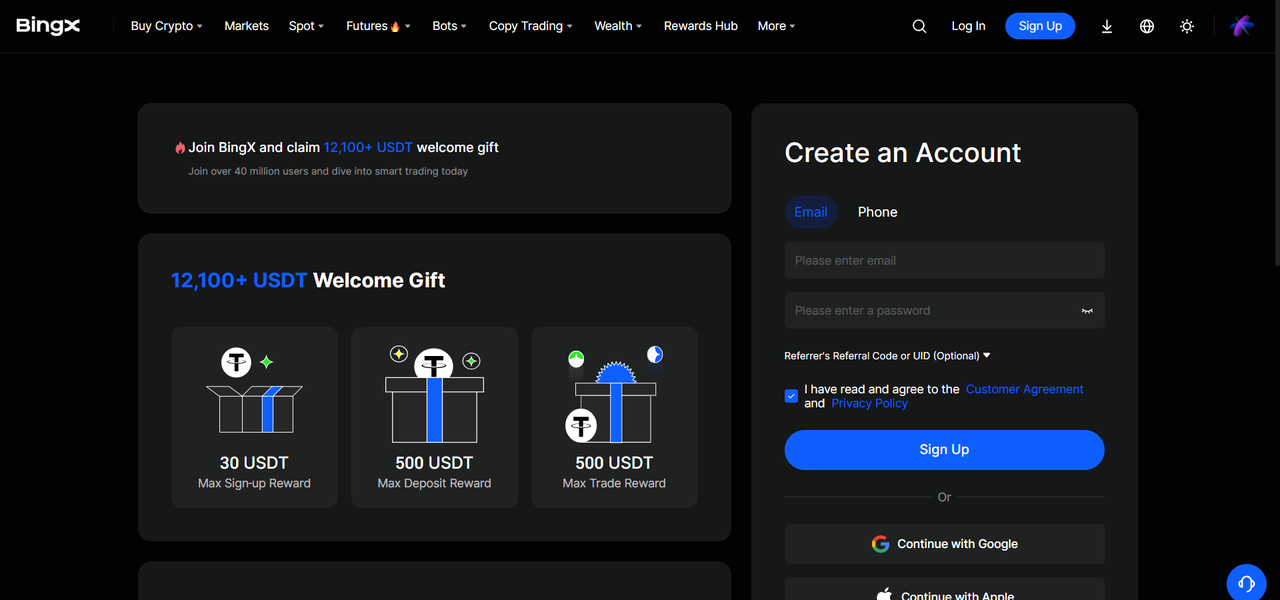
BingX account creation page — sign up with email or phone to get started.
2. Fund Your Account: Deposit crypto directly into your BingX wallet or buy USDT using a credit/debit card in supported regions. USDT is the most common base currency for trading ZEC.
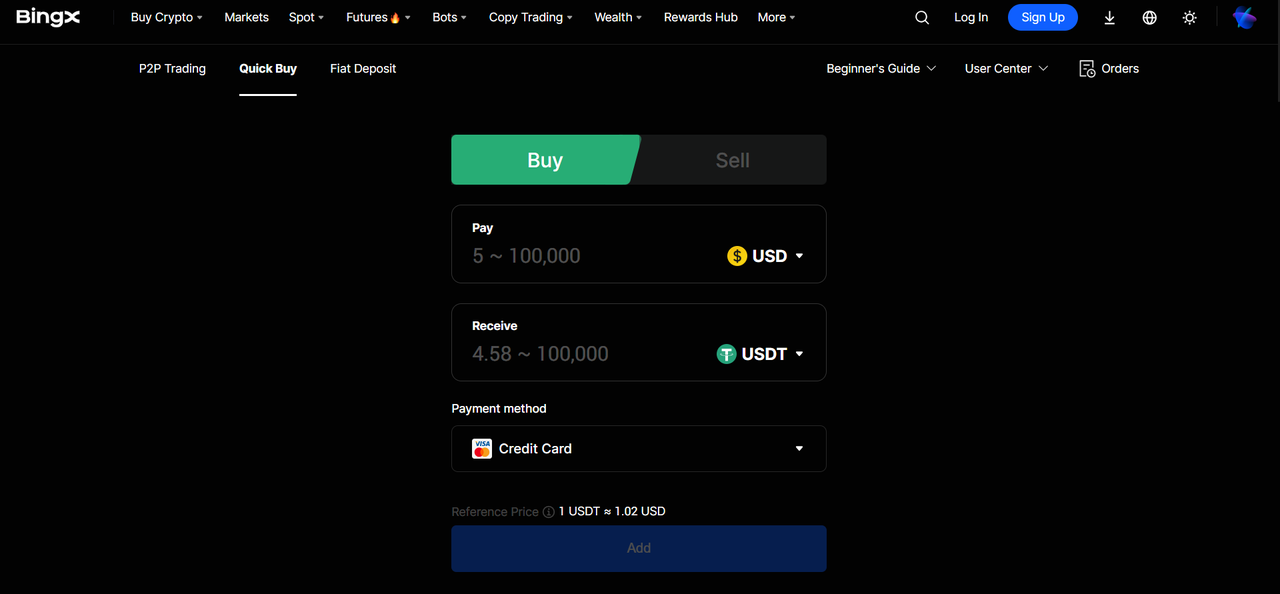
BingX Quick Buy — convert fiat to USDT directly via credit card.
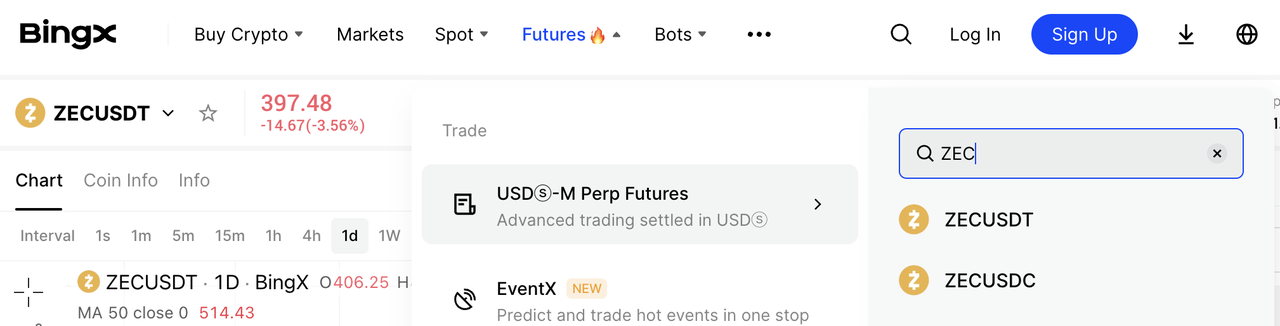
3. Search for ZEC/USDT: Use the BingX search bar and enter “ZEC” or “ZEC/USDT.” Select the ZEC/USDT perpetual contract to open the Zcash trading page.
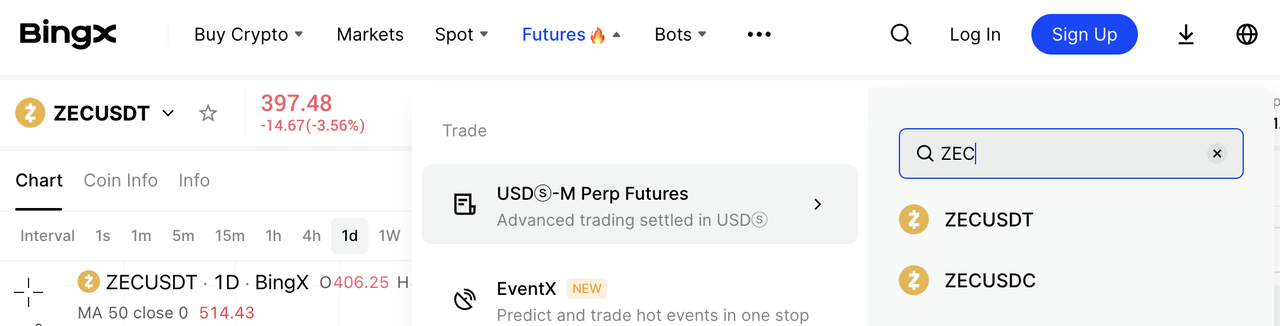
Searching ZEC/USDT on BingX brings up the available spot market.
4. Choose Futures Trading: ZEC is available on BingX’s futures market, which means traders can trade the token with leverage. Compared with BTC, ZEC usually moves more aggressively on a percentage basis, so avoid oversizing positions.
5. Use Limit Orders for Better Entry: Because ZEC’s order book depth can be thinner than major-cap assets like BTC or ETH, Limit orders are often better than Market orders. A Limit order lets you choose your entry price and helps reduce slippage during volatile moves.
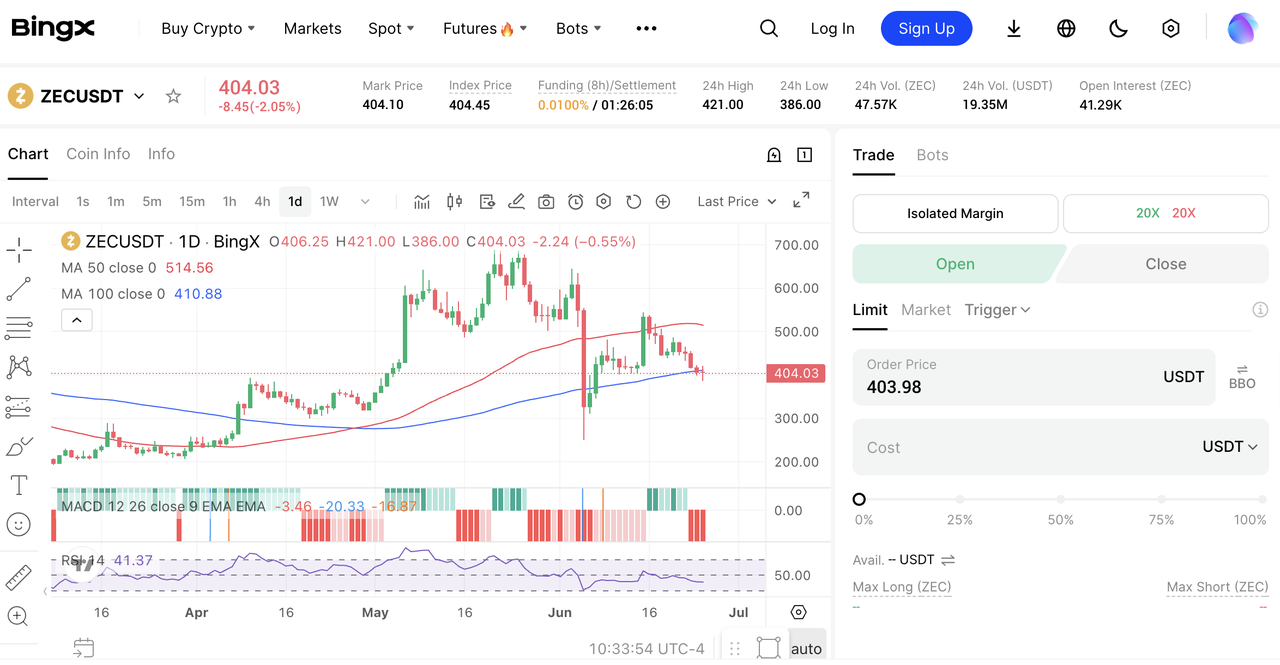
BingX Futures interface for ZEC/USDT — Limit orders help control entry price.
6. Set Risk Parameters: Before entering a trade, decide your stop-loss and take-profit levels. ZEC can see sharp drawdowns during market corrections, so using BingX’s TP/SL tools can help manage downside risk. Many traders use smaller position sizes on ZEC compared with BTC because of its higher volatility.
7. Monitor ZEC-Specific Catalysts: ZEC reacts to privacy-focused news more than most large-cap coins. Regulatory updates around on-chain surveillance, Monero delistings, privacy coin restrictions, or analytics firm developments can trigger sharp price moves. Traders should also monitor shielded adoption metrics, including shielded transaction activity and shielded pool growth, as these can signal stronger real-world utility.
8. Practice Before Trading Real Funds: BingX also offers demo trading and market analysis tools, which can help traders test ZEC strategies before using real capital.
BingX tools can help traders review ZEC price action before entering a live trade. Because ZEC is more volatile than BTC, traders should use smaller position sizes, prefer limit orders, and avoid trading more than they can afford to lose.
Conclusion
Bitcoin and Zcash share the same 21 million coin supply cap and proof-of-work foundation, but they serve different purposes. While Bitcoin dominates as digital gold, Zcash adds native privacy and fungibility through shielded transactions. For traders and investors seeking exposure to both transparent and privacy-focused digital assets, ZEC can complement a BTC portfolio. Whether you're investing long term or actively trading, BingX provides an easy way to buy, sell, and manage ZEC with spot trading, advanced order types, and built-in risk management tools.
Related Articles
- BNB NFTs in 2026: Top Collections, Marketplaces & How to Get Started
- Making Every Trade Efficient: A Guide to Stable Spot Portfolio Growth
- Risk Management in Crypto Trading: 7 Rules Every Trader Must Know
- How to Keep a Trading Journal: A Complete Guide for Crypto Traders
- Implied Volatility in Crypto: What It Means and How to Trade It
- Altcoin Season: What It Is, How to Spot It, and How to Trade It
FAQs on Zcash (ZEC) vs. Bitcoin (BTC)
1. What is Zcash and how does it differ from Bitcoin?
Zcash is a privacy-focused cryptocurrency that shares Bitcoin's 21 million supply cap and halving schedule, but adds optional shielded transactions that use zero-knowledge proofs. Bitcoin transactions are fully transparent; shielded Zcash transactions reveal nothing about the sender, receiver, or amount.
2. Do Zcash and Bitcoin have the same supply cap?
Yes. Both Bitcoin and Zcash have a hard cap of 21 million coins. Both use halving events to reduce new issuance over time. Zcash has approximately 79% of its supply minted, with ~16.66 million ZEC currently in circulation.
3. What is the Zcash dirty coin problem solution?
Zcash's shielded pool cryptographically severs the transaction history of ZEC that enters it. This eliminates the 'tainted coin' problem that affects Bitcoin, where coins associated with sanctioned or illicit addresses can be flagged and rejected by regulated services. All shielded ZEC is fungible — one unit is indistinguishable from any other.
4. Is Zcash a good hedge against Bitcoin?
ZEC and BTC are positively correlated in price — both tend to fall in broad market downturns. However, ZEC diversifies a Bitcoin position by offering regulatory exposure, privacy properties, and privacy-narrative-driven price cycles that don't affect BTC in the same way. It is a property hedge, not a price hedge.
5. When is the next Zcash halving?
The next Zcash halving is estimated for late 2028 (block 4,406,400). The most recent halving occurred in November 2024, reducing the block reward from 3.125 ZEC to 1.5625 ZEC. The next halving is expected to cut this to approximately 0.78125 ZEC.
6. What are NEAR Intents and Zodl Swaps?
NEAR Intents is a cross-chain solver network that enables asset swaps across blockchains without centralized intermediaries or KYC requirements. Zodl Swaps runs on NEAR Intents and allows users to convert BTC, ETH, SOL, and USDC directly into shielded ZEC within the Zodl wallet. As of March 2026, NEAR Intents had facilitated $1.5 billion in cumulative ZEC volume.
7. Can I trade Zcash on BingX?
ZEC is available for futures trading on BingX. Verify the current ZEC/USDT pair status on BingX before trading, as privacy coin listings can change with regulatory updates in different jurisdictions.
