
In early July 2026, Applied Digital Corporation (NASDAQ: APLD) stands at a defining operational and structural crossroads. Having successfully completed its transition from legacy cryptocurrency hosting to high-density, next-generation artificial intelligence (AI) and high-performance computing (HPC) infrastructure, the company is capturing monumental institutional demand for physical data center space.
Following a volatile quarterly close, Applied Digital's shares are currently trading at $35.52, navigating sector-wide consolidation and a temporary 15.95% weekly pullback. While APLD has locked in a resilient 26.36% year-to-date (YTD) gain, it remains highly volatile, down roughly 30% from its recent 52-week high of $50.73.
Investors are actively balancing an explosive multi-state infrastructure backlog against near-term balance sheet friction. In its latest quarterly disclosure, Applied Digital posted exceptional revenue growth that comfortably beat consensus expectations, yet deep GAAP net losses and a flurry of executive insider selling have sparked a high-stakes valuation debate between bullish Wall Street analysts and quantitative value skeptics.
This comprehensive guide dissects the APLD stock forecast and price prediction for the remainder of 2026, combining regulatory operational updates with fresh consensus models from Craig-Hallum, Lake Street Capital, Citizens JMP, and quantitative risk profiles.
You can trade APLD stock perpetual futures on BingX TradFi using flexible USDT collateral.
Top 5 Things for Applied Digital Traders to Know in 2026
As Applied Digital scales its ultra-dense data center footprint across North Dakota, Louisiana, and other southern states, market participants must closely track these core structural drivers:
- The $36 Billion Contracted Backlog: Applied Digital has secured long-term, 15-year take-or-pay lease agreements totaling over 1.4 Gigawatts (GW) of contracted capacity. This massive pipeline is projected to scale up to $86 billion if all 30-year renewal options are fully exercised.
- A Polarized Sentiment Structure: Wall Street brokers maintain a resounding Strong Buy consensus, with 11 out of 15 covering analysts rating it a top pick with zero Sell or Hold ratings. Conversely, quantitative risk services like Weiss Ratings carry an explicit Sell rating due to structural cash burn and fundamental debt stress.
- Severe Counterparty Concentration: Approximately 70% of Applied Digital's current contracted revenue backlog is tied to a single hyper-growth customer: CoreWeave. This extreme concentration means any timing slips or operational disruptions at shared sites will cut sharply in both directions.
- Modular, Labor-Light Construction Moat: To combat industry-wide construction and labor shortages forecasted to cause significant delays through 2026 and 2027, APLD utilizes a Lego-brick style pre-assembly approach offsite. This reduces onsite headcount requirements and helps avoid labor-saturated bottlenecks like West Texas.
- Aggressive Institutional Debt Accumulation: To finance its vertical scaling, Applied Digital has accumulated roughly $2.7 billion in total debt, recently pricing a $1.59 billion offering of 7.000% senior secured notes due 2031 alongside an expanded $430 million revolving credit facility.
What Is Applied Digital Corp (APLD)?
Founded originally to serve the power-dense requirements of digital asset networks, Applied Digital engineered highly specialized, large-scale industrial data infrastructures. Recognizing the secular compute bottleneck facing generative AI model training and deployment, the company pivotally repurposed its business model to design, build, and operate turn-key, direct-to-chip liquid-cooled data center campuses.
Today, Applied Digital operates as a premier digital real estate provider for the AI revolution. Rather than building competing software models, the company provides the physical infrastructure layer required by modern graphics processing unit (GPU) clusters. By securing enormous power commitments directly from utility grids and deploying waterless cooling technologies, APLD resolves the primary operational constraints of modern tech giants: energy scarcity, structural heat generation, and time-to-market infrastructure limits.
APLD Stock Performance in 2026: Financial Friction vs. Structural Scale
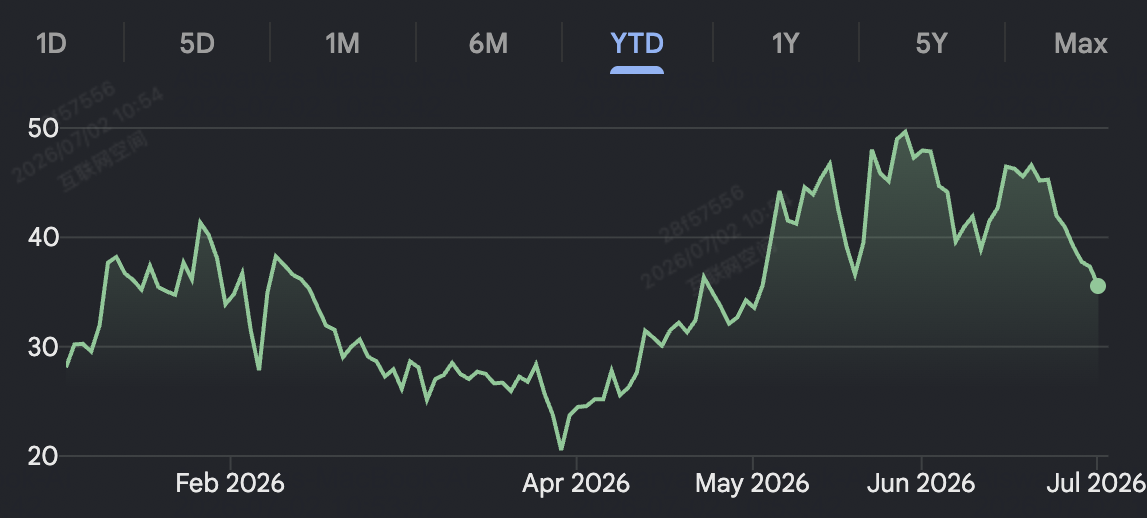
Applied Digital stock performance YTD as of July 2026 | Source: Google Finance
Applied Digital's fiscal 2026 performance highlights the capital-intensive friction of building a multi-billion dollar real estate empire ahead of actualized long-term recurring revenues. In its most recent quarter, revenue surged an impressive 139.3% year-over-year to $126.64 million, handily beating the analyst consensus estimate of $78.47 million by over 61%.
Applied Digital Corporation FY2026 Financial and Consensus Profile
|
Financial Metric / Segment |
Expected Value |
Reported / Revised |
Surprise / Trend |
|
Q3 FY2026 Revenue |
$78.47 Million |
$126.64 Million |
+61.37% Massive Beat |
|
Q3 Adjusted EPS |
-$0.21 |
$0.09 |
Positive Swing |
|
Q3 GAAP Net Loss |
— |
$100.90 Million |
352% YoY Deterioration |
|
Adjusted EBITDA |
$6.26 Million (YoY) |
$44.14 Million |
Explosive Scaling |
|
Full Year 2026 Revenue Est. |
— |
~$500.00 Million |
Forward Run Rate Target |
|
Total Balance Sheet Debt |
— |
$2.70 Billion |
Premium Capital Cost |
The fundamental catch lies within the accounting breakdown. While adjusted metrics point to an impressive operational swing, the headline revenue remains heavily flattered by one-time tenant fit-out work. On a GAAP basis, widening net losses, heavy stock-based compensation vesting, and high debt servicing costs continue to burn through capital, leaving the asset trading at a highly premium forward sales multiple of over 23x expected calendar 2026 revenue.
Applied Digital 2026 Trading Strategy: Managing Insider Activity and Concentration Risk
Successfully trading APLD for the remainder of 2026 requires market participants to look beyond simple adjusted earnings beats and focus on clear technical and structural indicators:
The $28.00 Structural Accumulation Floor
Technical analysts point to the $28.00 to $32.00 zone as the crucial horizontal support level. This range lines up with long-term moving averages and represents the valuation floor where institutional accumulation previously stepped in. If macro headwinds force a broad tech pullback, maintaining weekly closes above $28.00 keeps APLD’s long-term macro uptrend entirely intact.
Tracking Insider Behavior and Equity Dilution
A key warning light for momentum traders is persistent insider selling. Over the past 90 days, company directors and C-suite executives have sold over $1.2 million worth of shares in the $24.00 to $35.00 range with absolutely zero open-market purchases. Furthermore, the expansion of its Series G Convertible Preferred Stock commitment to $2.0 billion introduces near-term dilution risk that traders must actively hedge against.
The Second Anchor Tenant Catalyst
With 70% of current metrics concentrated on CoreWeave, the announcement of a formal contract execution with an alternative, independent high investment-grade hyperscaler, such as the rumored southern expansions at Polaris Forge 3, serves as the ultimate fundamental catalyst. Securing deep customer diversification will instantly de-risk the stock's capital profile and validate its premium data infrastructure multiple.
Applied Digital 2026 Stock Forecast: $90.00 Peak Target vs. $28.00 Structural Floor
Wall Street firms and quantitative risk models remain deeply divided on Applied Digital's short-term price discovery path, creating three distinct performance scenarios for the remainder of 2026:
The Bull Case for APLD Stock: $74.00 – $90.00 Peak on Pipeline Monetization
Led by an aggressive target hike from Lake Street Capital ($90.00) and Craig-Hallum ($79.00), bulls argue that Applied Digital’s $36 billion infrastructure backlog justifies an exponential valuation multiply. In this scenario, the company brings its 150 MW expansion at Polaris Forge 1 online on schedule while finalizing the construction of its 200 MW Polaris Forge 2 campus. As near-term contracted power converts cleanly into predictable, multi-year recurring lease revenue, institutional capital will re-rate APLD as a dominant alternative AI power utility, pushing the stock past its prior $50.73 peak toward the premium analyst targets.
Applied Digital's Base Case: $58.00 – $70.00 Consensus Plateau
Supported by maintained upgrades from Citizens JMP ($60.00) and the broader Wall Street average target of ~$70.56, the base case models a highly volatile, upward-sloping trading channel. Under this framework, Applied Digital successfully completes its immediate data center handoffs without severe labor constraints. However, near-term price appreciation faces resistance from the market applying a persistent risk discount to account for negative GAAP earnings, keeping the equity bound within a realistic consensus target zone of $58.00 to $70.00.
The Bear Case for APLD Stock: $28.00 – $34.00 Structural Support Test
Driven heavily by quantitative warning models and value-focused short sellers, the bearish thesis focuses entirely on balance sheet leverage and single-counterparty risk. If CoreWeave experiences any infrastructure deployment slips or if APLD encounters unexpected localized supply chain backlogs, its massive $2.7 billion debt load turns into an unforgiving weight. Under this scenario, a breakdown past intermediate horizontal support at $35.00 would expose the equity to a deep mean-reversion selloff back down to test its long-term asset-backed floor near $28.00.
Applied Digital (APLD) Price Predictions for 2026 by Wall Street Analysts
|
Covering Institution |
2026 Target (Avg/Peak) |
Core Analytical Outlook & Stance |
|
Lake Street Capital |
$90.00 |
Bullish: Boosted target from $70.00; highly confident in the monetization speed of the multi-gigawatt contracted pipeline. |
|
Craig-Hallum |
$79.00 |
Bullish: Maintained Buy; impressed by the company's lease flywheel and new multi-megawatt southern state sites. |
|
Wall Street Consensus Avg |
$70.56 to $73.36 |
Constructive: Reflects broad analyst optimism surrounding the $36 billion multi-year take-or-pay contract backlog. |
|
Citizens JMP |
$60.00 |
Outperform: Upgraded target from $40.00; highlights the massive operational scale of the liquid-cooled AI Factory infrastructure. |
|
Weiss Ratings |
Quantitative Sell |
Bearish: Reiterated an explicit sell rating; flags severe negative net margins, expanding GAAP losses, and dilution risk. |
How to Trade Applied Digital (APLD) Stock Futures on BingX TradFi
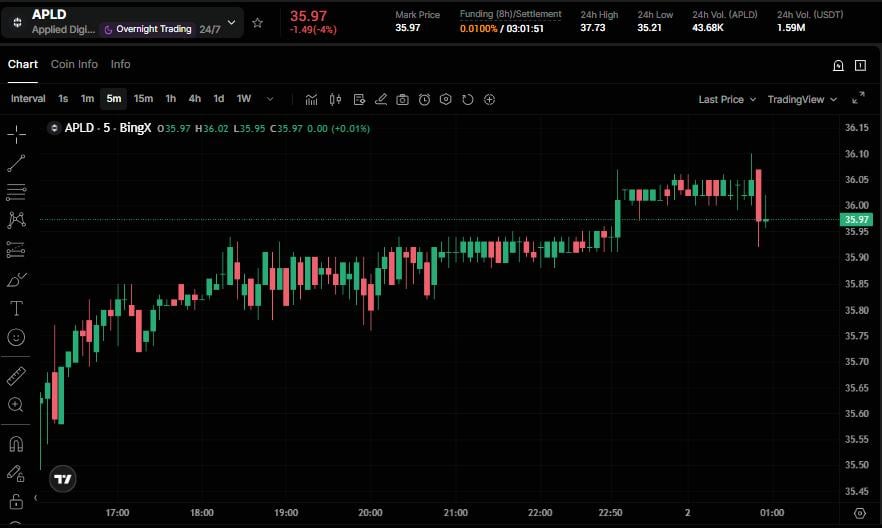
APLD/USDT perpetual contract on BingX futures market
Using the advanced BingX TradFi infrastructure, market participants can capitalize on Applied Digital's high historical beta, expanding backlog catalysts, and aggressive volatility:
- Access the BingX TradFi Portal: Log into your verified BingX account and navigate directly to the TradFi section on the primary exchange interface.
- Locate the Asset: Type APLD into the trading terminal search engine to select the APLD-USDT perpetual contract.
- Configure Leverage and Margin: Select your preferred structural risk protocol, Isolated Margin to strictly contain individual trade exposure, or Cross-Margin to manage broader pool liquidity. Set a disciplined leverage multiplier suited for high-beta equities.
- Establish Position Direction: Choose Open Long if you expect Applied Digital's modular construction model and imminent hyperscaler completions to drive the equity toward Wall Street's $90.00 peak target; choose Open Short if you expect widening GAAP losses and heavy insider selling to break the stock down toward its $28.00 floor.
- Deploy Advanced Risk Controls: Input your exact entry target, allocate your desired position size, and immediately engage mandatory Take-Profit / Stop-Loss (TP/SL) orders to completely insulate your capital from sudden after-hours gaps or market volatility.
Top 5 Risks to Consider Before Trading Applied Digital
Before committing capital to Applied Digital trading strategies, market participants must carefully evaluate these structural risk factors:
- Extreme Customer Concentration: Relying on CoreWeave for roughly 70% of contracted revenues exposes APLD heavily to the financial stability, hardware delivery timelines, and market fortunes of a single counterparty.
- Significant Balance Sheet Leverage: Managing $2.7 billion in high-interest debt means any operational delays or delayed lease activations will severely expand net losses and interest coverage stress.
- Dilution via Capital Raises: Increasing the Series G Convertible Preferred Stock commitment to $2 billion signals that management will continue using dilutive equity-linked structures to fund massive CapEx expansions.
- Adjusted vs. GAAP Performance Divergence: Automated quantitative funds and index models frequently trade on GAAP net income metrics. If GAAP losses continue to widen despite positive adjusted EBITDA optics, the stock may face systematic algorithmic selling pressure.
- Industry-Wide Supply Chain and Labor Constraints: While management's modular assembly limits onsite construction risks, macro shortages in specialized technical construction labor across 2026 and 2027 could still delay grid interconnections.
Final Thoughts: Is Applied Digital (APLD) Stock a Buy in 2026?
Applied Digital represents one of the most high-stakes, pure-play digital infrastructure opportunities operating at the heart of the generative AI hardware buildout. By lock-keying massive multi-megawatt utility access and engineering an operational blueprint around direct-to-chip liquid cooling, the company has successfully built a high-value real estate moat that software providers cannot duplicate.
However, trading an asset with a high beta of 5.69 navigating deep GAAP losses requires immense tactical discipline. For short-term derivatives traders, APLD's explosive operational beats, single-client dependency, and heavy institutional news flow provide an exceptionally fertile environment for momentum trading and volatility capture. Long-term investors must approach the asset defensively, monitoring the balance sheet closely to ensure that massive megawatt backlog figures turn smoothly into positive operating cash flow before over-allocating capital.
Risk Reminder: Early-stage digital real estate and AI infrastructure equities carry elevated execution, debt, and market risks. Always implement strict position sizing, keep trailing stop-losses active, and perform thorough independent due diligence.
Related Reading
- Top 10 AI Hardware Stocks to Watch in 2026: The Architecture Driving Next-Gen Intelligence
- Top AI Compute and GPU Stocks to Buy in 2026: The Shift to Inference and Custom Silicon
- Top AI Data Center Stocks to Buy in 2026: Cloud, Servers, and AI Compute Infrastructure
- CoreWeave Stock Price Prediction 2026: $250 Blackwell Boom or $35B Debt Trap?
- Top Energy Stocks and ETFs to Buy in 2026: The AI Power Crunch Meets Geopolitical Volatility
