
The global capital markets in mid-2026 are closely monitoring the hardware technology ecosystem as the lines between traditional consumer electronics demand and hyper-scale artificial intelligence data centers permanently dissolve. Direxion Daily Semiconductor Bear 3X Shares (NYSE: SOXS) serves as a primary vehicle for global day traders aiming to hedge against or profit from a short-term correction in this blistering tech run. By anchoring its core portfolio operations in cash-settled, short-term regulated derivative swap contracts rather than traditional equity ownership, the specialized investment vehicle presents a unique tactical allocation for the current macroeconomic climate.
As alternative asset platforms scale their hedging tools to compete directly with classic short-selling options, advanced trading desks are optimizing their holding windows to protect their net capital balances. Wall Street analysts indicate that the traditional tracking parameters for high-leverage inverse products are undergoing extreme pricing shifts throughout the second half of 2026. For international traders monitoring secular reversals in global hardware cycles and semiconductor output rails, tracking the performance metrics of the fund has become a core strategic imperative.
Read more: iShares MSCI South Korea ETF (EWY) 2026 Outlook: Can Semiconductor Supercycle Drive EWY to 250+?
Top 5 Things for Tech Investors to Know in 2026
- The Daily Triple Inverse Architecture: Operating under a rigid -300% single-day replication mandate, the vehicle acts as a direct financial mirror to the ICE Semiconductor Index. This model allows active portfolios to secure substantial short-term gains during market drawdowns without executing manual, high-maintenance margin shorts on individual names.
- The Compounding Volatility Decay Drag: Because the fund resets its structural leverage on a strict daily basis, intermediate-term holding strategies face severe mathematical decay. In choppy or sideways markets, this ongoing daily rebalancing process causes the asset's net value to drift lower, regardless of the underlying index's long-term trend.
- Heavy Hardware Sector Concentration: The underlying performance index is closely linked to a concentrated basket of global chip heavyweights. With a massive portion of its weighting driven by massive artificial intelligence and processing firms, the vehicle is directly sensitive to the capital expenditure updates of these specific hardware leaders.
- Advanced Derivative Liquidity Engines: Rather than holding physical common stocks, the fund relies entirely on swap agreements and over-the-counter futures contracts. This complex financial engineering allows the pool to maintain deep liquidity profiles on major exchanges like the NYSE Arca, accommodating high-volume institutional trades without disruptions.
- Purely Tactical Portfolio Positioning: The product is structurally engineered to serve as a high-velocity day trading mechanism or a temporary portfolio defense tool. Financial professionals view the asset as a poor choice for multi-month buy-and-hold strategies, instead treating it as an execution vehicle for short-term macroeconomic events.
Read more: What Is the U.S. CHIPS and Science Act? Its Impact on Semiconductors, Technology, and Crypto in 2026
What Is Direxion Daily Semiconductor Bear 3X Shares (NYSE: SOXS)?
Source: Yahoo Finance
Direxion Daily Semiconductor Bear 3X Shares is a leveraged inverse exchange-traded fund managed by Direxion Shares, a leading global pioneer in specialized, high-leverage trading products. Designed as a high-conviction instrument for advanced market participants, the fund seeks to deliver daily investment results that equal triple the opposite performance of the ICE Semiconductor Index.
Today, the asset ecosystem operates as a high-velocity trading gateway across three distinct focus disciplines:
- Leveraged Inverse Replication: The fund employs complex financial derivatives, utilizing institutional swap agreements with major investment banks to multiply underlying industry declines by three.
- Aggressive Portfolio Hedging: The retail-accessible product pool allows equity accounts to rapidly offset downward downside risk during tech sector corrections without needing to liquidate core structural stock holdings.
- Macro Component Monitoring: The fund's underlying index tracks the 30 largest U.S.-listed semiconductor enterprises, tying the fund's price directly to global production lines, foundry capacities, and hardware distribution channels.
With its prominent position as a primary vehicle for technology bears, the fund commands immense intra-day trading volume. In 2026, it operates as a deeply volatile, specialized instrument where rapid day trading strategies and macroeconomic semiconductor trends function side by side.
Core Details of SOXS ETF and Key Stock Metrics
- Primary Exchange Position: NYSE Arca / Leveraged Inverse Trading Segment
- Inception Date: Launched March 11, 2010 (Long-standing tactical industry trading tool)
- Fund Management House: Actively administered by Rafferty Asset Management, LLC
- Global Headquarters Location: New York City, New York, United States
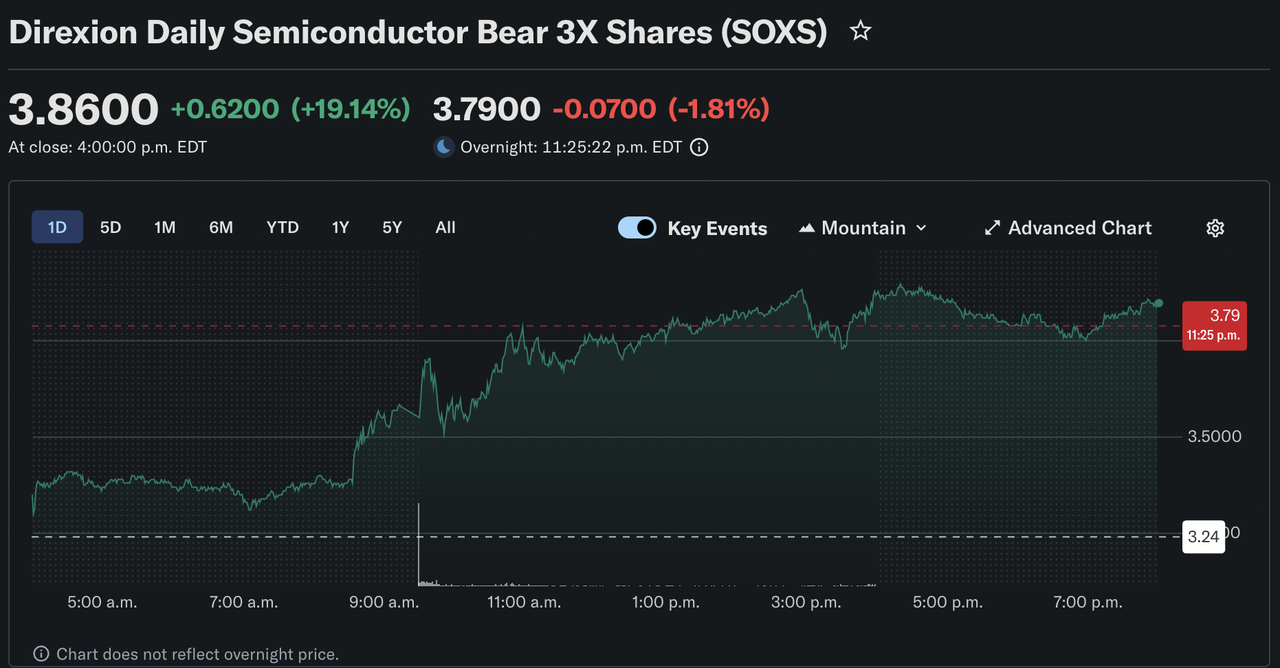
- Current Market Price: As of the July 1, 2026 market close, the stock finished trading at an asset price of $3.8600.
Key Financial and Operating Metrics Table
The fundamental data tracking the fund's operational footprint highlights the instrument's design heading into the second half of the 2026 fiscal year:
|
Financial and Operating Metric Category |
2026 Stated Value Status |
|
Current Stock Price |
$3.86 |
|
Target Sector Tracking Index |
ICE Semiconductor Index (30 Large Component Cap) |
|
52-Week Trading Range |
$2.11 to $14.65 |
|
Net Fund Management Cost (Expense Ratio) |
1.00% |
|
Underlying Rebalancing Frequency Profile |
Daily Reset (Every Market Closing Bell) |
|
Primary Holdings Architecture |
Institutional Index Swaps and Futures Derivatives |
|
Stated Leverage Factor Profile |
-300% (-3X Daily Inverse Replication Multiplier) |
|
Average 10-Day Trading Volume Profile |
Approx. 88.50 Million Shares |
|
Primary Index Semiconductor Weighting |
75.81% |
|
Primary Index Materials and Equipment Weighting |
24.19% |
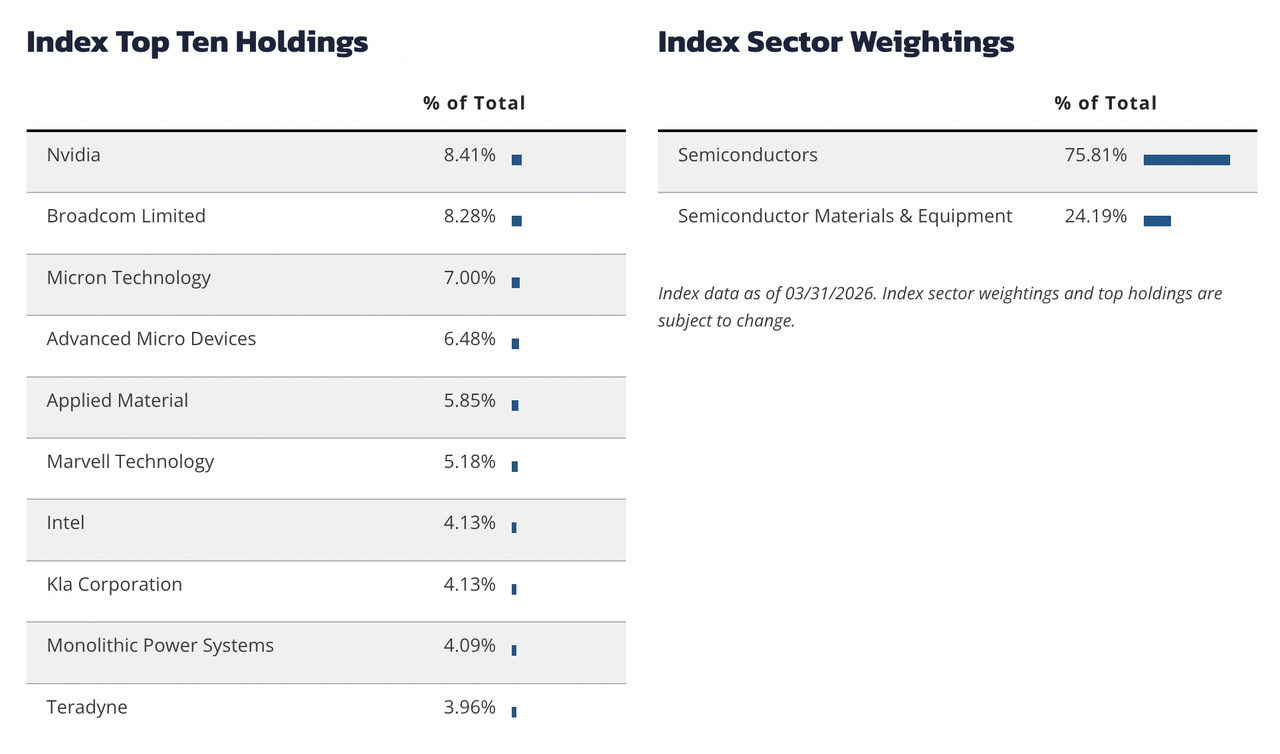
SOSX Semiconductor Index Top Ten Underlying Holdings
Source: Direxion
The fund's inverse performance is driven directly by the weighted market capitalization moves of the following leading global hardware components:
|
Index Component Company Name |
Ticker Weighting Status |
|
NVIDIA Corporation |
8.41% |
|
Broadcom Limited |
8.28% |
|
Micron Technology |
7.00% |
|
Advanced Micro Devices (AMD) |
6.48% |
|
Applied Materials |
5.85% |
|
Marvell Technology |
5.18% |
|
Intel Corporation |
4.13% |
|
KLA Corporation |
4.13% |
|
Monolithic Power Systems |
4.09% |
|
Teradyne Inc. |
3.96% |
2026 Tech Sector Investment Comparison
The table below contrasts the financial parameters, underlying attributes, and structural tailwinds defining the triple-short chip vehicle, traditional money center banks, and broad tech software channels in the 2026 market cycle.
|
Asset Class / Strategy |
Implied Focus Sector |
Primary Revenue Driver |
Primary Growth Tailwinds |
Structural Risks and Roadblocks |
|
Direxion Daily Semi Bear 3X |
Leveraged Inverse Technology Derivatives |
Triple-Inverse Daily Index Swap Agreements |
Short-term hardware cyclical corrections; rapid downside technological re-ratings. |
Severe compounding volatility decay; structural drag during long-term tech bull runs. |
|
Traditional Money Center Banks |
Multi-National Commercial and Retail Banking |
Traditional Spread Income and Investment Banking |
Deep institutional capital reserves; massive legacy corporate asset management operations. |
Heavy real estate branch maintenance overhead; slower integration of on-chain clearing systems. |
|
iShares Expanded Tech-Software ETF (IGV) |
Enterprise Application and Cloud Systems Software |
Pure-Play Software Licensing Contracts |
Rapid deployment of enterprise software; predictable recurring SaaS revenue. |
High dependency on compute pricing; zero defense against stock multiple compression shocks. |
Recent Corporate Developments and Strategy
Rather than behaving like a simple buy-and-hold equity position, the fund's mid-2026 structure relies on real-time derivative rebalancing and tight institutional execution lines.
1. Counterparty Swap Expansion Frameworks
In an effort to stabilize daily tracking during periods of high tech market volatility, the fund expanded its counterparty swap agreements to include a wider circle of global tier-one investment banks. This operational upgrade ensures the pool can maintain its strict -3X inverse execution targets, even during volatile trading sessions or unexpected earnings announcements from major chipmakers.
2. Intraday Rebalancing Safeguard Protocols
To manage risk during extreme market events, fund administrators updated their real-time intraday rebalancing protocols. If the underlying semiconductor index experiences an unprecedented single-day surge, these automated safeguards step in to rebalance derivative allocations mid-session, protecting the fund from sudden structural capital exhaustion.
Read more: Top 10 AI Infrastructure Stocks to Buy in 2026: Chip Manufacturing and Design Leaders
The Investment Thesis for 2026: 5 Pillars of Market Valuation
1. The Volatility Spike Monetization Tool
When technology sectors face valuation pressures, the vehicle delivers rapid capital appreciation. This extreme responsiveness allows short-term day traders to generate outsized returns during sharp market drawdowns without navigating complex options chains.
2. The Institutional Single-Ticker Hedge
The product gives large portfolio managers a clean, simple way to lower their technology exposure. By allocating capital to a single liquid ticker, fund managers can temporarily insulate multi-billion dollar portfolios from tech sector corrections, bypassing the high transaction costs of selling off core equity positions.
3. Asymmetric Profit Potential in Cyclical Downturns
As global chip supply chains catch up with demand, the semiconductor industry naturally faces inventory corrections. The fund's triple-inverse structure is perfectly built to capitalize on these cyclical tech pullbacks, turning cooling consumer and enterprise demand into clear trading upside.
4. Deep Capital-Efficient Derivative Pools
Because the vehicle maintains massive daily liquidity on major public exchanges, it provides smooth order execution. Active traders can scale into or out of significant positions quickly, benefiting from tight bid-ask spreads even when underlying technology markets are moving fast.
5. Zero Stock Liquidation Requirement
Using this leveraged tool lets investors temporarily protect their long-term holdings without triggering taxable capital gains events. By introducing short-term inverse exposure alongside their investments, market participants can navigate corrections cleanly while keeping their long-term equity foundations completely intact.
Read more: Nvidia (NVDA) Stock Price Outlook for 2026: Can Blackwell and Vera Rubin Take NVDA Back to $300?
SOXS Valuation and Performance Forecasts for 2026: Bull vs. Bear Outlook
Institutional research desks maintain an active dialog regarding the vehicle's short-term trajectory, balancing its aggressive hedging benefits against the persistent drag of daily compounding decay.
|
Institution / Analyst Desk |
2026 Target Valuation Range |
Market Outlook / Stance |
|
Susquehanna Tech Derivative Desk |
$12 |
Highly Bearish on Chips: Predicts a sharp near-term correction in hardware capex, leading to a major downward re-rating for chipmakers that pushes the inverse fund higher. |
|
Stifel Nicolaus Trading |
$9.50 |
Bearish on Chips: Expects cooling global data center demand to trigger an industry pullback, favoring short-term inverse trading positions. |
|
Raymond James Financials |
$6 |
Tactical Pullback: Sees moderate downside risk for the tech sector due to shifting inventory cycles, creating brief windows for active hedges. |
|
KeyBanc Capital Markets |
$6 |
Neutral / Range Bound: Expects choppy, sideways movement across the chip sector, which could erode the inverse fund's value through compounding decay. |
|
Goldman Sachs Global Markets |
$6 |
Neutral / Hold: Believes strong corporate software integrations will keep chip valuations stable, limiting the upside for inverse instruments. |
|
Bernstein Research |
$6 |
Bullish on Chips: Projects continued global demand for advanced computing hardware, likely keeping downward pressure on inverse vehicles. |
|
Wedbush Securities Tech Division |
$6 |
Highly Bullish on Chips: Anticipates persistent growth in enterprise infrastructure spending, warning that multi-month inverse holdings could face severe capital decay. |
The Bull Case: Cyclical Tech Pullbacks Fuel Rapid Price Surges
Bulls on the inverse fund argue that if enterprise infrastructure spending cools or hardware inventories pile up, the major chipmakers will face swift valuation corrections. Because the vehicle multiplies these sector drawdowns by three, a meaningful industry pullback would spark an immediate, powerful surge in the fund's price, delivering outsized gains to alert day traders.
The Bear Case: Strong Secular Growth and Constant Decay Pressures
Bears emphasize that the broader technology sector benefits from a long-term, structural expansion. If chip demand trends steadily upward over several quarters, the fund's -3X daily inverse reset mechanism will guarantee consistent losses, while ongoing volatility decay steadily reduces net asset value toward historical lows.
Competitive Risks and Sector Pressures for SOXS Traders
While the vehicle offers an efficient path to hedge against industry pullbacks, active market participants must carefully monitor several structural risks:
- Severe Mathematical Volatility Decay: Operating with a daily rebalancing mandate ensures the fund is vulnerable to compounding losses in choppy, non-trending markets. If chip stocks bounce up and down without a clear direction, the asset will lose value over time, even if the underlying index finishes right where it started.
- Long-Term Secular Growth Headwinds: Betting against the semiconductor sector means trading against a powerful, long-term secular expansion in global computing power. If the broader industry continues to scale, long-term inverse positions face a high risk of near-total capital erosion.
- Elevated Fund Holding Fees: Carrying a 1.00% baseline expense ratio makes the vehicle significantly more expensive than standard index products. These high ongoing management costs add an extra layer of structural drag, reinforcing the fund's design as a short-term tactical tool rather than a long-term portfolio holding.
Read more: Top AI Semiconductor Stocks to Buy in 2026: AI Chips and Supply Chain Complete Guide
How to Trade Direxion Daily Semiconductor Bear 3X Shares (SOXS) on BingX
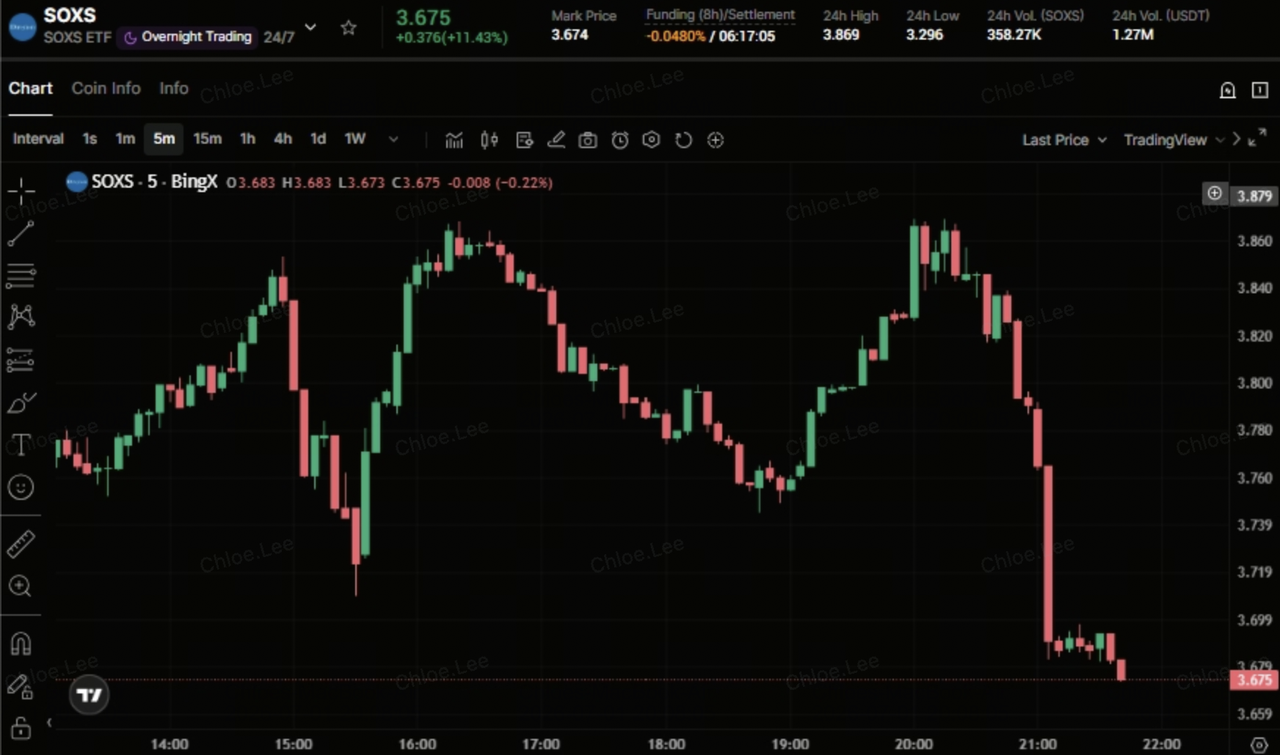
For global market participants looking to take advantage of the volatility surrounding tech earnings and semiconductor inventory cycles, trading derivative contracts offers a highly flexible, capital-efficient alternative to traditional stock ownership. This vehicle allows active traders to manage risk or target short-term price movements around major sector developments, much like how tech investors track updates across traditional finance (TradFi), semiconductor leaders like NVIDIA, or core digital assets like Bitcoin.
- Go to the BingX TradFi section and select Stock Futures.
- Search for the SOXS/USDT perpetual contract.
- Check the trading session before placing your order. Liquidity is typically lower during extended sessions, which can result in wider spreads and higher volatility.
- Select your Margin Mode (Isolated or Cross) and set your leverage.
- Choose Open Long if you expect momentum, strong chip architecture updates, or positive analog cycle inventory recovery. Choose Open Short if you anticipate margin pressures from heavy CapEx spending, factory execution delays, or valuation pullbacks.
- Set Take-Profit (TP) and Stop-Loss (SL) levels immediately to manage risk against SOXS's price swings driven by earnings, news, or global semiconductor production milestones.
Read More: Arm Holdings (ARM) Stock Outlook 2026: AI Licensing and the $200+ Price Target
Conclusion: Navigating the Inverse Leverage Frontier
The technology fund sector in 2026 is moving through an intense evolution. The investment tools positioned for sustainable utility are those that let advanced traders navigate fast-moving market trends with high precision. The strategic role of this vehicle as a regulated, triple-inverse trading instrument, backed by deep institutional derivative swap frameworks and clear index alignment, provides short-term market participants with a vital tactical option.
While traders must closely monitor daily compounding decay and broader technology growth trends, the fund's high liquidity and efficient execution architecture ensure it remains an important tool for capturing short-term market reversals. For day traders and portfolio risk managers alike, tracking the vehicle offers a direct path to navigate the changing electronics landscape as high-velocity derivatives and modern execution networks set a new global standard.
Risk Reminder: Derivative and leveraged investment contracts carry high market risk. Rapid shifts in central bank interest rates, sudden adjustments to futures clearing regulations, and unexpected margin requirement updates can cause sharp capital movements. Traders should always use disciplined risk management tools, sensible position sizes, and tight stop losses across every active session.
Related Reading
- Top AI Semiconductor Stocks to Buy in 2026: AI Chips and Supply Chain Complete Guide
- Top 10 AI Infrastructure Stocks to Buy in 2026: Chip Manufacturing and Design Leaders
- Top AI Compute and GPU Stocks to Buy in 2026: The Shift to Inference and Custom Silicon
- Top AI Cloud Infrastructure Stocks to Buy in 2026 Amid Hyperscaler Capex and the Neocloud Boom
- Roundhill Memory ETF (DRAM) Forecast 2026: $1.5B AI Supercycle or 'RAMmageddon' Trap?
