
In early 2026, AST SpaceMobile (ASTS) continues to stand out in the space technology sector. While many satellite projects remain conceptual, ASTS is executing real satellite deployments and advancing commercial service with major carriers. As of mid-2026, the narrative centers on BlueBird constellation scaling, direct-to-cell partnerships, and regulatory milestones.
AST SpaceMobile (ASTS) enters 2026 with strong structural tailwinds. The company is focused on constellation deployment, carrier integration, and global coverage expansion, projecting meaningful revenue growth and technological leadership. With key partnerships and upcoming launches, 2026 shapes up as a pivotal year for the satellite-to-phone pioneer.
This guide breaks down the AST SpaceMobile (ASTS) stock price prediction for 2026 using data from analysts and consensus estimates. You will also discover how to gain exposure to AST SpaceMobile (ASTS) stock futures through BingX TradFi.
Key Highlights: Top 5 Things for ASTS Investors to Know in 2026
- Satellite-to-Phone Technology Leadership: ASTS is pioneering direct-to-cell connectivity, enabling standard mobile phones to receive service from space. Successful BlueBird satellite tests have validated the core technology, with peak speeds demonstrated over 98 Mbps to unmodified smartphones. BlueBird satellites are massive, next-generation spacecraft designed to provide continuous, space-based cellular broadband directly to standard, unmodified smartphones
- Major Carrier Partnerships: Strategic agreements with AT&T, Verizon, Vodafone, and nearly 60 mobile network operators (MNOs) covering ~3 billion subscribers provide massive distribution channels and revenue potential as coverage expands.
- Revenue Momentum: The company ramped pre-commercial revenue in 2025 and has set ambitious 2026 targets ($150M–$200M) backed by growing government and commercial contracts.
- Polarized Targets: Analyst forecasts for 2026 show wide spread, ranging from cautious targets to highly bullish expectations above $130+.
- Valuation Debate: The market balances ASTS's high-growth potential and constellation milestones against capital intensity and execution risks.
What Is AST SpaceMobile (ASTS)?
AST SpaceMobile (ASTS) is a space technology company building the world's first space-based cellular broadband network. Its mission is to deliver direct-to-device connectivity to standard mobile phones anywhere on Earth on land, at sea, or in the air without requiring special hardware.
In 2026, AST SpaceMobile (ASTS) is viewed as a high-growth satellite infrastructure company with deep technological expertise. Its core value lies in eliminating coverage gaps and enabling seamless global mobile service through a constellation of Low Earth Orbit (LEO) BlueBird satellites. Unlike traditional satellite phone systems, ASTS works with existing cellular networks and standard smartphones.
AST SpaceMobile's Strategic Evolution (2017–2026): From Launch Vehicle Provider to Global Space Platform
Founded in its current iteration in 2017, AST SpaceMobile (ASTS)'s history features focused mission diversification. Early success in small-to-medium launch vehicle architecture led to spacecraft services and lunar landing diversification. A successful public listing marked mainstream entry. Recent years have focused on launch pad scalability, spacecraft payload integration, and strategic acquisitions. From small-satellite roots to multi-mission space infrastructure leadership, AST SpaceMobile (ASTS) has consistently built deep domain expertise.
Read more: Firefly Aerospace Stock Outlook 2026: Can Launch Vehicles, Spacecraft Services Drive FLY to $45+?
AST SpaceMobile's Key Growth Phases Over the Years
- The Technology Demonstration Phase (2017–2023): Focused on core IP development, ground testing, and the successful BlueWalker 3 mission that validated direct-to-cell technology.
- The Initial Deployment & Commercialization Era (2024–2025): First BlueBird launches, major MNO partnerships (AT&T, Verizon, Vodafone, etc.), initial revenue from gateways/government contracts, and manufacturing scale-up.
- The Constellation Scale Era (2026+): Targeting around 45 BlueBird satellites in orbit by end-2026, commercial service activation, revenue ramp, and expansion toward global coverage.
AST SpaceMobile's Financial Performance: Revenue Hits $70.9 Million in 2025
AST SpaceMobile (ASTS) delivered exceptional top-line growth in 2025. This carried into 2026 with strong liquidity (~$3.5 billion in cash as of Q1 2026) after significant capital raises, providing a fortress balance sheet to fund satellite production and launches. The company continues to invest heavily in manufacturing (capable of up to 6 BlueBirds per month) and has a substantial contracted revenue backlog/commitments exceeding $1.2 billion from partners.
AST SpaceMobile's Financial Performance: Revenue Hits $70.9 Million in 2025
AST SpaceMobile (ASTS) delivered exceptional top-line growth in 2025. This carried into 2026 with strong liquidity (~$3.5 billion in cash as of Q1 2026) after significant capital raises, providing a fortress balance sheet to fund satellite production and launches.
The company continues to invest heavily in manufacturing (capable of up to 6 BlueBirds per month) and has a substantial contracted revenue backlog/commitments exceeding $1.2 billion from partners.
The AST SpaceMobile Thesis for 2026: 5 Pillars of ASTS Stock Valuation
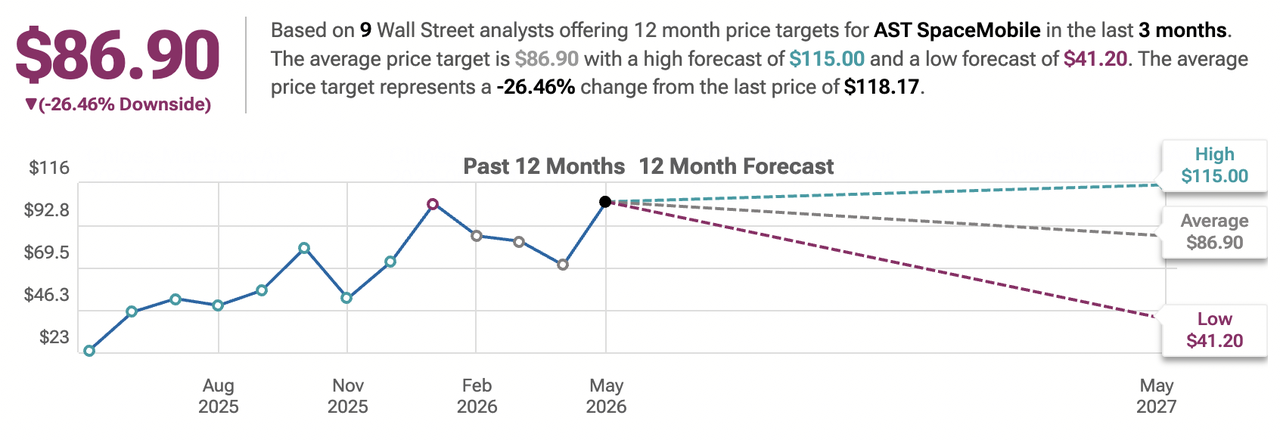
Source: TipRanks
- MNO Partnership and Distribution Moat: The Core Pillar Agreements with nearly 60 carriers, including AT&T, Verizon, Vodafone, covering billions of subscribers provide immediate go-to-market scale and revenue visibility as coverage comes online.
- BlueBird Constellation Scale: The Growth Pillar Targeting 45 satellites in orbit by end-2026 with Block 2 production ramping positions ASTS for initial commercial service and nationwide U.S. coverage potential, driving revenue acceleration.
- Technology & Regulatory Leadership: The Innovation Pillar Proprietary large-array antennas, direct-to-cell tech (demonstrated high speeds), extensive patents, and key approvals from FCC, international spectrum, etc., create a strong competitive edge.
- Backlog & Government Contracts: The Revenue Pillar Conversion of $1.2B+ commitments and U.S. government work (e.g., Missile Defense Agency, Space Development Agency) into recognized revenue supports operating leverage and growth.
- High-Barrier Capital & Execution Moat: The Defensive Pillar Massive cash reserves, vertical integration in manufacturing, and multi-launch provider strategy reduce single-point risks while creating high barriers for competitors.
Read more: Tesla (TSLA) Stock Outlook for 2026: Can the Great AI and Robotaxi Pivot Take TSLA Stock to $600?
AST SpaceMobile Price Forecasts for 2026: Bull vs. Bear Outlook
Institutional views on AST SpaceMobile (ASTS) remain active, reflecting massive long-term upside against execution and capital requirements.
The range from bullish targets above $130 to bearish consolidation models near $45 captures the market's ongoing assessment of capital expenditure cycles versus raw backlog growth.
|
Institution / Analyst |
2026 Price Target |
Market Outlook |
|
Goldman Sachs |
$110 to $130 |
Bullish: Successful constellation scaling and major carrier launches drive significant upside. |
|
Morgan Stanley |
$105 |
Bullish: Overweight rating based on partnership momentum and coverage expansion. |
|
Market Consensus (Aggregated) |
$75 to $95 |
Moderate Buy: Balanced view on revenue ramp versus capital intensity. |
|
JPMorgan |
$65 |
Neutral: Stable hold rating tracking near-term execution timelines. |
|
Bearish Outlooks (Various low-end) |
$45 to $60 |
Pessimistic: Focus on launch delays, dilution, and execution risks. |
Source: Aggregated from MarketBeat, TipRanks, Zacks, Yahoo Finance, and analyst reports (as of mid-2026)
The Bull Case: Constellation Expansion Drives ASTS Stock Price Above $130
Bulls focus on rapid contract monetization, explosive top-line revenue guidance scaling toward $150 million–$200 million and deep integration of space data software. If AST SpaceMobile (ASTS) maintains its triple-digit growth velocity, successfully scales its BlueBird mission timelines to target 45 to 60 satellites in orbit, and maximizes cash efficiency from its latest equity offering, the stock could achieve aggressive multiple expansions toward $130 or higher by year-end 2026.
The Bear Case: The Correction to $45 or Lower
Bears focus on structural cash burn and execution risk within highly technical environments. If spacecraft assembly pipelines encounter material delays, or if public equity dilution dynamics pressure near-term sentiment, multiples could consolidate, forcing the price floor back toward the $45 to $60 range.
Read more: Ondo Global Markets vs. xStocks: Which Tokenized Stock Platform Is Better in 2026?
How to Trade AST SpaceMobile (ASTS) Stock Futures on BingX TradFi
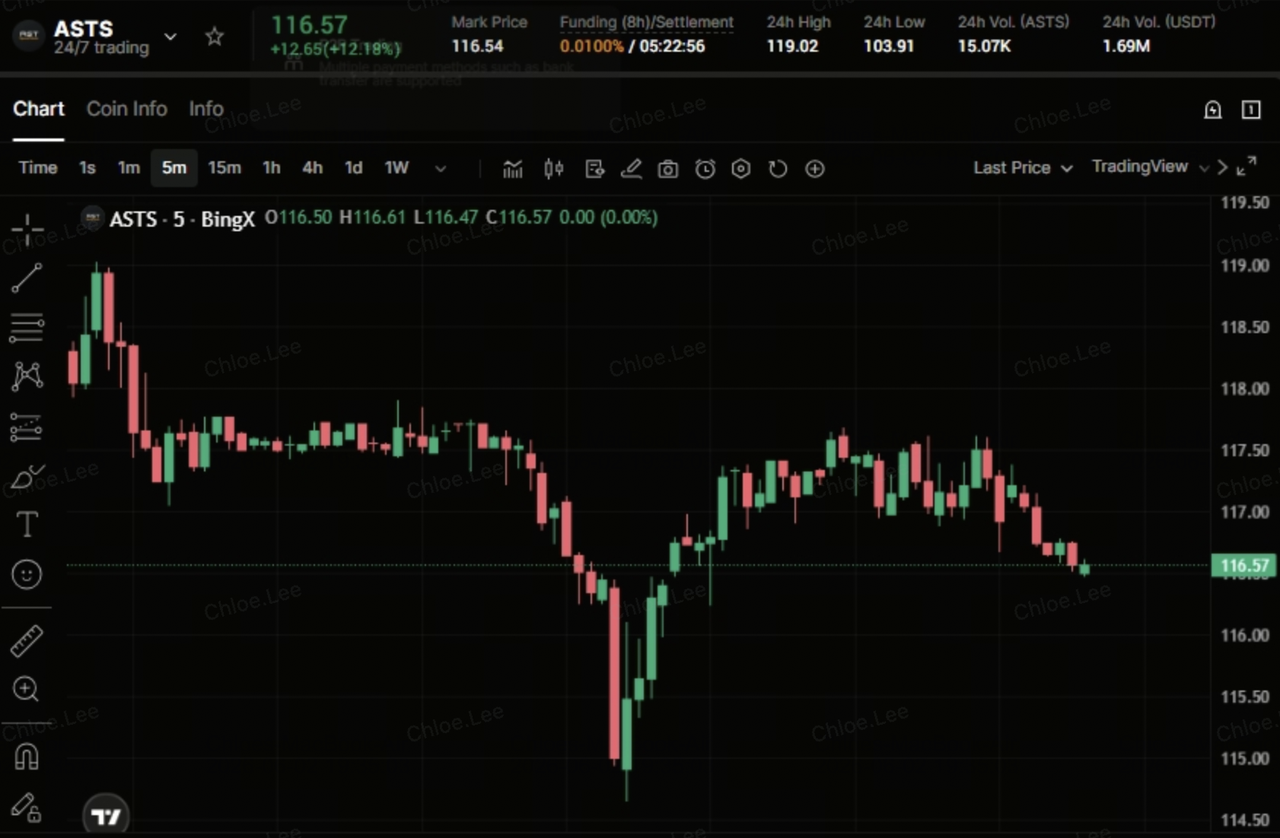
ASTS stock perpetuals on the futures market
For active traders looking to capitalize on high-volatility events like satellite launches and earnings reports, BingX TradFi offers advanced margin trading.
- Go to the BingX TradFi section and select Stock Futures
- Locate the ASTS/USDT perpetual contract.
- Choose your Margin Mode (Isolated or Cross) and set your Leverage (typically 2x–5x is recommended for equities).
- Analyze the trend and select Open Long if you expect a price increase or Open Short to profit from a decline.
- Set your Take-Profit (TP) and Stop-Loss (SL) levels immediately to manage risk against 2026's aggressive price swings.
Read more: What are Circle Tokenized Stocks CRCLX (xStocks) and CRCLON (Ondo) and How to Invest?
5 Critical Risks to Watch for AST SpaceMobile Investors in 2026
While AST SpaceMobile (ASTS) offers substantial upside through its specialized space and defense platform, investors face capital-intensive, technical, and regulatory challenges.
- Capital Expenditure and Cash Burn: Heavy investments in satellites, launches, and infrastructure continue to drive operating losses. Efficient capital use and future funding access are key.
- Launch and Technical Execution Risks: Satellite deployment depends on multiple providers; anomalies or delays (as seen with some prior missions) can impact timelines and sentiment.
- Revenue Recognition and Partnership Timing: Converting MOUs/contracts into actual revenue depends on coverage activation and commercial negotiations.
- Regulatory and Spectrum Challenges: International approvals and integration with terrestrial networks vary by country.
- Competition and Market Adoption: Rivals like Starlink Direct-to-Cell and broader economic factors could influence uptake.
Read more: What Is TradFi (Traditional Finance) On-Chain: A Beginner's Guide
Conclusion: Should You Invest in AST SpaceMobile (ASTS) in 2026?
Deciding whether to invest in AST SpaceMobile (ASTS) in 2026 requires viewing it as a high-conviction, long-term bet on space-based connectivity. For growth-oriented investors, successful constellation deployment, carrier partnerships, and revenue scaling present compelling upside. At the same time, the capital-intensive nature and technical risks mean volatility is likely. Monitor satellite launches success, partnership activations, and revenue milestones closely.
Risk Reminder: Trading and investing in equities like ASTS involves substantial risk of capital loss. Investors should conduct thorough independent research and consider professional financial advice before allocating capital.
Related Reading
- What Are Tokenized Stocks On-Chain, Could They Be the Next Big Trend?
- Ondo Global Markets Unlocks 100+ Tokenized U.S. Stocks on Ethereum - All You Need to Know
- Ondo Global Markets vs. xStocks: Which Tokenized Stock Platform Is Better in 2026?
- Tesla (TSLA) Stock Outlook for 2026: Can the Great AI and Robotaxi Pivot Take TSLA Stock to $600?
- How to Buy Google Stock in 2026: A Guide for TradFi and Crypto Investors
- Reddit (RDDT) Price Outlook for 2026: Can AI Data Licensing Drive RDDT Back to $200?