


Stablecoins now account for up to 90% of crypto asset transaction volume in Brazil, according to Federal Revenue data released at the end of 2025. This metric shifted the paradigm: the debate is no longer about "if" Brazilians use these digital assets, but rather which ones to strategically select. Whether you want to hedge your capital against BRL depreciation, trade the crypto market with less volatility, or execute low-cost cross-border remittances, choosing the right stablecoin makes a bottom-line difference.
Quick take: A stablecoin is a cryptocurrency engineered to maintain a stable value, typically pegged 1:1 to the US dollar or the Brazilian real. For Brazilian investors in 2026, the premier options are: USDT (deepest liquidity), USDC (highly regulated and transparent), BRZ (BRL-pegged), and DREX (the Central Bank Digital Currency, currently in roll-out). The optimal choice depends on your specific financial objective: spot trading, remittance, FX hedging, or generating passive yield via DeFi.
What is a Stablecoin and Why It Matters for Brazilian Investors
Think of a stablecoin as a digital traveler's check. You convert Brazilian Reais (BRL) into an asset that tracks the US dollar and moves on-chain, bypassing banking bureaucracy 24/7/365. When the USD rallies and the BRL slips, investors holding USDT or USDC successfully lock in their purchasing power instantly.
In Brazil, the primary catalyst isn't pure speculation—it's currency hedging. The Real depreciated by over 25% against the US Dollar between 2022 and 2025. During this macro cycle, capital parked in USD stablecoins preserved equity effortlessly.
There are four primary categories of stablecoins:
- Fiat-backed: Each token is backed 1:1 by cash or cash equivalents (like Treasury bills) held in bank reserves. Examples: USDT, USDC, BRZ.
- Crypto-backed: Collateralized by other crypto assets (primarily ETH), using over-collateralization mechanisms to absorb market volatility.
- Algorithmic: These use smart contracts and arbitrage algorithms to maintain the peg without physical underlying reserves. Historically high-risk: the UST/Terra collapse in 2022 wiped out roughly $40 billion. Proceed with extreme caution.
- Central Bank Digital Currencies (CBDCs): DREX is the Brazilian central bank's official project in this vertical.
How to Calculate the Real Yield of a Stablecoin
Before allocating capital, it is critical to understand the foundational calculation that differentiates basic returns from optimized yield.
Real Yield Formula in BRL:
Total Return (R$) = USD Yield x Final Exchange Rate (USD/BRL)
Practical Example:
You allocate R$ 10,000 into USDT when the exchange rate is at R$ 5.80, which equals $1,724.14 USD.
You deploy this capital into a DeFi liquidity pool yielding a 6% APY for 12 months:
- Ending Balance: $1,724.14 x 1.06 = $1,827.59 USD
- If the USD/BRL rate moves to R$ 6.20 at redemption: $1,827.59 x 6.20 = R$ 13,131.08
- Total Gain: +R$ 3,131.08 (+31.3%) on your initial capital in BRL.
Even if the exchange rate remained flat at R$ 5.80, your ending balance would be R$ 10,600, outperforming the CDI rate across most of the 2025 macro environment.
This dual vector of dollar-denominated yield coupled with FX appreciation is exactly why institutional asset managers maintain allocation in USD stablecoins. Implement robust risk management frameworks to determine the right portfolio weight for this asset class.
USDT (Tether): The World's Most Liquid Stablecoin
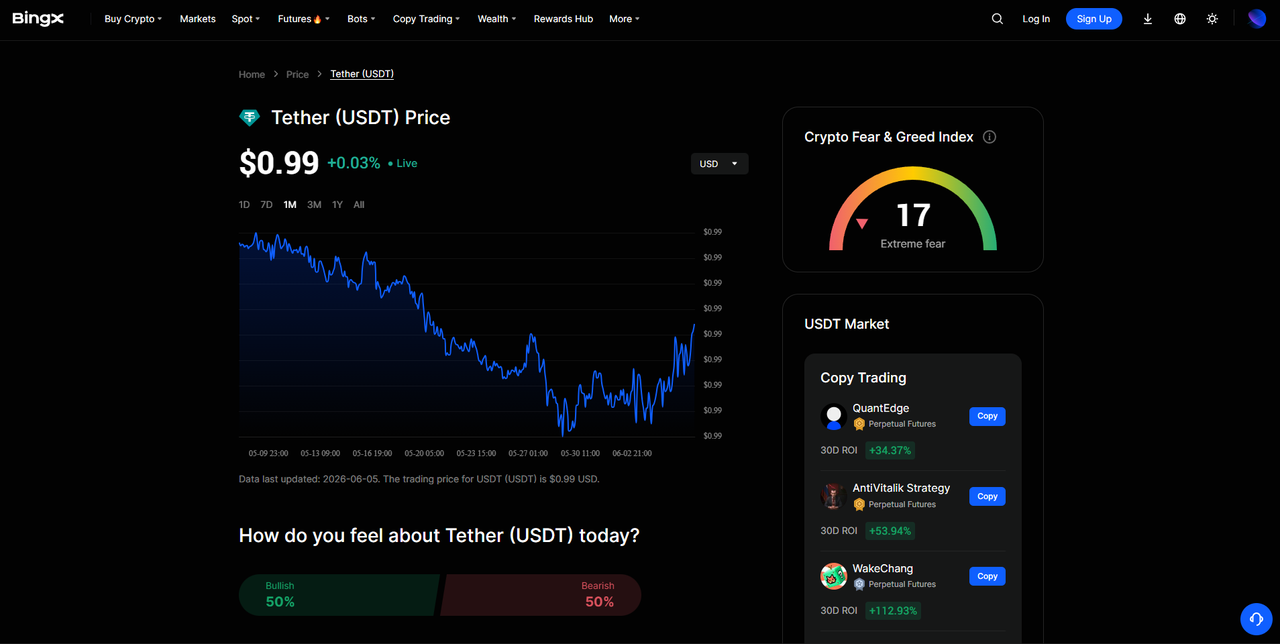
USDT remains the dominant stablecoin by volume in Brazil and globally. Tether reported over $186 billion in circulating supply in its January 2026 assurance report, with approximately $141 billion allocated to US Treasury bills by year-end 2025. This establishes the issuer as one of the largest private buyers of US T-bills globally.
In the Brazilian market, USDT captures the lion's share of order book volume across top crypto exchanges. Bid-ask spreads consistently print below 0.5%, indicating deep liquidity and highly competitive execution costs.
Why USDT is the Primary Market Entry Point
Liquidity is the ultimate value proposition. During high-volatility market events—where Bitcoin drops 20% in a 24-hour window—USDT allows traders to de-risk into stables within seconds, free from traditional banking hours or settlement delays. Trading pairs like BTC/USDT and ETH/USDT host the deepest order books across global digital asset platforms.
Key Risk Considerations
Tether operates as a private entity incorporated in the British Virgin Islands. While they provide regular attestation reports, fully comprehensive independent audits remain infrequent, drawing scrutiny regarding reserve transparency. For conservative allocators managing large capital pools, USDC serves as a highly regulated alternative.
Where to Buy in Brazil: BingX offers USDT pairs with deep liquidity capable of absorbing institutional-sized volume, alongside built-in infrastructure for copy trading and perpetual futures utilizing USDT as margin. For Brazilian traders looking to execute advanced strategies beyond passive holding, the platform provides an all-in-one execution environment.
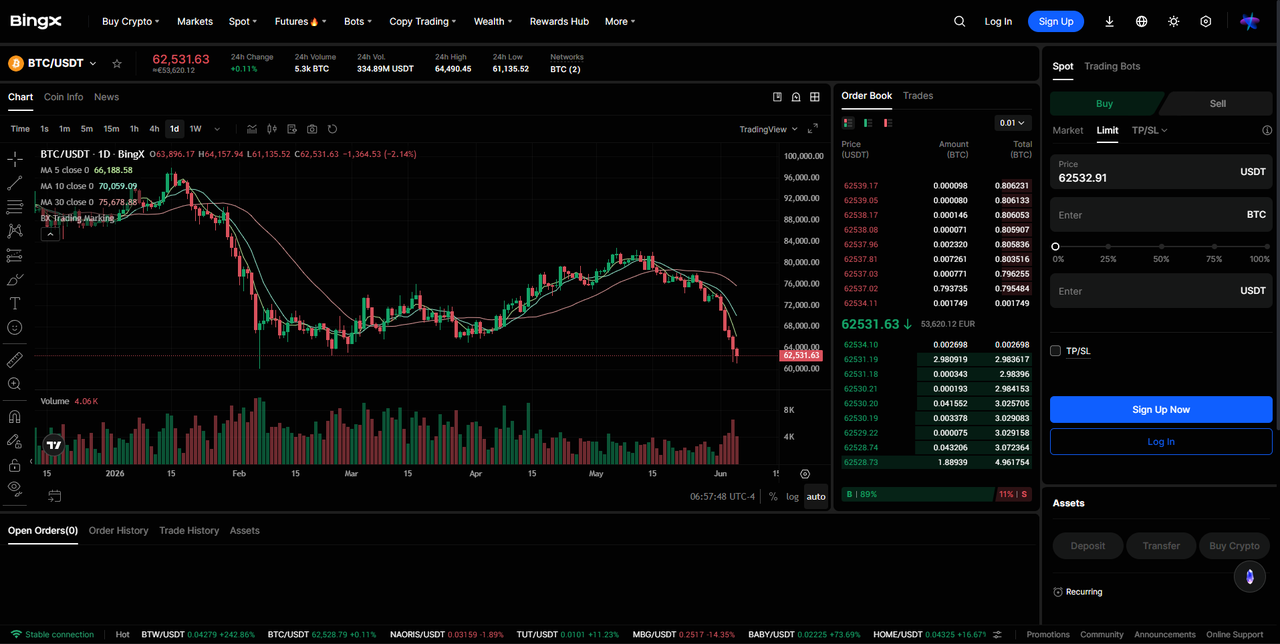
Trading the BTC/USDT pair on BingX
USDC (USD Coin): The Premier Choice for Compliance and Transparency
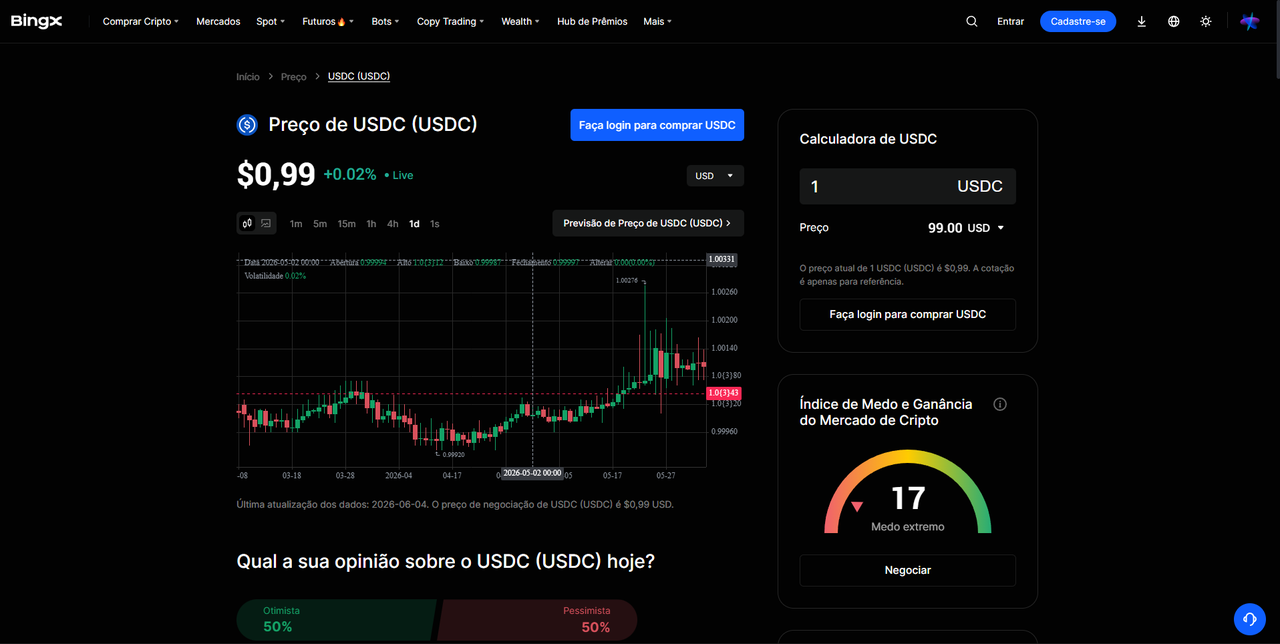
Issued by Circle in collaboration with Coinbase, USDC is widely recognized as the industry benchmark for transparent stablecoin reserves. Reserves undergo monthly third-party attestation audits and are backed entirely by cash deposits and highly liquid, short-duration US government obligations.
According to data from the BIS (Bank for International Settlements), USDT and USDC combined command over 95% of the aggregate circulating stablecoin supply, representing a combined market capitalization of roughly $270 billion as of March 2026. Explore the best and most popular stablecoins before finalizing your portfolio allocation strategy.
USDC in Practice
Institutional investors favor USDC primarily due to its regulatory-compliant profile. Funds and corporate treasuries that require concrete proof of asset origin and quality for balance sheet reporting find a much more robust documentation trail with USDC.
For retail traders, the operational difference is negligible. USDC maintains a stable peg, boasts deep liquidity across major pairs, and is available on all the same exchanges as USDT. Choosing between the two ultimately comes down to counterparty risk preference: if your focus is lower regulatory risk and superior transparency, USDC does the job. If your priority is maximum liquidity and trading pairs available on virtually every exchange on the planet, USDT still leads the pack.
The Silicon Valley Bank Episode
In March 2023, $3.3 billion of USDC’s reserves became temporarily trapped during the collapse of Silicon Valley Bank, causing the token to briefly depeg to $0.87. This event served as a stark reminder that even highly transparent stablecoins carry counterparty risk. Consequently, diversifying your stablecoin exposure isn't paranoia—it's smart risk management.
BRZ: The Brazilian Real-Pegged Stablecoin
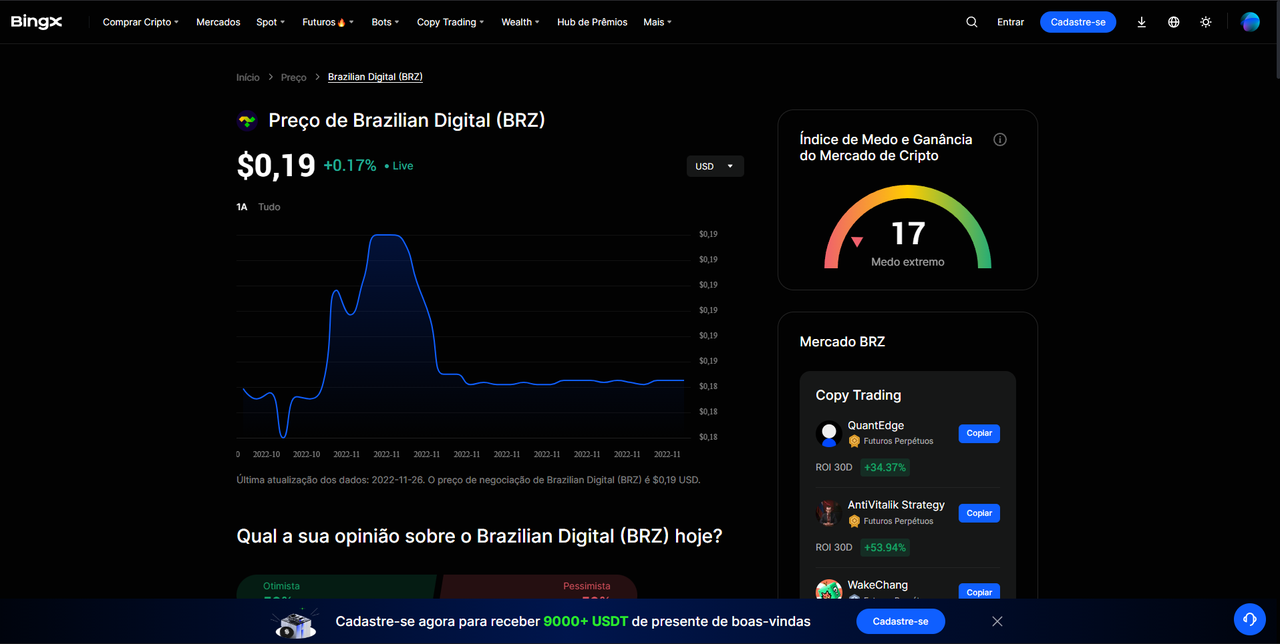
The BRZ (Brazilian Digital Token) is the largest stablecoin backed by the Brazilian Real (BRL), issued by Transfero Group. For investors looking to navigate DeFi protocols without taking on USD/BRL FX exposure, BRZ offers a compelling alternative: it allows you to maintain your purchasing power in Reais while leveraging blockchain infrastructure.
Practical use cases include:
- Settling trading operations without foreign exchange conversion friction.
- B2B payments within the Brazilian Web3 ecosystem.
- Accessing DeFi yields without FX volatility risk.
The main bottleneck is liquidity. BRZ suffers from limited presence on major international decentralized exchanges (DEXs), which narrows options for those trading outside the domestic market.
DREX: The Central Bank Digital Real
DREX is the Brazilian Central Bank’s CBDC project, succeeding the former "Digital Real" initiative. In November 2025, the Central Bank acknowledged technical hurdles in reconciling blockchain architecture with LGPD (General Data Protection Law) privacy standards and banking secrecy mandates. As a result, the project was refocused into a tokenization infrastructure operating without blockchain in its initial rollout phase, with a scaled-back implementation deferred to 2026.
Phase 2 is expected to scale the infrastructure to major tier-1 banks for initial public pilot operations, while Phase 3 plans to introduce widespread availability and complete integration into the legacy financial system.
Once fully deployed, DREX will stand as the only BRL-pegged stablecoin with sovereign backing—meaning its credit risk is tied directly to the Brazilian federal government. Expected taxation will follow standard crypto asset protocols (15% to 22.5% capital gains tax), though bespoke regulatory frameworks may emerge as the ecosystem matures.
For now, DREX remains out of reach for everyday retail investors. However, it represents a crucial strategic development: its eventual arrival will fundamentally reshape the landscape of BRL stablecoins.
Regulation: What Changed with BCB Resolution 521/2025
As of February 2026, stablecoins in Brazil operate under a revamped regulatory framework. BCB Resolution No. 521, published in November 2025, officially classified transactions involving foreign currency-referenced virtual assets as foreign exchange (FX) transactions under Law 14,286/2021.
The most immediate takeaway: trading USDT and USDC now triggers an IOF-Exchange tax at a flat rate of 3.5% on the converted amount. This shift primarily impacts institutional players utilizing stablecoins for cross-border payments or digital corporate treasuries. For retail investors employing a buy-and-hold strategy within exchanges, the day-to-day impact is minimal.
The critical friction point occurs during off-ramping back into BRL. Ensure all transactions are meticulously tracked and that you file a DARF tax form whenever monthly capital gains eclipse R$ 35,000. Leveraging exchanges that operate as fully regulated Virtual Asset Service Providers (VASPs) in Brazil will simplify transaction tracking for tax compliance purposes.
Comparison: USDT vs USDC vs BRZ in 2026
| Metric | USDT | USDC | BRZ |
| Peg | USD | USD | BRL |
| Issuer | Tether (Private entity) | Circle (US-regulated) | Transfero Group |
| Reserve Transparency | Partial | High | Partial |
| Liquidity (Brazil) | Very High | High | Low / Medium |
| DeFi Yields | Yes (via protocols) | Yes (via protocols) | Limited |
| Best Suited For | Active trading, FX hedging | Institutional, DeFi native | BRL-denominated operations |
| Primary Risk | Reserve opacity | Banking system risk | Low liquidity depth |
Where to Buy Stablecoins in Brazil: Key Factors to Consider
Before choosing a crypto exchange, evaluate these five practical criteria:
Trading Pair Liquidity: A thin order book forces you to accept worse execution prices (slippage). Always check the 24-hour trading volume for the specific pair you want to trade.
Spreads and Fees: The hidden cost of many trades lies in the spread rather than the explicit trading fee. Check out the BingX Fee Guide to understand the actual cost per transaction.
Fiat Withdrawals (BRL): Some exchanges take days to process Brazilian Real (BRL) withdrawals via TED or PIX. Verify limits and processing times before depositing significant volume. BingX supports withdrawals through its P2P Market with zero fees and native PIX integration.
Custody and Security: Mandatory 2FA, cold storage for the majority of funds, and a fully audited Proof of Reserves (PoR) are baseline requirements for a responsible platform.
Advanced Trading Tools: For traders looking beyond a basic buy-and-hold strategy, features like copy trading, futures, and built-in grid trading bots make a massive operational difference.
BingX checks all these boxes with a comprehensive product suite: support for USDT, USDC, PYUSD, and other major stablecoins across spot and futures markets, copy trading to replicate veteran strategies, and a fully localized Portuguese interface—a crucial detail for beginners looking to avoid costly misinterpretations.
Key Risks Every Crypto Investor Should Know
Stablecoins are not risk-free. Here are the primary risks to keep on your radar:
Depeg Risk: A stablecoin can lose its 1:1 parity with its peg asset. We saw this with USDC (SVB crisis, 2023), USDR (2023), and catastrophically with UST/Terra (2022). While larger, regulated issuers carry lower probability, the risk is never zero.
Regulatory Risk: Brazil's Central Bank Resolution BCB 521/2025 underscores how active local regulators have become. Sudden policy shifts can impact the cost or legality of specific crypto operations.
Counterparty Risk: On centralized exchanges (CEXs), you don’t directly hold your private keys; you rely on the platform's solvency and integrity. Moving your stablecoins to non-custodial wallets eliminates this risk, though it demands higher personal responsibility over key management.
Smart Contract Risk: In the DeFi space, code vulnerabilities and bugs can lead to total loss of funds. Allocating capital to audited, battle-tested protocols mitigates this but does not eliminate it. Always use compatible Web3 wallets with robust security layers when interacting with DeFi dApps.
FAQ: Stablecoins in Brazil
1. What is a stablecoin in simple terms?
It is a cryptocurrency engineered to maintain a stable price, usually pegged 1:1 to the US Dollar. Think of it as a digital dollar: you can transfer, store, and trade it within the crypto ecosystem without dealing with the high volatility typical of Bitcoin or Ethereum.
2. Can I earn yield on stablecoins in Brazil?
By default, holding USDT or USDC is just like holding physical cash—it doesn't inherently generate yield. To earn interest, you must deploy them in DeFi protocols (like Aave or Compound) or use yield products on centralized exchanges. Annualized yields ranging from 3% to 8% in USD were common throughout 2025, though rates fluctuate based on market demand. BingX offers native crypto staking options to seamlessly earn passive income on your stablecoins directly inside the platform.
3. Are stablecoins taxed in Brazil?
Yes. The Brazilian Federal Revenue (Receita Federal) treats stablecoins as crypto assets. Monthly sales/disposals exceeding R$ 35,000 must be declared and are subject to progressive capital gains tax (via DARF) between 15% and 22.5%. Additionally, under Resolution BCB 521/2025, conversions between BRL and USD-pegged stablecoins are hit with a 3.5% IOF-Câmbio (Foreign Exchange Tax).
4. What is the difference between USDT and USDC?
Both are backed by the US Dollar but differ in governance, transparency, and regulation. USDC, issued by Circle, features monthly independent audits and holds reserves exclusively in cash and short-term US T-bills. USDT boasts the highest global liquidity and trading volume but has historically faced less detailed auditing disclosures. Generally, traders opt for USDT for deep liquidity, while conservative investors lean toward USDC for regulatory transparency.
5. What is DREX, and when will it be launched?
DREX is the Central Bank of Brazil’s Central Bank Digital Currency (CBDC). Moving into 2026, it remains in the pilot phase, undergoing rigorous testing with institutional banking partners. Once open to the general public, it will serve as the premier sovereign BRL-backed digital currency, which will drastically shift the landscape for existing private BRL stablecoins like BRZ.
6. Which stablecoin is best for international remittances?
For cross-border payments that require low fees and high speed, using USDT on the Tron network (TRC-20) offers near-zero transaction fees and sub-minute settlement. Alternatively, USDC on the Stellar network provides highly competitive rates. Both setups completely outperform legacy banking wires in cost efficiency and speed. Use the BingX Crypto Converter to calculate your exact conversion costs before sending funds.
Essential Stablecoin Insights for 2026
- Stablecoins now account for up to 90% of all crypto transaction volume in Brazil, proving they have matured into essential financial infrastructure rather than a speculative niche.
- The global stablecoin market cap is projected to hit $500 billion in 2026 according to forecasts by Mercado Bitcoin—a massive 60% year-over-year surge.
- USDT maintains its dominant lead in market liquidity, while USDC commands the field in transparency and regulatory compliance.
- Resolution BCB 521/2025 introduced a 3.5% IOF-Câmbio tax on stablecoin conversions, impacting corporate players and institutional on/off-ramps far more heavily than retail traders trading within exchanges.
- DREX is not yet fully operational for retail use in 2026, but its arrival will introduce a sovereign, government-backed alternative for users looking for digital Brazilian Real assets.
- Algorithmic stablecoins have a documented history of catastrophic failure. Investors should steer clear of any project lacking transparent, fully-auditable collateral backing.
- For Brazilian retail traders, finding a crypto exchange that balances top-tier USDT/USDC liquidity, localized Portuguese support, and a robust suite of trading features beyond spot is the most efficient starting point.
Related Articles
- What Is USDT in 2026? A Complete Beginner's Guide to Tether's Stablecoin
- USDC vs. USDT: Key Differences and Which Stablecoin to Choose in 2026
- What Is USDC in 2026? A Complete Beginner's Guide to Circle's Stablecoin
- What Is a Stablecoin Depeg? Lessons from USDe, UST, and Other Historical Cases
- PIX and Crypto in Brazil: Why Stablecoins (USDT & USDC) Dominate the Market in 2026
