


Investing in Bitcoin (BTC) versus XRP presents a classic trade-off between a structurally decentralized, institutional-grade store of value and a high-efficiency, utility-oriented payment infrastructure asset. The two top-tier cryptocurrencies are engineered around fundamentally different objectives, leading to vastly divergent performances across shifting macroeconomic environments.
Through the back half of 2025 and into mid-2026, global markets faced a tighter macro landscape marked by persistent inflation prints and shifting central bank projections. Bitcoin, which set its ultimate historical high near $126,240 in late 2025, stabilized into a range of $60,000–$66,000 by June 2026. This consolidation reflects a broadening institutional profile that absorbs macro headwinds more like an equity index or digital commodity than a pure speculative play.
XRP, on the other hand, entered a monumental new phase. Following the final resolution of Ripple Labs' multi-year legal conflict with the SEC in 2025, the token systematically erased its regulatory discount. Supported by landmark legislative steps like the Digital Assets CLARITY Act clearing key committee milestones in mid-2026, XRP established a resilient macro baseline in the $1.15–$1.35 territory, moving dynamically into traditional banking structures.
As investors calculate structural changes for the rest of 2026, the question is no longer about which token is better in isolation. Instead, the focus has shifted to understanding their underlying structural architectures, monitoring real-time institutional product metrics, and determining how to strategically deploy both on BingX based on your specific risk profile.
Introduction: Understanding Bitcoin and XRP
To effectively evaluate these two assets for a 2026 portfolio, it is essential to trace their unique histories, foundational design metrics, and long-term market trends.
Bitcoin (BTC), the Decentralized Store of Value
Bitcoin was launched in January 2009 by an anonymous entity known as Satoshi Nakamoto, introducing the world’s first successful peer-to-peer electronic cash system.() Built as a direct response to the global financial crisis of 2008, Bitcoin was designed to exist completely outside the control of commercial banks, corporate boards, and sovereign governments. Rather than relying on human institutions, its trust layer is entirely derived from immutable mathematical logic and decentralized distributed ledger mechanics.
Over its 17-year timeline, Bitcoin has achieved massive milestones, evolving from a niche cypherpunk experiment into a highly regulated macroeconomic reserve asset. Key historic inflection points include the debut of the Lightning Network layer-2 protocol for scalable processing, corporate balance sheet adoption by public firms, and the watershed launch of spot Bitcoin ETFs in early 2024. In terms of market performance, Bitcoin has rebounded from multiple multi-year bear market cycles to establish long-term exponential growth, surging from fractions of a cent at inception to a historic peak of $126,240 in late 2025, maintaining a multi-trillion-dollar dominance over the broader crypto market.
XRP, the Enterprise Infrastructure Network
XRP was created in 2012 by technology pioneers Jed McCaleb, Arthur Britto, and David Schwartz, with its underlying open-source blockchain managed primarily by the XRPL Foundation. The token was optimized specifically to function as an institutional bridge asset for instantaneous, ultra-low-cost cross-border remittance and international banking settlement. The fintech company Ripple Labs was subsequently formed to build specialized enterprise software products, such as On-Demand Liquidity (ODL), utilizing the XRP Ledger to update the fragmented legacy SWIFT network.
XRP’s operational timeline has been defined by extreme corporate adoption milestones and intense regulatory battles. It built deep payment network relationships with over 300 international banking entities, but faced severe headwinds starting in December 2020 when the U.S. SEC initiated a high-profile lawsuit against Ripple Labs. The resolution of this legal case via a final settlement in 2025 marked a historic turning point, clearing its open-market regulatory status and paving the way for the historic launch of spot XRP ETFs. Historically, XRP has delivered massive cyclical price returns, setting an all-time high of $3.84 in January 2018, and building an exceptionally strong asset base above $1.00 in the post-settlement era of 2026.
Bitcoin vs. XRP's Core Operational and Technical Differences At a Glance
Despite being two of the most widely recognized digital assets, BTC and XRP diverge sharply across their underlying protocols, issuance mechanisms, and target ecosystems.
|
Factor |
Bitcoin (BTC) |
XRP (XRP) |
|
Primary Use Case |
Decentralized store of value ("Digital Gold") |
Cross-border payments, bank settlements, and asset tokenization |
|
Consensus Mechanism |
Proof-of-Work (PoW cryptographic mining) |
XRPL Consensus Protocol (Federated node voting) |
|
Transaction Speed |
7–15 transactions per second (10+ minute block confirmations) |
1,500+ transactions per second (3–5 second settlements) |
|
Average Base Fee |
Variable structural fees ($1.00 to $30.00+ depending on load) |
Fixed programmatic burn (Standard minimum of 0.00001 XRP) |
|
Total Token Supply |
Hard-capped mathematically at 21 million BTC |
Pre-minted fixed supply of 100 billion XRP |
|
Decentralization Profile |
Unowned, globally distributed miner network |
Open-source ledger with managed escrow holdings by Ripple Labs |
1. Consensus Mechanism: Security vs. High-Volume Speed
Bitcoin uses Proof-of-Work (PoW) running on the SHA-256 algorithm. Miners globally compete with hardware power to validate cryptographic puzzles, creating a completely unowned, immutable ledger. This design chooses absolute censorship resistance over throughput speed.
The XRP Ledger (XRPL) abandons mining entirely. It utilizes a federated social consensus protocol where a trusted list of independent validator, hub, and stock nodes compare entries and sort transaction sequences uniformly. Because it sidesteps computing competitions, transactions finalize in 3 to 5 seconds with negligible energy draw.
2. Supply Architecture and Issuance Mechanics
Scarcity is the primary driver of the Bitcoin valuation thesis. Over 19.9 million of the maximum 21 million BTC are already in circulation. Following the April 2024 halving, daily supply generation dropped to roughly 450 BTC, causing structural demand to interface with a highly constrained supply curve.
Conversely, XRP’s 100 billion tokens were minted concurrently at launch. To regulate new supply, 55 billion tokens were locked into specialized escrow protocols in 2017. Ripple Labs conditionally coordinates the monthly release of up to 1 billion tokens to handle operational financing and incentivize enterprise liquidity corridors, programmatically returning any unconsumed remnants back to the escrow smart contracts.
Bitcoin ETFs vs. XRP ETFs and Institutional Momentum in 2026
Institutional product liquidity has become the dominant price discovery mechanism for both assets in 2026. Checking the inflows and assets under management (AUM) across major spot products tells a clear story regarding corporate allocation trends.
Spot Bitcoin ETFs: Corporate Treasury Standard
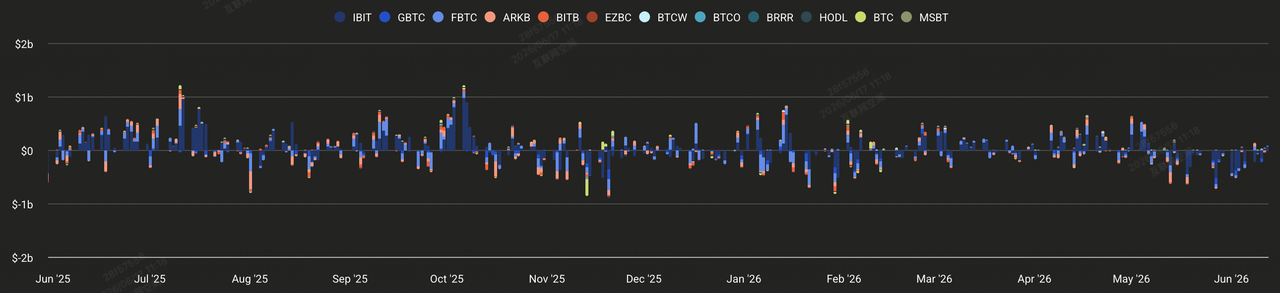
Spot Bitcoin ETF flows | Source: TheBlock
Since their initial regulatory greenlight in January 2024, spot Bitcoin ETFs have fundamentally shifted global finance. Led by BlackRock’s iShares Bitcoin Trust (IBIT) and Fidelity’s Wise Origin Bitcoin Fund (FBTC), cumulative net inflows have systematically built up an institutional foundation. By mid-2026, combined spot Bitcoin ETF assets under management sat comfortably north of $100 billion, converting BTC into an accessible balance sheet reserve asset for hedge funds, family offices, and multinational firms.
Spot XRP ETFs: The Historic Inflow Sprint
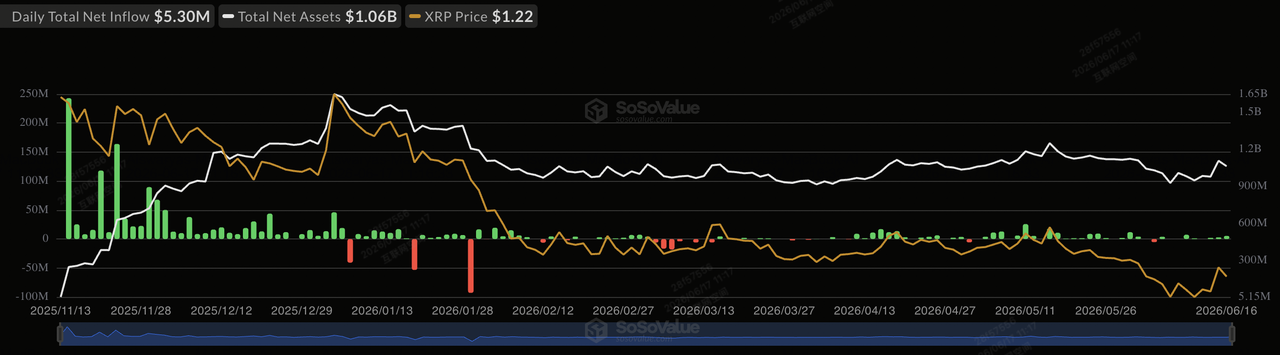
XRP ETF flows | Source: SoSoValue
Following the conclusion of Ripple's SEC legal battle and the subsequent structural relisting across primary US platforms, spot XRP ETFs debuted in November 2025. The speed of institutional uptake surprised the broader industry. By June 2026, seven active spot XRP vehicles, headlined by Bitwise (XRP), Canary Capital (XRPC), and Franklin Templeton (XRPZ), successfully locked up more than 926 million XRP tokens, driving total spot product AUM past $1.05 billion and setting structural speed records for new digital asset listings.
Should You Add XRP or BTC to Your Portfolio: Bull and Bear Cases for 2026
Evaluating whether to weight your portfolio toward Bitcoin or XRP requires a direct comparison of their primary growth catalysts alongside the structural risks that could cap their performance over the coming year. As global liquidity undergoes structural shifts, tracking precise target models, institutional flows, and legislative timelines becomes critical for proper position sizing.
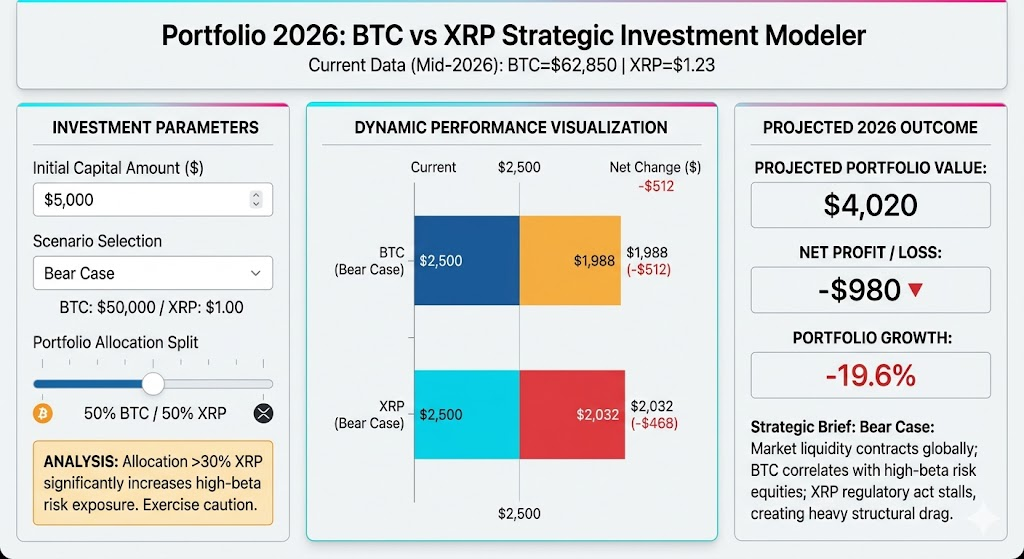
Why Invest in Bitcoin (BTC) in 2026?
The Bull Case: Price Target $143,000–$150,000
The institutional core of the market continues to consolidate around Bitcoin. With over $109 billion in AUM backing spot Bitcoin ETFs, daily price action is structurally anchored by deep traditional finance pipelines, heavily insulating it from the historic 80% drawdowns of past crypto cycles. Programmatically, the April 2024 halving structurally reduced daily supply issuance to just 450 BTC.
As macro allocation models shift toward scarce hedges against sovereign debt expansion and sticky 3% global inflation, a resumption of positive institutional net inflows sets a firm base-case price target at $100,000, with asymmetric institutional bull targets expanding up to $150,000 by late 2026.
The Bear Case: Price Target $50,000–$55,000
Bitcoin’s transition into a mature macro asset exposes it heavily to broader financial stress. Its 30-day rolling correlation with the S&P 500 sits at an elevated 0.55, meaning it consistently trades as a high-beta risk asset during liquidity contractions.
With the Federal Reserve holding interest rates steady amid stubborn macroeconomic prints, any broad-market risk-off capitulation could trigger a mechanical deleveraging event in the futures market, where liquidations could force a rapid flush down to major structural support zones between $50,000 and $55,000.
Why Buy XRP (XRP) in 2026
The Bull Case: Price Target $4.94–$8.00
XRP is positioned as the primary beneficiary of structural regulatory clarity in the United States. Following its historic 2025 SEC legal settlement, the primary catalyst for the rest of 2026 centers on the Digital Assets CLARITY Act, which cleared the Senate Banking Committee in a bipartisan 15-to-9 vote and maintains strong odds of passing a full floor vote.
Formally codifying XRP as a digital commodity under CFTC jurisdiction removes compliance barriers for pension funds and sovereign wealth, unlocking an institutional wave into spot XRP ETFs which have already attracted $1.44 billion in cumulative inflows. Accompanied by expanding utility, including a tripling of network activity to 3 million daily transactions fueled by over $1.5 billion in Real-World Asset (RWA) tokenization, Standard Chartered maps an aggressive bull case target of $8.00 by year-end, while conservative models project a base case of $2.80.
The Bear Case: Price Target $1.00–$1.15
Despite definitive regulatory milestones, XRP faces persistent structural drag. Sceptics point to long-term flat trends in foundational cross-border payment volume relative to alternative fiat-pegged institutional stablecoins.
Furthermore, the programmatic monthly release of 1 billion tokens from Ripple’s escrow creates continuous structural selling pressure that requires uninterrupted enterprise demand to neutralize. If legislative timelines for the CLARITY Act stall in the Senate or spot ETF inflows dry up, heavy short-interest positioning could crack current support, forcing a breakdown out of its multi-month chart triangle toward a $1.00 to $1.15 capitulation floor.
How to Trade Bitcoin (BTC) and XRP (XRP) on BingX
BingX provides a comprehensive ecosystem powered by advanced algorithmic tools and the embedded BingX AI smart trading assistant to streamline how you analyze trends, evaluate positions, and manage portfolio risk across different digital asset strategies.
Buy and Sell BTC and XRP on the Spot Market
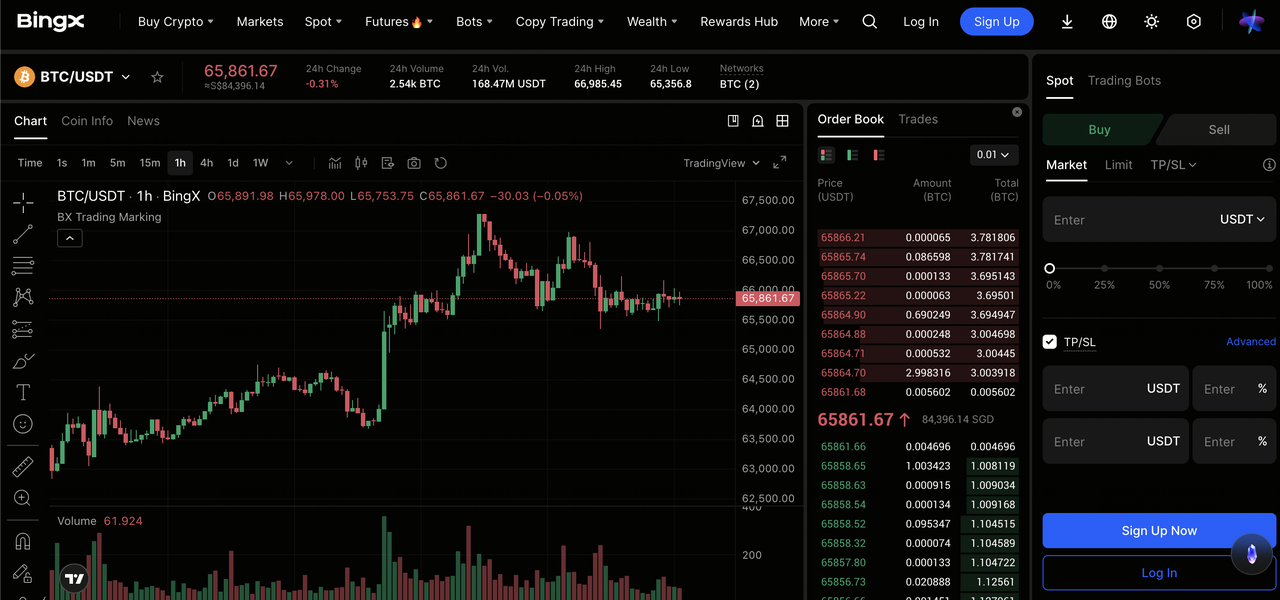
BTC/USDT trading pair on BingX spot market
- Log in to your account, navigate to the top menu bar, hover over Spot, and select Spot to open the core trading interface.
- Use the asset search bar on the left side of the screen to input either BTC/USDT or XRP/USDT to load your preferred asset chart.
- Review real-time volume metrics and use the order terminal to select a Market Order for instant execution at current prices, or a Limit Order to specify your targeted acquisition entry zone.
- Input your desired purchase amount in USDT, click Buy BTC or Buy XRP, and monitor your filled tokens securely inside your integrated spot wallet account.
Long or Short BTC and XRP with Leverage in the Futures Market
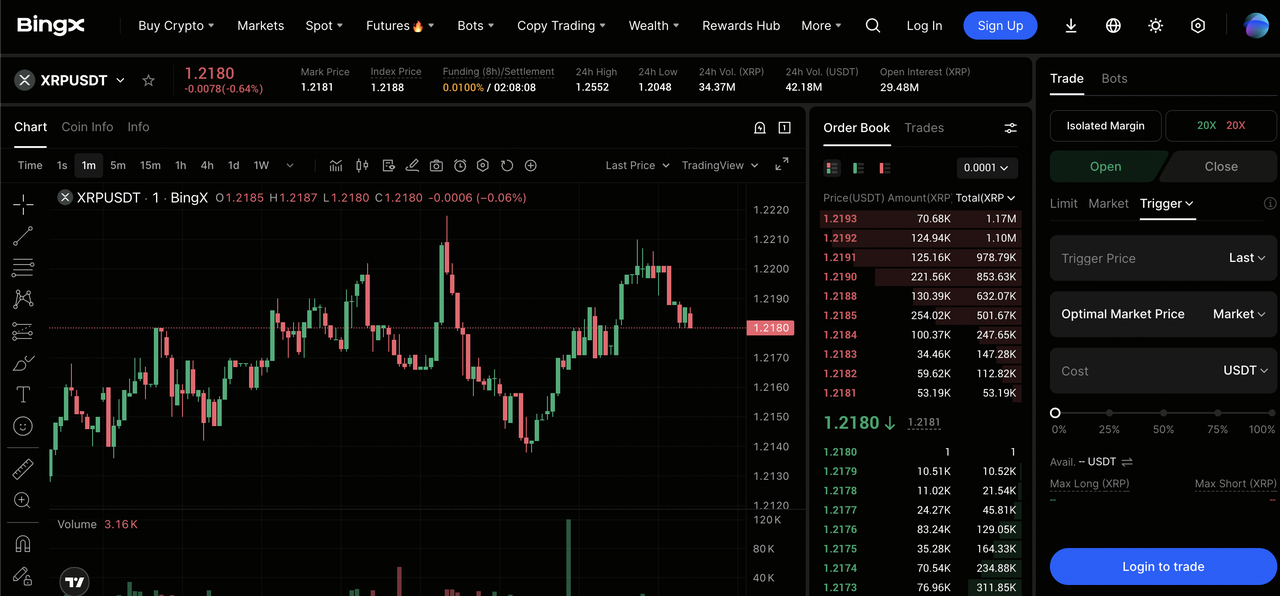
XRP/USDT perpetual contract on BingX futures market
- Navigate to the main dashboard menu, hover over Futures, and click Perpetual Futures to initialize the advanced high-liquidity trading contract console.
- Click the asset dropdown menu in the upper-left corner of the contract chart and select either the BTC/USDT Perpetual or XRP/USDT Perpetual contract pair.
- Choose your margin configuration mode (Isolated Margin to lock liability to a single trade, or Cross Margin to share collateral pool limits) and adjust your leverage parameters between a disciplined 2x-5x setting.
- Open the trade panel to select Long if your analytical metrics forecast an upward trend breakout, or select Short to position for a downside macro market correction.
- Set precise Take-Profit (TP) and Stop-Loss (SL) trigger thresholds in the order module before clicking the transaction button to lock in clear risk management boundaries.
DCA (Dollar-Cost Averaging) BTC and XRP on BingX Recurring Buy
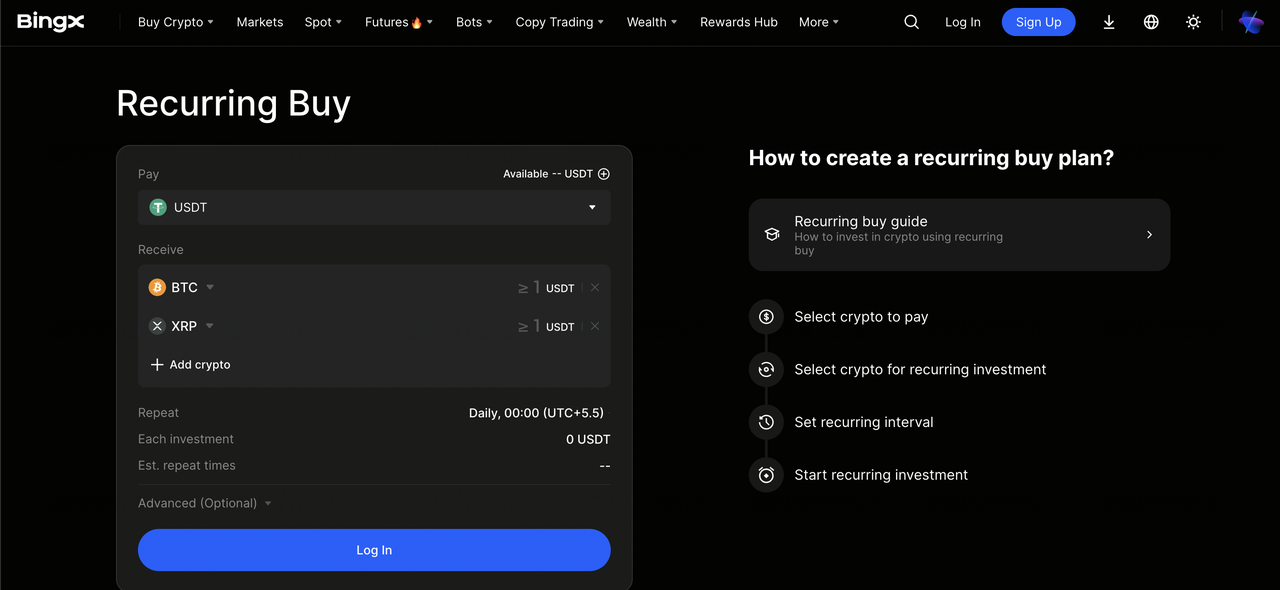
DCA BTC and XRP on BingX Recurring Buy
- Visit Recurring Buy to initialize automated, stress-free portfolio expansion via continuous Dollar-Cost Averaging (DCA).
- Select your target investment cryptocurrency allocation split, such as setting an automated routine to purchase up to 5 tokens like BTC and XRP simultaneously.
- Define your programmatic fiat or stablecoin funding source, such as USDT or USDC, and enter your specific recurring investment capital size per localized batch, starting from as low as 1 USDT.
- Customize your automated execution frequency settings by selecting a routine cadence from the dropdown checklist, including Daily, Weekly, Bi-Weekly, or Monthly intervals.
- Review your scheduled averaging profile parameters, accept the system protocol terms, and click Create Plan to process automatic systemic purchases that eliminate emotional trading biases.
Read more: How to Dollar‑Cost Average (DCA) Bitcoin in 2026: Buy Bitcoin Recurringly
5 Key Considerations for Investing in Bitcoin and XRP in 2026
Determining how to balance your capital across Bitcoin and XRP requires evaluating structural market parameters, institutional product maturity, and your personal risk-mitigation parameters.
- Institutional Inflow Imbalances: Bitcoin features an established, highly liquid Wall Street investment pipeline managing over $100 billion in spot ETF assets. While spot XRP ETFs are pacing historical milestone records by crossing $1.05 billion in AUM, they represent a much younger institutional asset class with lower structural capital depth.
- Regulatory Compliance and Oversight: XRP has cleared its principal legal overhang following a definitive court settlement and the subsequent advancement of the Digital Assets CLARITY Act. Bitcoin, however, remains the unique benchmark for pure decentralization and lacks any structural corporate dependency risk.
- Divergent Cyclical Valuations: Bitcoin’s post-halving tokenomics are anchored by mathematical scarcity, meaning long-term floor values respond predictably to demand shocks. Conversely, XRP behaves as a higher-beta utility token; its macro price trends are directly linked to real-world financial adoption and network volume changes.
- Macroeconomic Asset Correlation: Bitcoin trades closely with equity risk-on indexes during tight liquidity regimes. XRP exhibits independent price movements tied to legislative breakthroughs, yet remains vulnerable to localized selling pressures from scheduled monthly escrow releases.
- Strategic Position Sizing: Conservative market strategies favor designating Bitcoin as your core balance sheet holding due to its lower relative volatility and proven recovery metrics. Speculative satellite allocations are then utilized for XRP to securely capture the larger percentage multiplier potential of enterprise banking integration.
Conclusion: What’s a Better Investment for the Rest of 2026, BTC or XRP?
There is no singular, universal answer to the Bitcoin vs. XRP debate, because both assets are constructed to serve completely non-overlapping functions within a diversified portfolio.
Bitcoin remains the structurally safer, foundational choice for investors seeking maximum decentralization, long-term capital preservation, and deep institutional market backing. Its mathematically locked supply profile guarantees absolute scarcity, protecting portfolios against ongoing global currency debasement.
XRP presents a compelling, high-beta utility play for growth-oriented investors with an elevated risk tolerance. Trading at a much lower absolute face value per token, its growth curve is inextricably linked to real-world financial enterprise implementation. If the global banking architecture expands its usage of the XRPL for cross-border settling and RWA tokenization throughout 2026, XRP offers asymmetric percentage upside potential.
Many veteran market participants choose a balanced approach: allocating a core majority percentage to Bitcoin for portfolio stability, while setting aside a smaller satellite position for XRP to capitalize on targeted fintech adoption and accelerating ETF capital inflows.
Related Reading
- Bitcoin Post-Halving Cycle: Will BTC Enter a Bull Market or Face a Bear Market Reset in 2026?
- Bitcoin vs. Gold: What’s a Better Investment in 2026?
- Gold vs. Bitcoin: The $10,000 Investment in 2025 That Became $16,500 or $9,400
- Spot XRP ETFs to Launch on November 13: What Is a Spot XRP ETF?
- What Are the Top Spot Bitcoin ETFs to Watch in 2026?
FAQs on Bitcoin (BTC) vs. XRP
1. Is XRP built to replace Bitcoin?
No. Bitcoin is designed to function as an immutable, decentralized digital gold and alternative store of value. XRP is designed explicitly as a business-to-business infrastructure asset to serve as an intermediate bridge currency for fast cross-border fiat settlements.
2. How does the Digital Assets CLARITY Act impact XRP?
The progression of this legislation provides explicit legal parameters defining how cryptocurrencies are classified on open markets. For XRP, it solidifies the legal consensus that open-market trading does not constitute an investment security contract, encouraging mainstream corporate adoption.
3. Can you mine XRP on XRP Ledger (XRPL)?
No. The XRPL runs a unique consensus protocol based on server validation nodes voting on ledger updates. This completely eliminates the energy-heavy computational grids required by Bitcoin’s Proof-of-Work mining model.
Read more: What Is XRP Cloud Mining and How to Earn Rewards? (2026)
4. Can I convert my BTC into XRP directly on BingX?
Yes. You can instantly execute a trade by selling your BTC for USDT on the spot market and using the proceeds to buy XRP, or you can utilize BingX's integrated conversion interface for rapid capital rotation.
5. Why does Ripple Labs hold so much XRP in escrow?
The escrow system was created to guarantee market predictability and eliminate fears of sudden, large-scale token dilution. By unlocking precisely 1 billion tokens monthly, the market receives an orderly, transparent supply distribution sequence.
