



CrowdStrike Holdings, Inc. (CRWD) is a cybersecurity company protecting endpoints, cloud workloads, identities, and data, linking it to AI-related stocks and traditional equities. Falcon subscription revenue is its main engine. Retention and modules tie results to breaches, budgets, competition, and efficacy. Falcon Flex, AI security, Next-Gen SIEM, identity, and cloud protection widen customer relationships.
In 2026, the main question is whether record demand becomes durable ARR growth and cash generation. Fiscal Q2 revenue rose 26% to $1.47 billion, adjusted EPS reached $0.31, and net new ARR increased 51% to $332.8 million. CrowdStrike is scaling Flex, AI-agent identity, cloud security, and Next-Gen SIEM while raising guidance. For investors, the key question is whether growth and leverage justify a demanding valuation.
The CRWD stock forecast for 2026 now centers on two competing views:
- The AI-security platform Bull case: Sustained ARR acceleration, Falcon Flex adoption, and expanding margins could support targets as high as $280
- The growth-expectations Bear case: Slower bookings, tougher competition, execution setbacks, or software multiple compression could pull CRWD toward $170.
This guide breaks down the CRWD stock forecast, 2026 price scenarios, key risks, analyst views, the August 26 earnings release, and how to trade CRWD stock futures on BingX TradFi with USDT collateral.
Top 5 Things for CrowdStrike Investors to Know in August 2026
CRWD trades on Nasdaq and is sensitive to ARR, enterprise security spending, platform adoption, margins, execution, and software valuation multiples.
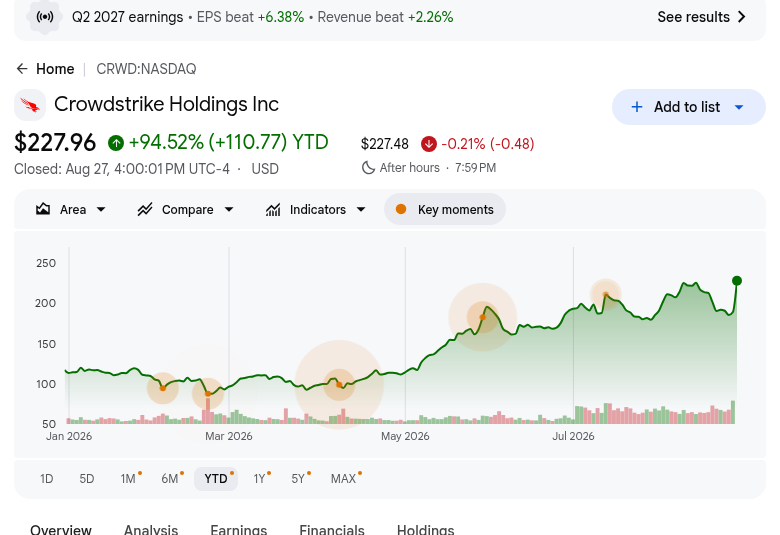
- Fiscal Q2 revenue rose 26% to $1.47 billion and beat consensus. Revenue came in above the roughly $1.44 billion estimate, while subscription revenue reached $1.40 billion. The result showed continued demand for CrowdStrike’s security platform despite a more selective enterprise spending environment.
- Net new ARR jumped 51% to a record $332.8 million. Ending ARR reached $5.84 billion, supported by Falcon Flex and broader platform consolidation. The next test is whether strong bookings translate into durable revenue growth, retention, and deeper module adoption.
- Free cash flow reached $377.4 million and cash rose to $5.01 billion. The stronger balance sheet gives CrowdStrike flexibility to invest in product development, acquisitions, and customer support while absorbing exceptional legal or remediation costs.
- Full-year revenue guidance moved higher. Management raised expected revenue to roughly $5.99-$6.01 billion, reinforcing confidence in continued subscription growth and platform demand through the rest of the year.
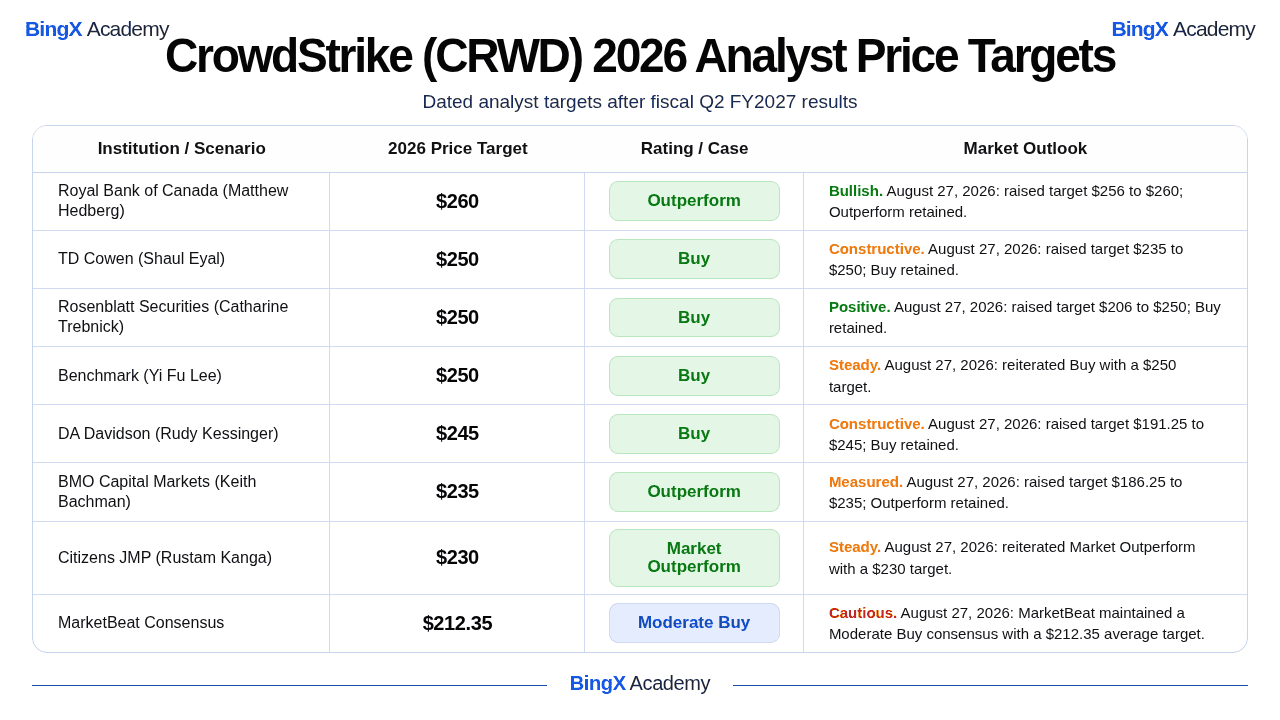
- Analyst targets remained clustered near current levels. Published targets across seven named institutions ranged from about $230 to $260, reflecting a broadly positive view on ARR growth and Falcon adoption but more caution around valuation and execution.
What Is CrowdStrike (CRWD)?
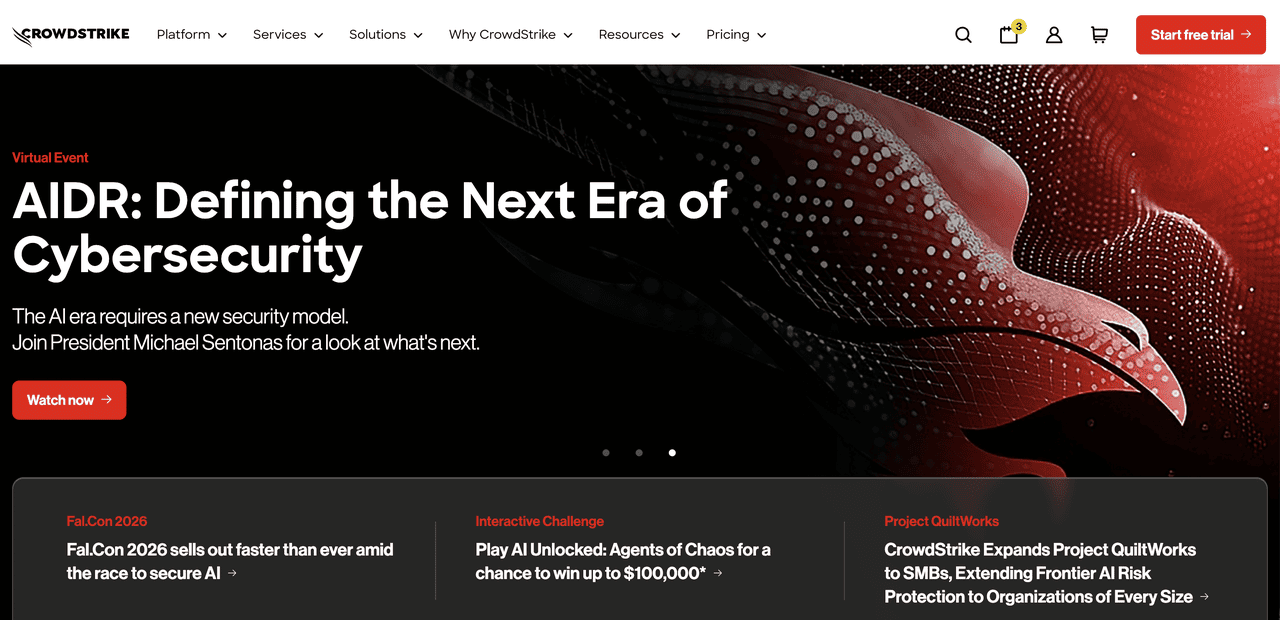
CrowdStrike is a cybersecurity company founded in 2011 that provides cloud-based protection across endpoints, cloud workloads, identities, and data. Its Falcon platform uses AI and threat intelligence to detect and respond to attacks, with subscription revenue forming the core of the business. Results depend on customer retention, security effectiveness, enterprise IT budgets, competition, and trust in the platform.
CrowdStrike is expanding Falcon into a broader security platform through Falcon Flex, Next-Gen SIEM, cloud security, identity protection, and AI-focused security tools. The strategy is to replace multiple standalone products with one integrated platform, deepen customer relationships, and grow recurring revenue. Future performance therefore depends on sustained ARR growth, strong margins and cash flow, and continued platform reliability.
Read More: Top AI Tokenized Stocks to Watch in 2026
CrowdStrike (CRWD) Q2 FY2027 Earnings: 5 Drivers Behind the Outlook
- Revenue rose 26% to $1.47 billion and beat consensus by 2.1%. Revenue increased from $1.17 billion a year earlier and topped the roughly $1.44 billion estimate, while subscription revenue reached $1.40 billion. The result reinforced continued demand for CrowdStrike’s platform.
- Adjusted EPS reached $0.31 and beat expectations by 6.9%. EPS came in above the roughly $0.29 consensus and rose from $0.23 a year earlier. Continued operating leverage will depend on balancing growth investments with margin discipline.
- Net new ARR jumped 51% to $332.8 million. Ending ARR reached $5.84 billion, while Falcon Flex ARR surpassed $2.29 billion and grew 101%. The key question is whether that momentum can translate into sustained platform consolidation and recurring revenue growth.
- Operating cash flow reached $530.3 million. CrowdStrike ended the quarter with $5.01 billion in cash and generated $377.4 million in free cash flow, giving the company flexibility to invest in products, acquisitions, and expansion.
- Non-GAAP operating income rose to $371.6 million. That compared with $255.0 million a year earlier, while subscription gross margin improved to 81% from 80%. Continued margin expansion would strengthen the bull case as recurring revenue scales.
Read More: CrowdStrike (CRWD) Q2 FY2027 Earnings Overview: Record $333M Net New ARR Drives a 20.50% Price Rally
CrowdStrike Q2 FY2027 Financial and Consensus Profile: Revenue, EPS and ARR Momentum
Fiscal Q2 combined accelerating ARR, adjusted profitability, and record cash generation with demanding post-earnings expectations. The table separates consensus, operating drivers, liquidity, guidance, and platform adoption.
|
Financial Metric |
Guidance / Consensus |
Reported / Actual |
Surprise |
|
Q2 FY2027 revenue |
$1.44 billion Bloomberg consensus |
$1.47 billion; +26% year over year |
Beat. +2.08%; subscription demand drove upside. |
|
Q2 FY2027 adjusted diluted EPS |
$0.29 Bloomberg consensus |
$0.31 versus $0.23 prior year |
Beat. +6.90%; leverage supported earnings. |
|
Ending annual recurring revenue |
— |
$5.84 billion; +25% |
Strong. Record net new ARR accelerated it. |
|
Subscription gross margin |
— |
78% GAAP; 81% non-GAAP |
Improved. Both rose one percentage point. |
|
Non-GAAP operating income |
— |
$371.6 million versus $255.0 million |
Strong. Subscription scale delivered leverage. |
|
Cash and free cash flow |
— |
$5.01 billion cash; $377.4 million FCF |
Strong. Liquidity supports investment. |
|
Fiscal 2027 revenue guidance |
$5.94 billion analyst estimate |
$5.9911-$6.0111 billion company outlook |
Raised. The range moved above Street expectations. |
|
Falcon Flex ending ARR |
— |
More than $2.29 billion; +101% year over year |
Strong. Flex can deepen platform consolidation. |
For context, CrowdStrike uses Falcon Flex, AI security, cloud, identity, and Next-Gen SIEM for consolidation. Revenue, ARR, margins, and cash support the Bull thesis, while expectations create risk. The key question is whether record bookings become durable growth and leverage.
CrowdStrike (CRWD) 2026 Investment Outlook: $280 Bull Case vs. $170 Bear Case
CrowdStrike's outlook for the rest of 2026 depends on one central question: whether Falcon Flex and AI-security demand sustain ARR growth and operating leverage, or whether execution pressure and a demanding valuation keep pressure on the stock.
The Bull Case: AI Security and Falcon Flex Momentum Pushes CRWD Toward $280
The Bull Case assumes fiscal Q2 starts a durable consolidation cycle. Falcon Flex expands modules while AI security, cloud, identity, and Next-Gen SIEM enlarge customer wallets. Strong cash generation can fund innovation and a premium valuation.
A move toward $280 would require revenue above guidance, ARR growth near 25%, strong bookings, and expanding operating income. The strongest confirmation would be repeated beats, higher guidance, Flex adoption, stable margin, and better cash conversion.
The Base Case: Durable Platform Growth Keeps CRWD Between $210 and $255
The Base Case keeps subscription revenue and platform consolidation as the main engines. Falcon Flex, AI security, cloud, identity, and Next-Gen SIEM expand as growth normalizes. Investors retain a premium valuation because execution remains strong.
Under this scenario, CRWD could trade mainly between $210 and $255 while investors test booking durability. Key confirmation points would include ARR near guidance, 80%-plus non-GAAP subscription gross margin, operating income, cash flow, and Flex adoption.
The Bear Case: Growth Deceleration and Multiple Compression Pulls CRWD Toward $170
The Bear Case assumes fiscal Q2 creates unsustainable comparisons. Slower net new ARR and tougher endpoint, cloud, identity, and SIEM competition would reduce leverage. Weaker growth and margins could force a lower multiple despite $5.01 billion of cash.
A move toward $170 would become more likely if net new ARR slows, guidance falls, and cash margins weaken. In that scenario, growth disappointment and multiple compression would outweigh cybersecurity demand.
CRWD Stock Price Forecasts for 2026 By Wall Street Analysts
Dated third-party CrowdStrike targets span $230 to $260 after fiscal Q2. The spread reflects differing views on ARR, Falcon Flex, margins, execution, and valuation.
|
Institution / Scenario |
2026 Price Target |
Rating / Case |
Market Outlook |
|
Royal Bank of Canada (Matthew Hedberg) |
$260 |
Outperform |
Bullish. August 27, 2026: raised target $256 to $260; Outperform retained. |
|
TD Cowen (Shaul Eyal) |
$250 |
Buy |
Constructive. August 27, 2026: raised target $235 to $250; Buy retained. |
|
Rosenblatt Securities (Catharine Trebnick) |
$250 |
Buy |
Positive. August 27, 2026: raised target $206 to $250; Buy retained. |
|
Benchmark (Yi Fu Lee) |
$250 |
Buy |
Steady. August 27, 2026: reiterated Buy with a $250 target. |
|
DA Davidson (Rudy Kessinger) |
$245 |
Buy |
Constructive. August 27, 2026: raised target $191.25 to $245; Buy retained. |
|
BMO Capital Markets (Keith Bachman) |
$235 |
Outperform |
Measured. August 27, 2026: raised target $186.25 to $235; Outperform retained. |
|
Citizens JMP (Rustam Kanga) |
$230 |
Market Outperform |
Steady. August 27, 2026: reiterated Market Outperform with a $230 target. |
|
MarketBeat Consensus |
$212.35 |
Moderate Buy |
Cautious. August 27, 2026: MarketBeat maintained a Moderate Buy consensus with a $212.35 average target. |
How to Trade CrowdStrike Holdings, Inc. (CRWD) Stock on BingX
Navigate CrowdStrike’s earnings cycle, ARR growth, Falcon Flex adoption, AI-security demand, and valuation using BingX TradFi and BingX AI tools. These can provide additional context around bookings, margins, guidance, and sentiment, while CRWD-USDT remains a TradFi perpetual contract rather than direct share ownership.
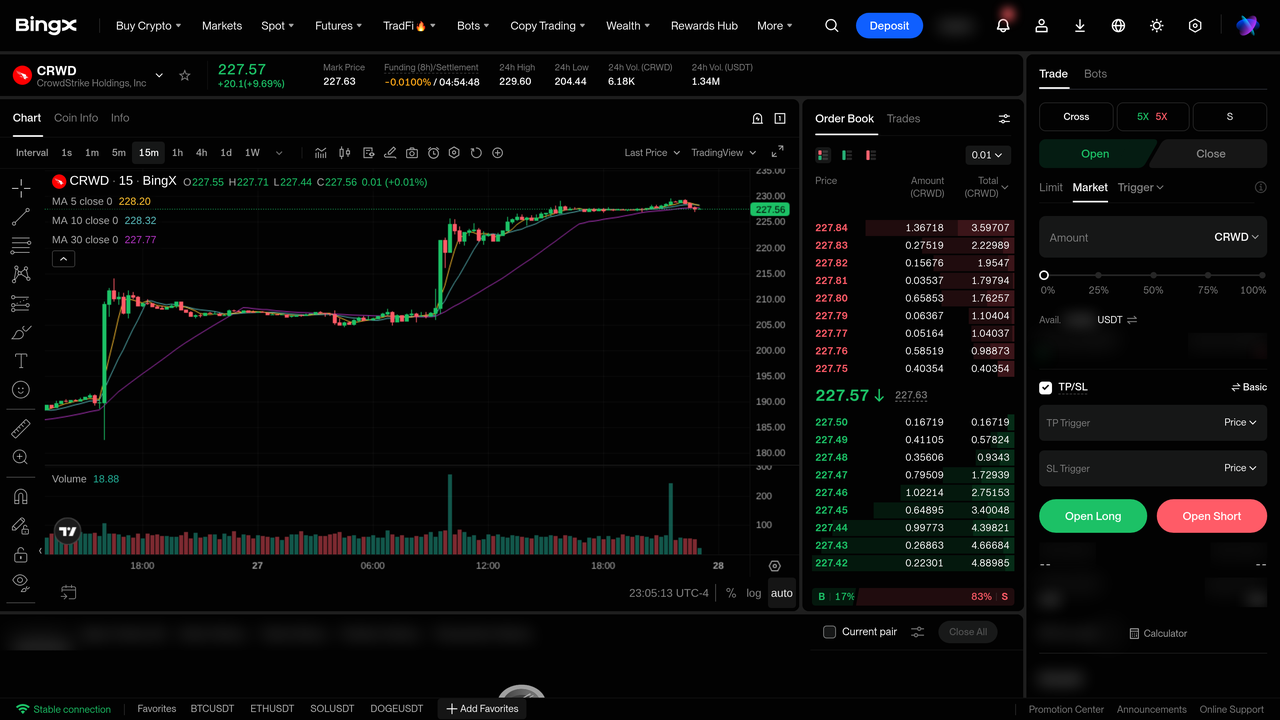
Step 1: Access BingX TradFi. Sign up and navigate to the specialized TradFi section on the main BingX exchange dashboard.
Step 2: Select CrowdStrike (CRWD). Search for and select the CRWD-USDT perpetual futures contract.
Step 3: Choose your direction. Select Open Long if you expect ARR acceleration, stronger Falcon Flex adoption, and improving margins to support CRWD. Select Open Short if you expect weaker bookings, execution pressure, or valuation compression to weigh on the stock.
Step 4: Select leverage and margin mode. Choose Isolated or Cross-Margin based on your risk tolerance. Because CRWD can react sharply to earnings, security incidents, guidance, and ARR updates, conservative leverage and clear position sizing are important.
Step 5: Execute strict risk protocols. Set Take-Profit and Stop-Loss (TP/SL) levels before or immediately after entering the trade. CRWD can move quickly around quarterly earnings, net new ARR, Falcon Flex growth, platform reliability, security incidents, litigation, margins, and analyst revisions.
Top 5 Risks to Watch for CRWD Investors in 2026
CrowdStrike’s outlook depends on sustained ARR growth, platform adoption, strong execution, and continued confidence in its premium valuation.
- Enterprise security spending could slow. Customers may delay expansion, consolidate vendors, or negotiate harder during tighter budget cycles. Slower net new ARR or weaker bookings would reduce visibility and pressure valuation.
- Competition could weaken pricing power. Microsoft, Palo Alto Networks, SentinelOne, and cloud providers compete across endpoint, cloud, identity, SIEM, and AI security, increasing pressure on pricing, sales costs, and module adoption.
- A reliability or security failure could damage trust. Product defects, outages, false positives, or missed attacks could raise remediation costs and weaken renewals, retention, and platform consolidation.
- Legal and regulatory requirements could raise costs. CrowdStrike operates across sensitive data, cybersecurity, AI, and government environments, leaving it exposed to new privacy, incident-reporting, procurement, and liability rules.
- A premium valuation leaves little room for disappointment. CRWD’s multiple depends on strong ARR growth, margins, and cash conversion. Slower guidance, higher rates, dilution, or weaker sentiment could compress the stock even if earnings remain positive.
Final Thoughts: Should You Invest in CrowdStrike (CRWD) in 2026?
CrowdStrike enters the rest of 2026 with strong recurring revenue, record net new ARR, growing Falcon Flex adoption, and solid free cash flow. The investment case now depends on whether that momentum can translate into sustained platform growth and operating leverage without weakening reliability or customer trust.
The bull case strengthens if ARR growth stays strong, Falcon Flex expands, margins remain disciplined, and cash conversion continues to improve. The bear case becomes more likely if bookings slow, guidance weakens, competition intensifies, or reliability issues return while the stock still carries a premium valuation.
Risk Reminder: CRWD remains exposed to enterprise security spending, cybersecurity competition, product reliability, legal and regulatory requirements, AI-related policy risk, and valuation volatility. Investors should conduct independent research and assess their own risk tolerance before trading.
Related Reading
- Palantir (PLTR) Stock Price Prediction 2026: Can 149% U.S. Commercial Growth Push PLTR Toward $255?
- Figma (FIG) Price Prediction 2026: $36.00 AI Launchpad or Overvalued Post-IPO Hangover Trap?
- Meta (META) Stock Price Prediction 2026: Can AI Efficiency and Custom Silicon Drive META to $900?
- Apple (AAPL) Price Prediction 2026: Can Siri AI and the Foldable iPhone Push AAPL Past $400?
- Amazon (AMZN) Stock Price Prediction 2026: Can AWS AI Re-acceleration Offset a $200B CapEx Gamble?
- Alphabet (GOOGL) Price Prediction 2026: Can 82% Cloud Growth and AI Push GOOGL Stock to $430?
