

Salesforce, Inc. (CRM) is an enterprise software company connecting customer data, sales, service, marketing, commerce, analytics, and artificial intelligence. Recurring subscription and support fees drive its business. Results depend on technology budgets, retention, pricing, data usage, and implementation. Agentforce, Data 360, Slack, and Informatica seek growth beyond mature CRM applications.
In 2026, the main question is whether Salesforce can turn agentic-AI adoption into organic reacceleration without sacrificing margins. Fiscal Q2 2027 revenue reached $11.35 billion, non-GAAP EPS reached $5.90, and subscription revenue grew 12%. Salesforce is integrating Informatica and preparing to add Contentful and Fin. For investors, the key question is whether these products can scale fast enough to improve organic growth and durable per-share value.
The CRM stock forecast for 2026 now centers on two competing views:
- The AI platform and capital-return Bull case: Agentforce monetization, recurring revenue, integration synergies, margin discipline, and buybacks could support targets as high as $330
- The organic-growth and execution Bear case: Acquisition dependence, slower enterprise demand, delayed AI monetization, or software multiple compression could pull CRM toward $190.
This guide breaks down the CRM stock forecast, 2026 price scenarios, key risks, and analyst views, drawing on the August 26, 2026 earnings release, plus how to trade CRM stock futures on BingX TradFi with USDT collateral.
Top 5 Things for Salesforce Investors to Know in August 2026
CRM trades on the NYSE and is sensitive to enterprise software demand, AI adoption, recurring revenue, margins, acquisitions, and valuation multiples.
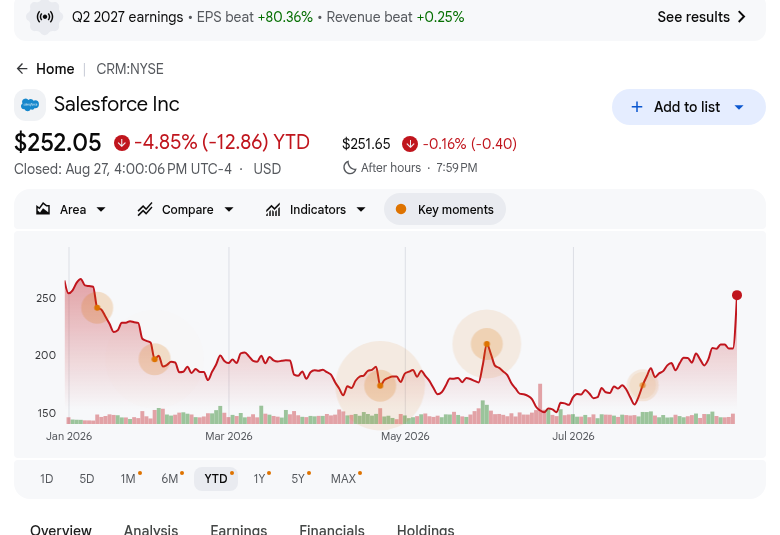
- Fiscal Q2 revenue rose 11% to $11.35 billion and beat consensus. Revenue came in slightly above the roughly $11.32 billion estimate, with $456 million contributed by Informatica. The result showed continued scale, though investors still need to separate acquisition-driven growth from underlying organic demand.
- Agentforce and Data 360 ARR approached $3.9 billion. ARR grew more than 210% year over year, while Agentforce alone surpassed $1.5 billion. The next test is whether rapid AI adoption can translate into stronger subscription growth, renewals, and broader customer spending.
- Free cash flow rose 81% to $1.1 billion. Stronger cash generation gives Salesforce more flexibility to support buybacks, dividends, and acquisitions while maintaining margins. Sustained free-cash-flow growth remains important as integration costs rise.
- Salesforce continued its $25 billion accelerated share repurchase. The program can support per-share value by reducing the share count, but the benefit depends on continued cash generation and disciplined capital allocation alongside acquisition spending.
- Analyst targets ranged from $204 to $315. The spread across seven named institutions reflects different views on AI monetization, organic growth, acquisition integration, margins, and valuation, with bullish analysts focused on Agentforce and more cautious firms watching execution and growth quality.
What Is Salesforce, Inc. (CRM)?
Salesforce is an enterprise software company founded in 1999 that provides cloud-based tools for sales, customer service, marketing, commerce, data management, and analytics. Its subscription business is the core revenue engine, with customers paying recurring fees to use products across the Salesforce platform. Results depend on customer retention, expansion, pricing, enterprise software spending, and the company’s ability to keep adding value across its product ecosystem.
Salesforce is now expanding beyond traditional customer relationship management into a broader data-and-AI platform. Agentforce is designed to automate work using enterprise data and workflows, while Data 360, Informatica, and Slack help organize information and connect employees with AI-driven tools. Future performance therefore depends on whether Salesforce can turn AI adoption into higher recurring revenue while integrating acquisitions, protecting margins, and maintaining customer trust.
Salesforce (CRM) Fiscal Q2 2027 Earnings: 5 Drivers Behind the Outlook
- Revenue rose 11% to $11.35 billion and slightly beat consensus. Revenue came in above the roughly $11.32 billion estimate, with Informatica contributing $456 million. The next question is whether underlying subscription growth can strengthen as acquisition-driven revenue enters future comparisons.
- Adjusted EPS reached $5.90 and beat expectations by more than 80%. EPS came in well above the roughly $3.27 consensus and more than doubled from $2.91 a year earlier. The size of the beat was much stronger than revenue growth, making the quality and repeatability of earnings an important point to watch.
- Agentforce ARR surpassed $1.5 billion and grew more than 240%. Agentforce and Data 360 together approached $3.9 billion in ARR, strengthening Salesforce’s AI monetization story. The key test is whether that adoption lifts customer spending, retention, cRPO, and broader subscription growth.
- Free cash flow rose 81% to $1.1 billion. Operating cash flow also increased 71% to $1.3 billion, giving Salesforce more flexibility to support buybacks, dividends, and acquisition integration. Sustained cash generation will matter as integration costs increase.
- Non-GAAP operating margin reached 34.1%. GAAP operating margin was 20.5%, while Salesforce maintained a 34.3% full-year non-GAAP margin outlook. Continued margin discipline would strengthen the growth case, while integration-related pressure could weaken earnings quality.
Salesforce Fiscal Q2 2027 Financial and Consensus Profile: Revenue, EPS and AI Growth
Salesforce's fiscal Q2 combined modest revenue upside with unusually strong adjusted EPS and fast AI-product growth. The table separates reported figures from Zacks consensus, segment drivers, cash flow, guidance, and structural backlog.
|
Financial Metric |
Guidance / Consensus |
Reported / Actual |
Surprise |
|
Fiscal Q2 2027 revenue |
$11.32 billion Zacks consensus |
$11.35 billion; approximately +11% year over year |
Beat. +0.27%; reported growth included Informatica. |
|
Fiscal Q2 2027 adjusted diluted EPS |
$3.27 Zacks consensus |
$5.90 versus $2.91 prior year |
Beat. +80.43%; earnings outpaced revenue growth. |
|
Subscription and support revenue |
— |
$10.8 billion; +12% year over year |
Strong. Recurring revenue remained the core engine. |
|
Agentforce and Data 360 ARR |
— |
Nearly $3.9 billion; more than +210% |
Strong. AI and data adoption accelerated sharply. |
|
Non-GAAP operating margin |
— |
34.1%; GAAP margin 20.5% |
Strong. Profitability remained high during expansion. |
|
Operating and free cash flow |
— |
$1.3 billion operating; $1.1 billion free cash flow |
Strong. Cash flow rose 71% and 81%, respectively. |
|
Full-year FY27 revenue guidance |
Prior $45.9-$46.2 billion range |
$46.1-$46.4 billion; +11%-12% |
Raised. Management lifted the range by $200 million. |
|
Remaining performance obligation |
— |
$66.3 billion; cRPO $33.5 billion |
Strong. Contracted backlog remained substantial. |
For context, Salesforce uses Agentforce, Data 360, Slack, and acquisitions to expand beyond CRM. Recurring revenue, AI ARR, margins, and backlog support the Bull thesis, while acquisition dependence keeps execution risk in focus. The key question is whether AI adoption produces sustained organic growth.
Salesforce (CRM) 2026 Investment Outlook: $330 Bull Case vs. $190 Bear Case
Salesforce's outlook for the rest of 2026 depends on one central question: whether Agentforce-led monetization and integration success produce organic reacceleration, or whether slower enterprise demand and valuation pressure keep pressure on the stock.
The Bull Case: Agentforce-Led Reacceleration Pushes CRM Toward $330
The Bull Case assumes Salesforce turns its installed base, data layer, and agents into a new expansion cycle. Agentforce and Data 360 could lift spending beyond seat growth. Recurring revenue, cash flow, margins, and buybacks could support a higher multiple.
A move toward $330 would require cRPO growth, faster organic subscriptions, successful integration, and margin discipline. The strongest confirmation would be repeated above-consensus quarters with higher organic revenue and cash-flow guidance.
The Base Case: Steady Execution Keeps CRM Between $235 and $290
The Base Case keeps subscriptions as the earnings engine while AI, data, Slack, and acquisitions broaden the platform. Margins and buybacks support per-share results, but acquisitions blur organic growth. Investors value Salesforce as a mature compounder rather than AI hypergrowth.
Under this scenario, CRM could trade mainly between $235 and $290 while investors await organic reacceleration. Key confirmation points would include cRPO, Agentforce ARR, free cash flow, integration, and the 34.3% margin outlook.
The Bear Case: Organic Growth and Valuation Pressure Pulls CRM Toward $190
The Bear Case assumes acquisitions support reported growth while core expansion slows. Integration could delay synergies and absorb resources. If AI monetization disappoints, investors may apply a lower software multiple despite positive cash flow.
A move toward $190 would become more likely if organic growth, cRPO, margins, and Agentforce adoption weaken. In that scenario, execution risk and valuation compression would dominate.
CRM Stock Price Forecasts for 2026 By Wall Street Analysts
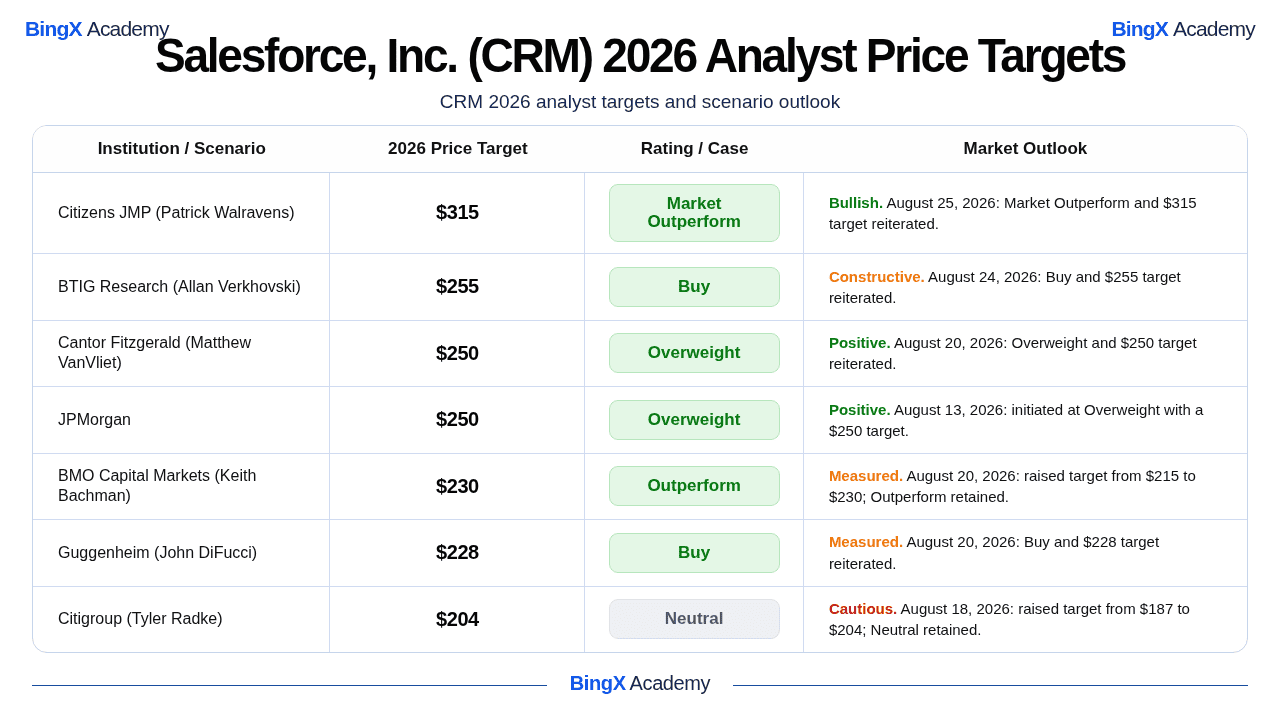
These dated third-party Salesforce actions span $204 to $315 and come from the source-backed MarketBeat table. The spread reflects differing views on AI monetization, organic growth, acquisitions, margins, and valuation.
|
Institution / Scenario |
2026 Price Target |
Rating / Case |
Market Outlook |
|
Citizens JMP (Patrick Walravens) |
$315 |
Market Outperform |
Bullish. August 25, 2026: Market Outperform and $315 target reiterated. |
|
BTIG Research (Allan Verkhovski) |
$255 |
Buy |
Constructive. August 24, 2026: Buy and $255 target reiterated. |
|
Cantor Fitzgerald (Matthew VanVliet) |
$250 |
Overweight |
Positive. August 20, 2026: Overweight and $250 target reiterated. |
|
JPMorgan |
$250 |
Overweight |
Positive. August 13, 2026: initiated at Overweight with a $250 target. |
|
BMO Capital Markets (Keith Bachman) |
$230 |
Outperform |
Measured. August 20, 2026: raised target from $215 to $230; Outperform retained. |
|
Guggenheim (John DiFucci) |
$228 |
Buy |
Measured. August 20, 2026: Buy and $228 target reiterated. |
|
Citigroup (Tyler Radke) |
$204 |
Neutral |
Cautious. August 18, 2026: raised target from $187 to $204; Neutral retained. |
How to Trade Salesforce, Inc. (CRM) Stock on BingX
Navigate Salesforce’s earnings cycle, Agentforce adoption, integration progress, and guidance using BingX TradFi and BingX AI tools. These can provide additional market context around earnings, cRPO, AI monetization, and sentiment, while CRM-USDT remains a TradFi perpetual contract rather than direct share ownership.
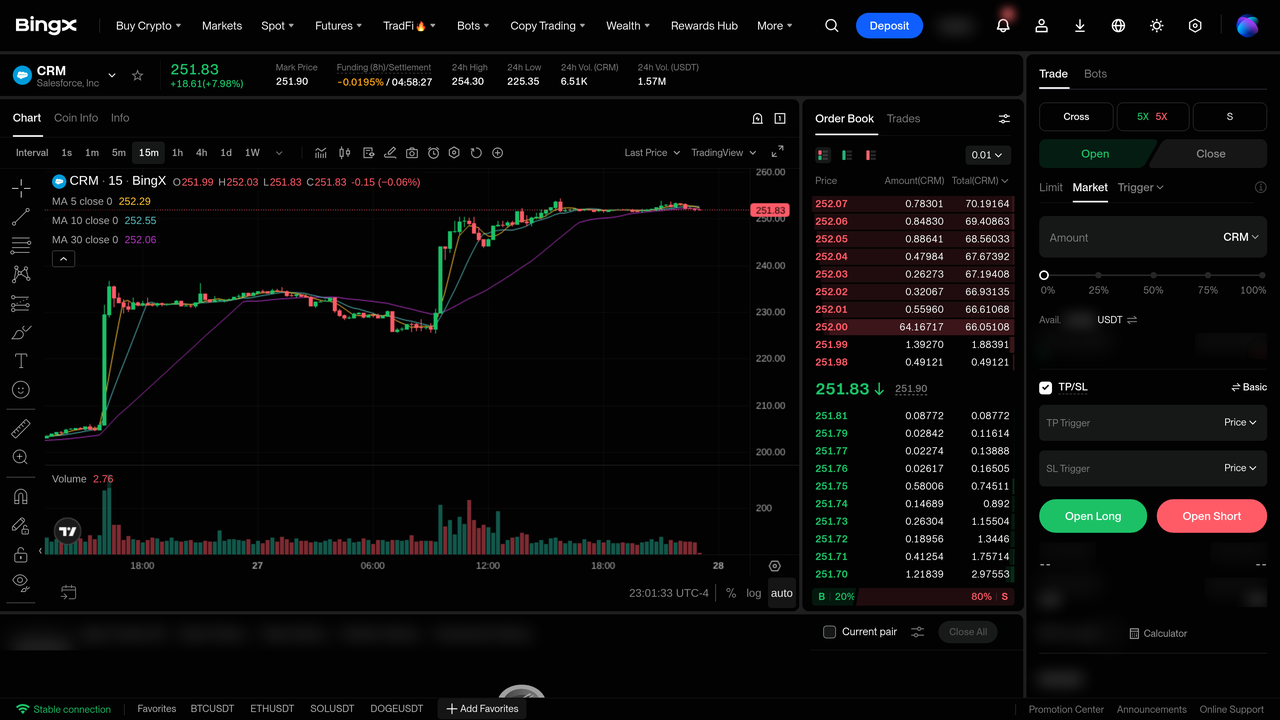
Step 1: Access BingX TradFi. Sign up and navigate to the specialized TradFi section on the main BingX exchange dashboard.
Step 2: Select Salesforce (CRM). Search for and select the CRM-USDT perpetual futures contract.
Step 3: Choose your direction. Select Open Long if you expect stronger Agentforce monetization, resilient cRPO, and continued margin discipline to support CRM. Select Open Short if you expect slower organic growth, weaker enterprise demand, or acquisition-integration pressure to weigh on the stock.
Step 4: Select leverage and margin mode. Choose Isolated or Cross-Margin based on your risk tolerance. Because CRM can react sharply to earnings, guidance, cRPO trends, and AI adoption updates, conservative leverage and clear position sizing are important.
Step 5: Execute strict risk protocols. Set Take-Profit and Stop-Loss (TP/SL) levels before or immediately after entering the trade. CRM can move quickly around quarterly earnings, Agentforce ARR, cRPO, margins, acquisition integration, enterprise software demand, and analyst revisions.
Top 5 Risks to Watch for CRM Investors in 2026
Salesforce’s outlook depends on sustained enterprise demand, successful AI monetization, disciplined integration, and continued margin strength.
- Enterprise software spending could slow. Longer approval cycles or tighter IT budgets could weaken new bookings, renewals, and cRPO growth, putting pressure on revenue and valuation.
- Competition could intensify across CRM and AI. Microsoft, Oracle, ServiceNow, and AI-native platforms can compete through pricing, bundling, and alternative agentic workflows, raising pressure on growth and customer retention.
- Agentforce and acquisition integration could disappoint. Salesforce must integrate Informatica, Slack, Data 360, Agentforce, and other acquired products without disrupting customers. Slower adoption or weaker synergies could delay revenue growth and increase costs.
- AI, privacy, and cybersecurity rules could raise costs. Salesforce handles large amounts of enterprise and customer data, so regulatory changes, security incidents, or model failures could slow deployments and affect customer trust.
- Valuation could compress even if earnings remain positive. CRM still depends on strong growth expectations, margins, and confidence in AI monetization. Higher rates, weaker guidance, or slower organic growth could push the valuation multiple lower.
Final Thoughts: Should You Invest in Salesforce, Inc. in 2026?
Salesforce enters the rest of 2026 with a large recurring-revenue base, strong margins, and solid cash generation. The main question is whether Agentforce and Data 360 can turn rapid AI adoption into faster organic subscription growth while Salesforce integrates Informatica and other acquisitions without weakening execution.
The bull case strengthens if Agentforce ARR converts into broader customer spending, cRPO remains healthy, margins stay disciplined, and free cash flow continues to grow. The bear case becomes more likely if enterprise demand slows, acquisitions mask weaker organic growth, or valuation compresses before AI monetization becomes material.
Risk Reminder: CRM remains exposed to enterprise software demand, AI competition, acquisition integration, cybersecurity, regulation, currency movements, and valuation volatility. Investors should conduct independent research and assess their own risk tolerance before trading.
Related Reading
- What Is OpenAI Pre-IPO and How to Trade It on BingX?
- What Is Anthropic Pre-IPO and How to Trade It on BingX?
- Reddit (RDDT) Price Outlook for 2026: Can AI Data Licensing Drive RDDT Back to $200?
- Figma (FIG) Price Prediction 2026: $36.00 AI Launchpad or Overvalued Post-IPO Hangover Trap?
- Alphabet (GOOGL) Stock Outlook 2026: Can Gemini and Google Cloud AI Drive GOOGL Cross $420?
- Apple (AAPL) Stock Outlook for 2026: MacBook Neo Growth or AI Valuation Trap?
