Dell Technologies (DELL) supplies enterprise infrastructure, personal computers, peripherals, software, services and financing through its Infrastructure Solutions Group and Client Solutions Group. PowerEdge servers and storage remain central to the business, while AI-optimized systems are becoming the dominant growth engine. That transition gives Dell broad exposure to data-center investment, although the shares remain sensitive to component availability, deployment timing and hardware margins.
The latest quarter showed that the transition is accelerating. Dell Fiscal Q2 2027 revenue reached $46.971 billion, up 58% year over year, as Infrastructure Solutions Group revenue rose 89% to $31.782 billion and AI-optimized server revenue doubled to $16.401 billion. Non-GAAP diluted EPS increased 203% to $7.04, yet operating cash flow declined 13% to $2.225 billion as working-capital needs expanded.
The DELL stock forecast for 2026 now centers on two competing views:
- The AI-backlog case: Dell converts its $95 billion AI-server backlog into revenue, sustains storage attachment and preserves double-digit infrastructure margins as enterprise and hyperscale deployments expand.
- The execution-and-valuation case: component costs, customer deployment schedules and working-capital demands slow cash conversion after a 316% YTD rally, making the current valuation harder to defend.
This guide breaks down the DELL stock forecast, 2026 price scenarios, key risks and analyst outlooks, drawing on Dell Technologies' September 1 fiscal Q2 2027 earnings release, company filings and market data through September 4, plus how to trade DELL stock futures on BingX TradFi with USDT collateral.
Top 5 Things for Dell Technologies Investors to Know in September 2026
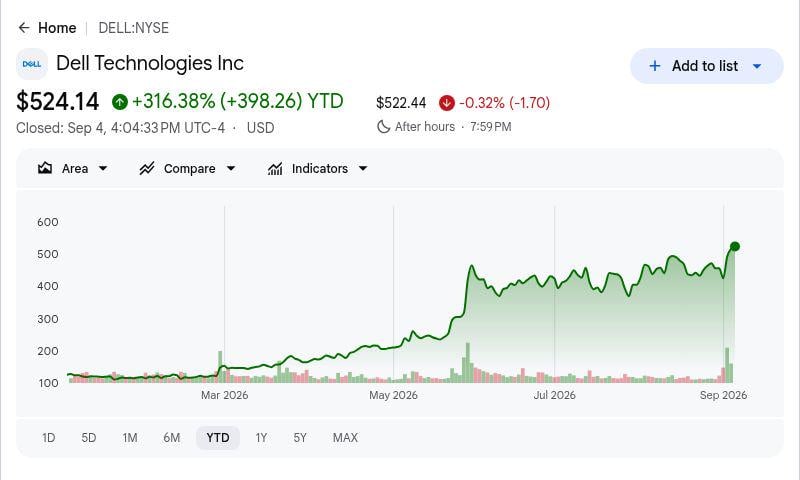
- DELL was up 316.38% YTD at the September 4 close of $524.14: The stock finished only about 2% below its $534.99 52-week high after investors repriced Dell around AI-server demand. That advance makes future gains more dependent on backlog conversion and earnings delivery than on another expansion in expectations alone.
- Quarterly revenue reached a record $46.971 billion, up 58% year over year: The result exceeded the roughly $44.89 billion consensus by about $2.08 billion. Growth extended beyond accelerators, showing that traditional servers, networking, storage and commercial PCs are participating in the infrastructure refresh.
- AI-optimized server revenue doubled to $16.401 billion as backlog reached $95 billion: Dell booked $60.9 billion of AI-server orders during the quarter, creating unusual forward visibility. The opportunity is substantial, although converting such a large order book requires GPUs, memory, networking, cooling and customer data centers to arrive on schedule.
- Management raised fiscal 2027 revenue guidance by $25 billion to $192 billion: The company also lifted AI-server revenue guidance from $60 billion to $74 billion and non-GAAP EPS from $17.90 to $25.50. These increases support the growth case, yet they also establish a much higher delivery threshold for the remaining quarters.
- Selected analyst targets range from $625 to $735 after fiscal Q2: Google Finance showed a wider 21-analyst average of $586.16, a $735 high and a $499 low. The dispersion reflects broad confidence in AI demand alongside disagreement over component costs, margins, cash conversion and how much growth is already reflected in the share price.
What Is Dell Technologies (DELL)?
Dell Technologies is a global technology company that designs, assembles and supports computing infrastructure for enterprises, governments, cloud operators and consumers. Infrastructure Solutions Group sells PowerEdge servers, storage systems, networking and associated services, while Client Solutions Group sells commercial and consumer PCs, displays and peripherals. Dell also earns revenue from support, deployment, managed services and financing, giving the company a broader customer relationship than a stand-alone hardware vendor.
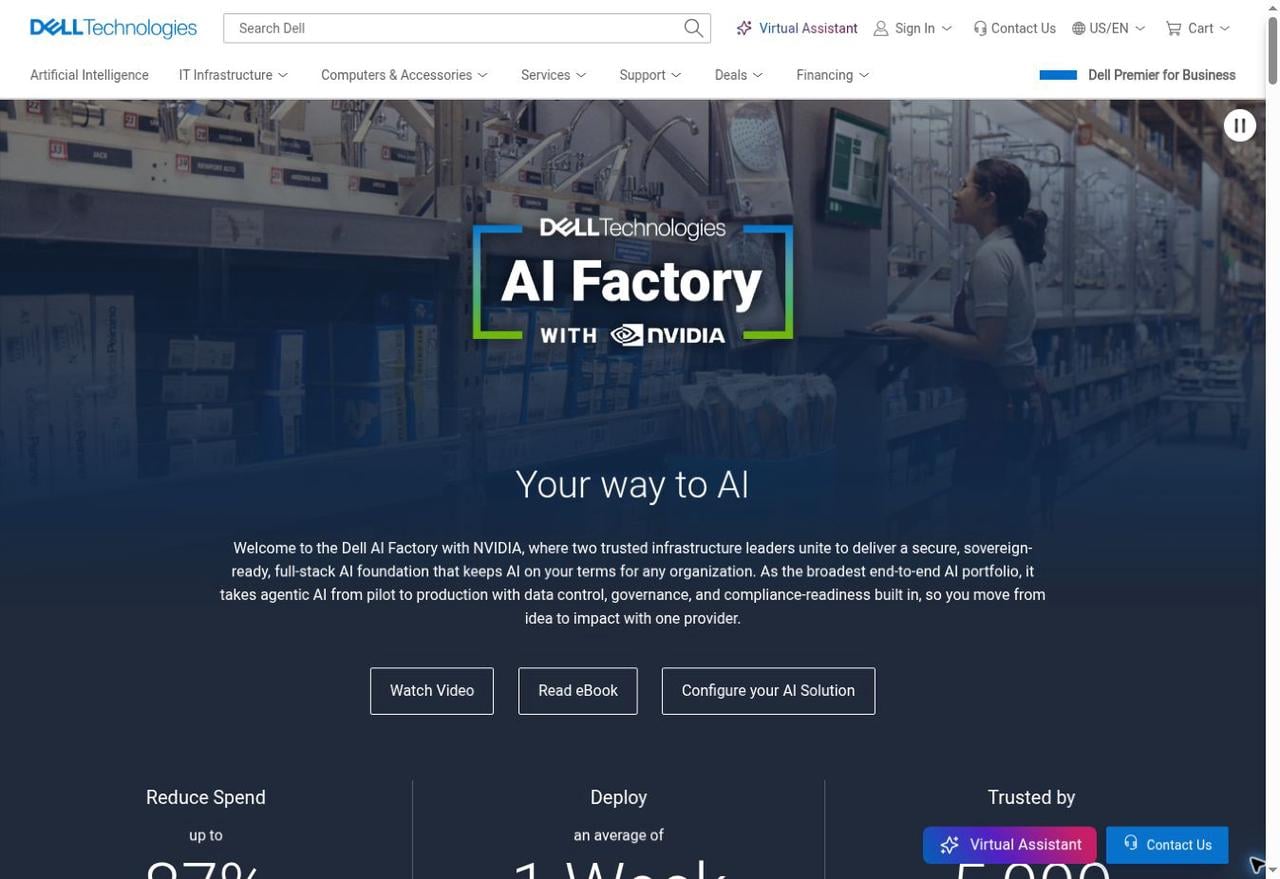
Dell's current direction centers on full-stack AI infrastructure that links compute, networking, storage, cooling, software and services. The AI data-center strategy is anchored by Dell AI Factory with NVIDIA, which combines PowerEdge systems with NVIDIA GPUs and networking in validated rack-scale configurations. Dell also markets an open AI platform with AMD, while cloud providers including CoreWeave and Nscale have become visible customers for AI systems. Storage attachment and enterprise services are important because they can improve the economics of high-volume server deployments.
Read More: Top AI Server Stocks to Buy in 2026: Rack-Scale Systems, GPU Servers, and AI Servers Infrastructure
Dell Technologies (DELL) Q2 FY2027 Earnings Overview: Revenue, EPS and AI-Server Growth
Dell delivered fiscal Q2 revenue of $46.971 billion versus the roughly $44.89 billion consensus, non-GAAP EPS of $7.04 versus $4.91 expected, and GAAP net income of $4.133 billion. ISG revenue climbed 89% to $31.782 billion, AI-server revenue doubled to $16.401 billion, and management raised fiscal 2027 revenue guidance to $192 billion from $167 billion. The main tension is whether backlog conversion can preserve margins and improve cash generation.
Read More: DELL Q2 FY2027 Earnings Overview: $16.4B AI Server Revenue and $192B FY27 Outlook Drive 15.81% Rally
|
Financial Metric |
Guidance / Consensus |
Reported / Actual |
Surprise |
|
Q2 FY2027 revenue |
$44.89B consensus |
$46.971B |
Beat. About $2.08B above consensus; up 58% YoY. |
|
Q2 non-GAAP diluted EPS |
$4.91 consensus |
$7.04 |
Beat. $2.13 above consensus; up 203% YoY. |
|
Q2 GAAP diluted EPS |
— |
$6.34 |
Improved. Up 273% from $1.70 a year earlier. |
|
Q2 GAAP net income |
— |
$4.133B |
Improved. Up 255% from $1.164B. |
|
Q2 ISG revenue |
— |
$31.782B |
Record. Up 89% as infrastructure demand broadened. |
|
Q2 AI-optimized server revenue |
— |
$16.401B |
Record. Doubled YoY as quarterly orders reached $60.9B. |
|
Q2 ISG operating income |
— |
$4.781B; 15.0% margin |
Expanded. Income rose 225% and margin increased from 8.8%. |
|
Q2 CSG revenue |
— |
$15.034B |
Improved. Up 20%, led by 22% commercial growth. |
|
Q2 cash flow from operations |
— |
$2.225B |
Declined. Down 13% despite higher net income. |
|
Q3 FY2027 revenue outlook |
— |
$49.0B |
Raised. Implies 81% year-over-year growth. |
|
FY2027 revenue outlook |
Prior: $167.0B |
$192.0B |
Raised. Increased $25B and implies 69% growth. |
|
FY2027 non-GAAP EPS outlook |
Prior: $17.90 |
$25.50 |
Raised. Increased $7.60 and implies 148% growth. |
- Revenue of $46.971 billion grew 58% and beat consensus by about $2.08 billion: Product revenue increased 72% to $41.112 billion, while services revenue was nearly flat at $5.859 billion. The mix confirms exceptional systems demand, although durable profitability increasingly depends on attaching storage, support and services to large hardware deployments.
- Non-GAAP diluted EPS of $7.04 exceeded consensus by $2.13: GAAP diluted EPS also rose 273% to $6.34 as net income increased 255% to $4.133 billion. Earnings grew materially faster than revenue, demonstrating operating leverage even as the company invested in inventory and financing capacity for AI systems.
- ISG revenue rose 89% to $31.782 billion as multiple product lines accelerated: AI-server revenue doubled to $16.401 billion, traditional server and networking revenue increased 122% to $10.531 billion, and storage rose 26% to $4.850 billion. The breadth reduces dependence on a single accelerator cycle and supports stronger system-level economics.
- ISG operating income increased 225% to $4.781 billion: Segment operating margin expanded to 15.0% from 8.8% a year earlier, countering concern that AI servers are inherently low-margin. Maintaining that rate depends on storage attachment, pricing discipline and component availability as the $95 billion backlog moves into production.
- Fiscal 2027 revenue guidance increased $25 billion to $192 billion: Management raised AI-server revenue guidance by $14 billion to $74 billion and non-GAAP EPS by $7.60 to $25.50. Q3 guidance of $49 billion revenue and $6.50 adjusted EPS provides the next measurable test of whether the higher annual targets remain achievable.
Dell Technologies (DELL) Price Prediction 2026: $700 AI Upside vs. $380 Execution Risk
The central test for DELL is whether record AI orders translate into shipments, margins and cash flow quickly enough to justify a share price that already rose 316.38% in 2026. The following bull, base and bear ranges are BingX Academy editorial scenarios, not Wall Street targets or price promises.
The Bull Case: Strong AI Server Demand Pushes DELL Toward $700
The Bull Case assumes fiscal 2027 AI-server revenue reaches or exceeds the raised $74 billion target as the $95 billion backlog converts on schedule. Storage stays above 20% growth, traditional server and networking demand remains healthy, and ISG operating margin holds near 15% as higher-value attachments offset component costs.
A move toward $680 to $700 would require Q3 revenue near $49 billion, non-GAAP EPS around $6.50, and continued estimate upgrades. Stable GPU supply, faster enterprise deployments, and stronger operating cash flow would provide the clearest confirmation.
The Base Case: Steady AI Growth Keeps DELL Between $520 and $600
The Base Case assumes Dell delivers near $192 billion of fiscal 2027 revenue and $25.50 of non-GAAP EPS as AI growth offsets higher memory, networking, and working-capital costs. ISG margin remains in the low-to-mid teens, while CSG continues growing without becoming the main valuation driver.
Under this scenario, DELL could trade mainly between $520 and $600. Q3 results near guidance, steady storage attachment, and better cash conversion would support the range, while weaker AI orders or lower margins would pressure the upper end.
The Bear Case: Slower AI Deployments and Margin Pressure Pull DELL Toward $380
The Bear Case assumes AI customers delay data-center readiness, component costs rise, and the $95 billion backlog converts more slowly than expected. Inventory and financing needs keep cash generation below earnings, while ISG margin falls below 12%.
A move toward $380 to $420 would become more likely if Q3 revenue misses $49 billion, fiscal 2027 guidance is reduced, or operating cash flow remains weak. Dell could still grow revenue, but slower estimate revisions and multiple compression would pressure the stock.
DELL Stock Price Forecasts for 2026 By Wall Street Analysts
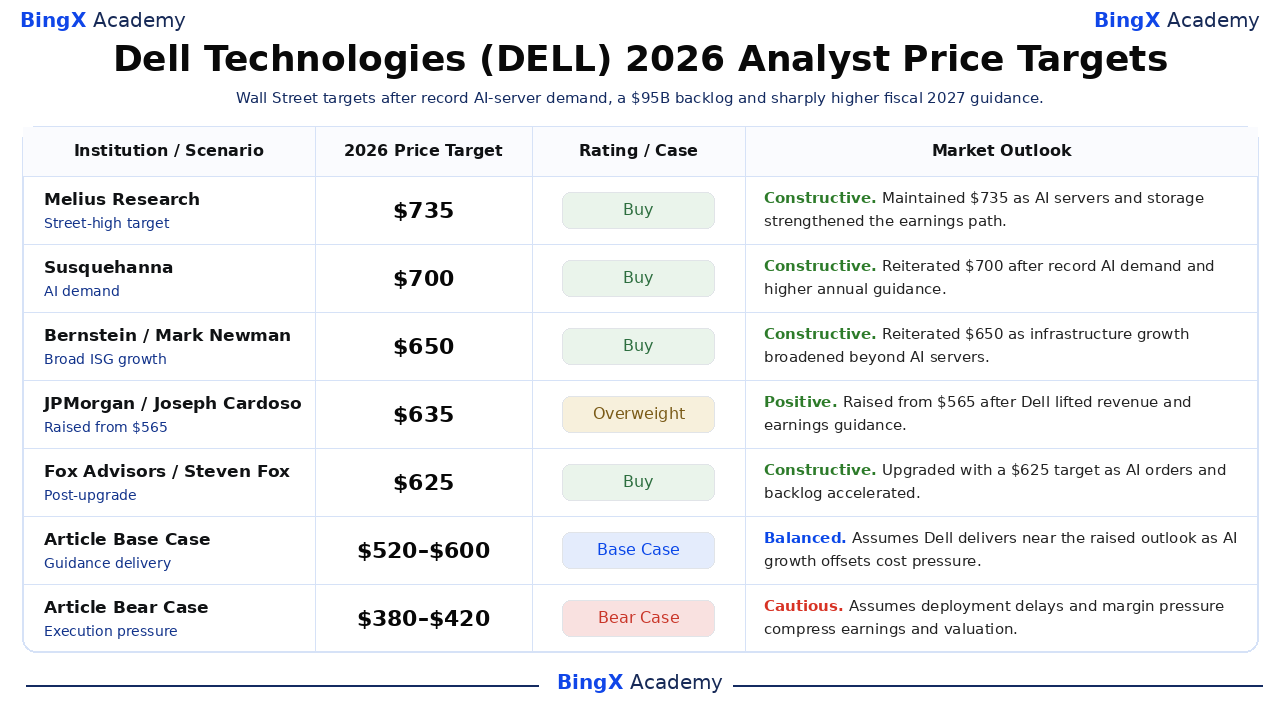
The five selected post-earnings actions are dated, named third-party targets and appear from highest to lowest. They range from $625 to $735, while Google Finance's wider 21-analyst set averaged $586.16 and ranged from $499 to $735 as of September 4. The final two rows are BingX Academy editorial scenarios rather than Wall Street forecasts.
|
Institution / Scenario |
2026 Price Target |
Rating / Case |
Market Outlook |
|
Melius Research |
$735 |
Buy |
Constructive. September 2: maintained a $735 target as AI-server demand and storage attachment supported a higher earnings path. |
|
Susquehanna |
$700 |
Buy |
Constructive. September 2: reiterated a $700 target after record AI demand and Dell's sharply higher annual outlook. |
|
Bernstein |
$650 |
Buy |
Constructive. September 2: reiterated a $650 target as infrastructure growth broadened beyond AI-optimized servers. |
|
JPMorgan |
$635 |
Overweight |
Positive. September 2: raised from $565 after Dell increased its revenue and earnings guidance following fiscal Q2. |
|
Fox Advisors |
$625 |
Buy |
Constructive. September 2: upgraded Dell with a $625 target as AI orders and backlog accelerated. |
|
Article Base Case |
$520–$600 |
Base Case |
Balanced. Assumes Dell delivers near raised guidance as AI growth offsets component and working-capital pressure. |
|
Article Bear Case |
$380–$420 |
Bear Case |
Cautious. Assumes deployment delays, weaker margins and multiple compression outweigh continued revenue growth. |
How to Trade Dell Technologies (DELL) Stock on BingX
Trade Dell's AI-server backlog, infrastructure growth and margin outlook using BingX TradFi and BingX AI tools. Because DELL can react sharply to order trends, component availability, guidance and customer deployment schedules, traders should define both the catalyst and risk limits before entering a position.
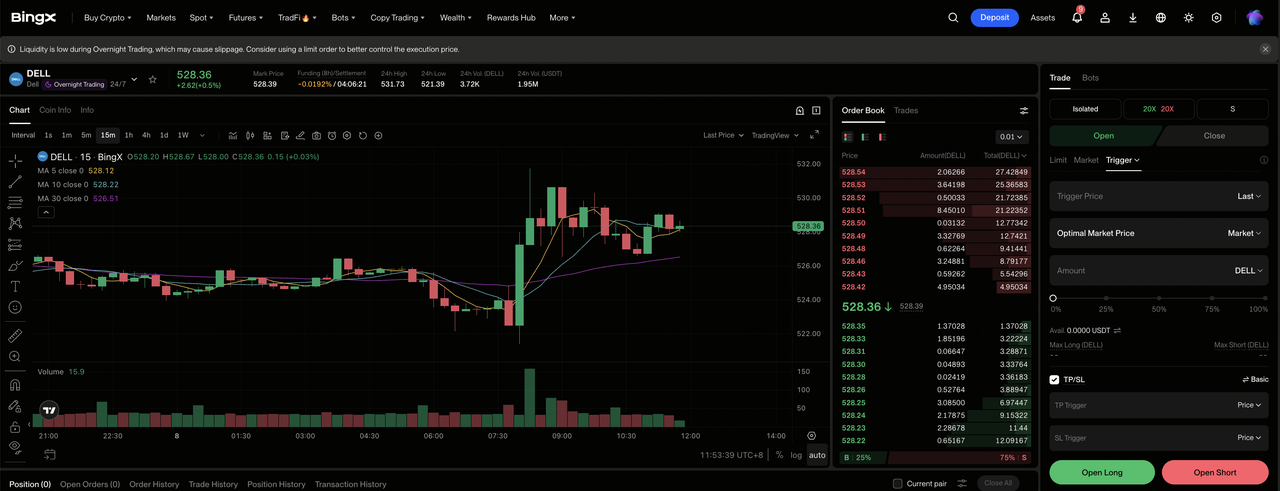
Step 1: Access BingX TradFi. Sign up and navigate to the specialized TradFi section on the BingX exchange dashboard.
Step 2: Select Dell Technologies (DELL). Search for and select the DELL-USDT perpetual futures contract.
Step 3: Choose your direction. Select Open Long if backlog conversion supports raised guidance and ISG margins remain firm. Select Open Short if deployment delays, component costs or weaker orders reduce earnings expectations.
Step 4: Select leverage and margin mode. Choose Isolated or Cross-Margin based on your risk tolerance. The 316.38% YTD advance shows why conservative leverage and clear position sizing are important.
Step 5: Execute strict risk protocols. Set Take-Profit and Stop-Loss (TP/SL) levels before or immediately after entering the trade. DELL can react quickly to AI-server orders, backlog conversion, component availability, margins and fiscal guidance.
Top 5 Risks to Watch for DELL Investors in 2026
Dell's record order book provides unusual revenue visibility, although the scale of the 2026 re-rating leaves the shares sensitive to execution, margins and cash conversion.
- A 316.38% YTD gain lifted DELL to $524.14: The share price now incorporates a large portion of the AI growth narrative. If revenue or earnings estimates stop rising, even positive operating results could trigger multiple compression and reduce per-share value.
- The $95 billion AI-server backlog creates a demanding delivery schedule: Orders become revenue only when GPUs, memory, networking, cooling and customer facilities are ready. Deployment delays could shift revenue between quarters, weaken cash collection and increase uncertainty around the $74 billion annual server target.
- Operating cash flow declined 13% to $2.225 billion: Net income rose 255%, showing a significant gap between reported earnings and quarterly cash generation. Persistent working-capital needs would limit financial flexibility even if revenue and adjusted EPS continue to expand.
- Inventory increased to $21.290 billion from $10.437 billion in January: Dell is carrying more components and finished systems to support the order ramp. If customers delay deployments or demand changes, excess inventory could absorb cash, require price concessions and pressure gross margins.
- AI systems depend on external component and ecosystem partners: Dell integrates NVIDIA GPUs, advanced memory, networking and cooling rather than manufacturing those components itself. Shortages, price inflation or product-transition delays could constrain shipments and reduce the margin benefit from stronger demand.
Final Thoughts: Should You Invest in DELL in 2026?
Dell's fiscal Q2 results confirmed exceptional operating momentum: revenue grew 58%, adjusted EPS rose 203%, AI-server revenue doubled and ISG operating margin expanded to 15.0%. Management raised fiscal 2027 revenue guidance by $25 billion and AI-server revenue guidance by $14 billion. The counterweight is a 316.38% YTD rally, weaker quarterly operating cash flow and a delivery schedule shaped by a $95 billion backlog.
The $520 to $600 Base Case assumes Dell meets its raised outlook as storage and traditional infrastructure protect margins. The $680 to $700 Bull Case requires timely backlog conversion and improving cash generation, while the $380 to $420 Bear Case reflects deployment delays and multiple compression. Investors should track new AI orders, backlog conversion, ISG margin, storage growth and operating cash flow before treating further upside as sustainable.
Risk Reminder: Stock and perpetual-futures trading can result in substantial losses. This article presents editorial scenarios for educational purposes and does not provide investment advice or guarantee future returns.
Related Reading
- AMD vs. Nvidia Comparison 2026: Which AI Computing Stock Is the Better Buy?
- Top AI Server Stocks to Buy in 2026: Rack-Scale Systems, GPU Servers, and AI Servers Infrastructure
- Top AI Compute and GPU Stocks to Buy in 2026: The Shift to Inference and Custom Silicon
- Top AI Data Center Stocks to Buy in 2026: Cloud, Servers, and AI Compute Infrastructure
- NVIDIA (NVDA) Price Prediction 2026: Can AI Infrastructure Growth Drive NVDA Toward $420?
- AMD Price Prediction 2026: Can AI Growth Push AMD Toward $700?
