
In April 2026, the Dow Jones Industrial Average (DJIA) is at a structural crossroads. After shattering the 50,000-point milestone on February 6, the index has become the primary arena for a battle between Old Economy resilience and New World volatility. While the S&P 500 and Nasdaq grapple with AI valuation bubbles, the Dow’s heavy concentration in financials and industrials like Goldman Sachs and Caterpillar has made it a barometer for global trade stability. However, the ongoing Iran-Israel conflict and the March 4 closure of the Strait of Hormuz have sent a shockwave through the index, dragging it from its 50,268 peak back toward the 49,100 support level as investors weigh the risk of an oil-driven stagflation.
As we enter late April, the market is pricing in a fragile de-escalation. While the Dow staged a recovery on hopes of a Pakistan-brokered ceasefire, the technicals remain on a knife-edge. With the 200-day SMA at 46,698 acting as the ultimate floor, the Dow’s path to 55,000 depends entirely on whether corporate America can outrun the rising costs of energy and logistics. This guide breaks down the Dow Jones price prediction for 2026 using data from Morgan Stanley, Citi, and Deutsche Bank.
You will also discover how to trade Dow Jones futures through BingX TradFi.
Top 5 Things for Dow Jones Investors to Know in 2026
- The 50,000 Ghost: The Dow hit 50,097 in February, the fastest 10,000-point climb in history. It now acts as a massive psychological resistance level that must be reclaimed to confirm the bull trend.
- Transportation Anomaly: The Dow Jones Transportation Average recently plunged 12.7% in three sessions, a 'canary in the coal mine' signal suggesting that energy costs are hitting the logistics sector harder than the broader market currently reflects.
- The Agentic Web Factor: Dow components like IBM and Microsoft are no longer just software plays; they are the backbone of the 2026 Agentic Web, where AI agents manage on-chain corporate workflows, supporting a higher P/E floor.
- Hormuz Inflation: With Brent crude surging past $100/bbl, the Dow’s industrial giants face a margin squeeze. If the Strait remains throttled through Q3, earnings growth of 8–12% may be revised downward.
- Federal Reserve Gridlock: High energy-driven inflation with TTM at 3.56% has frozen Jerome Powell’s Fed, removing the rate cut safety net many investors were banking on for the second half of 2026.
What Is the Dow Jones Industrial Average (DJIA)?
The Dow Jones Industrial Average is a price-weighted index of 30 prominent companies listed on stock exchanges in the United States. Unlike the market-cap-weighted S&P 500, the Dow is influenced more by the share prices of its constituents, making high-priced stocks like Goldman Sachs and UnitedHealth Group its most powerful movers.
In 2026, the Dow has evolved into a TradFi-Plus index. It anchors the U.S. economy through industrial leaders like Caterpillar and Boeing, but also integrates the digital frontier through Nvidia (added to the Dow in late 2024) and Amazon. For BingX traders, the Dow (US30) represents a lower-volatility alternative to tech-heavy indices, offering exposure to Real-World Asset (RWA) trends and traditional banking health.
Dow Jones Performance in 2025: A Review
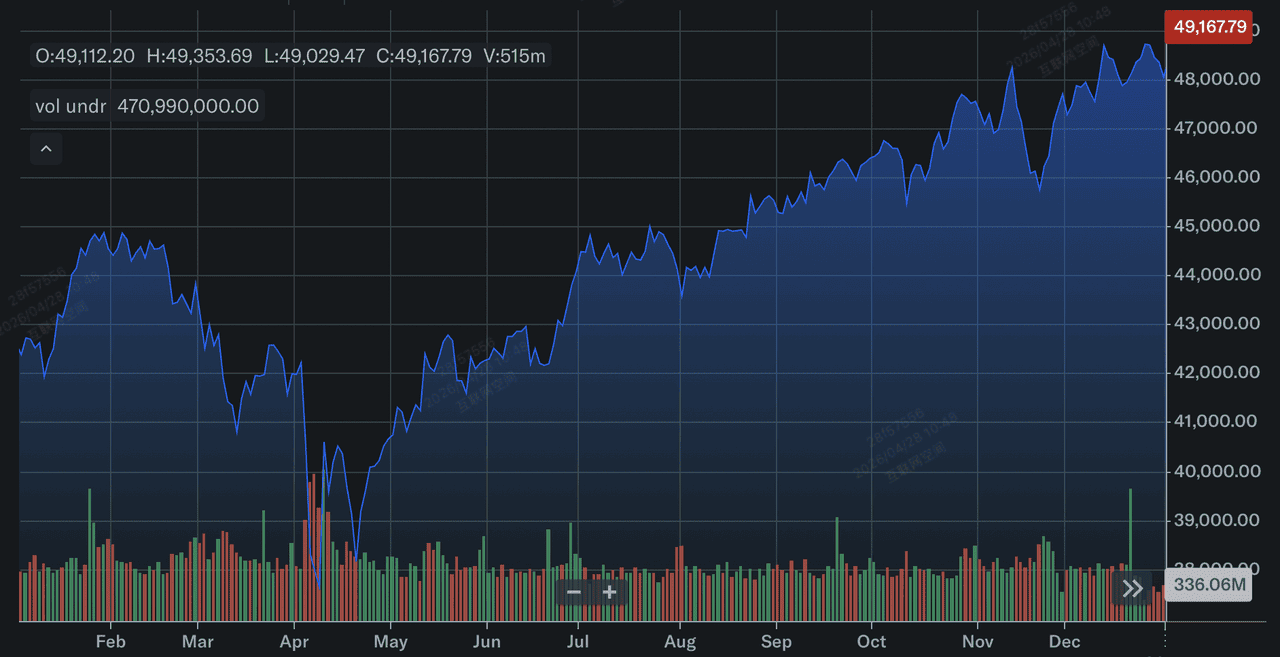
DJIA's performance in 2025 | Source: Yahoo Finance
In 2025, the Dow delivered a total return of 14.9%, outperforming expectations despite the April Tariff Shock. The year was a tale of two halves: a sharp drawdown in Q2 followed by a massive AI-Industrial rally. Industrials led the charge, with Caterpillar up 59% benefiting from global infrastructure spending, while Goldman Sachs surged 55% as M&A activity returned to pre-pandemic levels. The DJIA index ended 2025 at 48,063, setting the stage for the historic February 2026 breakout above 50,000.
Dow Jones 2026 Investment Outlook: 55,000 Alpha vs. 45,000 Bear Case
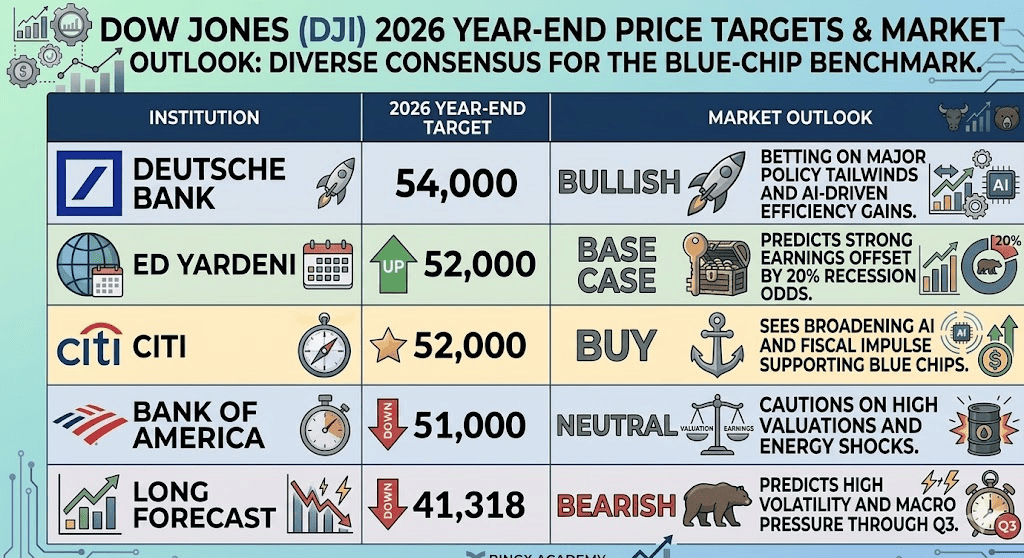
2026 Dow Jones price prediction by various Wall Street analysts
To navigate the current market crosscurrents, investors must evaluate three probability-weighted paths for the Dow Jones as the impact of the Iran conflict and Agentic Web productivity begins to hit corporate balance sheets.
The Bull Case: Dow Jones's 55,000 Peace & Productivity Rally
The bullish narrative centers on a Double Reset: a Pakistan-brokered reopening of the Strait of Hormuz by June 2026 and a rapid stabilization of Brent crude toward the $70–$75 range. This removes the Geopolitical Risk Premium that has suppressed industrial multiples, allowing the Dow’s price-weighted giants, specifically Caterpillar and Boeing, to capitalize on a surge in global infrastructure projects that were deferred during the conflict.
Furthermore, 2026 marks the Agentic Alpha phase, where AI agents move from experimental chat interfaces to autonomous corporate workflows. For high-priced Dow components like Goldman Sachs and Microsoft, this transition is projected to drive a 400–600 basis point expansion in operating margins through mid-year. If EPS growth for the index tracks toward the upper bound of 12%, a move to 55,000 represents a rational re-rating of blue-chip quality rather than speculative fervor.
The Base Case: 51,500 Sticky Inflation Consolidation for Dow
The base case assumes a Cold Peace, a scenario where active hostilities cease, but naval security costs in the Persian Gulf remain historically high. In this environment, oil lingers in a higher-for-longer band of $85–$95, keeping the Fed in a defensive, neutral posture. The Dow likely churns within a broad range, finding a fundamental floor at the 48,000 mark while attempting to turn the psychological 50,000 level from a ceiling into a support shelf.
Tactically, this scenario favors a pivot toward Quality and Yield. Investors should focus on Dow constituents with high free cash flow and low debt-to-equity ratios, such as UnitedHealth Group or Visa, which can pass through inflationary costs without sacrificing volume. In this stock-picker’s version of the Dow, the index drifts toward a year-end target of 51,500, driven by modest earnings growth and the resumption of corporate buyback programs that were paused during the Q1 volatility.
The Bear Case: The 45,000 Stagflation Trigger for Dow Jones Index
The bear case is triggered by a Systemic Energy Shock, a total breakdown in ceasefire talks that pushes Brent oil toward the $130–$150 danger zone. As diesel and jet fuel prices soar, the Dow Jones Transportation Average would likely lead a broader index collapse, signaling a shift from manageable inflation to true demand destruction. Consumer-heavy giants like Walmart and Coca-Cola would face a pincer movement of rising input costs and a consumer base that is rapidly scaling back discretionary spending.
Technically, this downside scenario targets a decisive breach of the 200-day SMA at 46,698. Such a break would likely activate massive programmatic de-risking, forcing the index toward the 45,000 primary uptrend support, effectively a 10% correction from current levels. In this hard-landing environment, the Agentic AI narrative would likely be discarded as cloud capex is slashed, leaving the Dow vulnerable to its steepest annual decline since the 2020 flash crash.
Dow Jones 2026 Forecast by Wall Street Analysts
|
Institution |
2026 Year-End Target |
Market Outlook |
|
Deutsche Bank |
54,000 |
Bullish: Policy tailwinds and AI-driven efficiency gains. |
|
Ed Yardeni |
52,000 |
Base Case: Strong earnings offset by 20% recession odds. |
|
Citi |
52,000 |
Buy: Broadening AI and fiscal impulse support blue chips. |
|
Bank of America |
51,000 |
Neutral: Cautions on high valuations and energy shocks. |
|
Long Forecast |
41,318 |
Bearish: High volatility and macro pressure through Q3. |
How to Trade Dow Jones Index Futures on BingX
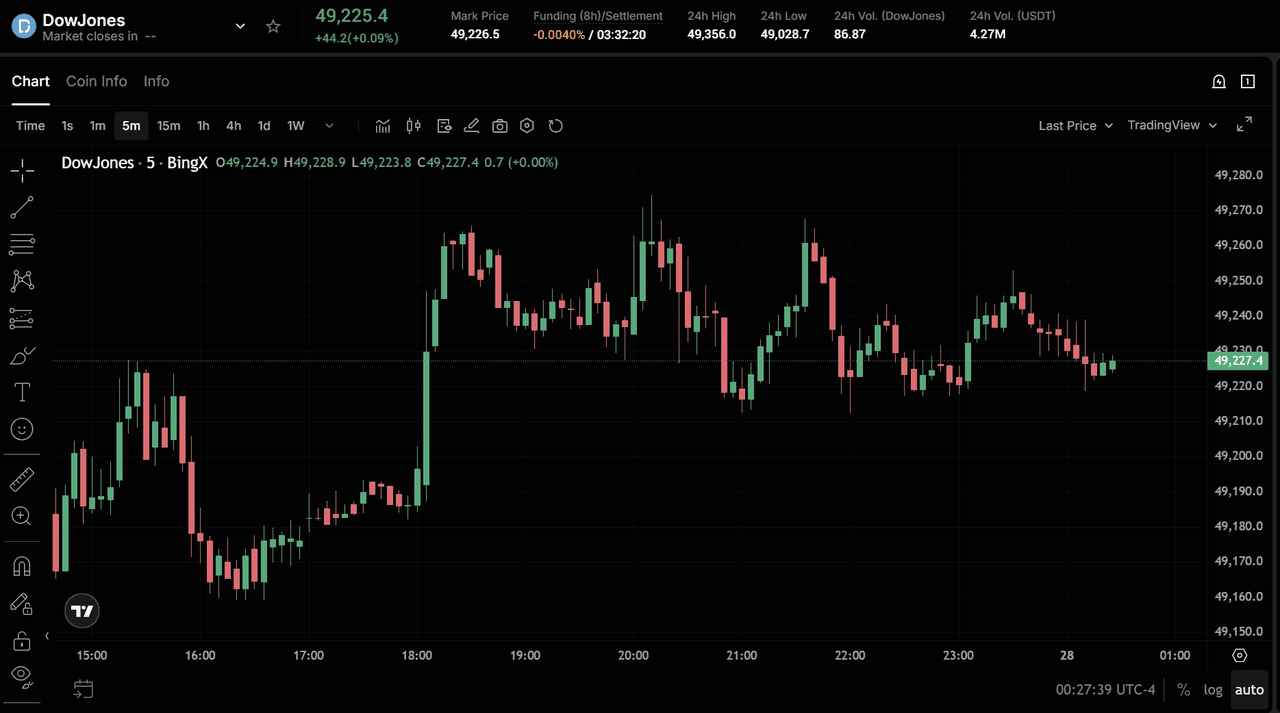
Dow Jones perpetuals on BingX futures market
BingX TradFi allows you to trade global indices with the same ease as crypto. Whether you are hedging your portfolio against an oil shock or going long on the 50,000 breakout with automated insights from BingX AI, BingX provides the tools.
- Access TradFi: Go to BingX TradFi and select Global Indices.
- Select US30: Open the DowJones-USDT perpetual contract.
- Leverage Wisely: Use 5x–20x leverage to amplify your position. Given the high volatility in 2026, many traders are opting for Isolated Margin to manage risk.
- AI Insights: Use BingX AI to monitor real-time news on the Strait of Hormuz and receive alerts when the Dow crosses key pivots.
Top 5 Risks and Considerations Before Investing in Dow Futures
Before allocating capital to Dow Jones (US30) futures, investors must evaluate the systemic and technical factors that define the high-leverage environment of 2026.
- Energy-Driven Margin Compression: With the Strait of Hormuz conflict pushing oil toward $115/bbl, the Industrial heavyweights in the Dow face immediate pressure. High fuel and logistics costs can rapidly erode corporate earnings, turning a bullish growth forecast into a stagflationary trap.
- The Price-Weighting Trap: Unlike the S&P 500, the Dow is weighted by share price rather than market cap. This means high-priced stocks like Goldman Sachs or UnitedHealth have a disproportionate impact on the index; a 5% move in a $500 stock swings the Dow significantly more than a 5% move in a $50 stock, regardless of the company's actual size.
- The Fed Paralysis Factor: Unlike previous cycles, the Federal Reserve is currently data-dependent on energy prices. Persistent inflation at 3.56% means the Fed Put, the expectation that the central bank will cut rates to save the market, is effectively off the table for the first half of 2026.
- Geopolitical Headline Sensitivity: The Dow is currently trading on War and Peace headlines. News regarding the Pakistan-brokered ceasefire or naval security in the Persian Gulf can cause gap-ups or gap-downs during off-market hours, bypassing traditional stop-loss orders.
- Agentic Web Implementation Lag: While the Agentic Web is a secular tailwind, the high capital expenditure required to integrate autonomous AI agents into legacy industrial frameworks may weigh on short-term cash flows before the promised efficiency gains are realized in late 2027.
Final Thoughts: Is the Dow a Buy in 2026?
The Dow Jones in 2026 has transitioned from a stable yield-haven into a high-volatility barometer for global energy and trade policy. While the 50,000 milestone confirmed the underlying health of U.S. blue chips, the Strait of Hormuz remains the primary constraint on sustained growth. For tactical traders, the current market is defined by a wait-and-see range between 48,000 Support and 50,800 Resistance. Until a formal ceasefire or infrastructure reopening is verified, the index is likely to remain sensitive to geopolitical headlines, making intraday technical levels more relevant to performance than traditional quarterly dividends.
For long-term participants, the current consolidation offers a strategic entry point into Quality factors, specifically companies with the pricing power to navigate $90+ oil and the technical infrastructure to leverage the Agentic Web. However, the risk of a Stagflationary Break cannot be ignored. A disciplined approach involves monitoring the 200-day SMA at 46,698; as long as the index holds above this shelf, the primary bull trend remains intact. Diversification into uncorrelated real assets or utilizing BingX TradFi short futures for hedging are practical ways to manage exposure during this transitionary year.
Risk Reminder: Trading global indices involves significant risk. The Dow Jones (US30) is currently highly sensitive to Middle East conflict escalations, energy supply shocks, and Federal Reserve policy shifts. Sudden price swings can lead to the loss of your initial capital. Always perform your own due diligence and use appropriate risk management tools like Stop-Loss orders before entering a position.
Related Reading
- Nasdaq 100 (NAS100) Forecast 2026: 27,000 AI Breakthrough or 22,000 Stagflation Trap?
- S&P 500 Forecast 2026: 7,600 Bull Run or a 6,000 Energy-Driven Crash?
- Crude Oil Price Forecast 2026: $140 War Premium or $60 Surplus Baseline?
- Goldman Sachs (GS) Price Prediction 2026: Strategic Renaissance or Value Trap at $860?
- JPMorgan Chase (JPM) Price Prediction 2026: Fortress Defense or AI-Driven Alpha at $330?
