
At the start of 2026, many analysts, including the EIA and J.P. Morgan, predicted a bearish year with Brent averaging $60 per barrel due to structural oversupply. However, as of March 9, 2026, the market has shifted violently. Oil prices have surged over 20% in a single session, with both Brent and WTI hitting their highest levels since July 2022. The driving force is an expanding U.S.-Israeli war with Iran, which has led to:
• Production Collapses: Iraq and Kuwait have slashed output as storage hits maximum capacity.
• Chokepoint Closures: The Strait of Hormuz is effectively blocked, trapping 20% of the world's oil supply.
• Political Hardlining: Iran’s naming of Mojtaba Khamenei as Supreme Leader suggests a prolonged conflict, with some analysts predicting WTI could reach $130/bbl shortly.
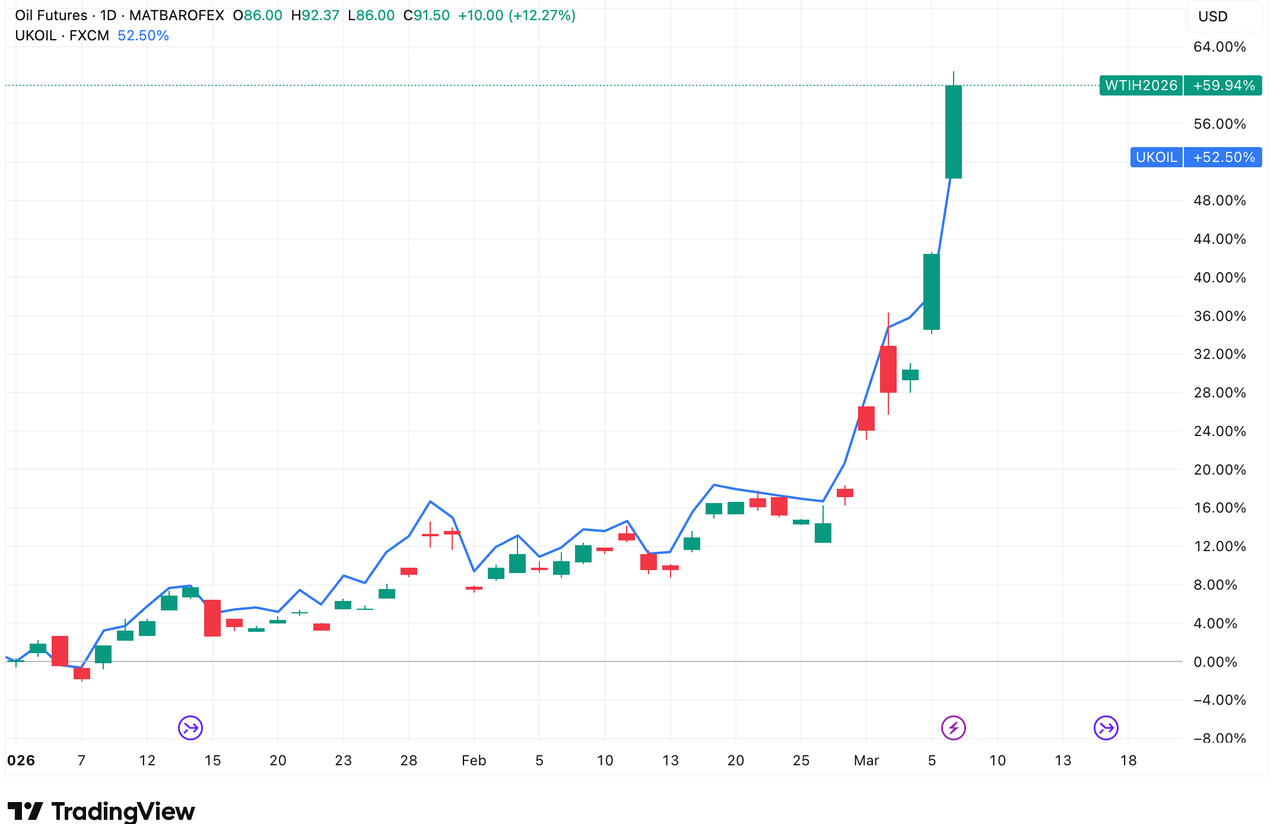
US WTI vs. UK Brent crude oil surge in 2026 | Source: TradingView
For the modern trader, these macro shifts represent a massive opportunity. On BingX, you can trade this volatility 24/7 using your existing crypto balance.
In this article, you will learn what drives crude oil prices, how oil trading works, and how to access oil exposure using crypto on BingX TradFi. We explain how to trade WTI and Brent oil perpetual futures on the BingX Futures market, providing the tools you need to navigate historic price shocks, hedge against geopolitical instability, or capture short-term momentum as the 2026 energy crisis unfolds.
What Is Crude Oil and Why Is It a Popular Asset to Trade?
Crude oil is a raw fossil fuel extracted from underground reservoirs and refined into products such as gasoline, diesel, jet fuel, and petrochemicals. In 2026, global oil consumption is expected to exceed 102 million barrels per day, making crude one of the most liquid and closely watched commodities in the world.
It is priced globally using benchmarks like WTI (U.S.) and Brent (international), and it sits at the center of the global economy, fueling transport, industry, power generation, and supply chains.
1. West Texas Intermediate (WTI): The U.S. benchmark, often more sensitive to domestic production in the Permian Basin.
2. Brent Crude: The international benchmark, currently the most affected by the Middle Eastern supply crunch.
Crude oil is popular to trade because it combines deep liquidity, strong volatility, and clear macro drivers. Prices react quickly to events such as OPEC+ decisions, geopolitical conflicts, sanctions, inventory data, and shifts in global growth or interest rates. For traders, this creates frequent opportunities to go long or short, hedge portfolios, or trade short-term momentum. When accessed via crypto markets, such as oil perpetuals or on-chain oil-themed tokens, crude oil becomes even more practical to trade, offering 24/7 access, leverage, and fast execution without owning or storing physical oil.
What Are WTI and Brent Crude Oil, and Why Do Traders Watch Both?
WTI (West Texas Intermediate) is the primary U.S. crude benchmark, representing light sweet crude stored at the Cushing, Oklahoma hub. It is the pulse of the American energy sector. In early 2026, WTI was pressured by record Permian Basin output, but as of March, it has surged over 22% in a single session, hitting $111.24. Traders monitor WTI to gauge U.S. Strategic Petroleum Reserve (SPR) releases and domestic refinery demand, which are now critical as the U.S. faces a wartime price shock.
Brent Crude is the international benchmark, sourced from the North Sea but used to price 80% of global oil. It is the most sensitive to the March 2026 Middle East crisis. Because Brent is waterborne, it is directly impacted by the closure of the Strait of Hormuz and force majeure declarations in Kuwait and Iraq.
What Is the Brent–WTI Spread in 2026?
While both benchmarks usually move together, the Brent–WTI spread, the price difference between the two, has widened significantly in March 2026. While U.S. WTI is rising due to global pressure, Brent is commanding a massive war premium because it is physically closer to the supply disruptions in the Middle East.
Insight: In early 2026, the spread was narrowed by Venezuelan imports into the U.S., but the current Strait of Hormuz blockade has caused Brent to decouple, making it the preferred instrument for traders betting on further international escalation.
Oil Market Outlook for 2026: What to Expect
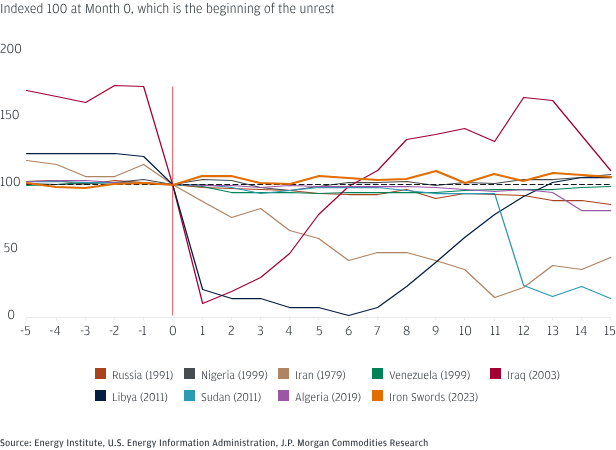
Major gepolitical events can disrupt oil production | Source: JP Morgan
The oil market began 2026 in a structural bearish cycle. As recently as late February, J.P. Morgan Global Research forecast Brent crude to average just $60/bbl for the year, citing a sizable surplus and soft supply-demand fundamentals. However, the expansion of the U.S.-Israeli war with Iran on March 2, 2026, has triggered a historic V-shaped recovery, rendering those base-case surplus forecasts obsolete in a matter of days.
• The War Premium Reality: J.P. Morgan analysts previously noted that regime changes in oil-producing nations typically lead to an average 76% price increase from onset to peak. While BloombergNEF initially called a $91 Brent price a low-probability tail risk, that threshold was smashed on March 8, 2026. Prices are now factoring in a prolonged loss of 20% of global sea-borne oil.
• Production Collapses: Iraq’s output has fallen 70% to 1.3 million bpd as of this week because they cannot export via the Persian Gulf. This involuntary cut is far more severe than any voluntary OPEC+ agreement J.P. Morgan anticipated in their February soft supply outlook.
• Leadership Hardliners: J.P. Morgan specifically warned that sweeping political reform in Iran would have a profound impact. The appointment of Mojtaba Khamenei in Tehran signals that a hardline stance is locked in, keeping a firm floor under oil prices at $100 for the foreseeable future.
• Inventory Exhaustion: While early 2026 was defined by storage builds, analysts from ANZ and Rakuten Securities now warn that the UAE and Saudi Arabia are running out of space to put oil they cannot ship. If they are forced to shut in wells, the supply disruption becomes structural, potentially pushing WTI toward $130/bbl.
Bottom line for 2026: The surplus narrative of February has been replaced by a scarcity reality in March. For BingX traders, the market has shifted from mean-reversion of trading back to $60 to volatility trading. Success now depends on tracking military escalations and shipping data while using tight risk management to navigate Trump-tweet volatility and potential Strategic Petroleum Reserve (SPR) releases.
What Are Oil Perpetual Futures and How Do They Work on BingX TradFi?
Oil perpetual futures are derivative contracts that track crude oil prices and allow you to trade price movements without owning physical oil or dealing with contract expiry. Through BingX TradFi, traders can access Oil WTI and Oil Brent perpetual contracts using USDT collateral, making it possible to trade global oil markets with the same crypto balance, interface, and risk tools used for BTC or ETH futures.
Designed for macro-driven traders, BingX’s oil perpetuals combine traditional commodity exposure with crypto-native flexibility, letting you react quickly to OPEC+ decisions, geopolitical headlines, inventory data, or supply disruptions, all without leaving the crypto ecosystem. These contracts are particularly useful in 2026, when oil prices are expected to oscillate between surplus-driven pressure and event-driven spikes.
How Crude Oil Perpetual Futures Trading with Crypto Works
• Long / Short: You can go long if you expect oil prices to rise or short if you expect them to fall, enabling directional trades and portfolio hedging.
• Funding fees: Like crypto perpetuals, oil perps use periodic funding of typically every 8 hours, which can add holding costs for longer-term positions.
• Market hours (WTI and Brent, UTC): Oil perpetuals on BingX operate in specific sessions rather than 24/7, with WTI typically trading from late Sunday through Friday and Brent following a slightly later daily opening schedule. Both assets undergo daily maintenance breaks, roughly 80 minutes for WTI and 140 minutes for Brent in UTC, during which new positions cannot be opened. In the high-volatility climate of 2026, managing leverage before the weekend close is critical, as geopolitical escalations frequently cause massive price gaps when markets reopen on Monday.
• Leverage: BingX offers adjustable leverage of up to 500x on oil perpetuals, improving capital efficiency, but higher leverage significantly increases liquidation risk and should be used cautiously.
Together, these features make BingX TradFi oil perpetuals a practical way for crypto traders to gain direct crude oil exposure, manage macro risk, and trade global energy markets using crypto, without physical delivery, brokerage accounts, or traditional commodity platforms.
How to Trade WTI and Brent Oil Perpetuals with Crypto on BingX Futures
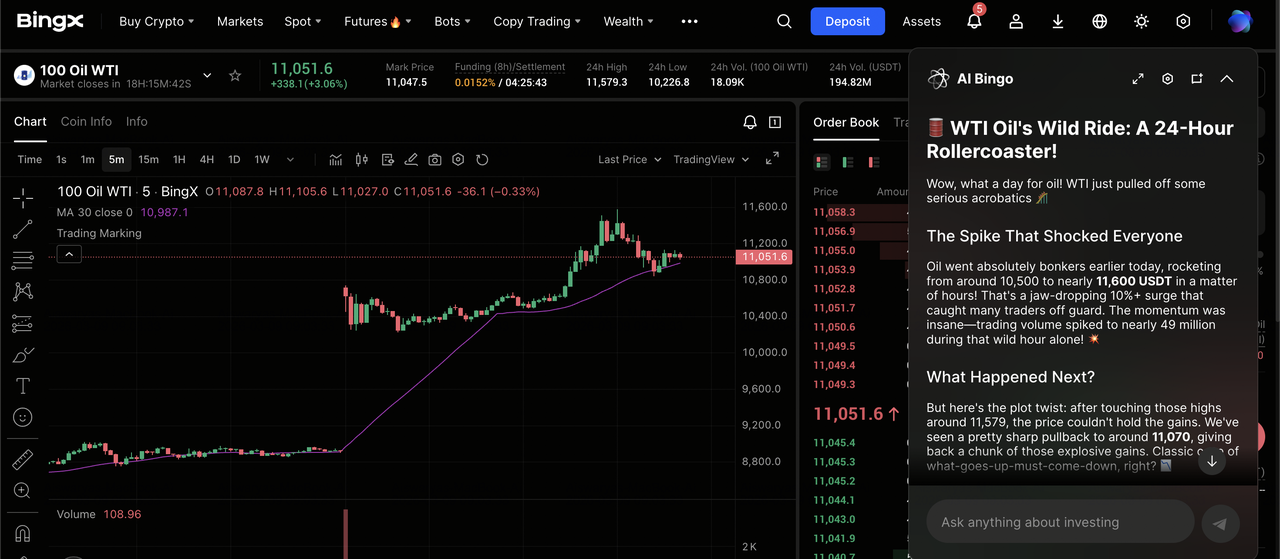
WTI Oil perpetual contract on the BingX futures market featuring BingX AI insights
By integrating BingX AI, you can automate your strategy using USDT collateral to navigate 2026’s extreme oil volatility without the need for traditional brokers, physical delivery, or the manual rolling of expiring contracts.
Step 1: Fund Your Futures Wallet with USDT
After signing up for a BingX account and completing KYC, deposit or transfer USDT into your Futures account/wallet so you’re ready to place trades.
Note: USDT is the margin and settlement currency for these contracts.
Step 2: Open the Oil Perpetual Contract to Trade
Go to Futures tab and select USD-Margined Perpetual Futures, then choose Oil WTI/USDT perpetuals or Oil Brent/USDT perpetual contract.
Step 3: Choose Your Direction to Go Long or Short
• Go long if you expect oil to rise, e.g., disruption risk, supply cuts, shipping constraints.
• Go short if you expect oil to fall, e.g., surplus supply, weak demand, rising inventories.
Step 4: Set Leverage and Place an Order
Pick a conservative leverage level, then choose:
• Market order for instant execution
• Limit order for a specific entry price
Oil can gap around macro headlines, so lower leverage usually improves survival.
Step 5: Manage Risk Like a Pro
Use stop-loss (SL) and take-profit (TP). Monitor your margin, especially around:
• session opens/closes (gap risk)
• major headlines (sanctions, OPEC+, conflict risk)
• funding intervals (cost accumulation)
WTI vs. Brent Oil Perpetuals: Which Should You Trade?
In the current March 2026 market, Brent Crude is the superior choice for trading pure geopolitical volatility. As the global benchmark for 80% of traded oil, Brent is directly exposed to the Strait of Hormuz crisis, recently surging 23% in a single session to cross the $114 mark. Because Brent is waterborne and sourced near the conflict zone, it carries a higher war premium than its U.S. counterpart. BingX traders should select Brent if they are looking to capitalize on immediate Middle Eastern supply shocks, force majeure declarations in Kuwait, or the hardline policies of Iran’s new Supreme Leader, Mojtaba Khamenei.
Conversely, WTI is the better option for trading U.S. policy responses and domestic production shifts. While it followed Brent’s lead with an 18.2% jump to $107.40, WTI is often weighed down by record output from the Permian Basin and potential Strategic Petroleum Reserve (SPR) releases ordered by the U.S. administration. Trade WTI if you are tracking U.S. inventory data or looking for a discounted entry into the oil market, as WTI currently trades at a $4–$7 discount to Brent. This Brent-WTI spread is a favorite for pair traders on BingX who bet on the gap widening as Middle Eastern supplies remain choked while U.S. production remains steady.
Top 5 Risks to Know Before Trading Crude Oil Assets with Crypto
Trading oil with crypto combines commodity volatility with crypto-style leverage and liquidity, so understanding the risks upfront is essential.
1. Extreme War Premium Volatility: In March 2026, oil has seen single-day moves exceeding 20%. Unlike crypto, which often trends over weeks, oil reacts instantly to military strikes or leadership changes, such as the naming of Mojtaba Khamenei. This event-driven volatility can blow through a standard Stop-Loss in seconds, especially when WTI and Brent are trading at $110+ levels.
2. The Sunday Gap Liquidity Risk: Because oil markets close on Sundays while geopolitical news does not, the price often gaps when it reopens. For example, on Monday, March 9, 2026, Brent jumped nearly $18.35 at the open. If you hold a high-leverage short position over the weekend, your account could be liquidated at the Monday open before you have the chance to exit manually.
3. Force Majeure and Supply Shut-ins: As seen with Kuwait and Iraq this week, countries can declare force majeure, effectively cancelling oil deliveries overnight. These are not market decisions but political ones that can cause sudden, vertical price moves. When storage hits 100% capacity in the UAE and Saudi Arabia, shutting in wells creates a structural supply hole that can sustain $100+ prices for months, punishing those betting on a quick mean reversion.
4. Regulatory and Sanction Blowback: Trading oil-related assets involves navigating a complex web of international sanctions. In 2026, President Trump's stance on Iranian military targets and U.S. tariffs on Indian/Chinese buyers of Russian oil can shift global trade flows in a single tweet. These political wild cards can decouple WTI from Brent, making historical correlations unreliable.
5. Leverage and USDT Collateral Risks: Using USDT as collateral on BingX is convenient, but combining crypto leverage with 20% daily oil swings is a high-stakes game. A 5x leverage position on WTI can be wiped out by a single routine price correction in this high-priced environment. Beginners should avoid high leverage during active conflict phases to prevent slippage during periods of thin liquidity at the session opens.
Final Thoughts: Should You Trade Oil with Crypto in 2026?
Trading crude oil with crypto in 2026 offers a high-impact alternative to traditional equity markets, especially as the current U.S.-Iran conflict drives Brent and WTI into a new era of extreme volatility. For crypto-native traders, BingX provides the necessary infrastructure to pivot from digital assets into global energy macro-trends using USDT as collateral. The ability to trade 20% daily price swings and war premiums without the friction of traditional brokerage accounts makes oil a compelling instrument for those looking to hedge against global inflation or capitalize on the historic supply shocks currently defining the Middle Eastern landscape.
However, the 2026 market is not for the faint of heart. While the potential for breakout profits is high, with some analysts eyeing $130/bbl, the risks of Sunday gaps, session liquidity breaks, and sudden geopolitical shifts remain severe.
Risk Reminder: Trading crude oil futures involves significant risk of loss and is not suitable for all investors. The high leverage available on BingX can work against you as easily as it can work for you; a single force majeure event or a sudden ceasefire could cause a violent price reversal. Always use strict stop-loss orders and never trade more capital than you can afford to lose in this highly unpredictable energy cycle.
Related Reading
1. How to Trade Forex, Commodities, Stocks, and Indices With BingX TradFi: A Beginner’s Guide (2026)
2. How to Trade Commodities With Crypto in 2026 as Oil, Gold, Silver, and TradFi Go On-Chain
3. What Is TradFi (Traditional Finance) On-Chain: A Beginner's Guide
4. What Is the United States Oil Reserve (USOR) Token and How to Buy It?
5. Top Oil-Themed and Energy-Linked Coins to Know in Early 2026
