
The global capital markets in mid-2026 are preparing for an unprecedented hardware milestone as artificial intelligence deployment transitions from data center infrastructure to on-device consumer execution. HP Inc. (NYSE: HPQ) serves as a principal vehicle for global investors aiming to capture this massive device-refresh cycle. By anchoring its core operations in the distribution of next-generation personal computers and specialized enterprise printing systems, the Palo Alto-headquartered multinational presents a unique tactical allocation for the current macroeconomic climate.
As corporate IT budgets scale up to meet the technical demands of local generative AI processing, hardware manufacturers are optimizing their pricing frameworks to absorb chip and component premium costs. Wall Street analysts indicate that the traditional margin expectations for hardware OEMs (Original Benchmark Manufacturers) are undergoing a rigorous recalculation throughout the second half of 2026. For international traders monitoring secular shifts in commercial technology procurement, tracking HP's performance metrics has become a core strategic imperative. You will also discover how to gain exposure to HP Inc. (NYSE: HPQ) stock futures through BingX TradFi.
Read more: Texas Instruments Stock Outlook 2026: Can Analog Chip Recovery, AI Infrastructure Drive TXN to 370+?
Key Highlights: Top 5 Things for Tech Investors to Know in 2026
- The On-Device AI Growth Engine: Unlike software-focused entities, HP is capitalizing directly on physical silicon deployment by leading the rollout of dedicated AI PCs. Its streamlined Omni branding structure leverages localized NPU (Neural Processing Unit) silicon to drive immediate enterprise upgrade demands.
- A Solidified Global Market Position: Operating firmly as the world's second-largest personal computer vendor by unit sales, HP holds a deep market share foundation. This scale ensures premium pricing leverage when sourcing core internal components amidst ongoing global hardware supply tight spots.
- The Enterprise Collaboration Expansion Via Poly: HP's integrated acquisition of communication hardware provider Poly Inc. allows it to offer highly complete, multi-device ecosystem bundles. These target high-margin commercial meeting spaces and flexible hybrid workflows globally.
- The "Print-as-a-Service" Recurring Revenue Shift: While traditional retail printing faces long-term structural changes, HP is systematically stabilizing its imaging wing. It does this by deploying commercial subscription plans and sustainable industrial packaging systems to lock in high-margin supply agreements.
- Compelling Shareholder Capital Return Dynamics: Bolstered by steady free cash flow, HP continues to stand out in the technology sector as a highly disciplined capital allocator. It balances regular equity buybacks with an institutional dividend profile that appeals to value-oriented equity managers.
Read more: Top AI Semiconductor Stocks to Buy in 2026: AI Chips and Supply Chain Complete Guide
What Is HP Inc. (HPQ)?
HP Inc. is a leading global provider of personal computing devices, imaging and printing products, and related technologies, solutions, and services. The company's origin stems from one of the most famous events in Silicon Valley history: the 2015 corporate split of the original Hewlett-Packard Company (founded in 1939 by Bill Hewlett and David Packard). While its sister company, Hewlett Packard Enterprise (HPE), took over enterprise server, storage, and networking operations, HP Inc. retained the core consumer-facing and corporate endpoint technology hardware business, continuing to trade under the historic HPQ ticker symbol.
Today, HP Inc. operates through two primary corporate pillars:
- Personal Systems: This segment covers commercial and consumer desktop PCs, notebooks, mobile workstations, retail point-of-sale (POS) systems, and a growing portfolio of hybrid work peripherals.
- Printing: This segment designs and manufactures individual consumer printers, massive commercial graphics/3D printing installations, and the proprietary ink and toner consumables that provide a steady stream of recurring revenue.
Driven by an institutional focus on free cash flow generation, cost efficiency, and consistent capital returns, HP Inc. has transitioned from a legacy computer builder into a modern IT hardware partner. In 2026, it acts as a critical bridge between local hardware layers and native generative AI software ecosystems.
Key Details for HP Investors
- Primary Corporate Index: S&P 500 Index / Fortune 63rd-Largest US Corporation
- Inception Date (Original / Split): Founded 1939 (Split implemented November 1, 2015)
- Corporate Headcount: Approx. 55,000 global employees (as of 2025/2026 reporting)
- Global Headquarters Location: Palo Alto, California, United States
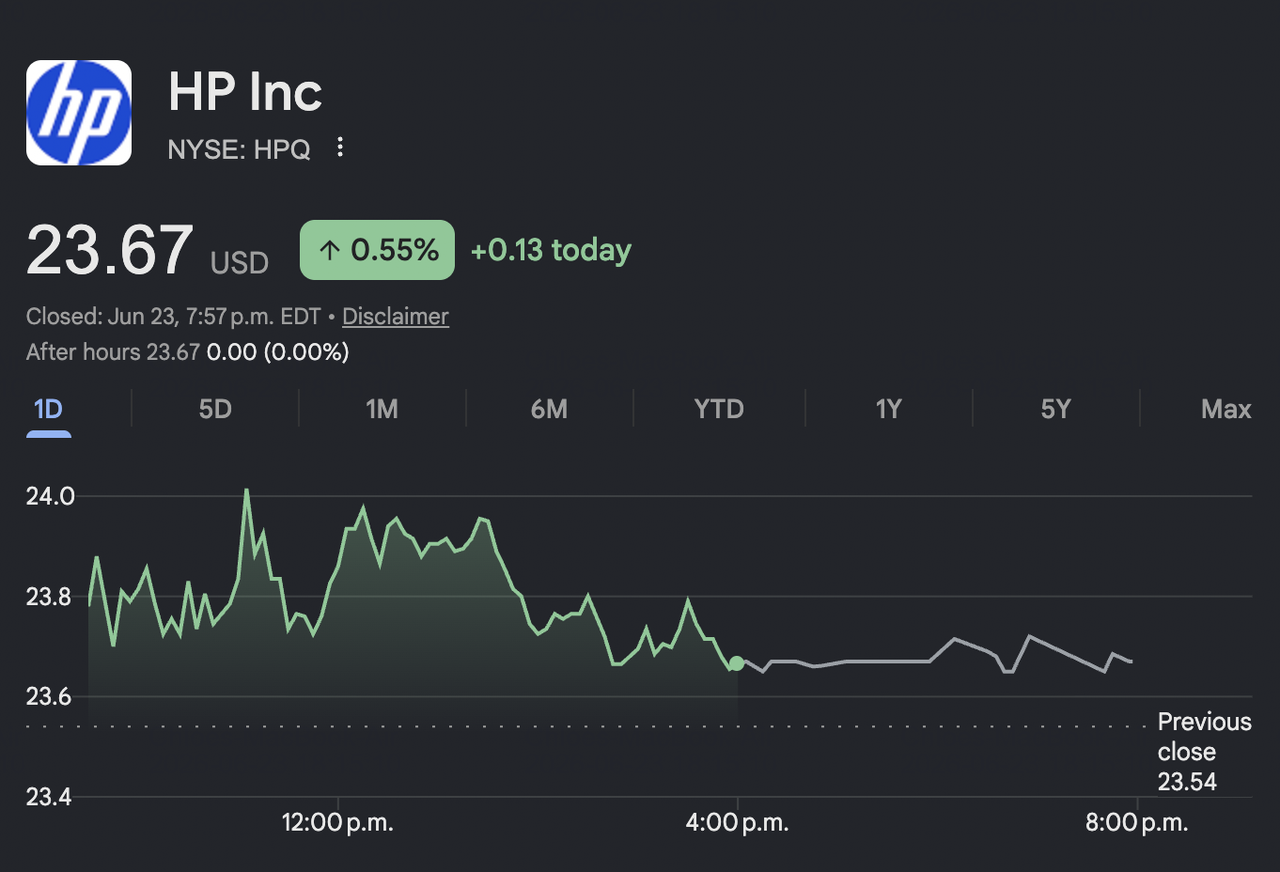
- Current Market Price: As of June 23, 2026, the equity closed trading at $23.67 USD per share.
Read More: Nvidia (NVDA) Stock Price Outlook for 2026: Can Blackwell and Vera Rubin Take NVDA Back to $300?
HP's Core Strategy
Unlike modern tech enterprises that rely entirely on digital software pipelines, HP builds its core value strategy around physical product touchpoints and corporate infrastructure logistics. The organization separates its asset distribution into clear divisions designed to capture consumer and heavy industrial budgets.
Brand Infrastructure Portfolio Distribution
The core revenue engine of HP relies on a strategic matrix of consumer, premium commercial, and gaming ecosystems. As of mid-2026, the primary segments driving corporate revenue generation are structured as follows:
|
Brand / Subsidiary |
Core Product Mandate |
Target Market Demographic |
Operational Focus Area |
|
Omni (OmniBook / Studio) |
Next-Gen AI Integrated PCs |
Mainstream Consumer & Executive |
Localized Neural Network and LLM Processing |
|
Dragonfly & EliteBook |
Ultra-Premium Notebook Systems |
Enterprise Corporate IT / Government |
Deep Fleet Management & Local Data Security |
|
Omen & Victus |
High-Performance Dedicated Gaming |
Core Gaming & Independent Creators |
Custom Liquid Cooling & High-Frame GPU Scaling |
|
HyperX |
Specialized Premium Peripherals |
Esports Competitors & Streaming Pros |
Custom Audio Arrays & Console Accessories |
|
Poly Inc. |
Advanced Telecommunication Hardware |
Commercial Boardrooms & Hybrid Offices |
Unified Ecosystem Video & Audio Bundling |
|
HP LaserJet & Supply Wings |
Imaging Systems & Consumable Inks |
Home Office to Industrial Packaging |
High-Margin Contractual Subscription Models |
Segment Breakdown: The consolidated corporate balance sheet remains heavily weighted toward Personal Systems (Computing), while the Imaging and Printing division continues to contribute a disproportionate portion of localized net operating profit margins due to stable consumable material cycles.
Read More: Intel (INTC) Stock Forecast 2026: Foundry Breakthrough to $89 or Value Trap?
2026 Tech Sector Investment Comparison
The table below contrasts the financial parameters, underlying attributes, and structural tailwinds defining the prime technology hardware and application exposure channels in the 2026 market cycle.
|
Asset Class / Strategy |
Implied Focus Sector |
Underwriter / Issuer |
Primary Growth Tailwinds |
Structural Risks & Roadblocks |
|
HP Inc. Equity (NYSE: HPQ) |
Personal Computing, Commercial Printing & Peripherals |
Self-Directed Corporation |
Accelerating commercial AI PC upgrade cycle; enterprise ecosystem bundling via Poly. |
Vulnerable to consumer component inflation; multi-year elongation of consumer refresh habits. |
|
Lenovo Group ADR (OTC: LNVGY) |
Global Multi-Category Hardware (PC, Server, Mobile) |
Self-Directed Corporation |
Strong diversified footprint in international enterprise infrastructure and server layers. |
Geopolitical supply chain hurdles; varying regulatory standard pressures in major trade corridors. |
|
iShares Expanded Tech-Software ETF (IGV) |
Application & Systems Software Frameworks |
BlackRock / iShares |
Rapid deployment of enterprise AI logic platforms; robust subscription software margins. |
High dependency on compute density pricing; zero buffering against software multiple compression. |
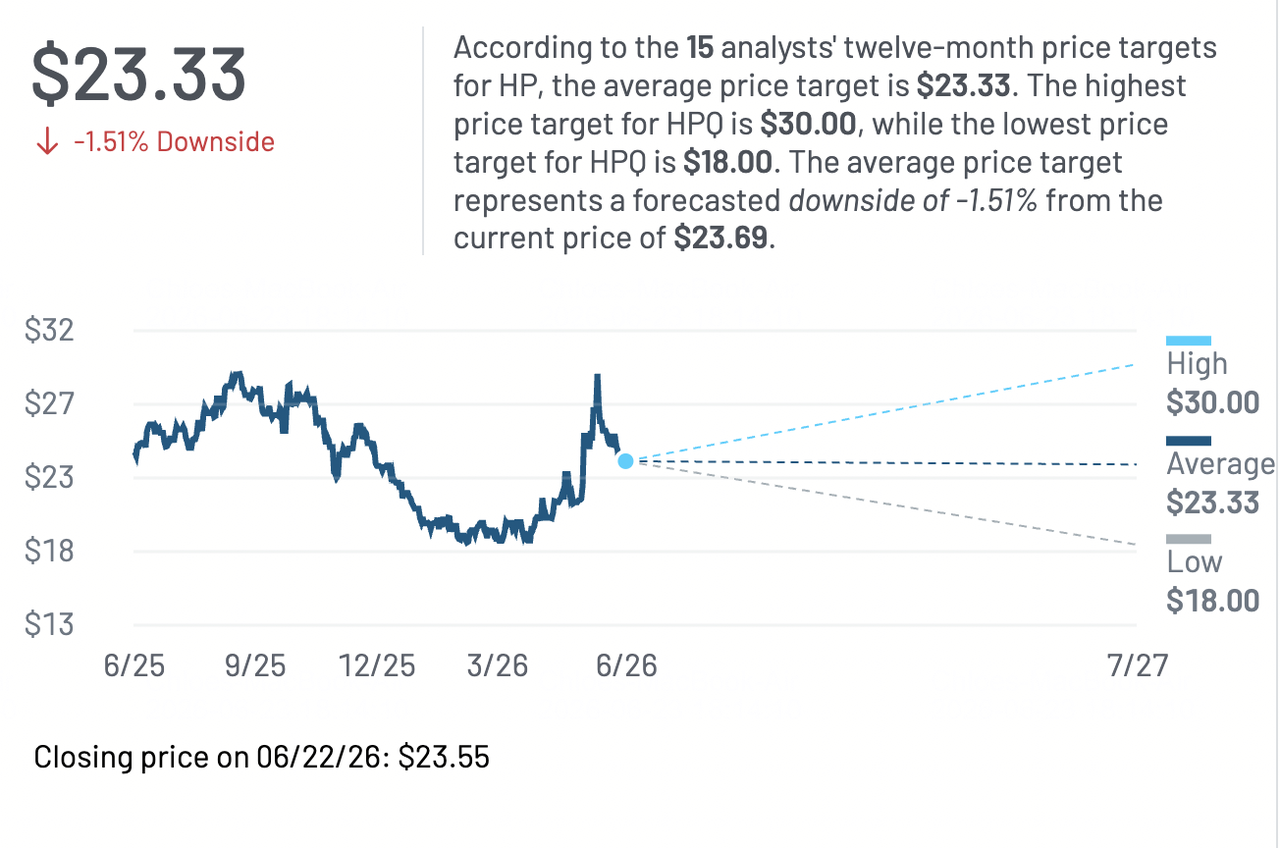
The HPQ Investment Thesis for 2026: 5 Pillars of Market Valuation
Source: MarketBeat
1. The AI PC Upgrade Catalyst
The strategic implementation of Windows operating system adjustments and local AI application suites makes old hardware obsolete. HP's newly restructured OmniBook portfolios offer direct, on-device AI performance. This forces enterprise IT departments to accelerate their hardware refresh schedules to maintain worker productivity.
2. Premium Margin Expansion Via Peripheral Ecosystem Bundles
By combining its core computing units with premium sub-brands like HyperX for creators and Poly for corporate clients, HP increases its average order value. Selling integrated ecosystem bundles protects its net margins far better than selling standalone budget notebooks.
3. Operational Optimization and Structural Cost Controls
Following multi-year global restructuring plans, HP enters the second half of 2026 with a lean operational model. Lower fixed overhead allows the company to maintain stable earnings per share (EPS) even during periods of varying consumer demand.
4. Resilience in Commercial Print Custom Transformation
Through calculated moves into sustainable packaging verticals (such as Choose Packaging) and advanced 3D industrial print manufacturing, HP is redefining its imaging sector. This shifts the focus from declining desktop print volumes to industrial production supply loops.
5. Disciplined Capital Return to Global Shareholders
HP continues to return excess free cash flow to its investors.() Its steady dividend payouts and active share buyback programs help reduce downside equity volatility during broader market corrections.
Read more: How to Trade Forex, Commodities, Stocks, and Indices With BingX TradFi: A Beginner's Guide (2026)
HPQ Valuation and Performance Forecasts for 2026: Bull vs. Bear Outlook
Institutional equity desks maintain an active dialog regarding HP's stock trajectory, balancing the speed of the corporate AI PC upgrade cycle against broader global supply chain realities.
|
Institution / Analyst Desk |
2026 Target Implied Range |
Market Outlook / Stance |
|
Goldman Sachs Tech Group |
$29.00 – $34.00 |
Highly Bullish: Expects strong corporate AI PC adoption to expand enterprise margins through the end of 2026. |
|
Morgan Stanley Equity Desk |
$26.00 – $31.00 |
Bullish: Supported by the steady performance of high-margin commercial print contracts and enterprise hardware bundles. |
|
Bank of America Global |
$22.00 – $27.00 |
Neutral / Core Buy: Notes solid valuation support from dividend payouts, but remains cautious on consumer wallet trends. |
|
Market Consensus (Aggregated) |
$21.00 – $26.00 |
Moderate Hold: Expects steady, balanced cash flow generation, though near-term margins may face component cost headwinds. |
|
Barclays Capital |
$18.00 – $22.00 |
Underweight: Cautious about potential delays in consumer upgrade cycles and rising raw material costs for hardware OEMs. |
The Bull Case for HP Stock: Rapid AI Adoption Accelerates Corporate Hardware Upgrades
Bulls project that as businesses recognize the productivity gains of local AI processing, the corporate PC replacement cycle will compress significantly. This surge in demand would allow HP's premium Omni and Dragonfly lines to command higher prices, driving revenue growth past current market expectations.
HPQ's Bear Case: Elevated Component Costs Slow Margin Expansion
Bears caution that global hardware manufacturing remains highly exposed to raw material and component cost inflation. If memory chips or specialized logic components face supply constraints, HP's margins could come under pressure, keeping the stock range-bound.
Competitive Risks and Sector Pressures for HP Stock
While HP benefits from an established global brand and strong institutional distribution channels, management must carefully navigate several key market headwinds:
- Commoditization and Price Competition: The PC market is highly competitive. If rival manufacturers launch aggressive discount campaigns to clear inventory, HP may face pricing pressure, which could impact margins in its mainstream consumer segments.
- Component and Supply Chain Vulnerabilities: As an international hardware assembler, HP relies on steady access to third-party processors, displays, and memory units. Any logistical disruptions or component price spikes can quickly raise production costs before those expenses can be passed on to end consumers.
- Longer Consumer Device Ownership Lifespans: While enterprise clients tend to update their systems on regular schedules, everyday retail consumers are keeping their laptops and home printers for longer periods. If the consumer market delays adopting AI-driven features, growth in the retail segment could slow down.
How to Trade HP Inc. (HPQ) Futures on BingX TradFi
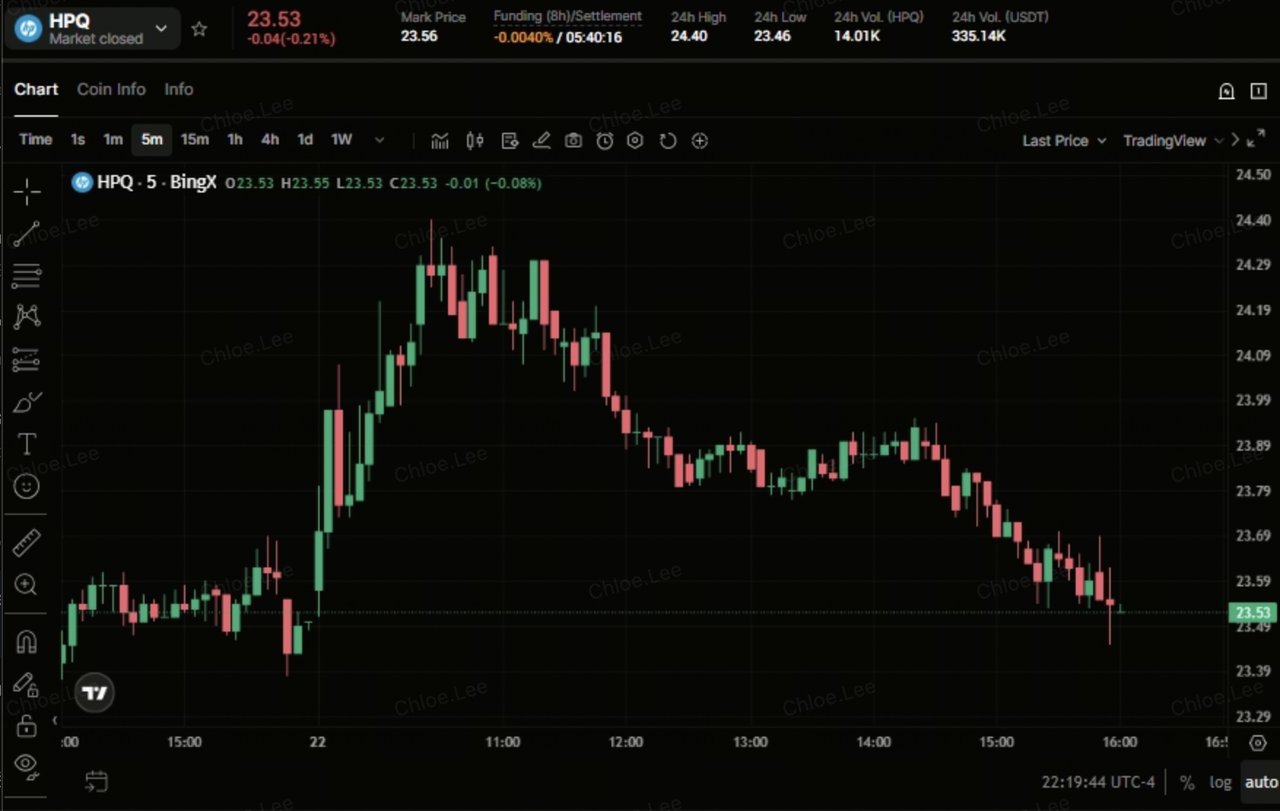
For global market participants looking to take a position on the technology hardware sector, trading HPQ derivative contracts offers a flexible, capital-efficient alternative to traditional stock ownership. This approach allows traders to respond quickly to corporate earnings reports and broader product cycles, much like how tech investors use digital ecosystems to track developments in traditional finance (TradFi), sector leaders like NVIDIA, or major digital assets like Bitcoin.
- Go to the BingX TradFi section and select Stock Futures.
- Search for the HPQ/USDT perpetual contract.
- Check the trading session before placing your order. Liquidity is typically lower during extended sessions, which can result in wider spreads and higher volatility.
- Select your Margin Mode (Isolated or Cross) and set your leverage.
- Choose Open Long if you expect momentum, strong chip architecture updates, or positive analog cycle inventory recovery. Choose Open Short if you anticipate margin pressures from heavy CapEx spending, factory execution delays, or valuation pullbacks.
- Set Take-Profit (TP) and Stop-Loss (SL) levels immediately to manage risk against TXN's price swings driven by earnings, news, or global semiconductor production milestones.
Read More: Arm Holdings (ARM) Stock Outlook 2026: AI Licensing and the $200+ Price Target
Conclusion: How to Navigate the Hardware Pivot with BingX TradFi
The technology sector in 2026 is experiencing a structural transition. As the initial buildout of cloud data centers establishes a baseline for AI infrastructure, the focus is expanding to on-device hardware capabilities. HP Inc. sits at the center of this shift, offering a diverse product portfolio designed to bring artificial intelligence capabilities directly to enterprise workstations and consumer desks worldwide.
While investors need to monitor potential component cost inflation and competitive pricing pressures, HP's stable enterprise contracts and history of disciplined capital returns help support the company's long-term outlook. For tactical market participants and long-term asset allocators alike, tracking the HPQ ecosystem provides a direct way to gain exposure to the evolving global computing footprint as hardware utility models adapt to next-generation software needs.
Risk Reminder: Trading technology equities involves immense financial risk due to elevated beta metrics, capital-intensive manufacturing timelines, and rapidly evolving technological cycles. Always enforce strict risk management protocols, proper position sizing, and mandatory stop-losses.
Related Reading
- Top AI Tokenized Stocks to Watch in 2026
- Top 10 AI Infrastructure Stocks to Buy in 2026: Chip Manufacturing and Design Leaders
- Top AI Compute and GPU Stocks to Buy in 2026: The Shift to Inference and Custom Silicon
- Top AI Cloud Infrastructure Stocks to Buy in 2026 Amid Hyperscaler Capex and the Neocloud Boom
- Roundhill Memory ETF (DRAM) Forecast 2026: $1.5B AI Supercycle or 'RAMmageddon' Trap?
