

U.S. Oil Reserve (USOR) emerged in January 2026 as one of the most explosive tokens on the Solana blockchain. Positioned at the intersection of Real-World Asset (RWA) tokenization and political "meme" culture, it quickly drew in thousands of retail investors. However, as the project transitioned from its hyped launch phase toward its promised February rollout, critical questions about its legitimacy have triggered a massive market correction.
An Introduction to U.S. Oil Reserve (USOR)
U.S. Oil Reserve (USOR) is a Solana-based SPL token marketed as a digital proxy for the United States Strategic Petroleum Reserve (SPR). The project claims to provide "on-chain exposure" to physical oil barrels through a transparent ledger. It viralized during a period of geopolitical trade tension and energy security debates, leading many to believe it was a revolutionary bridge between traditional energy markets and decentralized finance (DeFi).
What Makes USOR a Potentially Promising Investment?
The primary appeal of USOR lies in its narrative strength and accessibility. In January 2026, the global RWA market cap neared $24 billion, and USOR positioned itself as a "first-mover" in the oil sector. By offering "digital barrels" on Solana, it allowed retail traders to bypass the complexities of traditional futures and ETFs, attracting millions of social media impressions.
The project’s hype was further amplified by unverified claims of political and institutional ties. Rumors of "Trump Team" and "BlackRock-linked" wallet activity identified via on-chain heuristics acted as a massive catalyst. In mid-January 2026, USOR surged over 400,000% from its all-time low, reaching a peak market cap of $55 million. For momentum traders, USOR became a high-leverage vehicle for betting on U.S. energy policy and trade-war headlines.
You can trade USOR on BingX ChainSpot if you are interested in buying this token. Learn more about how to buy USOR on ChainSpot in our comprehensive guide before getting started.
USOR Crashes 90% in February 2026 Amid Risk-off Sentiment in Crypto
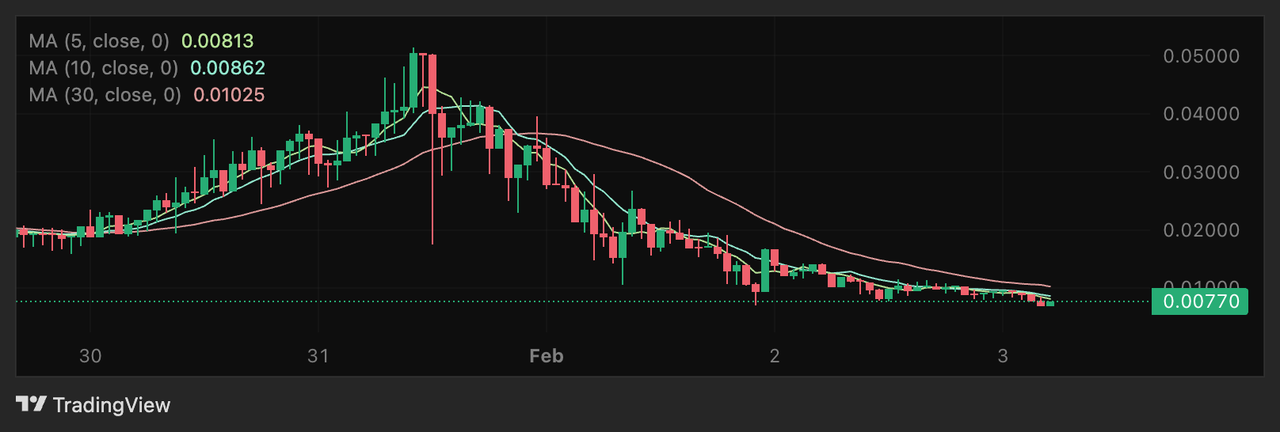
USOR/USDT price chart on ChainSpot
As of February 3, 2026, U.S. Oil (USOR) is navigating a catastrophic liquidity event, trading at $0.007640, a staggering 90.89% decline from its all-time high of $0.0839 set just 13 days ago. The token's performance today reflects a 41.91% drop within the last 24 hours, triggered by the February 1 "tokenization rollout" deadline that failed to produce any verified link to physical oil reserves. Despite the price collapse, trading volume remains abnormally high at $3.85 million, resulting in a Volume/Market Cap ratio of 50.49%.
This high turnover indicates that while long-term holders are exiting en masse, speculative day traders continue to flip the asset amidst extreme volatility. With a current market cap of just $7.64 million, USOR has officially entered a "deleveraging phase," where the initial FOMO has been replaced by a "legitimacy crisis," leaving the token's value entirely dependent on whether its remaining 110,000 holders can find a new catalyst to prevent a total retracement to its $0.0042 launch price.
The Key Aspects of the USOR Controversy
The path to recovery for U.S. Oil (USOR) is currently blocked by a combination of unverified fundamentals and extreme technical fragility. As of early February 2026, the following factors remain the primary "rally-killers":
1. The Legitimacy Gap: Until a third-party audit or a verified custodian link is provided, USOR remains a "prove-it" asset that the broader market is rejecting. The U.S. Department of Energy (DOE), which manages the nation’s actual reserves, has issued no confirmation of this project, leaving USOR’s "oil-backed" claims solely in the realm of marketing.
2. Deep Liquidity Fragmentation: With liquidity pools on Orca, Meteora, and Raydium remaining thin relative to its $7.64M market cap, even modest trades cause extreme slippage. For instance, recent data shows that a single trade of just $5,000 to $10,000 can move the price by 3–5% on some Solana DEXs, creating a volatile environment where large holders cannot exit without crashing the price further.
3. A "Negative-Leaning" Market Ratio: The token’s 24-hour Volume/Market Cap ratio sits at a staggering 50.49%. While high volume can signify interest, in USOR’s case, it highlights an unstable "churn" where short-term speculators are flipping the token for pennies, preventing the accumulation needed to build a sustainable support level.
4. Overhead Resistance from Underwater Holders: With over 110,000 holders and a price that is over 90% down from its all-time high, there is a massive "supply wall" of investors who bought at higher prices. Any price recovery toward $0.015 or $0.02 is met with immediate selling pressure from retail holders looking to "break even" and exit.
What Are the Risks of Investing in USOR?
Despite its flashy "Reserve Board" dashboard, USOR carries extreme fundamental risks. The most critical issue is the lack of official verification. Neither the U.S. Department of Energy (DOE) nor the Federal Reserve has confirmed any partnership with a private Solana token. Reports from CCN and Yahoo Finance in late January revealed no legal or financial documentation proving that physical oil actually backs the token.
Blockchain audits also reveal a "shadow" supply concentration. Bubblemaps analysis shows that over 26% of the supply is held in interconnected wallet clusters allegedly linked to the project's deployers. This creates a severe "whale risk," where a few insiders can, and have, triggered massive "liquidity cascades," causing the price to drop violently.
Learn more about whether USOR is a legit crypto project in our detailed analysis
Top 3 Considerations for USOR Investors
The tension between USOR’s "government-backed" marketing and its actual on-chain performance has created a deep divide in market sentiment, driven by three primary fundamental shifts.
1. The February 1 Catalyst: The widely anticipated "oil tokenization technology" rollout, teased for February 1, 2026, failed to materialize into a verified commodity product. This triggered a violent "sell the news" event, with the price collapsing by over 70% as speculative assumptions were challenged by the lack of a tangible bridge to physical reserves.
2. Treasury Composition Audit: Real-time data from the USOR Token Pulse (captured Feb 3, 2026, at 3:34 PM) confirms that the project’s $803,020 Treasury Value is comprised entirely of digital assets rather than physical oil. The allocation is heavily weighted toward high-cap cryptos: BTCB (54.6%), ETH (19.2%), XRP (13.4%), ADA (7.7%), and SOL (4.5%). This indicates that $USOR currently functions as a crypto-index proxy rather than an oil-backed commodity.
3. On-Chain Concentration Risk: Analysis of the $251,468 24-hour momentum volume suggests that liquidity remains thin relative to supply concentration. As of early February, the top 20 wallets continue to control approximately 25% of the total supply, creating a technical ceiling and sustained downward pressure on the token’s fragile $0.007–$0.01 price floor.
Is USOR Worth Investing?
USOR is currently a high-stakes speculative play that has transitioned from a viral pump into a "legitimacy crisis." While the token remains technically functional on the Solana network, its core claim of being "oil-backed" appears to be an unproven marketing narrative. The spectacular 70% crash from its $0.08 peak to the $0.01–$0.02 range reflects the market's realization that the token is a sentiment-driven meme rather than a regulated RWA.
For traders, USOR is best viewed as a high-beta volatility instrument. It may see relief bounces toward $0.03–$0.05 if geopolitical hype returns, but its long-term survival depends on bridging the gap between its "digital barrel" claims and regulated reality. Without a confirmed federal partnership or a transparent audit, USOR remains a blend of groundbreaking narrative and extreme financial risk.
In short: Treat USOR with extreme caution. If you are looking for genuine commodity exposure, traditional WTI or Brent futures remain the gold standard; if you are looking for Solana-based RWAs, ensure you prioritize projects with verifiable audits and legal jurisdictional clarity.
