
The activation of the Protocol v25 upgrade on Wednesday, July 22, 2026, marks a major architectural milestone in the evolution of the Pi Network. Transitioning the network from a highly distributed mobile mining initiative into a fully programmable, privacy-preserving Layer-1 blockchain, Protocol v25 integrates zero-knowledge (ZK) cryptographic primitives directly into its execution layer. By equipping the network with enterprise-grade privacy and verifiable computing, the Pi Core Team is aligning the blockchain’s infrastructure with modern Web3 standards.
However, this technical achievement arrives during a period of macroeconomic friction for the network's native asset, PI. After printing a historic low of approximately $0.07059 on July 14, 2026, driven by continuous token emission schedules and secondary market liquidity bottlenecks, the market is closely observing whether infrastructural maturity can drive long-term valuation recovery.
By the end of this guide, you will understand what the Pi Network Protocol v25 upgrade entails, its cryptographic foundations, node operator execution steps, ecosystem utility launches, macroeconomic tokenomics, stakeholder impacts, and how to trade PI on BingX.
What Is the Pi Network Protocol v25 Upgrade?
On July 22, Pi is scheduled to upgrade to Protocol v25, which primarily focuses on improving network stability and reliability, and supports new capabilities for more efficient, privacy-preserving smart contracts.
— Pi Network (@PiCoreTeam) July 15, 2026
Go to the Pi mining app to learn more! pic.twitter.com/Btg8aEFAFh
The Protocol v25 upgrade is a major protocol-level hard fork and architectural synchronization of the Pi Network execution layer scheduled for July 22, 2026. Built upon a customized adaptation of the Stellar Consensus Protocol (SCP) and Federated Byzantine Agreement (FBA), Protocol v25 directly incorporates features derived from the Stellar Development Foundation's "X-Ray" Protocol 25 specification.
At its core, Protocol v25 exposes native host functions optimized for zero-knowledge verifications—specifically zk-SNARKs (Zero-Knowledge Succinct Non-Interactive Arguments of Knowledge) and zk-rollup execution frameworks. By embedding pairing-friendly elliptic curves and algebraic hashing algorithms into the protocol layer, Pi Network allows smart contracts to verify off-chain mathematical proofs on-chain without revealing underlying sensitive user data or identity credentials.
When Is the Protocol v25 Upgrade Expected to Roll Out?
The Protocol v25 ledger-level activation takes place on Wednesday, July 22, 2026. This milestone represents the culmination of a rigorous, multi-stage sequential modernization strategy established by the Pi Core Team following the removal of its closed-network firewall on February 20, 2025.
To prevent consensus state divergence across its global network of more than 421,000 active validator nodes, the Core Team executed a non-skippable upgrade roadmap throughout 2026.
Pi Network 2026 Sequential Upgrade Roadmap
|
Protocol Version |
Mainnet Activation Date |
Primary Architectural Focus |
Core Infrastructure Changes |
|
Protocol v19.6 |
February 15, 2026 |
Legacy Client Deprecation |
Mandatory client node standardization; initial Linux configuration deployment. |
|
Protocol v20.2 |
March 13, 2026 |
Consensus Alignment |
Preparatory synchronization of validator nodes ahead of virtual machine integration. |
|
Protocol v23.0 |
May 11, 2026 |
Soroban Virtual Machine Activation |
Integration of native smart contracts, PostgreSQL 16 migration, Ubuntu 24.04 OS upgrade. |
|
Protocol v24.1 |
June 2, 2026 |
External Interoperability Layers |
Offline integration capabilities; customized Stellar consensus architectural optimizations. |
|
Protocol v25.2 |
June 18, 2026 |
Node Pre-Release & Standardization |
Database optimizations to minimize node synchronization latency and restart times. |
|
Protocol v25.0 |
July 22, 2026 |
Zero-Knowledge Cryptography |
Activation of BN254 curve primitives, Poseidon hashing, and privacy-preserving smart contracts. |
|
Protocol v26.0 |
To Be Determined |
Enterprise Scaling & Post-Quantum Security |
Integration of Stellar Core Protocol 26; initial frameworks for post-quantum cryptographic security. |
What Are the Key Features of Pi Network Protocol v25?
Protocol v25 mainly improves how the Pi blockchain handles privacy-focused applications and complex transaction verification. Instead of forcing smart contracts to perform every calculation from scratch, the upgrade adds built-in tools that can complete certain cryptographic checks more efficiently.
1. The BN254 Elliptic Curve: Faster Verification for Privacy Applications
Protocol v25 adds native support for the BN254 elliptic curve, a cryptographic tool commonly used to verify zero-knowledge proofs. These proofs allow users or applications to confirm that information is valid without revealing the underlying data.
For everyday users, this could support private identity checks, confidential transactions and secure account verification. Built-in BN254 support helps the Pi blockchain complete these checks faster and with fewer computing resources.
2. The Poseidon Hashing Algorithm: More Efficient Data Processing
Protocol v25 also introduces Poseidon, a hashing algorithm designed for zero-knowledge applications. Hashing creates a secure digital fingerprint that applications can use to verify data without exposing the original information.
Compared with traditional methods, Poseidon requires less computing work inside privacy-focused applications. This could help developers build faster and more affordable identity, payment and data-verification tools on Pi Network.
What Changes After the Pi Network Protocol v25 Upgrade?
Protocol v25 updates how Pi Network nodes process transactions while giving developers new tools for privacy, identity verification and more advanced applications. Node operators must install compatible software and remain synchronized with the latest network state. Nodes that continue using older versions may fall out of sync and stop validating transactions.
For most Pi users, no technical action is required. The upgrade work is mainly handled by node operators and developers. Its effects may become more visible through improved applications, broader smart-contract capabilities and several ecosystem products being developed around the upgrade.
- Updated node software: Node operators need to install a Protocol v25-compatible version to remain connected and continue validating transactions.
- Improved network synchronization: Updated nodes must process the same latest transactions as the rest of the network, helping prevent compatibility issues.
- SoloHost distributed computing: SoloHost is intended to let desktop node operators host decentralized applications and localized AI workloads, expanding the role of Pi nodes beyond transaction validation.
- PiVerify identity verification: PiVerify aims to use zero-knowledge proofs and Pi’s KYC system to let outside platforms confirm that a user is a unique person without receiving the user’s raw identity documents. Verification fees may also create additional utility for PI.
- Pi Sign-in and persistent app storage: Developers can use shared authentication and persistent data storage to build applications that retain user accounts, progress and activity across sessions. Potential uses include games, financial applications and productivity tools.
- SLICE testnet campaign: The temporary SLICE test token was used to test Pi Launchpad functions, including token participation flows and liquidity mechanisms, before broader deployment.
Together, these changes position Protocol v25 as both a network upgrade and a foundation for more practical Pi applications. The main test will be whether developers launch working products that attract users and generate sustained demand for PI.
How Does Protocol v25 Impact Different Pi Ecosystem Stakeholders?
The Protocol v25 upgrade alters the operating dynamics across all levels of the Pi Network community:
- For Pioneers (Users): Protocol v25 enables zero-knowledge privacy protection. Users can verify their human KYC status and geographic eligibility on third-party dApps using ZK proofs without sharing passport details or personal documents. Additionally, the launch of "Fast Track KYC" aims to clear legacy tentative approval backlogs.
- For Developers: Builders gain access to BN254 and Poseidon host functions within the Soroban Wasm runtime, enabling the creation of private DeFi pools, anonymous voting systems, and compliant Web3 identity products.
- For Node Operators & Validators: Operators must maintain synchronized v25 client software (kosasih/pi-supernode:v25.0.0) and Ubuntu 24.04 environments to avoid consensus drops while accessing new monetization streams via SoloHost AI compute hosting.
- For Traders & Investors: Protocol v25 introduces functional utility levers (PiVerify, SoloHost) that generate non-speculative buy demand for PI. Traders should monitor how effectively this demand offsets the ~6.5 million daily token emission rate through H2 2026.
How to Prepare for the Pi Network Protocol v25 Upgrade
- Mobile Mining Users & Pioneers: No manual token migration is required for the Protocol v25 hard fork. Ensure your official Pi Mining App is updated to the latest version to access refreshed interface features and track your KYC migration checklist status. Never share your 24-word passphrase with unverified third-party websites claiming to "upgrade" your wallet.
- Node Operators: Confirm that your supernode container has executed the migrate-v25 script and that your local sync status (curl http://localhost:31401) accurately tracks the latest mainnet ledger height.
- dApp Developers: Update local Wasm contract build environments to target the new BN254 and Poseidon host function bindings provided in the Protocol v25 SDK updates.
Pi Network (PI) Price Prediction: Will PI Price Rise After the Protocol v25 Upgrade?
Protocol v25 has revived short-term interest in PI, though the longer-term outlook still depends on token unlocks and real ecosystem demand.
1. PI Rebounds as Upgrade Interest and Futures Activity Recover
PI fell to approximately $0.07059 on July 14, more than 97% below its February 2025 peak of $2.99, pushing the daily RSI to an oversold reading of 17. After the Protocol v25 activation date was confirmed, PI rebounded by roughly 10% to 15% into the $0.083 to $0.093 range by July 20.
Daily trading volume increased 116% to $29.5 million, while futures open interest recovered from $9.11 million to $10.73 million. The increase points to renewed speculative demand and short covering, though a sustained recovery requires volume to remain elevated after the upgrade.
2. Token Unlocks Remain the Main Barrier to a Sustained PI Recovery
PI has a maximum supply of 100 billion tokens, with approximately 10.4 billion to 11.0 billion currently circulating. Around 775.8 million PI may enter circulation between July and December 2026, including 103.7 million to 127.0 million in July.
This supply growth creates continued selling risk because the market must absorb an average of roughly 6.5 million new PI per day. Protocol v25 could offset part of that pressure if new applications create real token demand, but the upgrade must produce measurable usage rather than temporary market attention.
PI Needs to Break $0.093 to Extend the Post-Upgrade Rally
The bullish case depends on PI holding above $0.080 and breaking above $0.093 with sustained volume. The main risk is that post-upgrade interest fades while token unlocks continue, which could bring the July low near $0.07059 back into focus.
Key PI Supply and Tokenomics Metrics
|
Tokenomics Metric |
Supply or Allocation |
|
Circulating Supply |
10.4 billion–11.0 billion PI |
|
Maximum Supply |
100.0 billion PI |
|
Community Mining Allocation |
65.0 billion PI (65%) |
|
Core Team Allocation |
20.0 billion PI (20%) |
|
Foundation Reserve Allocation |
10.0 billion PI (10%) |
|
Liquidity Pools Allocation |
5.0 billion PI (5%) |
|
Scheduled Unlocks, July–December 2026 |
775.8 million PI |
|
July 2026 Unlock Volume |
103.7 million–127.0 million PI |
|
Average Daily Token Release |
Approximately 6.5 million PI |
Read More: Pi Network (PI) Price Prediction 2026: The AI Human-Infrastructure Thesis vs. The 163M Token Unlock
What’s Next After Protocol v25: The Path to Protocol v26
Following the activation of Protocol v25, the network will shift its focus toward Protocol v26.0, scheduled for future deployment.
Protocol v26 will integrate the Stellar Core Protocol 26 updates, focusing on enterprise-grade throughput scaling, multi-state channel optimizations, and foundational research into post-quantum cryptographic security. Combined with ongoing technical evaluations from Tier-1 exchanges and efforts to clear legacy KYC queues, Protocol v26 represents the final planned step in establishing Pi Network as a commercial-grade blockchain infrastructure.
How to Trade Pi Network (PI) on BingX
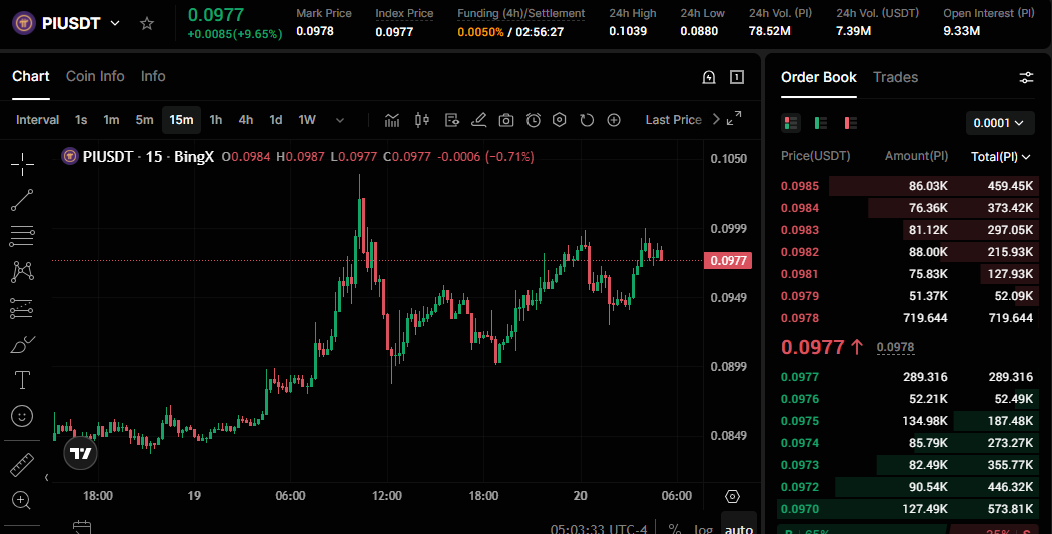
BingX does not currently offer PI spot trading, so users cannot buy and hold PI directly through the BingX spot market. Instead, users who want exposure to Pi Network price movements can trade PI perpetual futures on BingX.
Futures Trading: Trade PI Price Movements
Perpetual futures allow users to trade PI price swings without holding the underlying token, using USDT as margin. Traders can open long positions if they expect PI to rise following major protocol upgrades (such as Protocol v25), or short positions if they expect PI to decline under continuous unlock supply pressures. This makes futures flexible for short-term trading, but also carries higher risk because leverage can amplify both gains and losses.
Given the significant daily token emissions (~6.5 million PI unlocked daily) and high volatility surrounding major protocol activations, PI price swings can be sharp. Futures trading is best suited for users who understand leverage, liquidation thresholds, funding rates, and strict risk management.
Step 1: Account Setup and Security. Sign up and log into your BingX account, complete the identity verification (KYC) required in your region, and enable two-factor authentication.
Step 2: Fund Your Futures Account. Deposit USDT into your BingX account, or buy USDT through a supported payment method. Transfer USDT to your futures account, where it will be used as margin.
Step 3: Select the PI-USDT Perpetual Contract. Go to the BingX Futures / Perpetual market page. Search for the PI-USDT perpetual contract and ensure you select the correct pair before setting up your order parameters.
Step 4: Choose Order Type and Execution Parameters. Enter the order amount and choose a market or limit order depending on your trading plan. Review the margin requirement, estimated liquidation price, and fees before confirming the trade.
Step 5: Set Direction and Select Leverage. Open long if you expect PI to rise, or open short if you expect PI to decline. Choose leverage based on your risk tolerance and position size. For new meme coins, lower leverage is generally safer because volatility can be extreme.
Step 6: Apply Risk Management. Set stop-loss and take-profit orders before or immediately after entering the position. Monitor funding rates, position size, and liquidation risk, especially during high-volume meme coin rotations.
Conclusion: What to Expect From Pi Network's Protocol v25 Update
The Protocol v25 upgrade represents a technical milestone for the Pi Network, executing a seamless transition into a privacy-preserving Layer-1 blockchain powered by zero-knowledge cryptography. By natively implementing the BN254 elliptic curve and Poseidon algebraic hashing, the core network establishes a foundation for decentralized identity verification, confidential smart contracts, and enterprise utility.
As the ecosystem progresses through H2 2026, the long-term market performance of PI will depend on the rapid adoption of utility applications like PiVerify and SoloHost to absorb ongoing token unlock distributions. Stay informed on key network developments through BingX Academy for real-time market analysis and crypto insights.
Related Reading
- What Is Pi Network and How to Mine PI Coins in 2026?
- Pi Network (PI) Price Prediction 2026: The AI Human-Infrastructure Thesis vs. The 163M Token Unlock
- What Are The Top Wallets for Pi Network? The Complete List
- How to Buy, Trade & Sell Pi Network (PI) Coins in 2025: A Beginner's Guide
- Top 7 Pi Network dApps to Watch in 2025 (Beginner’s Guide)
- Why is PUMP Up 19.46% Today, July 20? A Support Reclaim and Buyback Debate Lift the Token
FAQs About the Pi Network Protocol v25 Upgrade
1. What is the Pi Network Protocol v25 upgrade?
Protocol v25 is a major network upgrade for the Pi Network activated on July 22, 2026. It introduces zero-knowledge (ZK) cryptographic host functions (BN254 elliptic curve and Poseidon hashing) directly into the blockchain's execution layer, enabling privacy-preserving smart contracts and decentralized identity verification.
2. When does the Protocol v25 upgrade take place?
The ledger-level activation of Protocol v25 takes place on Wednesday, July 22, 2026, following a node pre-release deployment (Protocol v25.2) completed on June 18, 2026.
3. How do BN254 and Poseidon hashing improve the Pi Network?
BN254 is a pairing-friendly elliptic curve that enables fast on-chain verification of zk-SNARK proofs. Poseidon is an algebraic hash function optimized for finite field arithmetic that reduces ZK circuit complexity. Together, they allow 128-byte compressed ZK proofs to be verified on-chain in under 5 milliseconds.
4. What is PiVerify and how does it relate to Protocol v25?
PiVerify is a KYC-as-a-Service utility that leverages Protocol v25's zero-knowledge capabilities. It allows third-party organizations to verify that a user is a unique, verified human without exposing raw personal identity documents. All verifications are settled natively using PI tokens.
5. Do users need to migrate or move their PI tokens for Protocol v25?
No. Mobile mining users and token holders do not need to take manual action. Your PI balance remains safe in your non-custodial wallet. Node operators, however, must update their Docker containers and execute the migrate-v25 database script.
6. What is the current circulating supply and unlock schedule for PI?
As of July 2026, PI has a circulating supply of approximately 10.4 billion to 11.0 billion tokens out of a 100 billion maximum cap. Between July and December 2026, roughly 775.8 million PI is scheduled to unlock, introducing approximately 6.5 million PI in daily emissions.
7. What is the next major upgrade for Pi Network after Protocol v25?
Following Protocol v25, the network will work toward Protocol v26.0, which integrates Stellar Core Protocol 26 optimizations aimed at enterprise throughput scaling and preliminary post-quantum cryptographic security.
