

The global cryptocurrency mining architecture has completed a definitive industrial shift by mid-2026. Armed with sub-15 J/TH hydro-cooled hardware deployments, institutional mining farms have pushed the Bitcoin network hashrate and network difficulty to historic, lifetime highs. In this hyper-competitive, gigawatt-scale ecosystem, mining Bitcoin with a consumer GPU has officially reached absolute economic and mathematical obsolescence.
Discover why specialized ASIC miners completely dominate the SHA-256 algorithm, analyze the stark efficiency metrics separating graphics cards from custom silicon, and learn how to trade digital asset infrastructure via spot and futures pipelines on BingX.
Crypto mining has evolved from a hobbyist home pursuit into a highly sophisticated, industrial-scale computational race. By mid-2026, the global mining architecture is no longer defined by decentralized graphics processing units (GPUs) humming in garages, but by massive, gigawatt-scale data centers stacked with custom-built application-specific integrated circuits (ASICs).
A persistent misconception among entry-level market participants is that high-end consumer graphics cards, such as the NVIDIA RTX 4090 or the newly released Blackwell-based RTX 5090, can still be used to mine Bitcoin (BTC). The mathematical reality of the network makes this entirely unfeasible.
As the global network hashrate scales to unprecedented vertical heights, understanding the structural shifts in mining hardware is essential for any digital asset strategist. For market participants who want to bypass the massive capital expenditures and electricity constraints of running physical hardware, platforms like BingX provide direct, alternative exposure. Through the BingX Spot and Futures markets, global investors can trade Bitcoin and other PoW mining-related assets using USDT collateral, capturing pure macro sector momentum on unified, crypto-native rails.
Top 3 Reasons Why GPUs Cannot Mine Bitcoin in 2026: The Math
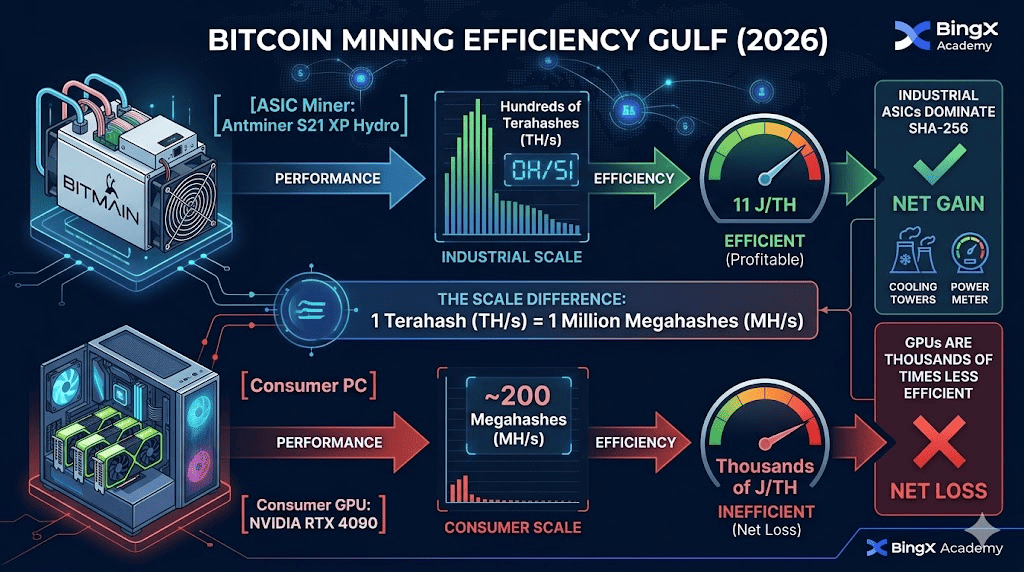
Bitcoin relies on the SHA-256 cryptographic hashing algorithm to secure its blockchain and validate transactions via Proof of Work (PoW). This specific mathematical framework rewards brute-force computational repetition. The hardware landscape is divided by a massive efficiency gulf:
1. The Hashrate Disparity
A top-tier consumer graphics card like the NVIDIA RTX 4090 produces roughly 100 to 200 MH/s (megahashes per second) when processing the SHA-256 algorithm. In stark contrast, modern industrial ASIC miners deliver hundreds of TH/s (terahashes per second) per single unit.
Because one terahash equals one million megahashes, a single high-end ASIC miner puts out the equivalent processing power of millions of top-end gaming GPUs combined. Trying to mine Bitcoin with a GPU is like bringing a bicycle to an aerospace race.
2. Radical Inefficiency (Joules per Terahash)
In modern mining economics, raw hashrate is secondary to efficiency, measured in Joules per Terahash (J/TH). Leading 2026 ASIC miners operate at sub-15 J/TH thresholds, with hydro-cooled systems dropping as low as 9 to 12 J/TH. A consumer GPU processing SHA-256 is thousands of times less efficient, consuming massive amounts of power for a statistically negligible hashing output.
3. Guaranteed Financial Loss
Operating a GPU on the Bitcoin network means your ongoing electricity costs will outpace your mining rewards by several orders of magnitude. At any standard residential utility rate, a GPU-based Bitcoin mining setup functions exclusively as an incredibly expensive space heater, generating a guaranteed net financial loss. Bitcoin GPU mining has been completely obsolete since the first commercial ASICs arrived around 2015.
What Altcoins Can You Mine Using GPU Mining Rigs?
While GPUs are fundamentally useless on the Bitcoin network, they remain highly relevant for alternative, ASIC-resistant altcoins. These networks intentionally utilize memory-hard algorithms designed to favor the parallel processing pipelines and high-speed VRAM configurations of graphics cards rather than specialized chips.
The top GPU-mineable targets include:
- Kaspa (KAS): Running on the kHeavyHash algorithm, Kaspa rewards core throughput and high-efficiency hardware. It stands as a popular target for modern GPU rigs, though the recent entry of entry-level ASICs into the KAS ecosystem is steadily compressing margins.
- Ethereum Classic (ETC): Utilizing the Etchash algorithm, ETC offers a stable, highly liquid, and deeply established ecosystem, making it a primary entry point for small-scale miners.
- Ravencoin (RVN): Powered by KawPoW, this network is aggressively ASIC-resistant. It requires significant VRAM overhead but features high power draw and steep thermal demands.
- Ergo (ERG): Built on the Autolykos v2 algorithm, Ergo is highly memory-intensive, running exceptionally well on high-bandwidth consumer cards.
What Are the Best ASIC Miners for Bitcoin Mining in 2026?
For operators targeting Bitcoin mining, hardware procurement must focus entirely on specialized SHA-256 ASICs. The leading manufacturers and hardware configurations dominating the network infrastructure include:
1. Bitmain Antminer S21 XP Hydro
- Core Metrics: 473 TH/s | 5,676W | 12 J/TH
Bitmain’s flagship hydro-cooled system is designed for large-scale operations with dedicated liquid-cooling infrastructure. By reducing the power ratio down to an industry-leading 12 J/TH framework, the S21 XP Hydro maximizes gross revenue per megawatt.
This option is Ideal for operators who can secure cheap industrial electricity under $0.06/kWh and manage closed-loop water systems, as hydro units completely eliminate the thermal throttling and fan failures common in air-cooled configurations.
2. MicroBT Whatsminer M60S Series
- Core Metrics: 188 TH/s | 3,293W | 18.5 J/TH
MicroBT’s premium air-cooled model is heavily favored by multi-tier data center architectures due to its advanced thermal engineering and ESG-friendly customization. This series features high-durability voltage scaling, making it the perfect option for deployments utilizing variable renewable energy sources like solar or wind. Its robust power supply unit (PSU) handles localized grid fluctuations efficiently, dramatically reducing operational downtime.
3. Canaan AvalonMiner A1566
- Core Metrics: 185 TH/s | 3,420W | 18.5 J/TH
Equipped with a new 4-pin receptacle power supply and a rapid 5-minute boot-to-nameplate runtime, Canaan's air-cooled champion bridges the gap between industrial power stability and fleet deployment. Built with wide-margin thermal tolerances, the A1566 maintains a stable average hashrate of 187 TH/s under hotter ambient conditions without crashing. This makes it an ideal pick for warm-climate installations or facilities utilizing standard air-duct ventilation architectures.
4. MicroBT Whatsminer M63S (Hydro-Blade Rig)
- Core Metrics: 412 TH/s | 7,416W | 18 J/TH
Built specifically into a 4U rack-mountable form factor, the M63S Hydro is engineered to integrate natively into industrial enterprise blade server deployments. This configuration maximizes physical spatial density inside data center layouts while lowering ambient noise to zero. It is heavily deployed by institutional miners looking to capitalize on high-density power grids and fast ROI turnarounds through ultra-dense hashing clusters.
5. Canaan Avalon Nano and Mini Series
- Core Metrics: Variable Hashrate | Sub-1000W | Integrated Power & Quiet Fan Controls
Catering directly to residential or small-office operators, Canaan's down-scaled consumer models isolate mining from industrial infrastructure limitations. If your goal is learning the mechanics of decentralized block validation or utilizing excess residential solar power, these compact units prioritize quiet operation and low power requirements. This design insulates standard home electrical panels from over-current trips while providing plug-and-play network access.
Comparison of Top Crypto Mining Hardware Options
The following table summarizes how hardware choices split across the cryptocurrency mining sector, based on performance benchmarks and target network configurations.
|
Hardware Category |
Primary Mining Target |
Core Efficiency Metric |
Pros |
Cons |
|
Bitcoin ASICs (e.g., Antminer S21 XP) |
Bitcoin (BTC) Only |
Excellent: 9–15 J/TH on SHA-256 |
Dominant hashpower; highly profitable under low electricity rates ($0.06/kWh). |
Zero algorithm flexibility; high noise/heat; near-zero resale value outside mining. |
|
High-End GPUs (e.g., RTX 4090 / 5090) |
Altcoins Only (Kaspa, Ravencoin, ETC) |
Moderate: High raw throughput per watt on alt-algos |
Absolute algorithm flexibility; premium resale value to gaming/AI markets. |
Completely useless for BTC; high upfront card cost; thin altcoin margins. |
|
Mid-Range GPUs (e.g., RTX 4070 / Super) |
Altcoins Only (Kaspa, Ergo, Flux) |
Excellent for Altcoins: Highly optimized hashrate-per-watt |
Best balance of hardware cost and power efficiency; manageable thermals. |
Subpar raw computing power compared to flagship graphics cards. |
How to Trade Bitcoin and Other PoW Coins on BingX
Running physical mining hardware demands deep technical expertise, access to cheap commercial electricity, and continuous thermal management. For most market participants, the most capital-efficient way to gain exposure to Bitcoin's growth is by trading the assets directly using unified, crypto-native rails on BingX.
Trade Bitcoin (BTC) on BingX Spot
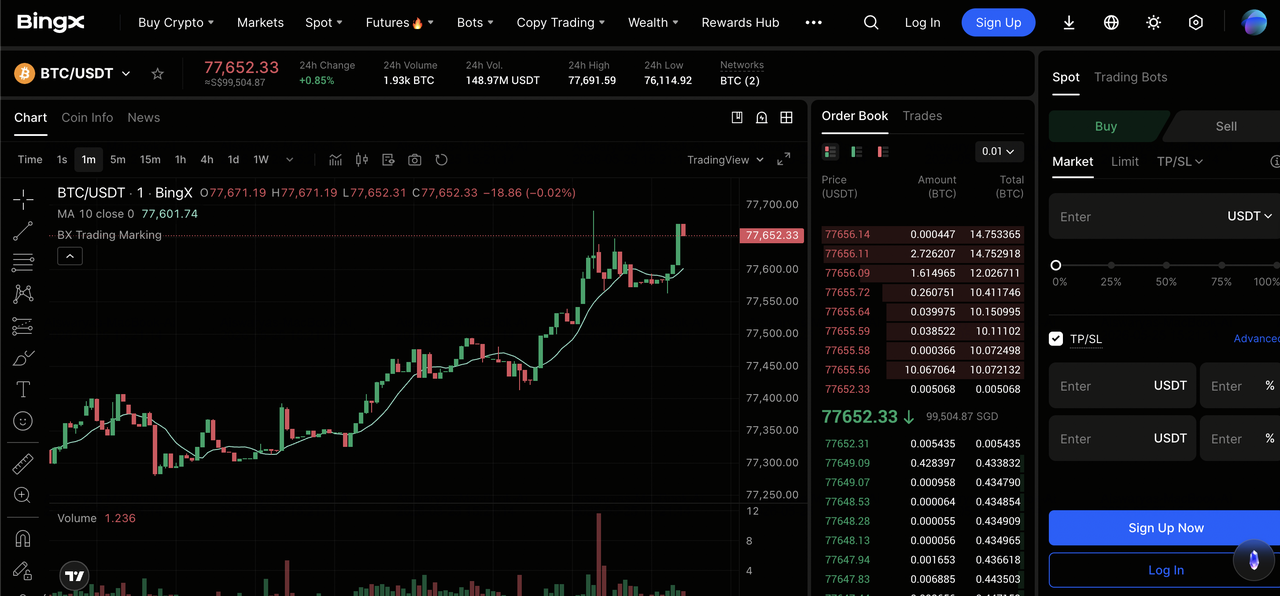
BTC/USDT trading pair on the BingX spot market
For investors looking to build direct, non-leveraged positions in the world's premier digital asset, the BingX Spot market provides deep liquidity and secure access.
- Log into your verified BingX account and ensure your account security infrastructure is fully active, such as Google 2FA.
- Transfer or deposit stablecoins like USDT into your Spot Wallet.
- Navigate to the Spot Trading terminal and select the BTC/USDT trading pair.
- Utilize the integrated BingX AI Analyst panel to evaluate real-time moving averages, volume anomalies, and key support/resistance zones.
- Select your preferred order type (Market or Limit), input the amount of USDT you wish to allocate, and confirm the purchase. Your Bitcoin balance will immediately reflect in your account.
Long or Short Bitcoin (BTC) Perpetuals on BingX Futures
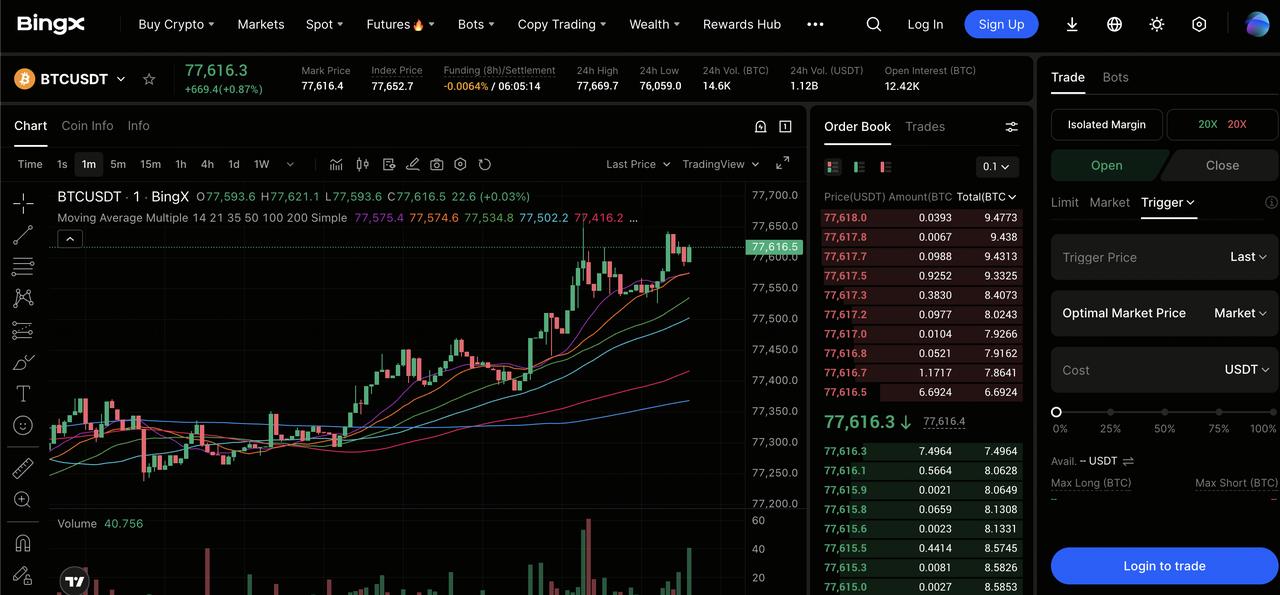
BTC/USDT perpetual contract on BingX futures market
For active traders seeking to capitalize on short-term market momentum, hedge physical mining operations, or utilize directional leverage, BingX offers USDT-settled perpetual contracts.
- Access the Advanced Futures interface or the BingX TradFi portal.
- Transfer your desired quantity of USDT collateral from your Spot Wallet into your Futures Account.
- Choose the BTC-USDT Perpetual contract from the highly liquid derivatives directory.
- Define your macro thesis: Select Open Long if you anticipate price appreciation driven by network hashrate growth, or Open Short to profit from broader market corrections.
- Set your leverage parameters defensively based on your risk tolerance. Input your position sizing, establish precise Take-Profit (TP) and Stop-Loss (SL) markers to insulate your capital against volatility, and execute the trade. Real-time P&L settles dynamically in USDT.
Automate Capital Allocation via BingX Recurring Buy (DCA)
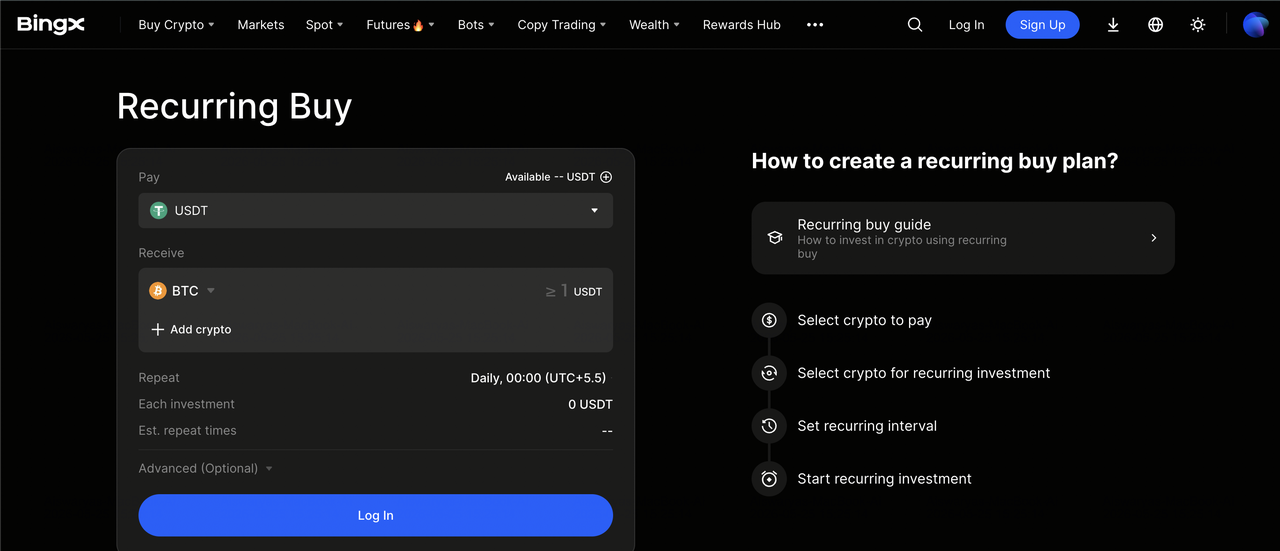
DCA Bitcoin on BingX Recurring Buy
Trying to time short-term market cycles can be highly inefficient. For long-term accumulation, the BingX Recurring Buy feature allows users to deploy a disciplined Dollar-Cost Averaging (DCA) strategy completely on autopilot.
- Navigate to the Recurring Buy terminal under the Spot trading directory. This tool automatically triggers buy orders at fixed intervals, helping to mitigate market volatility by flattening your average entry cost over time.
- Select the payment cryptocurrency, e.g., USDT, and the target PoW asset you want to systematically accumulate, such as Bitcoin (BTC).
- Establish your recurring interval parameters, with flexible scheduling choices ranging from hourly, daily, weekly, to monthly executions.
- Define your custom budget allocation. The system supports micro-investments starting from a baseline of just 1 USDT per interval, removing the barrier to entry for smaller portfolios.
- Confirm your parameters to launch the automation. The plan will run 24/7 directly from your spot balance, eliminating the emotional pressures of day-to-day price movements.
What Are the Top Risks and Key Considerations of the Mining Landscape?
Before deploying capital into cryptocurrency infrastructure or related trading vehicles, market participants must carefully evaluate several systemic risks:
- Radical Power Sensitivity: Electricity cost is the ultimate determinant of mining survival. Rigs operating at residential power rates above $0.12–$0.15/kWh struggle to maintain baseline profitability. Industrial operations scale strictly where power is secured near or below $0.06/kWh.
- Network Difficulty Expansion: The Bitcoin network is self-regulating. As more efficient ASICs go online globally, the network difficulty adjusts upward. This means your fixed physical hardware will produce progressively less BTC over time as the global competition intensifies.
- Hardware Obsolescence and Depreciation: ASICs are highly specialized. When a next-generation architecture debuts, older machines instantly lose market competitiveness and suffer aggressive capital depreciation, carrying near-zero resale value outside of scrap metal.
Final Thoughts: How to Navigate the 2026 Crypto Mining Cycle
The structural reality of cryptocurrency infrastructure requires absolute clarity: GPU mining for Bitcoin is dead. ASICs have permanently captured the SHA-256 ecosystem, leaving consumer graphics cards to compete across a shifting terrain of alternative altcoins.
For the vast majority of investors, the immense capital requirements, cooling constraints, and structural depreciation associated with running physical hardware make direct asset allocation a far more practical path. Utilizing the secure, high-liquidity spot and futures pipelines on BingX enables global capital to capture the pure upside of the Bitcoin macro cycle without the operational headaches of running a data center.
Related Reading
- How to Mine Bitcoin (BTC) in 2026: A Beginner's Guide
- How to Mine Bitcoin (BTC) on iPhone
- How Does Bitcoin Mining Hashrate Impact BTC Price in 2026?
- How to Mine Bitcoin (BTC) on Android Mobile Devices in 2026
- What Are the Top Proof-of-Work (PoW) Coins to Mine in 2026?
- What Is Kaspa (KAS) Proof-of-Work Blockchain: A Beginner's Guide
- How to Mine Litecoin (LTC) in 2026: A Beginner’s Guide
