
Virgin Galactic (SPCE) is a commercial human-spaceflight company developing a premium suborbital tourism service around its next-generation Delta-class spacecraft. Ticket sales and future flight cadence define its long-term revenue opportunity, although commercial operations remain paused. This transition leaves the equity highly sensitive to test milestones, liquidity needs and the schedule for returning paying customers to space.
The latest quarter showed progress in demand and program preparation without resolving the central financial tension. Virgin Galactic Q2 2026 revenue was only $0.1 million, free cash flow was negative $91 million and management moved the first commercial Delta flight to February 2027. The investment case depends on whether the Delta program can cross from development spending into reliable service before additional financing substantially dilutes shareholders.
The SPCE stock forecast for 2026 centers on two competing views:
- The milestone case: October captive-carry testing and firm premium demand improve confidence in the 2027 commercial ramp.
- The funding case: further delays and sustained cash consumption force more equity issuance before recurring revenue begins.
This guide breaks down the SPCE stock forecast, 2026 price scenarios, key risks and analyst outlooks, drawing on Virgin Galactic's August 12 Q2 2026 earnings release, quarterly filing and market data through September 2, plus how to trade SPCE stock futures on BingX TradFi with USDT collateral.
Top 5 Things for Virgin Galactic Investors to Know in September 2026
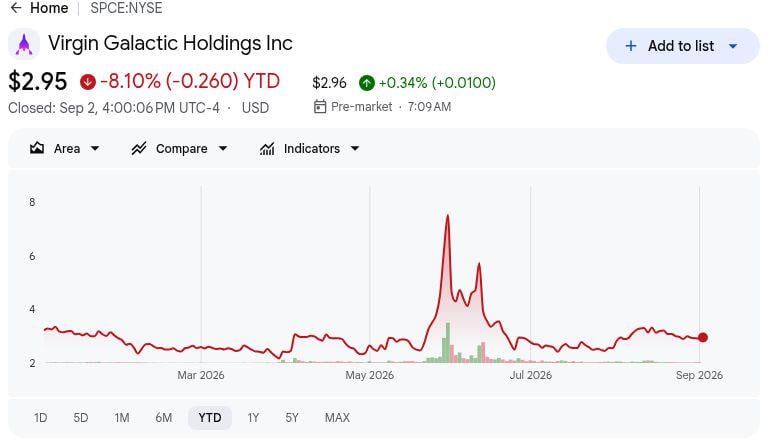
- SPCE closed at $2.95 on September 2: Shares rose 1.37% that day and remained between the selected $2 to $5 analyst targets. The price still reflects expectations around Delta-class execution rather than evidence of established commercial profitability.
- Q2 revenue fell to just $0.1 million from $0.4 million a year earlier: With commercial flights still paused, current revenue remains immaterial relative to the company’s development costs. The investment case therefore depends primarily on testing milestones and the February 2027 return-to-service target.
- Free cash flow improved to negative $91 million: Cash burn narrowed from negative $114 million in Q2 2025, while cash and marketable securities stood at about $286 million. Management still expects another roughly $175 million to $190 million of negative free cash flow across Q3 and Q4 combined.
- Premium ticket demand represents more than $50 million of expected revenue: The oversubscribed tranche was priced at $750,000 per seat, supporting the premium-demand thesis. That expected revenue only becomes meaningful once Delta spacecraft enter reliable commercial service.
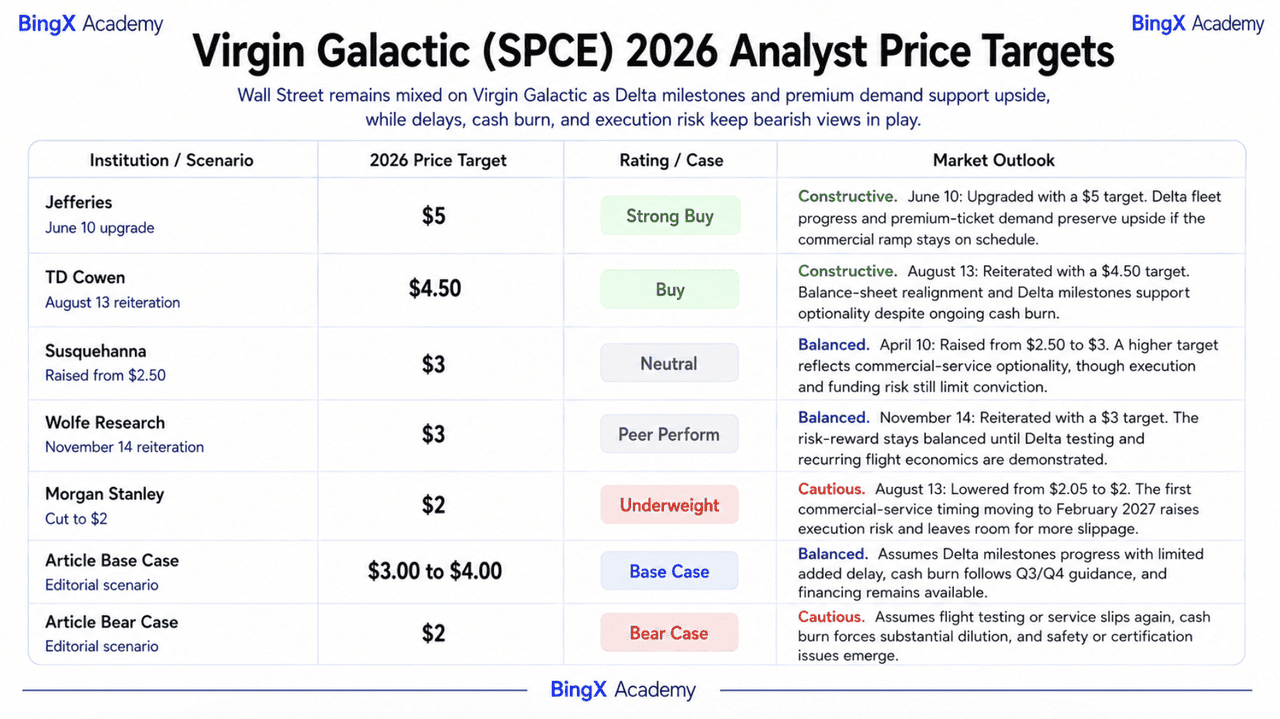
- Selected analyst targets range from $2 to $5: The $3 spread reflects sharply different views on Delta timing, financing needs, and dilution risk. With $134 million already raised through the ATM program and 41 million shares issued, future funding remains a major variable for per-share value.
What Is Virgin Galactic (SPCE)?
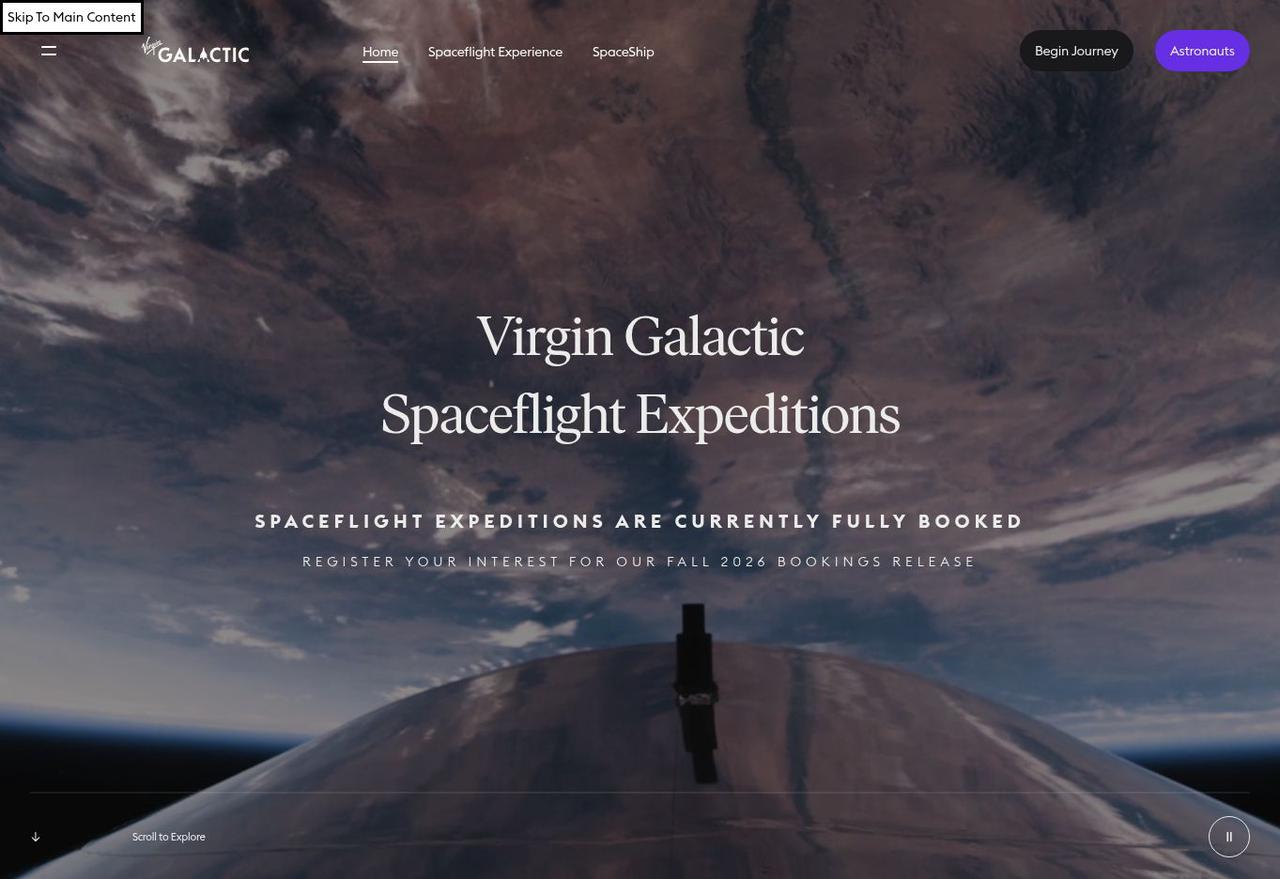
Virgin Galactic (SPCE) is a commercial spaceflight company focused on suborbital human space tourism and research missions. It develops reusable spacecraft designed to carry private astronauts and scientific payloads to the edge of space, with revenue expected to come primarily from premium ticket sales and research flights. Unlike launch providers such as Rocket Lab or SpaceX, Virgin Galactic is centered on human suborbital experiences rather than orbital launch services.
Its growth strategy is increasingly centered on the Delta-class fleet and a higher-frequency commercial flight model. Virgin Galactic is developing Delta vehicles to reduce turnaround time, increase annual flight capacity, and support a more scalable space-tourism business once service resumes. The company is also targeting affluent private customers and research institutions, with premium ticket pricing helping support the economics of each flight. That strategy gives SPCE a distinct position in commercial space tourism, but execution depends on completing testing, bringing Delta spacecraft into service on schedule, and reaching enough flight frequency to support sustainable cash generation.
Read More: Top Space Stocks to Buy Ahead of SpaceX IPO
Virgin Galactic (SPCE) Q2 2026 Earnings Overview: Revenue, Cash Burn and Delta Milestones
Virgin Galactic’s Q2 showed modest cost improvement but continued heavy cash burn and another delay to commercial service. Revenue fell to $0.1 million from $0.4 million a year earlier, net loss narrowed to $56 million, and free cash flow improved to negative $91 million. Cash and marketable securities stood at $286 million, while management still expects roughly $175 million to $190 million of additional negative free cash flow across Q3 and Q4. The company also raised $134 million through its ATM program, underscoring that liquidity remains central until Delta flights begin generating recurring revenue.
|
Financial Metric |
Prior Period / Guidance |
Reported / Actual |
Surprise |
|
Q2 2026 revenue |
$0.4 million in Q2 2025 |
$0.1 million |
Lower. Flights remain paused. |
|
Q2 2026 net loss |
$67 million in Q2 2025 |
$56 million |
Improved. Losses narrowed year over year. |
|
Adjusted EBITDA |
Negative $52 million in Q2 2025 |
Negative $52 million |
Stable. Operating deficit persisted. |
|
Free cash flow |
Negative $114 million in Q2 2025 |
Negative $91 million |
Improved. Burn moderated. |
|
Cash and marketable securities |
N/A |
$286 million |
Available. Funds the development runway. |
|
ATM financing |
N/A |
$134 million gross proceeds; 41 million shares issued |
Dilutive. Liquidity required more equity. |
|
Q3 and Q4 FCF guidance |
N/A |
Negative $95-$100 million; negative $80-$90 million |
Heavy. Outflows continue through year-end. |
|
Premium expedition tranche |
N/A |
Over $50 million expected revenue |
Positive. Premium demand remained firm. |
|
First Delta commercial service |
Previously Q4 2026 |
February 2027 |
Delayed. Revenue shifted later. |
- Revenue declined to $0.1 million: Commercial flights remain paused, so current revenue is still immaterial relative to the company’s cost base and future valuation depends mainly on Delta milestones.
- The net loss narrowed to $56 million: The deficit improved from $67 million a year earlier as spending discipline helped offset the lack of recurring flight revenue.
- Adjusted EBITDA remained negative $52 million: The unchanged operating deficit shows that material earnings improvement will require more than cost control and depends on restarting commercial service.
- Free cash flow improved to negative $91 million: Cash burn narrowed from negative $114 million, but the company still faces substantial outflows before Delta enters service.
- The first Delta commercial flight moved to February 2027: Captive-carry testing is scheduled for October 2026, with the second spacecraft expected to enter service in March. Another delay would extend the pre-revenue period and increase financing pressure.
Virgin Galactic (SPCE) 2026 Investment Outlook: $5 Bull Case vs. $2 Bear Case
The central test is whether Delta progress can improve confidence faster than cash burn and dilution weaken per-share value.
The Bull Case: Delta Testing Pushes SPCE Toward $5
The Bull Case assumes captive-carry testing begins in October, the first two Delta ships keep their early-2027 service dates, and premium ticket demand remains strong. Meeting those milestones would reduce schedule uncertainty and shift investor focus toward flight cadence and unit economics.
A move toward $5 would require technical progress without a major safety or certification setback, plus enough liquidity to reach commercial service. Stable testing milestones and no major increase in cash burn would provide the clearest confirmation.
The Base Case: Measured Delta Progress Keeps SPCE Between $3 and $4
The Base Case assumes testing advances with limited additional delay, cash burn remains near guidance, and financing stays available. Investors continue to wait for evidence that Delta execution is moving from development into reliable operations.
Under this scenario, SPCE could trade mainly between $3 and $4. Visible captive-carry progress, stable service dates, and controlled spending would support the range, while another timeline change or accelerated share issuance would weaken it.
The Bear Case: Further Delays Pull SPCE Toward $2
The Bear Case assumes testing or commercial service slips again, extending the period of minimal revenue and negative free cash flow. Additional financing would then spread the eventual value of the Delta fleet across a larger share count.
A move toward $2 would become more likely if testing is pushed back, the February 2027 service date slips, or cash burn exceeds guidance. In that environment, time and dilution alone could pressure per-share value even if customer demand remains intact.
SPCE Stock Price Forecasts for 2026 By Wall Street Analysts
These dated third-party actions span bullish fleet optionality and concern about the delayed service schedule. Their spread reflects uncertainty rather than a unified consensus. Article scenarios are identified separately from real analyst rows.
|
Institution / Scenario |
2026 Price Target |
Rating / Case |
Market Outlook |
|
Jefferies |
$5 |
Strong Buy |
Constructive. June 10: Upgraded with a $5 target. The Delta fleet and premium ticket demand preserve upside if the commercial ramp arrives on schedule. |
|
TD Cowen |
$4.50 |
Buy |
Constructive. August 13: Reiterated with a $4.50 target. Balance-sheet realignment and Delta milestones support optionality despite continuing cash burn. |
|
Susquehanna |
$3 |
Neutral |
Balanced. April 10: Raised from $2.50 to $3. A higher target recognizes commercial-service optionality while execution and funding risk limit conviction. |
|
Wolfe Research |
$3 |
Peer Perform |
Balanced. November 14: Reiterated with a $3 target. The risk-reward remains balanced until Delta testing and recurring flight economics are demonstrated. |
|
Morgan Stanley |
$2 |
Underweight |
Cautious. August 13: Lowered from $2.05 to $2. The move of first commercial service to February 2027 increases execution risk and leaves room for further schedule slippage. |
|
Article Base Case |
$3.00-$4.00 |
Base Case |
Balanced. Assumes delta milestones progress with limited additional delay, cash burn follows Q3/Q4 guidance, and financing remains available. |
|
Article Bear Case |
$2 |
Bear Case |
Cautious. Assumes flight testing or service slips again, cash burn forces substantial dilution, and safety or certification issues emerge. |
How to Trade Virgin Galactic (SPCE) Stock on BingX
Trade Virgin Galactic's Delta-milestone, premium-demand and financing outlook using BingX TradFi and BingX AI tools. Because SPCE can react sharply to test updates, schedule changes and capital raises, traders should define both the catalyst and risk limits before entering a position.
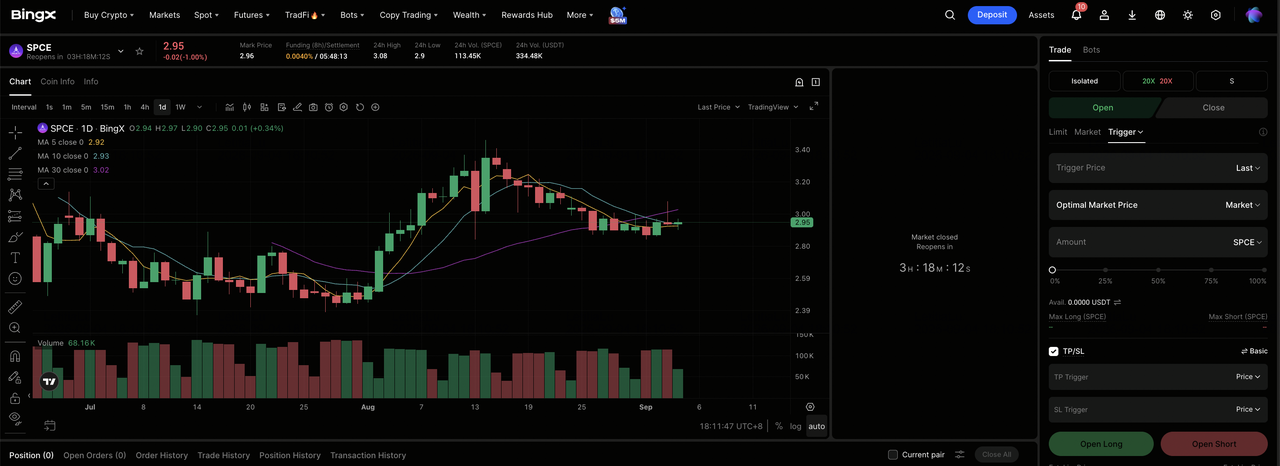
Step 1: Access BingX TradFi. Sign up and navigate to the specialized TradFi section on the BingX exchange dashboard.
Step 2: Select Virgin Galactic (SPCE). Search for and select the SPCE-USDT perpetual futures contract.
Step 3: Choose your direction. Select Open Long if testing begins on schedule and the 2027 service dates hold. Select Open Short if new delays or financing needs weaken the expected per-share outcome.
Step 4: Select leverage and margin mode. Choose Isolated or Cross-Margin based on your risk tolerance. Milestone-driven small-cap shares can reprice quickly, so conservative leverage and clear position sizing are important.
Step 5: Execute strict risk protocols. Set Take-Profit and Stop-Loss (TP/SL) levels before or immediately after entering the trade. SPCE can react quickly to test results, service timing, safety developments and capital issuance.
Top 5 Risks to Watch for Virgin Galactic Investors in 2026
Virgin Galactic’s upside still depends on reaching commercial service before delays, cash burn, or dilution materially weaken the economics for shareholders.
- Another schedule delay would extend the pre-revenue period: The first Delta commercial flight is now targeted for February 2027. Any further slip would push ticket revenue out while development and corporate expenses continue.
- Persistent cash burn could drive more dilution: Free cash flow was negative $91 million in Q2, and management expects another roughly $175 million to $190 million of outflows across Q3 and Q4. More equity financing may be needed if testing or fleet-ramp costs rise.
- Safety or certification setbacks could delay the entire program: A spacecraft or testing issue could trigger redesign work, additional regulatory review, and reputational damage before paying customers return to flight.
- Low flight cadence could weaken unit economics: Even if Delta enters service, the business still needs enough flights per spacecraft to spread fixed costs effectively. Slower turnaround times or weaker fleet utilization would delay the path to positive cash flow.
- Premium reservations may convert more slowly than expected: The latest tranche represents more than $50 million of expected revenue at $750,000 per seat, but cancellations, deferrals, or slower customer conversion would reduce the revenue available to support the early fleet ramp.
Final Thoughts: Should You Invest in Virgin Galactic in 2026?
Virgin Galactic has demonstrated premium customer interest and narrowed parts of its cash deficit, yet the company still lacks meaningful operating revenue. Delta testing and the February 2027 service target therefore carry more weight than short-term sales comparisons.
The bull case requires timely testing, stable entry-to-service dates and adequate liquidity. The bear case needs only another delay or heavier financing to weaken the per-share outcome. Conservative traders may wait for captive-carry evidence and a clearer funding bridge before treating the commercial timetable as dependable.
Risk Reminder: Trading and investing in equities like SPCE involves a high risk of capital loss. Spaceflight safety, certification, schedule delays, cash burn, dilution and uncertain demand conversion can affect results. Conduct independent research before allocating capital.
Related Reading
- Top Space Stocks to Buy Ahead of SpaceX IPO
- SpaceX (SPCX) Price Prediction 2026: $227 Street-High AI Fusion or Trillion-Dollar Valuation Bubble?
- Firefly Aerospace Stock Outlook 2026: Can Launch Vehicles, Spacecraft Services Drive FLY to $45+?
- Archer Aviation Stock Price Prediction 2026: $11.83 eVTOL Breakout or Dilution Death Spiral?
- Redwire Price Prediction 2026: Can Space and Defense Momentum Help RDW Extend Its 220% Rally?
- Sidus Space Stock Price Prediction 2026: $10 Satellite Boom or Dilution Trap?
