AKEDO (AKE) is an AI-powered game and content creation engine and launchpad that lets users build games through natural language prompts rather than traditional coding. Instead of requiring a full development studio, AKEDO uses a multi-agent AI framework where specialized agents handle world-building, rules, balancing, and storytelling, aiming to make game creation dramatically faster and cheaper. It sits at the intersection of two active narratives: artificial intelligence and Web3 gaming.
KEDO launched the AKE token in 2025 and has continued developing its AI game-creation platform and creator ecosystem. The ecosystem has several key parts: AKE is the utility token, the AI creation engine turns prompts into games, a launchpad lets creators tokenize and monetize their games, and a burn mechanism ties token scarcity to platform activity. This guide explains what AKEDO is, how the platform works, how AKE tokenomics function, the main risks to consider, and how to trade AKE on BingX.
What Is AKEDO (AKE)?
Source: Akedo
AKEDO (AKE) is a multi-agent AI framework and launchpad designed to democratize game and digital content creation. Using specialized AI agents, it lets people design games in minutes from simple natural language prompts, without needing to code. The platform aims to cut development time and cost sharply compared with traditional methods, and it hosts both first-party and user-generated games. AKE is available as a token on BNB Chain, while users should verify the official contract and supported network before transferring it. AKEDO combines AI creation tools with game incentives and a launchpad for tokenizing games.
AKE is the utility and coordination token of this system. It is used for AI creation, game publishing, staking, rewards, and liquidity provision, and crucially it serves as the base liquidity pair for new game tokens launched on AKEDO's launchpad, which ties its demand to ecosystem growth. The team behind AKEDO includes members with experience on large global games, and the project has reported a large online community, although public figures may include community members rather than verified active platform users.
The core idea behind AKEDO is simple: if anyone can create a game from a prompt, game creation becomes a mass activity, and AKE is the asset that powers and captures value from that activity.
Key components of the AKEDO ecosystem include:
- AKE token: The utility token used for AI creation, publishing, staking, rewards, and as the base liquidity pair for new game tokens.
- AI creation engine: A multi-agent system that turns natural language prompts into playable games.
- Launchpad: A platform that lets creators tokenize and monetize their games, paired with AKE liquidity.
- Player rewards: Part of the community allocation is reserved for player incentives designed to encourage participation in AKEDO games.
- Burn mechanism: A system that burns a share of platform fees, reducing supply as usage grows.
How Does AKEDO Work?
AKEDO works as an AI-driven creation platform whose games, tokens, and incentives are coordinated by a multi-agent framework, a launchpad, and the AKE token.
- AI agents turn prompts into games: A specialized multi-agent system handles different parts of game design, such as world-building, rules, balancing, and storytelling, so users can create coherent games from natural language prompts without coding.
- AKE powers creation and publishing: The platform charges AKE for actions such as generating and publishing games, creating direct utility demand tied to how much the engine is used.
- The launchpad tokenizes games: Creators can launch tokens associated with their games, and new tokens launched on AKEDO are paired with AKE in liquidity pools, linking AKE demand to ecosystem activity.
- Player rewards drive engagement: Part of the community token allocation is reserved for player incentives, while creators and liquidity providers are supported through the token’s utility and fee-sharing model.
- Fees fund burns and staking: A share of platform fees is burned to reduce supply, and staking lets holders earn a portion of fees, tying scarcity and rewards to real platform usage.
AKEDO vs. Traditional GameFi: Key Differences
AKEDO and traditional GameFi projects both combine gaming with tokens, but they differ in focus, token demand, and user participation.
|
Comparison |
AKEDO |
Traditional GameFi |
|
Core model |
Game creation and tokenization platform |
Individual game or small game ecosystem |
|
Main users |
Creators, developers, and launch participants |
Players and token earners |
|
Token demand |
Linked to game creation, launches, and platform activity |
Linked mainly to gameplay and in-game rewards |
|
User role |
Build, launch, and tokenize games |
Play specific games and earn rewards |
|
Main advantage |
Broader creator-economy infrastructure |
Clearer gameplay experience and established game loops |
|
Main tradeoff |
Depends on large-scale creator adoption |
Often relies heavily on play-to-earn incentives |
AKEDO positions itself as infrastructure for a creator economy rather than a single game. Traditional GameFi suits users who want to play specific titles and earn rewards, while AKEDO suits users interested in creating, launching, and tokenizing games. Its long-term potential depends on whether creators adopt the platform at scale.
Read More: Top Web3 Games in the GameFi Sector to Watch in 2026
What Are the AKEDO (AKE) Tokenomics?
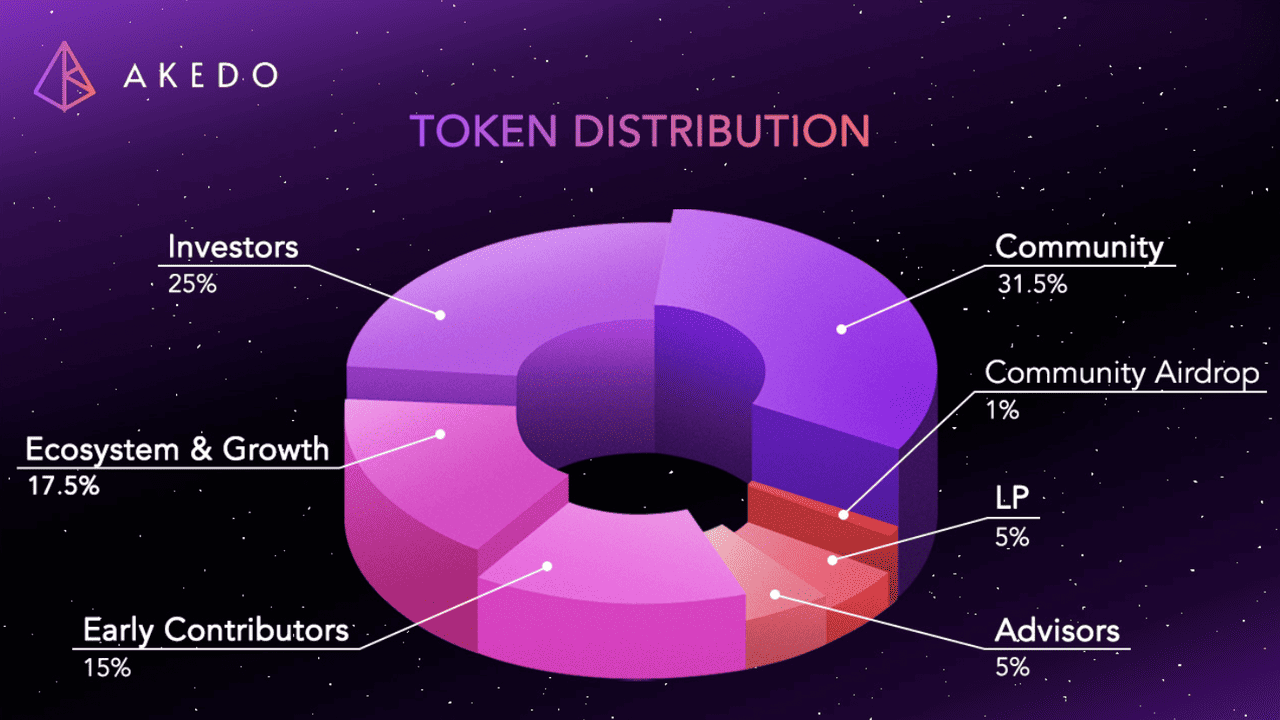
AKE tokenomics centers on a fixed total supply of 100 billion tokens, category-specific release schedules, and a fee mechanism that connects staking rewards and token burns to platform usage. Community rewards receive the largest allocation, while investors, early contributors, ecosystem growth, advisors, liquidity, and the community airdrop account for the remaining supply.
AKE Token Utility and Supply Mechanisms
AKE is the utility asset of the AKEDO ecosystem. Its utility spans AI creation, publishing, staking, liquidity, and supply reduction.
- AI creation and publishing: Users need AKE to prompt the AI creation engine and publish games. AKEDO’s whitepaper lists a cost equivalent to $0.10 per prompt and $10 per published game.
- Base liquidity pair: New game tokens launched on AKEDO are paired with AKE in their liquidity pools, linking AKE demand to launchpad and ecosystem activity.
- Staking rewards: Users can stake AKE to earn rewards funded by protocol fee revenue.
- Protocol revenue: According to the whitepaper, 33% of protocol fees is reserved as platform revenue, 33% is distributed to AKE stakers, and 33% is used to burn AKE.
- Supply reduction: The fee-burn mechanism permanently removes AKE from supply. Its effect depends on actual platform usage and the amount of protocol fees generated.
AKE Token Allocation and Supply Considerations
Source: Akedo Whitepaper
- Community and Community Airdrop: 32.5%, or 32.5 billion AKE. This combines the community allocation of 31.5%, or 31.5 billion AKE, and the community airdrop allocation of 1%, or 1 billion AKE. The community allocation includes 16% for node rewards, 8% for creator rewards, and 7.5% for player rewards.
- Investors: 25%, or 25 billion AKE. Investor tokens are subject to a three-month cliff followed by a 24-month linear unlock.
- Ecosystem and Growth: 17.5%, or 17.5 billion AKE. This includes 15.8% for ecosystem and marketing, which was fully unlocked at the token generation event, and 1.7% for KOLs, services, and related purposes. For the latter allocation, 20% was unlocked at launch and the remainder unlocks over six months.
- Early Contributors and Advisors: 20%, or 20 billion AKE. This combines early contributors at 15%, or 15 billion AKE, and advisors at 5%, or 5 billion AKE. Both allocations have a six-month cliff followed by a 42-month linear unlock.
- Liquidity Provision: 5%, or 5 billion AKE. This allocation was released at the token generation event to support market liquidity.
AKE has a fixed total supply of 100 billion tokens. Different allocation categories follow separate launch, cliff, and linear-release schedules, with the community allocation extending over 48 months. The community allocation begins with 2.08% of the total supply released at the token generation event, while the remainder unlocks linearly over 48 months. The 1% community airdrop was also allocated during the launch period.
By 2026, AKE’s supply dynamics depend on the balance between scheduled token unlocks and the fee-funded burn mechanism. Because investor, early contributor, advisor, and community tokens follow different release schedules, investors should monitor both platform usage and upcoming unlocks when evaluating potential supply pressure.
How to Trade AKEDO (AKE) on BingX
BingX offers AKE through its futures market, letting active traders take long or short exposure to AKE price movements without holding the underlying token. If you want to buy and hold AKE directly instead, you can acquire USDT on BingX and swap it for AKE on a supported decentralized exchange on BNB Smart Chain.
Futures Trading: Trade AKE Price Movements
For active traders, BingX offers USDT-margined AKE perpetual futures. Futures allow users to trade AKE price movements without holding the underlying asset, with the flexibility to open long positions if they expect AKE to rise or short positions if they expect AKE to fall.
Because futures involve leverage, they can amplify both gains and losses. This approach is more suitable for traders who already have a clear risk plan and understand liquidation risk, particularly for an early-stage, micro-priced token like AKE that is sensitive to AI-gaming narrative cycles and token unlocks.
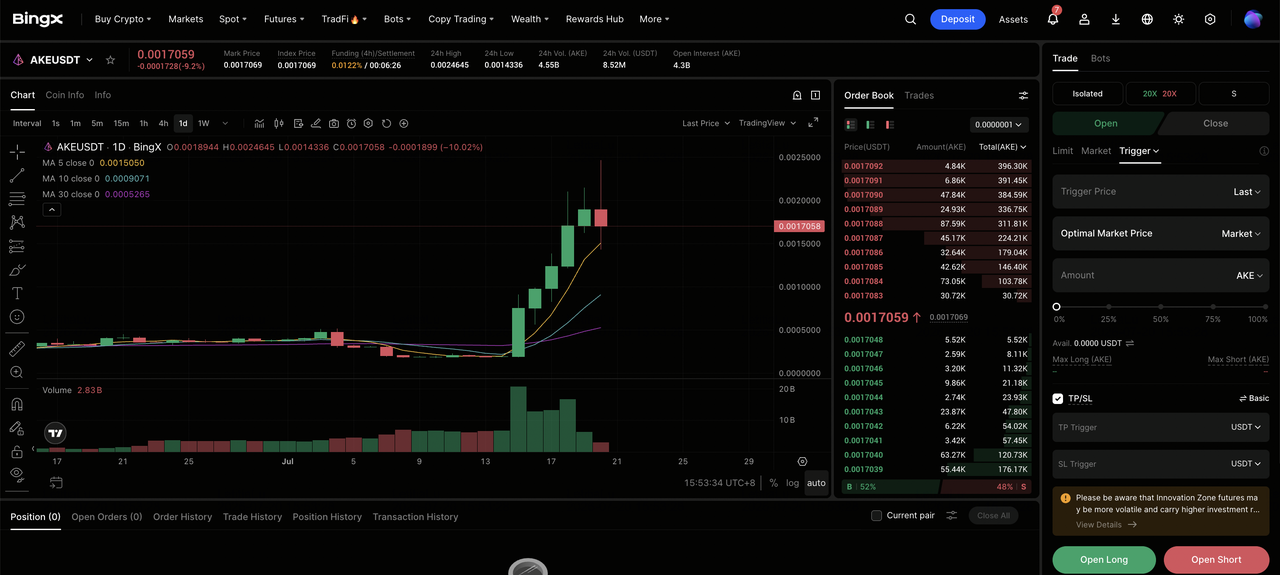
Step 1: Account setup and security. Sign up and log into your BingX account, complete the identity verification (KYC) required in your region, and enable two-factor authentication.
Step 2: Transfer collateral. Move USDT from your spot account into your futures account, where it will serve as margin.
Step 3: Select the contract. Search for the AKE-USDT perpetual contract.
Step 4: Set direction and leverage. Open long if you expect AKE to rise, or open short if you expect AKE to decline. Choose leverage based on your risk tolerance and position size. For micro-priced tokens, lower leverage is generally safer because volatility can be extreme.
Step 5: Execute the trade. Enter the order amount and choose a market or limit order depending on your trading plan.
Step 6: Manage risk. Set stop-loss and take-profit orders before or immediately after entering the position. Profit and loss settle dynamically in USDT.
Risks and Considerations Before Investing in AKEDO (AKE)
AKEDO has an appealing narrative, an experienced team, and a clear utility model. However, AKE still carries significant risks tied to token unlocks, adoption, burn dependency, and extreme volatility.
- Large future unlocks: Because several allocation categories follow scheduled release periods, future token distributions may increase market supply and create selling pressure.
- Adoption is unproven at scale: AKE's utility model depends on creators actually building and launching games; if adoption stays limited, utility demand and burns may remain low.
- Burn depends on volume: The fee-burn mechanism only meaningfully reduces supply with strong trading and usage volume, which requires substantial ecosystem growth.
- Extreme volatility: As a micro-priced, early-stage AI-gaming token, AKE has shown very large swings, including sharp rallies and steep drops, and past performance does not guarantee future results.
- Narrative rotation risk: AKE trades heavily on the AI-gaming narrative; if attention rotates to other sectors, demand can fade quickly.
Final Thoughts: Should You Invest in AKEDO (AKE) in 2026?
AKEDO is an ambitious AI-gaming project that combines a natural-language game creation engine, a launchpad, and a token whose demand is tied to ecosystem activity. Its 2026 story is anchored by growth of the AI creation engine, expansion of the launchpad, and a roadmap toward mobile and cross-chain tools.
The key question for 2026 is whether AKEDO can convert an appealing narrative and a large reported user base into real creator adoption and platform usage that drives token demand and burns. Its creation-layer focus and multi-agent design set it apart from single-game GameFi projects, but AKE remains an early-stage, micro-priced token exposed to large unlocks, burn dependency, and sharp volatility. For investors and traders, the most important metrics to watch are creator and platform usage, launchpad activity, burn volume, unlock schedules, and AI-gaming sector sentiment.
Related Reading
- What Are the Top 10 AI Agent Crypto Projects of 2026?
- What Are the Top 10 AI Crypto Projects to Watch in 2026?
- Top Web3 Games in the GameFi Sector to Watch in 2026
- Top Gaming Blockchain Networks in 2026: List and Stats to Know
- What Are the Top 7 AI-Powered Memecoins in 2026?
FAQs About AKEDO (AKE)
1. What makes AKEDO different from other gaming projects?
AKEDO focuses on the creation layer rather than a single game. It uses a multi-agent AI framework to let anyone build games from natural language prompts, and its launchpad pairs every new game token with AKE, tying token demand to overall ecosystem activity.
2. What blockchain is AKE on?
AKE is available on BNB Chain. Users should verify the official contract address and supported network before transferring tokens.
3. How does AKEDO reduce its token supply?
AKEDO burns a share of platform fees, which removes AKE from circulation over time. The impact of this burn depends on how much trading and platform usage occurs, so meaningful supply reduction requires strong ecosystem activity.
4. Which wallets support AKE?
AKE can be stored in BNB Chain-compatible wallets that support the BEP-20 standard, including MetaMask and other compatible wallets. Users should always confirm they are using the correct network before transferring AKE to avoid loss of funds.
