
Before Bitcoin was a household name, it was just an idea shared on internet forums. In May 2010, Laszlo Hanyecz, one of Bitcoin’s early users, made a trade that would go down in crypto history: 10,000 Bitcoin for two pizzas.
What later became known as Bitcoin Pizza Day now stands as a milestone in cryptocurrency history. It represents the first time Bitcoin was used for a real-world purchase — a small step that signaled the beginning of its journey from experimental software to global financial innovation.
It’s a story about early adopters, small beginnings, and how one ordinary purchase helped kickstart a global financial movement.
What Is Bitcoin Pizza Day?
Bitcoin Pizza Day marks the anniversary of the first real-world purchase made using Bitcoin. On May 22, 2010, Laszlo Hanyecz, an early Bitcoin enthusiast, exchanged 10,000 Bitcoin for two Papa John's pizzas — creating what is now seen as the first commercial transaction in cryptocurrency history.
This simple exchange turned Bitcoin from a niche digital experiment into something tangible — proof that it could be used as real money, not just an idea shared among online communities.
History of Bitcoin Pizza Day
In 2008, an anonymous creator known as Satoshi Nakamoto introduced Bitcoin to the world — a new idea for decentralized, peer-to-peer money. It wasn’t until 2010, however, that Bitcoin found its first real-world use.
That moment came thanks to Laszlo Hanyecz, a programmer and Bitcoin hobbyist based in Florida. On May 18, 2010, he posted a casual offer on the Bitcointalk forum: 10,000 Bitcoin to anyone who would send him two large pizzas.
Back then, Bitcoin had almost no established value — it was more of a tech experiment than a currency. Still, another forum user, Jeremy Sturdivant (known online as "jercos"), accepted the offer and ordered two Papa John’s pizzas to Hanyecz’s house.
Laszlo received his pizzas on May 22, worth about $41 at the time, and posted a picture to the forum, documenting what would later be seen as a historic milestone. In his own words: "It wasn't like bitcoins had any value back then, so the idea of trading them for a pizza was incredibly cool."
What seemed like an ordinary dinner order ended up proving Bitcoin’s potential: it could be exchanged for something tangible. That simple act helped set Bitcoin on the path from an obscure experiment to the global phenomenon it is today.
Why Is Bitcoin Pizza Day Important?
Beyond the memes and pizza parties, Bitcoin Pizza Day holds real significance for crypto enthusiasts, and for the history of money itself. Here’s why:
- Bitcoin Pizza Day proved Bitcoin could be used as real money. When Laszlo Hanyecz exchanged 10,000 BTC for two pizzas, it showed that Bitcoin wasn’t just theoretical; it could buy real-world goods, marking Bitcoin’s first practical transaction.
- The first Bitcoin transaction gave the cryptocurrency an initial price. That $41 pizza order valued Bitcoin at roughly $0.004 per coin, setting an early benchmark that made Bitcoin easier to understand and track.
- Bitcoin’s first real-world purchase turned an idea into reality. Until that day, Bitcoin mostly existed in forums and theory. Hanyecz’s simple act proved Bitcoin could work as a decentralized currency for everyday use.
- Bitcoin Pizza Day helped build the early Bitcoin community. The story of two pizzas became a symbol, bonding early adopters and helping Bitcoin's grassroots movement grow into a global community.
- The Bitcoin Pizza Day story made Bitcoin’s growth tangible. Watching the value of 10,000 BTC rise over time gives a vivid, emotional example of cryptocurrency’s long-term potential and volatility.
How Much Would 10,000 Bitcoins Be Worth Today, May 22, 2026?

Bitcoin pizza day: How much would Laszlo Hanyecz's $10,000 BTC be worth today? | Source: Bitcoin Pizza Index
With Bitcoin currently trading around $77,530.79 per coin, the 10,000 BTC that once bought two pizzas would now be worth an astonishing $775, 307,991.
What started as a casual $41 pizza order has become one of the most remarkable stories of value appreciation in financial history, representing a rise of over 1.9 billion percent, or roughly a 19-million-fold return over sixteen years.
But the real significance of Laszlo Hanyecz’s transaction goes beyond the numbers. It wasn’t just about the price — it was about proving Bitcoin could be used in the real world. That simple act of trading digital coins for two pizzas marked the first real-world use of Bitcoin as money, laying the foundation for the cryptocurrency's global rise.
Even today, Hanyecz has expressed no regrets. In interviews, he has said that being part of Bitcoin’s early history was worth far more than the missed fortune. "I think it's great that I got to be part of the early history of Bitcoin in that way," he reflected.
For Hanyecz, spending Bitcoin on everyday goods wasn’t a loss but a necessary step to show that Bitcoin could work beyond theory. Without moments like this, Bitcoin might have remained just an idea confined to online discussions. Instead, it grew, circulated, and evolved, and it all started with two pizzas and a bold leap of faith.
Fun Facts About Bitcoin Pizza Day
- The Order That Turned May 22 Into Bitcoin Pizza Day: Every May 22, Bitcoin fans worldwide honor the first real-world crypto transaction by doing what Laszlo Hanyecz did in 2010, ordering pizza. Whether paying in Bitcoin or not, the tradition is a nod to Bitcoin’s earliest step into mainstream utility. Online communities host Bitcoin Pizza Day contests, pizza parties, and meme fests to celebrate how far crypto has come.
- The Man Never Regretted His Bitcoin Pizza: Despite the jaw-dropping value those 10,000 BTC would hold today, Laszlo Hanyecz has expressed no regrets. He has often said that helping Bitcoin become a usable currency felt more important than holding onto theoretical wealth. Without that simple pizza purchase, Bitcoin might have stayed stuck in the world of abstract tech discussions a little longer.
- The Man Actually Spent Even More Bitcoins on More Pizzas: While the May 22 pizza transaction is the most famous, Hanyecz didn’t stop there. He completed several Bitcoin-for-pizza trades around that time. Each transaction quietly helped Bitcoin move from a tech experiment to a functioning digital currency, at least among early Bitcoiners.
- Crypto Pizza Deals and Promotions Are Now Part of the Tradition: Today, Bitcoin Pizza Day isn’t just an online meme, but also a marketing event. Pizza chains, local shops, and crypto companies often offer special discounts, giveaways, and even crypto payment options. Some even launch crypto-exclusive pizza ordering portals just for the occasion.
- The Bitcoin Pizza Index Tracks 10,000 BTC Over Time: Crypto enthusiasts track the Bitcoin Pizza Index, a real-time measure of how much the 10,000 BTC spent in 2010 would be worth today. It’s a quirky, unforgettable reminder of Bitcoin’s meteoric rise from obscurity to a global financial asset.
What Are Bitcoin's Major Milestones Since the First Pizza Day?
Since that fateful delivery in 2010, Bitcoin has evolved from a niche internet experiment into a trillion-dollar global financial asset. Key historical milestones include:
- The Halving Cycles: The programmatic halving of block rewards (moving from 50 BTC down to 25, 12.5, and 6.25 BTC over the years) continuously reinforced asset scarcity and acted as catalysts for multi-year bull cycles.
- The 2017 Mainstream Surge: Retail FOMO and the ICO boom drove Bitcoin near $20,000 for the first time, cementing its place in public awareness.
- The Institutional Dawn (2020–2021): Large public corporations, such as MicroStrategy and Tesla, began utilizing Bitcoin as a treasury reserve asset. Driven by institutional adoption, Bitcoin peaked at approximately $69,000 in November 2021.
- The Spot ETF Watershed (January 2024): The U.S. SEC approved multiple Spot Bitcoin ETFs managed by heavyweights like BlackRock and Fidelity, unlocking a structural conduit for billions in traditional capital inflows. By December 2024, Bitcoin breached the $100,000 mark for the first time in history.
The 2025–2026 Institutional Era Consolidation and New ATH Past $126K
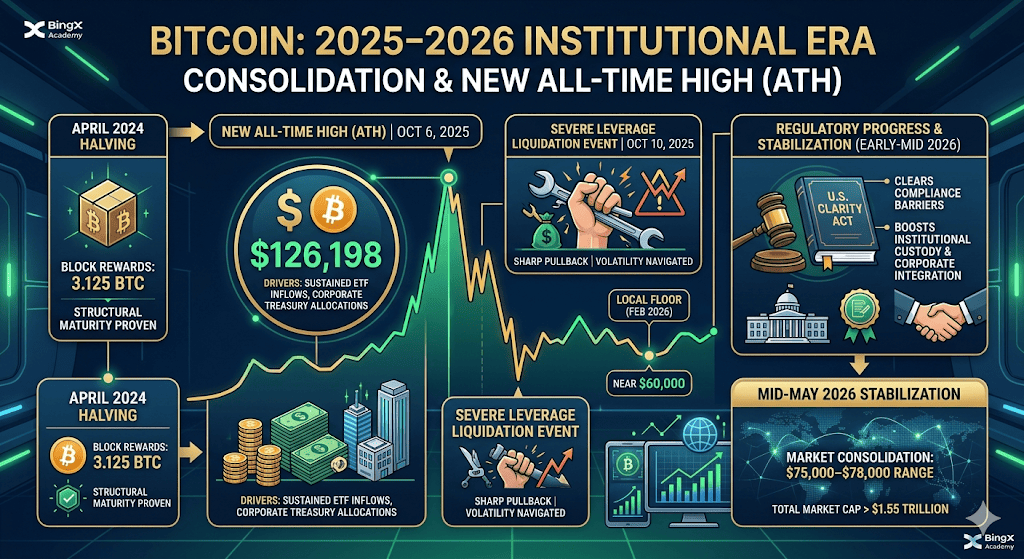
The period between mid-2025 and May 2026 put Bitcoin's structural maturity on full display, tracking a classic post-halving market cycle. Following the April 2024 halving, which dropped block rewards to 3.125 BTC, sustained ETF inflows and corporate balance sheet allocations pushed Bitcoin to an all-time high of approximately $126,198 on October 6, 2025.
True to its volatile history, a severe leverage liquidation event on October 10, 2025, caused a sharp pullback. Entering early 2026, the market navigated further volatility, finding a local floor near $60,000 in February before recovering. Significant regulatory progress, highlighted by the introduction of the CLARITY Act in the United States, helped clear compliance barriers for institutional custody and corporate integration.
As of mid-May 2026, the market has stabilized, with Bitcoin consolidating steadily in the $75,000–$78,000 range and maintaining a total market cap of over $1.55 trillion.
One-Year Outlook: What Could BTC Price Be By Bitcoin Pizza Day 2027?
As the market gears up for the 12 months leading to Bitcoin Pizza Day on May 22, 2027, macro analysts point to several pivotal drivers likely to dictate price performance.
Top 5 Drivers Supporting an Uptrend in Bitcoin in 2026-27
- Corporate and Sovereign Treasury Inflows: Corporate treasury holdings have scaled to roughly 1.33 million BTC globally. Continuous buying strategies alongside potential shifts by sovereign wealth funds or state strategic reserves represent a significant supply-sink.
- Regulatory Clarity: Full implementation of bills like the CLARITY Act alongside evolving MiCA frameworks in Europe will likely de-risk the asset class for risk-averse institutional allocation.
- Ecosystem Scalability: Technical progress on BTC Layer 2 scaling protocols like the Lightning Network continues to expand Bitcoin's actual utility for global micropayments.
- The Rise of BTCFi (Bitcoin DeFi): The rapid growth of BTCFi protocols is transforming Bitcoin from a passive, dormant store of value into a capital-efficient, yield-bearing financial asset. Rather than leaving holdings inactive in cold storage, users can leverage Layer 2 solutions like Stacks and Merlin Chain or self-custodial protocols like Babylon to lend, borrow, and stake native BTC directly. This unlocking of multi-billion dollar sleeping liquidity creates a powerful incentive for long-term holding and drastically reduces the liquid market supply of BTC.
- Macroeconomic Frameworks: Bitcoin remains sensitive to global liquidity conditions, interest rate shifts, and concerns regarding fiat debasement, reinforcing its narrative as digital gold.
Read more: Bitcoin Post-Halving Cycle: Will BTC Enter a Bull Market or Face a Bear Market Reset in 2026?
Analyst Consensus and the BTC to $1 Million Target
Market forecasts for the next year exhibit a wide spread. Conservative models target a consolidation floor between $60,000 and $110,000, assuming range-bound accumulation. Base-to-moderate consensus estimates from prominent investment banks cluster between $100,000 and $200,000, driven by steady ETF accumulation. Highly bullish outlooks from institutions like Bernstein project cycle-peak targets near $200,000 to $300,000 by late 2027.
Long-term structural bulls, including prominent figures like Arthur Hayes, maintain optimistic targets that see hyper-liquidity and systemic fiat devaluation driving Bitcoin toward $750,000 and eventually the $1,000,000 mark over an extended time horizon. These ultimate milestones rely on complete global sovereign adoption and structural disruptions to traditional banking systems.
Read more: Will Bitcoin Cross $1 Million? BTC Price Prediction Explained in 2026
Final Thoughts: Bitcoin's Evolution Since Pizza Day Toward Digital Scarcity
Fourteen years after Laszlo Hanyecz spent 10,000 Bitcoin on dinner, the foundational premise of Bitcoin has shifted from testing its operational validity to managing its integration into global finance. With circulating supply surpassing 20.03 million BTC out of its programmatic maximum of 21 million, the reality of absolute digital scarcity is becoming an immediate factor for institutions and market participants alike. Growth is no longer driven by speculative internet forum posts, but by programmatic halving cycles, corporate treasury mandates, and regulated spot market exchange-traded funds.
Looking ahead, the long-term viability of the network will depend on balancing institutional capital consolidation with active utility and decentralized network security. While structural demand and clear policy guidelines provide a sturdier market floor than seen in previous retail cycles, participants must remain aware of underlying risks. Macroeconomic shocks, swift shifts in global monetary policies, security vulnerabilities, or unforeseen regulatory adjustments can generate sudden drawdowns. Market participants should utilize robust risk management frameworks, evaluate their individual risk thresholds, and conduct comprehensive due diligence when interacting with highly volatile digital asset markets.
Related Reading
- Will Bitcoin Cross $1 Million? BTC Price Prediction Explained in 2026
- Bitcoin Post-Halving Cycle: Will BTC Enter a Bull Market or Face a Bear Market Reset in 2026?
- Who Owns the Most Bitcoin in 2026? Top 10 BTC Rich List Revealed
- What Are the Top 10 Bitcoin Treasury Companies of 2026: Institutional BTC HODLers
- What Are the Top BTCFi (Bitcoin DeFi) Projects in 2026?
