

Cap Protocol (CAP) is an advanced, multi-sided institutional credit and programmable financial guarantee network purpose-built on the Ethereum blockchain. By introducing a decentralized covered credit marketplace, Cap acts as a neutral money layer that aggregates regulated dollar-denominated reserves, such as USDC, USDT, pyUSD, and tokenized real-world assets (RWAs), to mint its native stablecoin, cUSD, and its yield-bearing counterpart, stcUSD. Supported by strategic institutional backers like Franklin Templeton, Cap uniquely shields retail stablecoin depositors from defaults by shifting all risk to professional underwriters operating through Shared Security Networks (SSNs) like Symbiotic and EigenLayer.
As the decentralized finance (DeFi) landscape matures into a multi-billion-dollar economy, its structural yield mechanics remain fundamentally circular. The vast majority of crypto-native stablecoin yield relies heavily on speculative, highly correlated activities: continuous leveraging on perpetual exchanges, basis trading, and inflationary governance token handouts. When crypto markets encounter broader macroeconomic headwinds or deep drawdowns, these localized yield pools compress rapidly, exposing capital allocators to massive volatility and unpredictable smart contract vulnerabilities.
Conversely, the massive multi-trillion-dollar traditional private credit market operates efficiently but remains entirely cloaked behind opaque corporate reporting, manual off-chain oversight, and severe geographical gatekeeping. Legacy credit originators rarely hold the risk of the loans they originate, introducing a classic principal-agent misalignment where protocol growth is routinely prioritized over credit quality.
Cap Protocol directly bridges this gap. Built as an open, decentralized execution layer, Cap structures the entire institutional credit lifecycle directly on-chain. It separates the distinct functions of lending, borrowing, and underwriting through trustless smart contracts, enabling users to capture non-inflationary, real-world credit spreads with programmatic, verifiable downside protection.
What Is Cap Protocol (CAP)?
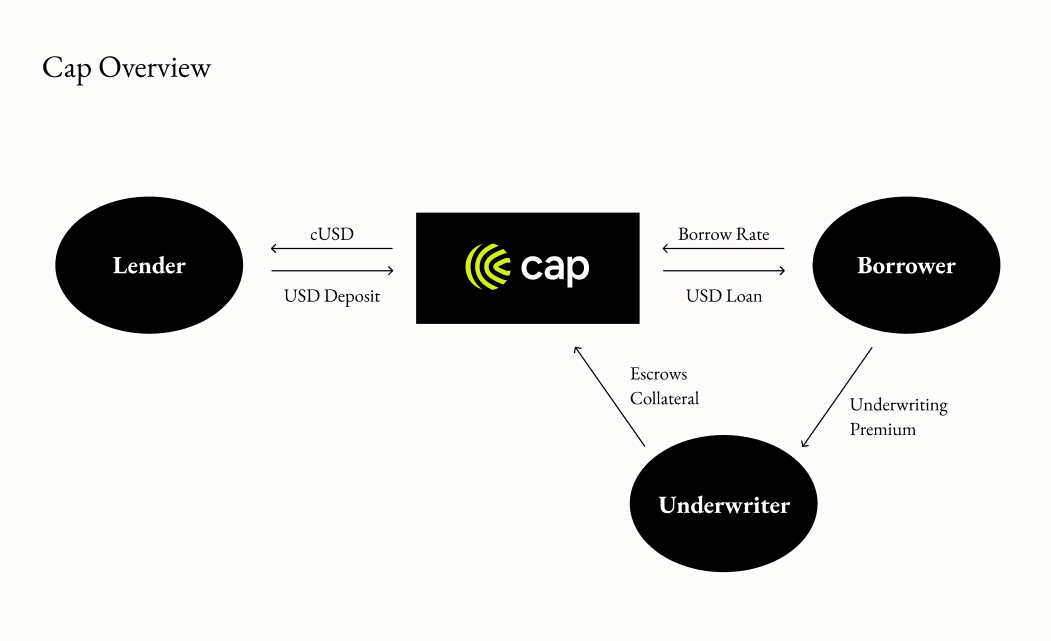
An overview of Cap Protocol | Source: Cap docs
Cap Protocol is a decentralized finance framework engineered to host, secure, and run a capital-efficient credit marketplace backed by automated financial guarantees. Conceived to dismantle the systemic flaws governing modern digital asset lending, Cap targets three fundamental structural boundaries within the current on-chain credit ecosystem:
- The Principal-Agent Realignment: In legacy credit architectures, originators are incentivized by throughput rather than portfolio longevity. Cap resolves this by introducing an open marketplace of independent Underwriters who must escrow their own capital to backstop specific loans. This ensures honest underwriting becomes the mathematically dominant strategy.
- Complete Portfolio Transparency: Traditional private credit portfolios are typically priced manually by the same managers who originated them, leaving lenders blind until a default occurs. Cap forces every collateral position, loan health factor, and borrower exposure to update transparently on-chain, allowing any participant to audit risk mitigation in real time.
- The Mitigation of Contagion Risk: Standard DeFi lending pools pool all assets together, meaning a singular bad debt event can cascade to compromise the entire protocol. Cap enforces strict isolated credit lines where each Underwriter-Borrower pair operates as an independent node, successfully preventing systemic contagion across stcUSD holders.
How Does Cap Protocol Work?
The Cap architecture completely bypasses the typical pooled-liquidity vulnerabilities of DeFi by establishing an end-to-end, horizontally scalable transaction and fund routing loop. The system manages capital via two primary products: cUSD, the core transactional digital dollar, and stcUSD, the savings vault.
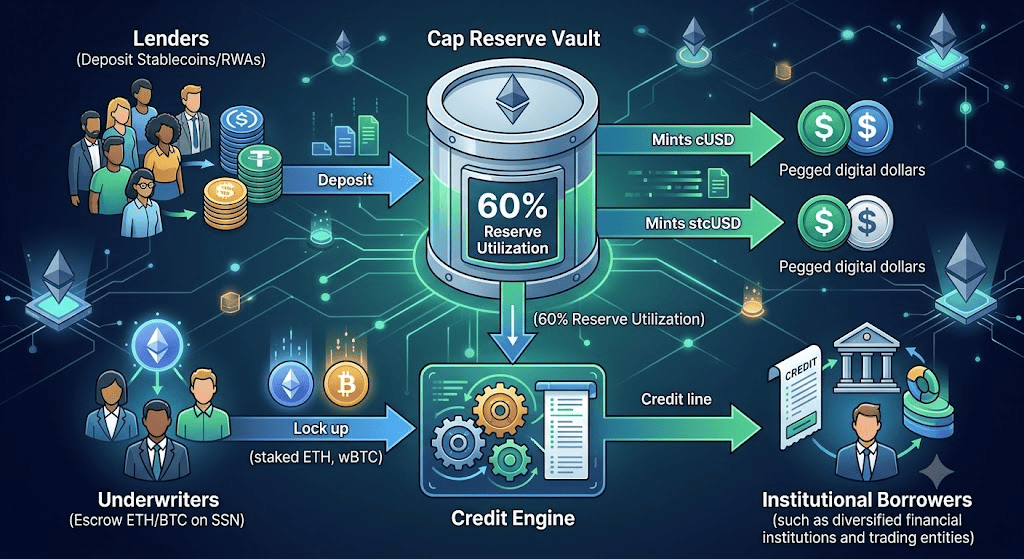
When an institutional borrower draws liquidity or an allocator deposits assets, funds traverse a tightly integrated on-chain workflow across four core actors:
1. Reserve Assembly and Fractional Buffering
Lenders seed the protocol by depositing whitelisted reserve assets into the Cap Reserve Vault, minting cUSD at a base value. To maximize efficiency without compromising user liquidity, Cap utilizes a Fractional Reserve framework automated by Gelato. Idle assets inside the vault are automatically deployed into hyper-liquid external ecosystems like Aave V3 or Morpho to establish a robust baseline yield, while maintaining a dedicated buffer to handle user redemptions instantly.
2. Underwriter Escrow via Shared Security Networks
To access liquidity from the Cap Reserve, an institutional borrower, such as a blue-chip trading firm like Susquehanna or Flow Traders, cannot simply post its own volatile collateral. Instead, the borrower must source economic guarantees from an independent Underwriter.
Underwriters leverage Shared Security Networks (SSNs) like Symbiotic or EigenLayer to lock up alternative assets, such as staked ETH (wstETH), Bitcoin (wBTC), or tokenized gold (XAUm), as a performance bond. Each Symbiotic Vault or EigenLayer Operator Set is strictly bound to one unique borrower address, isolating counterparty risk completely.
3. Credit Drawdown and Interest Hurdling
Once active coverage is live on the SSN middleware, the Credit Engine calculates the borrower's maximum borrowing capacity based on the Underwriter's effective stake and a conservative, asset-specific Loan-to-Value (LTV) ratio, typically initialized at 50%. The borrower then draws stablecoin liquidity directly from the Cap Reserve.
The interest rate paid by the borrower is a composite function designed to reflect true market opportunity costs:
Borrow Rate = Minimum Rate + Utilization Rate + Underwriting Premium
The Minimum Rate selects the maximum value between a protocol floor and external market reference rates, e.g., Aave USDC supply rates, ensuring the protocol never lends capital below its organic opportunity cost. The Utilization Rate scales sharply via a piecewise linear function if reserve utilization crosses a target 90% threshold, while the Underwriting Premium is a fixed rate negotiated bilaterally between the Underwriter and the Borrower to reward the risk-taker.
4. Dynamic Dutch Auction Liquidations
If a borrower executes an underperforming strategy or the dollar value of the Underwriter’s escrowed crypto assets drops significantly, the position's Health Factor will degrade. The health metric is governed strictly by the following logic:
Health Factor = Total DebtTotal Delegation × Liquidation Threshold
A liquidation event is triggered autonomously the moment the Health Factor drops below 1, typically correlating to an 80% LTV. After a standard 12-hour grace period, which is bypassed instantly under emergency conditions if the LTV breaches 90%, the protocol initiates a permissionless reverse Dutch auction.
Liquidators step in to repay the borrower's outstanding debt using standard stablecoins. In exchange, they receive the Underwriter’s restaked collateral at a sliding bonus cap of up to 10%. The recovered assets are fed directly back into the Cap Reserve Vault, keeping cUSD 1:1 backed at all times and insulating stablecoin savers from loss.
Cap Protocol vs. Alternative Capital Providers: Key Differences
|
Feature |
Cap Protocol (CAP) |
Ethena (USDe) |
Sky (USDS / DAI) |
Centralized Private Credit |
|
Yield Origin |
Institutional Credit Spreads |
Delta-Neutral Funding Rates |
Real-World Assets & Crypto Loans |
Offline Corporate Lending |
|
Risk Architecture |
Sharded Underwriter Collateral |
Centralized Exchange Hedging |
Pooled Overcollateralization |
Opaque Balance Sheet Trust |
|
Default Protection |
100% Slashed First-Loss Buffer |
Insurance Fund Backstop |
Protocol Inflation Minting |
Complex Legal Recourse |
|
Capital Efficiency |
High (Unfunded Crypto Backing) |
High (Synthetic Tracking) |
Low (Overcollateralized Loans) |
Variable / High Friction |
|
Infrastructure Layer |
SSN Middleware (Symbiotic/Eigen) |
Centralized Exchange APIs |
Native L1/L2 Governance |
Legacy Banking Rails |
The tokenized stablecoin yield landscape has shifted dramatically, moving from standard overcollateralized lending pools to highly complex risk-isolated frameworks. Cap Protocol isolates itself from competitors like Ethena and Sky Protocol by functioning as a decentralized credit marketplace that decouples user capital from institutional default risk.
While Ethena relies heavily on centralized exchange APIs to manage delta-neutral funding risk, and Sky aggregates diversified RWA and crypto collateral under a unified protocol governance, Cap delegates institutional underwriting directly to Shared Security Networks (SSNs) like Symbiotic and EigenLayer. This infrastructure layer creates a multi-sided ecosystem where underwriters must escrow their own alternative digital assets like ETH or wBTC behind individual borrowers. This effectively realigns incentives by absorbing first-loss defaults up to 100% via smart contract slashing before stablecoin depositors ever face principal drawdowns.
From an operational efficiency standpoint, Cap Protocol structures a capital-efficient environment that eliminates the steep overcollateralization constraints native to older DeFi models like Sky.() By utilizing unfunded crypto backing via restaked assets, Cap allows institutional entities to draw capital-efficient liquidity against isolated lines of credit while maintaining high resource utilization, as evidenced by its 60% reserve utilization rate driving organic annual yields of 5–7% on cUSD.
Traditional corporate private credit features opaque balance sheet valuation and complex legal collection procedures that introduce high transaction friction. In contrast, Cap programmatically automates defaults via continuous health factor calculations. If a borrower breaks risk thresholds, a permissionless, descending-price Dutch auction immediately uniwinds the underwriter's SSN collateral, liquidating assets to ensure cUSD remains fully backed 1:1 on-chain.
Deep Dive: The Mathematics of Excess Value
The true economic engine driving Cap Protocol is the capture of the yield differential between uncorrelated asset classes without triggering tax-inefficient asset liquidations. This surplus is mathematically isolated as Excess Value:
Excess Value = USD Unsecured Borrow Rate + Alternative Asset Native Yield − USD Risk-Free Rate − Alternative Asset Unsecured Lending Rate
To visualize this on-chain mechanism, consider a live 100M USD revolving facility issued to an institution, backed by $200 million of restaked ETH collateral (200% overcollateralization). Assume a macroeconomic landscape featuring a 10% institutional USD borrow rate, a 4% risk-free rate, an alternative asset landing cost of 4%, and an underlying Proof-of-Stake (PoS) native execution yield of 3%:
On-Chain Cashflow Routing Loop
- Gross Institutional Inflow: $10 million generated annually from the Borrower.
- Lender Yield Allocation: $4 million funneled directly to stcUSD holders, satisfying the 4% risk-free floor on the active principal.
- Underwriter Minimum Floor: $2 million directed to the staking vault, covering the 4% target opportunity cost on the $200 million collateral, offset by the native 3% PoS yield running concurrently.
- Net Excess Capital Surplus: The remaining $4 million is classified as unencumbered Excess Value, programmatically split between stcUSD holders and Underwriting premiums via real-time market discovery.
What Is Cap (CAP) Tokenomics?
The entire structural framework of the Covered Agents Protocol is managed and secured by its native ERC-20 utility asset, CAP.
CAP Token Utility Matrix
- Granular Protocol Governance: CAP holders maintain absolute voting power over core risk configurations. This includes whitelisting specific institutional borrowers, adjusting the asset allocation matrix inside the cUSD Peg Stability Module, modifying liquidation parameters, and onboarding novel collateral assets, such as Matrixdock’s XAUm tokenized gold.
- Discretionary Treasury Buybacks: Protocol fees generated via minting/burning parameters and excess interest spreads flow into the protocol treasury. These funds are programmatically deployed to execute discretionary market buybacks of CAP, continually aligning long-term token value with protocol utilization.
- Surety Coverage Limits: Governance utilizes the token to regulate maximum exposure thresholds for financial guarantee markets, acting as an administrative circuit breaker to manage multi-network safety.
CAP Token Distribution
Cap maintains a strictly hardcapped maximum supply of 10,000,000,000 (10 Billion) CAP tokens. The circulation architecture is designed around long-term stakeholder retention, utilizing a standard 12-month cliff system to control market dilution.
- Ecosystem and Community (47.37%): Allocated to sustain long-term liquidity incentives, bootstrap early active delegators through programs like Homestead, and fund retroactive builder grants.
- Private Investors & Strategic Backers (≤20.00%): Distributed to early financial backers, including institutional leaders like Franklin Templeton and Triton Capital, subject to a 1-year lockup and subsequent 3-year linear monthly vesting.
- Project Core Team (≤20.00%): Cordoned off for protocol engineers and founders under matching institutional vesting schedules.
- Public Sale / ICO (5.00%): Assigned for public distribution, intentionally delayed during market pullbacks to protect community capitalization.
- Strategic Private TVL & Community Pools (7.63%): Encompasses allocations for dedicated private TVL agreements (3.75%) and the early Echo community sale (3.28%).
How to Trade Cap (CAP) on BingX
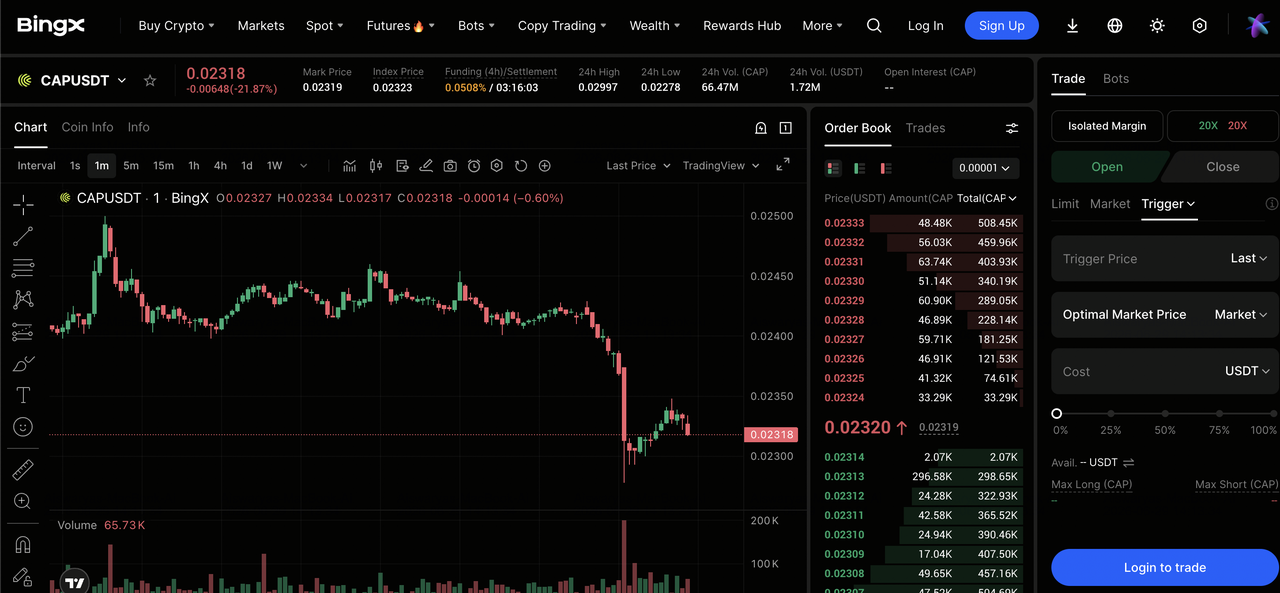
CAP/USDT perpetual contract on BingX futures market
Leveraging the sophisticated BingX advanced derivatives ecosystem, you can optimize capital efficiency by trading native Cap Protocol liquidity distributions with institutional-grade risk parameters. Follow this structural execution path to trade the CAP/USDT Perpetual Futures contract:
- Access the Futures Derivative Suite: Log into your verified BingX account, hover over the Futures navigation header, click Perpetual Futures, and input CAP into the contract search index to instantly synchronize your interface with the active perpetual market layout.
- Capitalization and Collateral Routing: Ensure your primary Perpetual Futures wallet holds an adequate margin allocation of Tether (USDT). If your liquidity is currently positioned in alternative ledgers, such as your Funding or Spot accounts, perform an instantaneous, zero-fee internal transfer to route funds directly into your Futures account.
- Configure Margin and Leverage Mechanics: Select your cross-network risk preference by toggling your margin mode. Choose Isolated Margin to confine your liquidation risk strictly to the individual trade, or choose Cross Margin to utilize your entire account equity to backstop the position. Adjust your desired leverage multiplier using the slider tool, ensuring your configuration respects volatile market conditions.
- Define Position Parameters and Execute: Navigate to the transaction console on the right hand of your interface. Choose a Limit Order to establish a precise manual entry price target, or select a Market Order to fill your position immediately at the best available order-book depth. Specify your total position size, hardcode your defensive Take-Profit (TP) and Stop-Loss (SL) thresholds to guard against unexpected downside, and select Buy/Long to speculate on upward price momentum, or Sell/Short to capture short-term down-trends.
5 Critical Considerations Before Investing in Cap Protocol (CAP)
Prior to committing liquidity to CAP, cUSD minting vaults, or configuring an institutional underwriting node, meticulously review these operational risk factors:
- Platform Dependency and Shared Security Risk: Cap's automated liquidation and slashing mechanics are deeply integrated with external restaking protocols like Symbiotic and EigenLayer. Any core architectural bug or protocol-level pause within those platforms will directly impact Cap’s financial guarantee enforcement.
- The Volatility of Delegation Collateral: Underwriters frequently employ volatile assets like ETH or liquid staking tokens (LSTs) to back stablecoin facilities. Sudden, massive market drawdowns can compress the dollar value of these assets faster than the Dutch auction can clear, potentially introducing short-term asset mismatch risk to the cUSD reserve.
- Institutional Withdrawal Lockups: To respect the epoch models of underlying shared security frameworks, unwinding an Underwriter delegation inside a Symbiotic vault requires up to two full epochs, roughly 8 to 14 days. During this exit window, the capital remains entirely exposed to borrower slashing events.
- Oracle Dependency and Price Delays: The calculations governing dynamic mint/burn fees and LTV health metrics rely heavily on continuous price feeds from RedStone and Chainlink. If an underlying oracle network experiences extreme latency or data corruption, core minting and redeeming functions are automatically paused by the smart contracts.
- Regulatory Exposure of Backing Reserves: Unlike entirely algorithmic synthetic dollars, cUSD is backed directly by real-world, regulated digital cash instruments like USDC, pyUSD, and tokenized money market funds. This exposes the protocol to compliance parameters, asset-freezing risks, or structural alterations instituted by third-party centralized issuers.
Final Thoughts: Is Cap Protocol a Good Investment?
Cap Protocol marks an important structural shift in decentralized finance, transitioning stablecoin yields away from unstable, circular token economies toward real-world institutional private credit spreads. By offloading capital risk to professional underwriters through Symbiotic and EigenLayer, Cap successfully isolates retail depositors from default losses while driving capital utilization toward an impressive 60%.
Ultimately, the long-term enterprise valuation of the CAP token relies on the continuous growth of its total value locked, the ongoing expansion of its institutional borrower pipeline, and the successful integration of alternative RWA collateral formats like tokenized gold and money market assets.
Risk Reminder: Engaging with decentralized credit engines, multi-layered restaking infrastructures, and volatile utility tokens involves substantial technological, structural, and capital risks. Always protect your Web3 credentials, closely monitor protocol health metrics, and conduct comprehensive personal research before deploying funds. BingX bears no liability for external smart contract execution parameters or independent market trading outcomes.
Related Reading
- Everything You Need to Know About PayPal USD (PYUSD): A Beginner's Guide (2026)
- Best Crypto Neobanks and Crypto-Friendly Banks for 2026
- What Are the Top 10 DeFi Lending Protocols to Watch in 2026?
- What Is Aave (AAVE) Crypto Lending: All You Need to Know in 2026
- What Are the Top 10 Ways to Earn Passive Income from Crypto in 2026?
