
Since its inception in 2016, Cosmos (ATOM) has carved out a pivotal position in the digital asset landscape by pioneering the concept of sovereign interoperability. Over the years, its market performance has mirrored the volatile cycles of the broader crypto market, reaching historical highs near $44.45 in 2021 before entering deep, structural drawdowns. In June 2026, ATOM maintains a steady capitalization with a market cap hovering around $813 million and an active circulating supply of 516.05 million tokens, establishing its rank firmly within the top 100 global digital assets.
In 2026, the structural value of the Cosmos network is defined by its massive ecosystem footprint rather than individual chain TVL alone. While the core Cosmos Hub ledger operates with a lean Total Value Locked (TVL) due to its primary design as a security router rather than a generic DeFi platform, the broader Interchain network represents a juggernaut of on-chain activity. Cosmos SDK-based and IBC-enabled platforms command billions in aggregate ecosystem assets, highlighted by dominant chains like Provenance with a $1.34 billion TVL, Cronos's $259 million TVL, and dYdX's $98 million TVL. As Cosmos deploys its aggressive 2026 technical roadmap, aiming for 5,000 TPS, 500ms block times, and native enterprise Proof-of-Authority frameworks, it has solidified its role as an indispensable foundational layer for the multi-chain Web3 economy.
This article explores the inner workings of the Cosmos ecosystem, breaks down its innovative architectural framework, and highlights key factors to monitor as its new tokenomics model rolls out. Furthermore, we provide direct, step-by-step guidance on how to securely buy, sell, and trade Cosmos (ATOM) on the BingX platform using both spot and perpetual futures markets.
What Is Cosmos (ATOM)? Understanding the Internet of Blockchains
The early eras of decentralized technology introduced a foundational systemic flaw: blockchain fragmentation. Legacy networks like Bitcoin and Ethereum operate as independent data silos. A smart contract on Ethereum cannot natively read a transaction on Bitcoin; assets cannot move across these borders without traversing complex, high-risk third-party bridges. This lack of communication forces networks to compete for the same global state, leading to extreme congestion, skyrocketing transaction fees, and a fractured user experience.
Cosmos delivers a radical alternative to this isolated structure. Often hailed as the "Internet of Blockchains," Cosmos is a decentralized ecosystem of independent, parallel, and autonomous blockchains. Instead of forcing every application to deploy on a single crowded highway, Cosmos provides a modular toolkit that empowers developers to build their own custom, sovereign blockchains. Most importantly, these networks do not operate in a vacuum - they communicate, trade, and transfer data seamlessly via an open-source messaging framework, turning a fragmented crypto landscape into a unified, collaborative economy.
The Layer 0 Thesis: How Hubs and Zones Work on Cosmos
To understand how Cosmos redefines scalability, you must look at its Hub-and-Spoke architectural model. While traditional networks act as Layer-1 execution lines, Cosmos positions itself as a Layer-0 infrastructure layer. It acts as an underlying foundational web that coordinates independent chains rather than executing every smart contract itself.
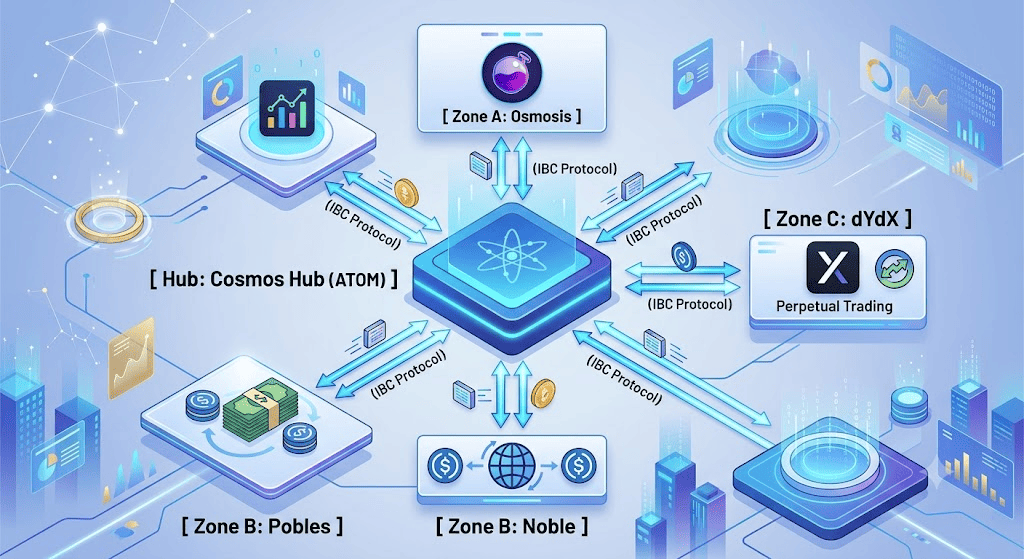
The Anatomy of Hubs and Zones
- Zones (The Spokes): Zones are application-specific, sovereign blockchains built to execute specialized tasks, e.g., decentralized finance, privacy-centric data, or gaming. Each Zone maintains its own unique state, manages its own transaction ledger, and is secured by its own independent set of validators.
- Hubs (The Routers): Hubs are central blockchains designed specifically to connect the independent Zones. Instead of forcing every individual Zone to establish a direct pipeline to every other network, which would trigger an unsustainable web of thousands of connections, Zones connect directly to a centralized Hub. The Hub acts as a trust-minimized router, tracking token balances and securing cross-chain transfers.
The Power Triple Threat: CometBFT, Cosmos SDK, and IBC
This Layer 0 topology operates smoothly thanks to three core technologies engineered by Cosmos Labs:
- CometBFT Consensus Engine: Formerly known as Tendermint Core, CometBFT is a high-performance Byzantine Fault-Tolerant (BFT) Proof-of-Stake consensus engine. It handles the networking and consensus layers automatically, providing instant transaction finality (settlement in under 3 seconds) and massive throughput capability exceeding 10,000 transactions per second (TPS) under optimal conditions.
- The Cosmos SDK Blueprint Layer: Think of the Cosmos SDK as the WordPress of blockchains. It is a highly customizable, modular framework that allows developers to snap together pre-built blockchain modules, such as governance, staking, or banking, or write custom business logic without constructing a consensus engine from scratch.
- The Inter-Blockchain Communication Protocol (IBC): IBC is the crown jewel of the Cosmos stack, the literal TCP/IP protocol for blockchains. It establishes point-to-point, light-client-verified communication links between networks. It allows independent chains to securely pass tokens, messages, and arbitrary data packages back and forth without relying on central authorities or wrapped asset vendors.
ATOM vs. Cosmos: Distinguishing the Token from the Network
A frequent point of confusion for beginners is separating Cosmos from ATOM. They are not interchangeable terms.
Cosmos is the holistic, open-source multi-chain ecosystem encompassing hundreds of connected blockchains, developer toolkits, and interoperability protocols.
ATOM is the native utility and governance token of the very first blockchain built on this network: The Cosmos Hub.
Unlike Ethereum or Solana, where a single native token is required to pay for gas fees across every app deployed on the network, ATOM does not automatically secure or dictate fees for the entire Cosmos ecosystem. Each independent Zone features its own native token and economic system. ATOM functions explicitly as the lifeblood of the central Cosmos Hub ledger.
What Is ATOM Tokenomics: A Look at the 2026 Shift
Historically, ATOM relied on a dynamic inflation mechanism, ranging from 7% to 20%, designed to heavily reward stakers and maintain a target network security bonding ratio of 67%. However, to address community concerns regarding dilution and sell pressure, Cosmos Labs launched a landmark Tokenomics Redesign initiative.
This structural overhaul transitions ATOM away from aggressive inflationary minting towards a sustainable, fee-driven model. The core economic mechanics are structured below:
- Network Security and Staking: Holders lock their ATOM tokens with validators to actively secure the Cosmos Hub. Under the scheduled 2026 economic reforms, base inflation bands are designed to narrow to 2–6%, introducing lock-based staking options, spanning 3, 6, and 12 months, that offer custom multiplier rewards to incentivize long-term builders.
- Governance Sovereignty: Holding ATOM grants direct protocol voting rights within the ecosystem. Token holders use this weight to actively vote on core software upgrades, treasury deployments, and key strategic directives, such as the creation of the Hub's new native enterprise liquidity layer.
- Ecosystem Value Capture: Rather than relying purely on circular network inflation, the Cosmos Hub is shifting toward sustainable value accrual by integrating an enterprise order book DEX and native liquidity layer. This infrastructure is designed to capture transaction taker fees, cross-chain routing revenues, and programmatic asset buybacks to directly benefit ATOM holders.
Cosmos's Real-World Utility: How Top Chains Like Osmosis and dYdX Fit In
The true genius of the Cosmos thesis is proven by the prominent, heavy-hitting networks that utilize its infrastructure. By giving apps their own sovereign app-chains instead of forcing them into shared execution constraints, Cosmos hosts some of the largest specialized primitives in Web3.
- Osmosis (OSMO): The premier decentralized exchange (DEX) and automated market maker (AMM) of the Interchain. Osmosis acts as the primary hub of cross-chain liquidity, executing billions in volume by connecting asset pools across dozens of separate IBC-enabled networks.
- dYdX Chain (DYDX): Originally deployed as a Layer-2 network on Ethereum, the world’s largest decentralized perpetual exchange migrated completely to its own standalone Cosmos app-chain. By using custom block structures and a custom off-chain order book powered by CometBFT, dYdX achieved the sub-second execution speeds and zero-gas trading mechanics required for institutional-grade derivative trading.
- Noble: A specialized asset issuance chain inside Cosmos. Noble functions as the native home for institutional-grade collateralized assets, allowing global issuers like Circle to mint native USDC directly into the Interchain, where it can propagate instantly across all IBC zones.
- Mantra (OM): A security-first, compliance-centric Real World Asset (RWA) blockchain. Mantra utilizes the modular Cosmos SDK to build regulatory-friendly frameworks, allowing institutional players to tokenize traditional capital market products like real estate, debt, and commodities safely.
Here are the two new sections tailored precisely to the layout, tone, and formatting of the article:
How to Trade Cosmos (ATOM) on BingX
Leveraging the sophisticated BingX AI-driven derivatives and spot ecosystem, you can optimize capital efficiency by trading native ATOM liquidity distributions with institutional-grade tools.
Buy, Sell, or HODL ATOM in the Spot Market
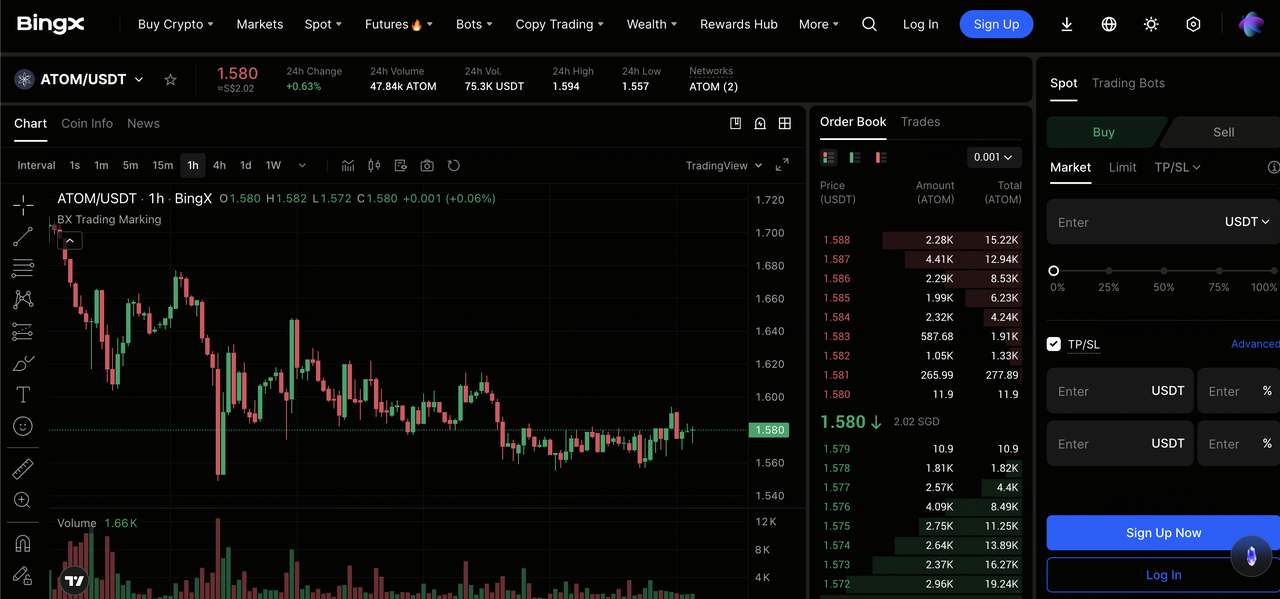
ATOM/USDT trading pair on BingX spot market
- Access the Spot Market: Log into your verified BingX account, hover over the Spot navigation header, and click Spot to access the digital asset matching engine.
- Locate the Trading Pair: Input ATOM into the upper-left asset search bar and select the ATOM/USDT spot trading pair to synchronize your charting interface.
- Execute Your Order: Navigate to the transaction execution module, choose between a Limit Order for a manual entry target or a Market Order to buy immediately at the current order-book depth, input your desired purchase amount, and click Buy ATOM.
Long or Short ATOM Perpetuals with Leverage in Futures Trading
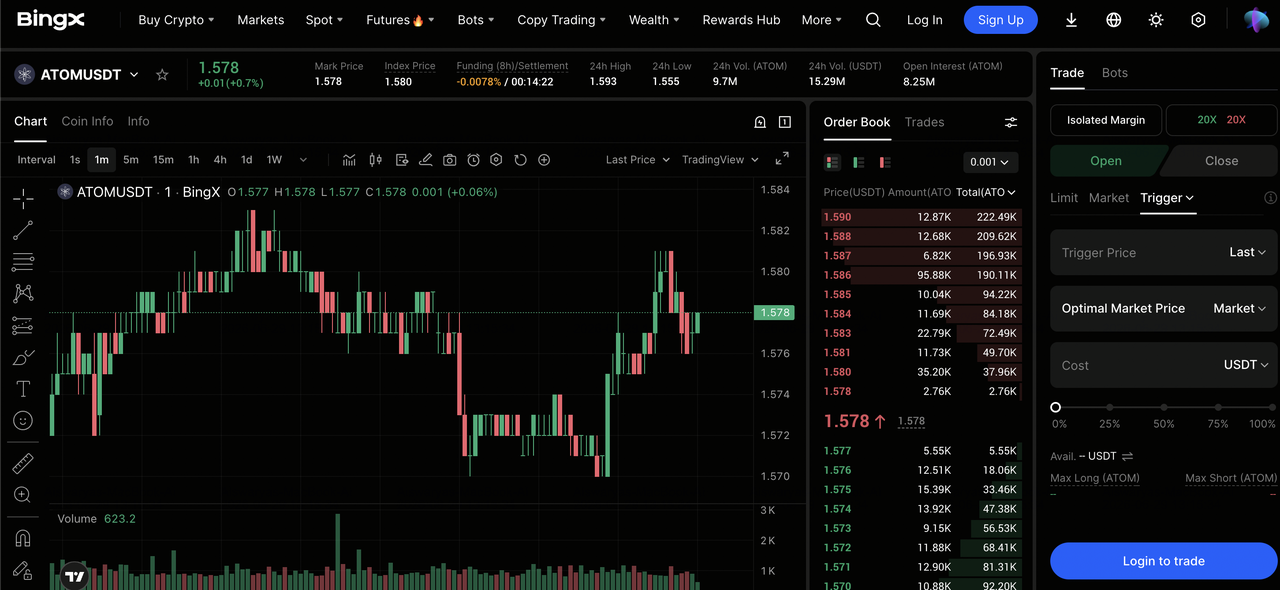
ATOM/USDT perpetual contract on BingX futures market
- Open the Derivatives Suite: Hover over the Futures navigation header and select Perpetual Futures, then search for ATOM/USDT perpetual contract to activate the leveraged trading console.
- Configure Risk and Leverage: Toggle your preferred margin mode between Isolated Margin, limiting risk strictly to the individual trade, and Cross Margin, utilizing total account equity, then adjust your leverage multiplier using the slider tool.
- Place and Guard Your Position: Select either a Limit or Market entry order type, define your position size, input hardcoded Take-Profit (TP) and Stop-Loss (SL) risk protocols, and click Buy/Long to capture upward price momentum or Sell/Short to profit from market corrections.
5 Critical Considerations Before Investing in Cosmos (ATOM) in 2026
Before allocating investment capital to ATOM or committing assets to long-term staking pools, evaluate these operational macro risk parameters carefully:
- Execution Risk of the Economic Overhaul: The shift from high dynamic inflation to a tight 2–6% fee-driven model relies entirely on community governance approval and successful technical deployment. If revenue generation from the Hub's new order book DEX falls short of expectations, it could alter the projected value-accrual runway.
- Ecosystem Bridge and Contract Vulnerabilities: While the core Cosmos Hub infrastructure remains highly secure, high-profile exploits on connected zones, such as the $4.67 million Secret Network bridge hack in June 2026, can damage broader market sentiment and spill over to negatively impact ATOM's price action.
- Intense Modular Infrastructure Competition: The Layer-0 interchain landscape faces aggressive competition from evolving modular networks and emerging Ethereum Layer-2 frameworks. Cosmos must continuously accelerate its front-end adoption to maintain its market share against alternative scalability stacks.
- Staking Illiquidity and Lock Tiers: The introduction of tiered multiplier rewards requires locking tokens for 3, 6, or 12 months to maximize yield efficiency. Investors must balance the appeal of double-digit staking yields against the risk of capital lockups during periods of intense market volatility.
- Broader Macro and Sentiment Correlations: Despite steady codebase updates and infrastructure expansion, ATOM remains tightly correlated with macro crypto market cycles. Sudden shifts in global liquidity conditions can lead to severe near-term price swings regardless of underlying ecosystem milestones.
Conclusion: Why Interoperability Is the Final Frontier for Web3
The multi-chain thesis is no longer a hypothetical concept but is also an active, rapidly expanding reality. As the global digital asset landscape scales to accommodate institutional capital, sovereign digital currencies, and complex multi-chain applications, the industry cannot afford to remain segregated inside rigid, isolated network walls.
Cosmos provides a future-proof response to this architectural bottleneck. By choosing complete chain sovereignty backed by trust-minimized, universal communication protocols, Cosmos ensures that individual networks can protect their unique rules and scaling demands without sacrificing global access. As the Inter-Blockchain Communication (IBC) framework actively expands beyond its native borders into major networks like Solana, Ethereum Layer-2 solutions, and permissioned institutional ledgers, Cosmos’s vision of a frictionless, coordinated Internet of Blockchains positions it as a foundational layer for the future of Web3.
Risk Reminder: Engaging with blockchain protocols, decentralized interoperability layers, and native utility digital tokens involves high operational, technological, and market risks. Always protect your private keys and perform meticulous due diligence before deploying funds into staking mechanisms or active digital asset markets.
Related Reading
- How to Stake Cosmos (ATOM) and Earn Passive Rewards in 2026
- What Is Keplr Web3 Wallet and How to Set Up a Keplr Wallet?
- What Is Avalanche (AVAX) in 2026? Complete Beginner's Guide to the Subnet Powered Layer 1
- What Is Hedera (HBAR) and How Does aBFT Consensus Power the Hashgraph Ecosystem?
- The 2026 Guide to NEAR Intelligence: User-Owned AI Agents
FAQs on Cosmos (ATOM)
1. What is the difference between Cosmos and Ethereum?
Ethereum operates as a single, general-purpose blockchain where all decentralized applications (dApps) share the same execution space, computing resources, and gas fee queues, which can lead to high network congestion. Cosmos is a decentralized network of independent, application-specific blockchains or Zones that run in parallel and communicate freely via the IBC protocol, preventing congestion and preserving each app's sovereignty.
2. Does ATOM have a maximum supply cap?
No, ATOM has an infinite maximum supply. It utilizes an inflation mechanism to continuously mint new tokens to reward stakers for securing the Cosmos Hub ledger. However, the ecosystem is executing a major tokenomics overhaul to significantly lower base inflation and shift the asset toward a sustainable, fee-driven model.
3. Is the core Cosmos network safe if an individual Zone gets hacked?
Yes. Because each Zone operates as an independent blockchain with its own separate validator set and isolated smart contracts, a security exploit or contract breach on one specific Zone, such as a bridge exploit on a peripheral chain, does not compromise the security, ledger integrity, or uptime of the Cosmos Hub or other neighboring Zones.
4. How do I store and manage my Cosmos (ATOM) assets?
Cosmos assets can be stored across several popular, native non-custodial interchain wallets. Keplr and Leap are the widely preferred wallet options for the ecosystem, enabling seamless asset storage, cross-chain IBC transfers, governance voting, and native staking across more than 50 integrated Cosmos chains. Alternatively, users looking for high liquidity and immediate trading access can securely store their tokens directly on the BingX exchange wallet, which provides an institution-grade custodial infrastructure, seamless integration with localized market tools, and instant routing between spot and derivatives markets.
