
Filecoin (FIL) is a decentralized storage network built to replace parts of the centralized cloud storage market with an open, verifiable, and incentive-driven alternative. Instead of trusting a single provider like Amazon Web Services or Google Cloud with a copy of your data, Filecoin lets anyone with spare hard drive space compete to store and prove that data on-chain. Its roots go back to 2017, when Protocol Labs raised $205 million to build a storage network on top of the InterPlanetary File System (IPFS), the peer-to-peer protocol also created by Filecoin founder Juan Benet.
As AI data pipelines, enterprise archives, and Web3 applications generated more demand for verifiable, tamper-resistant storage, Filecoin expanded from a purely speculative mining story into a network trying to prove it can generate real, paid usage. The ecosystem has several key parts: Filecoin is the storage network, FIL is the token used to pay for storage, reward providers, and secure the chain, and the Filecoin Onchain Cloud is the newest layer designed to make the network usable for everyday developers. This guide explains what Filecoin is, how the network works, how FIL tokenomics function, the main risks to consider, and how to trade FIL on BingX.
What Is Filecoin (FIL)?

Filecoin (FIL) is the native token of Filecoin, a decentralized storage network built on top of IPFS and often categorized as a DePIN project. The network connects clients who need to store data with storage providers, sometimes called miners, who supply hard drive capacity and earn FIL in return. Filecoin was created by Protocol Labs, the research and development company founded by Juan Benet, and launched its mainnet on October 15, 2020, after a 2017 token sale that raised $205 million from investors.
Filecoin's original design centered on cold storage: cheap, redundant, and cryptographically verifiable, but slower to retrieve and more complex for developers to build on than traditional cloud storage. By 2026, the network had shifted its strategy toward converting years of bootstrapped storage capacity into paid, revenue-generating usage. The centerpiece of that shift is Filecoin Onchain Cloud, alongside the F3 fast-finality upgrade, which reduces finality from roughly 7.5 hours to minutes and makes Filecoin more practical for applications and payment flows.
The core idea behind Filecoin is simple: verifiable, decentralized storage should be able to compete with centralized cloud providers on cost and trust, especially for data that needs to remain provably intact over time, such as AI training sets, cultural archives, and blockchain backups. Storage providers stake FIL as collateral to prove they are storing data correctly, while the network uses cryptographic proofs to verify files without relying on a central authority. This real-world storage infrastructure is what places Filecoin within the broader DePIN sector.
Key components of the Filecoin ecosystem include:
- Filecoin network: The decentralized storage marketplace that matches client demand with provider capacity.
- FIL token: The token used to pay for storage deals, reward providers, and stake as collateral.
- Storage providers: Node operators that supply hard drive capacity and earn FIL for verified storage.
- Filecoin Onchain Cloud (FOC): The newer platform offering verifiable storage, fast retrieval, and programmable, onchain payments through the Synapse SDK.
- Protocol Labs: The research and development company behind Filecoin, IPFS, and related infrastructure.
Read More: What Are the Top 10 DePIN Crypto Projects to Know in 2026?
How Does Filecoin Network Work?
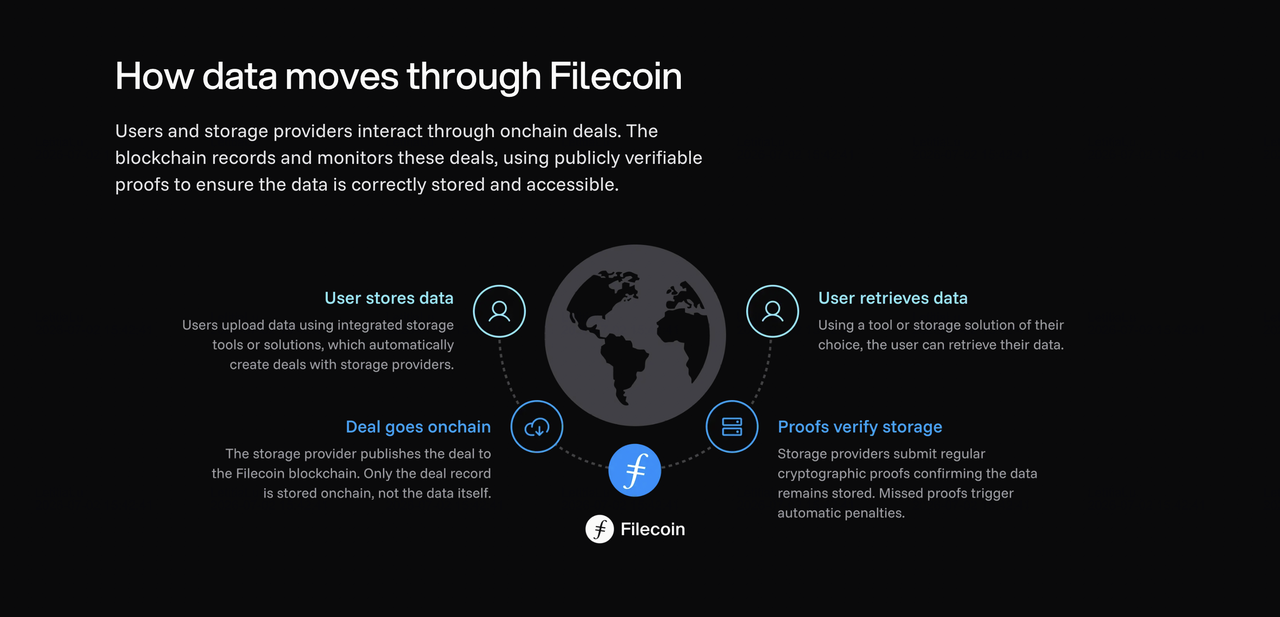
Filecoin works as a decentralized storage market. Clients pay to store data, storage providers compete to win that business and prove they are holding it correctly, and FIL moves between clients, providers, and the protocol to keep the system honest.
- Clients submit storage deals: Users, enterprises, and developers who need to store data create deals on the network, specifying price, duration, and redundancy requirements.
- Storage providers stake collateral: Providers must stake FIL as collateral before accepting a deal. This gives them an economic incentive to store data honestly, since misbehavior can result in that collateral being slashed.
- Proofs verify storage over time: Filecoin uses cryptographic proof mechanisms to repeatedly verify that providers are still storing the data they agreed to store, without needing a trusted third party to check.
- FIL is minted and distributed as block rewards: Storage providers earn newly minted FIL for participating in consensus and proving storage, in addition to the fees clients pay directly for deals.
- The Filecoin Onchain Cloud adds programmable payments: Through the Synapse SDK, developers can build applications with verifiable storage, fast retrieval, and onchain payments, including the option for clients to pay in stablecoins through Filecoin Pay rather than only in FIL.
Read More: What Is Filecoin Onchain Cloud, the Next-Generation Decentralized Cloud Launching in January 2026?
Filecoin vs. Arweave: Key Differences Between Decentralized Storage Networks
Filecoin (FIL) and Arweave (AR) are often compared because both aim to replace parts of the centralized cloud storage market with blockchain-based alternatives. However, their designs solve different problems. Filecoin is built around a flexible marketplace where clients negotiate deals with individual storage providers, while Arweave is built around permanent, one-time-payment storage through its endowment model.
|
Category |
Filecoin |
Arweave |
|
Core positioning |
Decentralized storage marketplace |
Permanent data storage |
|
Payment model |
Ongoing storage deals, collateral, and rewards |
One-time payment into a storage endowment |
|
Main technical focus |
Verifiable storage and deal flexibility |
Permanent data availability through the permaweb |
|
Ecosystem strength |
Large storage capacity, enterprise and AI data pilots |
Permanent archive and Web3 content use cases |
|
Key challenge |
Converting capacity into real paid demand |
Proving long-term storage economics can sustain permanence |
The main difference is that Filecoin treats storage as an ongoing, negotiated service, while Arweave treats storage as a permanent, prepaid commitment. For investors, the comparison comes down to use case: Filecoin is betting on flexible, enterprise-grade decentralized storage and AI data pipelines, while Arweave has stronger positioning in permanent archiving and on-chain content.
Read More: Top Decentralized Storage Crypto Projects to Know in 2026
Filecoin Ecosystem in 2026: Onchain Cloud, AI Data, and Enterprise Storage
Filecoin has evolved from a storage-mining project into a broader decentralized data infrastructure network. Its 2026 adoption story is supported by Filecoin Onchain Cloud, the F3 fast-finality upgrade, Filecoin Pay, and growing interest in verifiable storage for AI datasets, archives, blockchain backups, and Web3 applications.
|
Timeline |
Key Development |
Why It Matters |
|
2017-2020 |
Token sale and mainnet launch |
Filecoin raised $205 million in 2017 and launched its mainnet in October 2020, building a decentralized storage network on top of IPFS |
|
2025-2026 |
Filecoin Onchain Cloud rollout |
Introduced developer tools for verifiable storage, retrieval, and programmable onchain payments |
|
2026 |
F3 fast-finality upgrade |
Reduced Filecoin finality from about 7.5 hours to minutes, making the network more practical for applications and payment flows |
|
2026 |
Filecoin Pay and USDFC payment rails |
Added more flexible payment infrastructure for Filecoin Onchain Cloud services, including stablecoin-based payment options |
|
2026 |
AI and enterprise data use cases |
Positioned Filecoin for AI datasets, digital archives, blockchain backups, and other verifiable storage needs |
|
October 2026 |
Protocol Labs and Foundation vesting milestone |
The 6-year vesting schedules for Protocol Labs and Filecoin Foundation allocations approach completion, reducing one source of long-running supply overhang |
Filecoin's next challenge is proving that storage capacity can turn into sustained paid demand. The network already has large infrastructure scale, but long-term value depends on whether developers, AI data providers, enterprises, and Web3 projects use Filecoin for verifiable storage because they need the service, not only because incentives subsidize capacity.
Read More: Top AI Data Center Stocks to Buy in 2026: Cloud, Servers, and AI Compute Infrastructure
What Are the Filecoin (FIL) Tokenomics?
FIL tokenomics centers on a mining-and-rewards model rather than a fixed circulating supply. Storage providers stake FIL as collateral, earn newly minted FIL as block rewards, and the network's early fundraising vesting schedule is a major factor in near-term supply.
FIL Token Utility and Supply Mechanisms
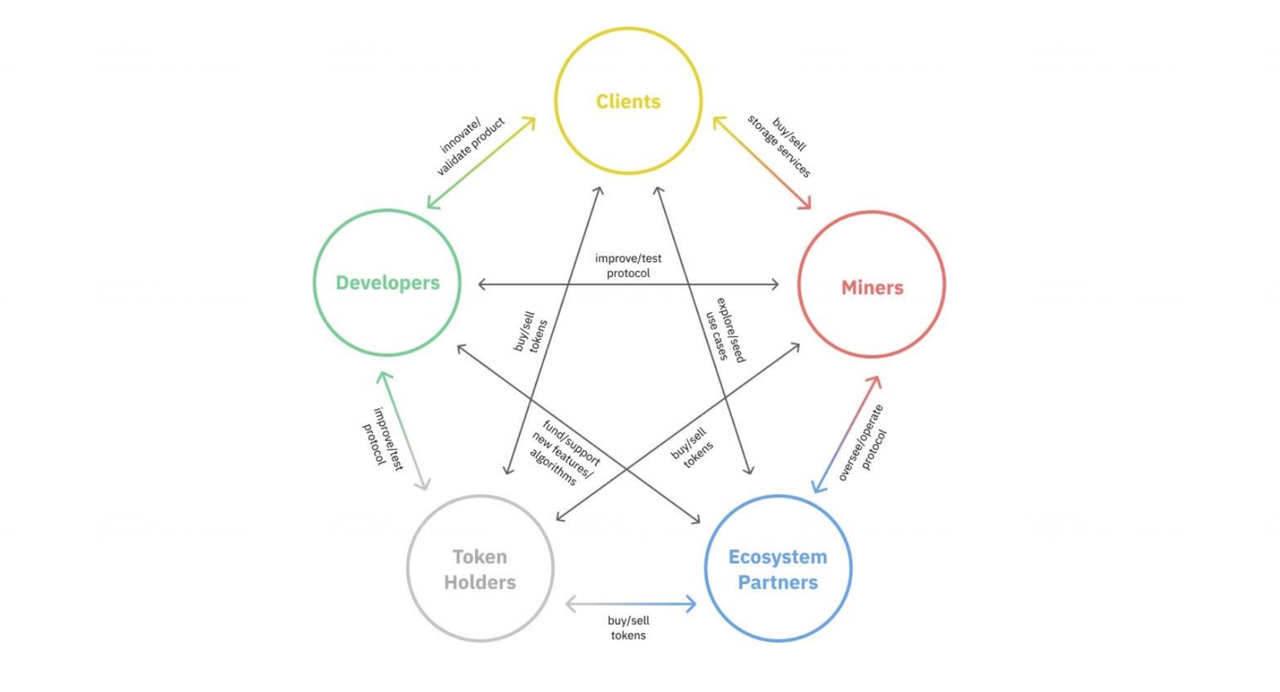
Source: Filecoin Blog
FIL is the core economic asset of the Filecoin network. It is used to pay for storage, collateralize deals, reward providers, and participate in network security.
- Storage payments: Clients pay FIL, or increasingly stablecoins through Filecoin Pay, to store and retrieve data from providers on the network.
- Collateral staking: Storage providers must lock up FIL as collateral before accepting deals, giving them a financial stake in storing data honestly.
- Block rewards: The network mints new FIL, roughly 130 million to 140 million tokens per year at current issuance levels, to reward storage providers for participating in consensus and proving storage.
- Investor and team vesting: A large share of FIL supply is still subject to vesting from the 2017 token sale. The major early-investor vesting schedule concludes in October 2026, which removes the largest predictable source of structural sell pressure in FIL's history.
- Network security: Collateral requirements and slashing penalties tie FIL directly to the honest operation of the storage network, rather than functioning purely as a governance or payment token.
FIL Token Allocation
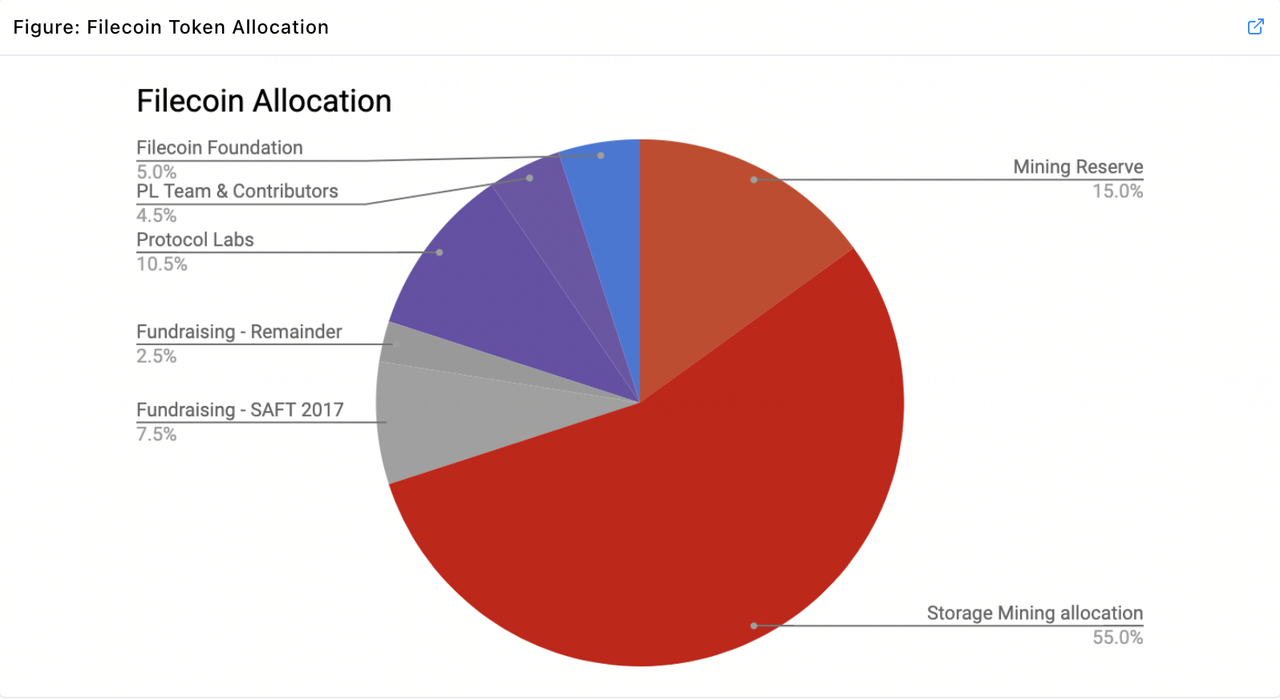
Source: Filecoin Spec
Filecoin has a large token supply relative to many newer crypto projects, with a maximum supply of 2 billion FIL. As of mid-2026, circulating supply remains below 1 billion FIL, while total supply is close to 2 billion FIL. Filecoin’s allocation was established around the 2017 token sale and mainnet launch.
|
Category |
Approximate Share |
Description |
|
Storage mining allocation |
~55% |
Reserved for storage provider block rewards and early storage mining incentives |
|
Mining reserve |
~15% |
Set aside for future mining incentives, such as retrieval, repair, or other network needs |
|
Protocol Labs |
~15% |
Allocated to Protocol Labs, including team and contributor incentives |
|
Fundraising |
~10% |
Includes the 2017 token sale and ecosystem development / potential future fundraising |
|
Filecoin Foundation |
~5% |
Supports grants, ecosystem growth, governance, and community initiatives |
Because storage mining rewards are released gradually over time, Filecoin’s circulating supply has continued to grow after mainnet launch. Long-term FIL supply dynamics depend on new mining rewards, vested allocations, locked collateral, burned fees, and actual network demand for decentralized storage.
How to Trade Filecoin (FIL) on BingX
BingX offers two practical ways to gain exposure to Filecoin, depending on whether the goal is direct ownership or short-term trading. Spot trading is better suited for users who want to buy and hold FIL directly, while futures trading is designed for active traders who want long or short exposure to FIL price movements.
Spot Trading: Buy and Own FIL Directly
Spot trading is the most straightforward way to buy Filecoin on BingX. When users buy FIL on the spot market, they own the asset directly and can hold it in the BingX spot account, transfer it, or withdraw it to a self-custody wallet.
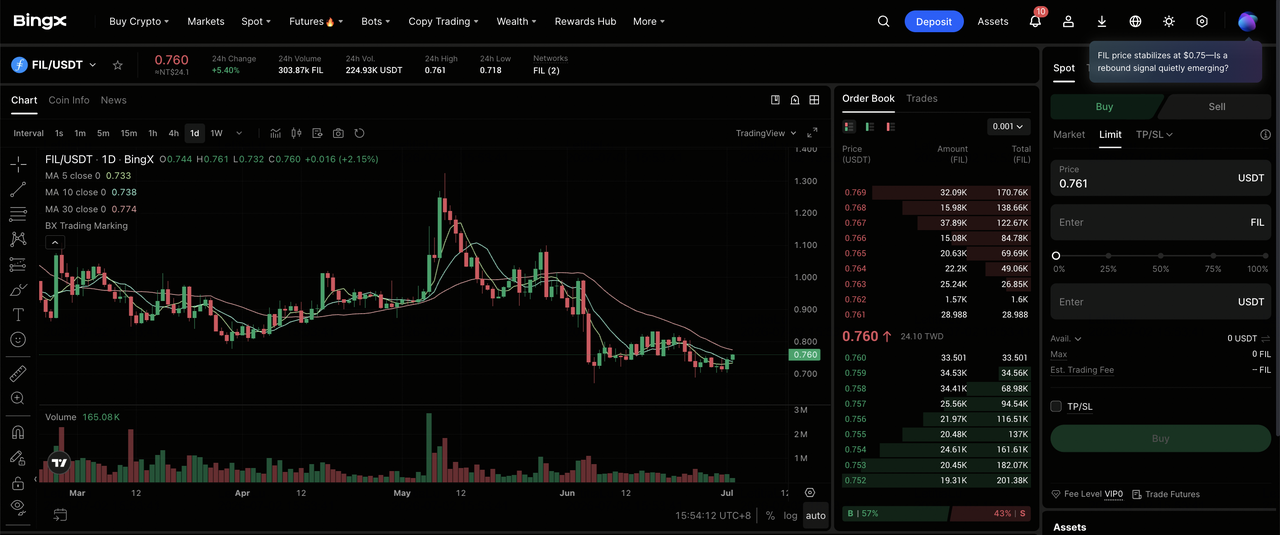
Step 1: Account setup and security. Sign up and log into your BingX account, complete the identity verification (KYC) required in your region, and enable two-factor authentication.
Step 2: Fund your spot account. Deposit USDT or another supported asset into your BingX spot account. Where available, users can also use supported fiat on-ramp options.
Step 3: Navigate to the spot market. Search for the FIL/USDT trading pair.
Step 4: Place your order. Choose a market order to buy FIL immediately at the current price, or use a limit order to set the price you want to pay.
Step 5: Manage your FIL. Once filled, your FIL appears in your spot account. You can keep it on BingX for convenience or withdraw it to a Filecoin-compatible wallet for long-term holding or network participation.
Futures Trading: Trade FIL Price Movements
For active traders, BingX offers USDT-margined FIL perpetual futures. Futures allow users to trade FIL price movements without holding the underlying asset, with the flexibility to open long positions if they expect FIL to rise or short positions if they expect FIL to fall.
Because futures involve leverage, they can amplify both gains and losses. This approach is more suitable for traders who already have a clear risk plan and understand liquidation risk, particularly for an asset like FIL that is sensitive to storage demand data, vesting unlock schedules, and broader crypto market sentiment.
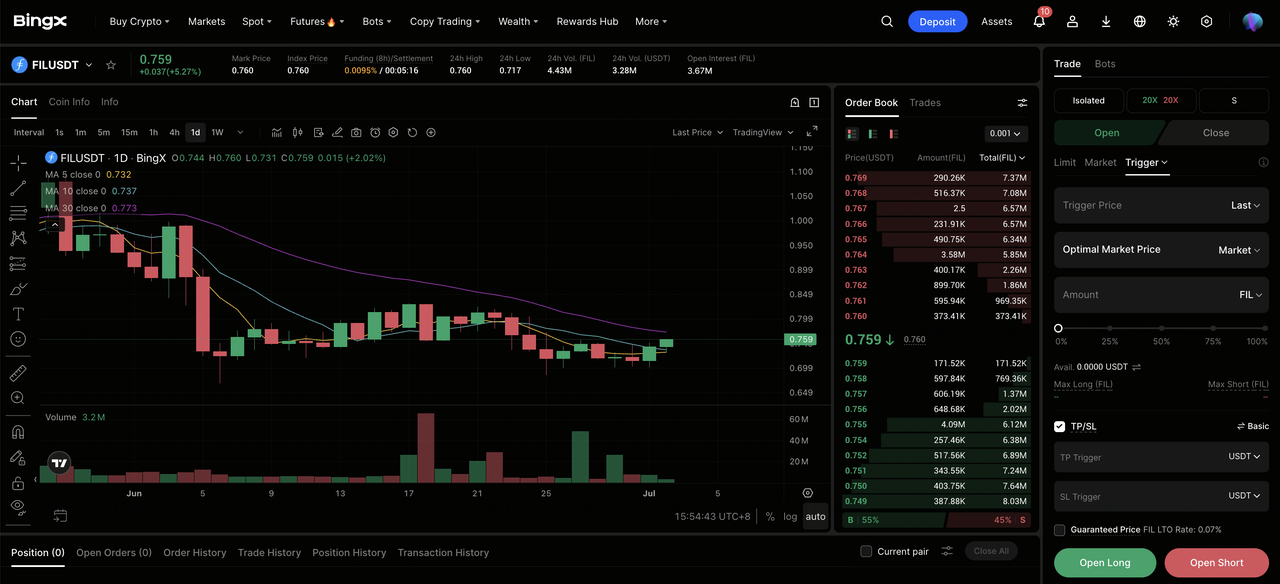
Step 1: Transfer collateral. Move USDT from your spot account into your futures account, where it will serve as margin.
Step 2: Select the contract. Search for the FIL-USDT perpetual contract.
Step 3: Set direction and leverage. Open long if you expect FIL to rise, or open short if you expect FIL to decline. Choose leverage based on your risk tolerance and position size.
Step 4: Execute the trade. Enter the order amount and choose a market or limit order depending on your trading plan.
Step 5: Manage risk. Set stop-loss and take-profit orders before or immediately after entering the position. Profit and loss settle dynamically in USDT.
Risks and Considerations Before Investing in Filecoin (FIL)
Filecoin has real storage capacity, a long operating history, and a growing list of enterprise and AI-related integrations. However, FIL still carries risks tied to token supply, competition, regulatory status, and the pace of paid adoption.
- Annual token inflation remains high: The network mints roughly 130 million to 140 million new FIL per year to reward storage providers. Demand needs to outpace this constant new supply for FIL to appreciate sustainably.
- Vesting unlocks have weighed on price for years: Early investors from the 2017 token sale received FIL at a fraction of current prices and have been a persistent source of selling. This schedule concludes in October 2026, but the transition period could still be volatile.
- Adoption still needs to convert into paid demand: Much of Filecoin's historical storage capacity was bootstrapped by mining incentives rather than organic client demand. The Filecoin Onchain Cloud is designed to change this, but real paid usage is still developing.
- Competition is intense: Filecoin competes with other decentralized storage networks such as Arweave (AR), Sia (SC), Storj (STORJ), and Crust (CRU), as well as low-cost centralized providers like AWS, Google Cloud, and Microsoft Azure that offer far greater scale and reliability guarantees.
- Regulatory status is unresolved: The U.S. Securities and Exchange Commission has previously cited FIL as a potential unregistered security. While regulators have held roundtables on clearer digital asset rules in 2026, definitive legal clarity has not been established, which can limit U.S. institutional participation.
- FIL has underperformed its own history: FIL trades far below its 2021 all-time high near $237, reflecting years of heavy token inflation and a market that has not yet fully priced in the network's storage capacity or newer product launches.
Final Thoughts: Should You Invest in Filecoin (FIL) in 2026?
Filecoin is one of the most established decentralized storage networks, with real infrastructure scale, a long operating history dating back to 2020, and a 2026 product push through the Filecoin Onchain Cloud aimed at converting bootstrapped storage capacity into paid, verifiable usage. The F3 fast-finality upgrade and Filecoin Pay stablecoin option also make the network more practical for everyday developers than it was in earlier years.
The key question for 2026 is whether Filecoin can turn that infrastructure and product progress into sustained paid demand that outpaces ongoing token inflation. The October 2026 conclusion of the early-investor vesting schedule is a widely watched tokenomics event, but it only addresses one source of supply pressure, not the annual block rewards miners still receive. For investors and traders, the most important metrics to watch are paid storage deals, Onchain Cloud adoption, enterprise and AI client growth, and how circulating supply trends once the 2017 vesting schedule ends.
Related Reading
- What Is Filecoin Onchain Cloud, the Next-Generation Decentralized Cloud Launching in January 2026?
- Top Decentralized Storage Crypto Projects to Know in 2026
- What Are the Top 10 DePIN Crypto Projects to Know in 2026?
- Top AI Data Center Stocks to Buy in 2026: Cloud, Servers, and AI Compute Infrastructure
- Top AI Memory Stocks to Buy in 2026: DRAM, HBM, and AI Storage Demand Explained
- Top AI Cloud Infrastructure Stocks to Buy in 2026 Amid Hyperscaler Capex and the Neocloud Boom
FAQs About Filecoin (FIL)
1. What makes Filecoin different from centralized cloud storage?
Filecoin uses cryptographic proofs to verify that storage providers are actually holding client data over time, without relying on a single trusted company. This creates a decentralized, verifiable alternative to providers like AWS, Google Cloud, and Azure, though it does not yet match their scale or reliability guarantees.
2. Is Filecoin built on Ethereum?
No. Filecoin is an independent Layer 1 blockchain built on top of the IPFS protocol. It has its own consensus mechanism and storage-proof system rather than relying on Ethereum or the EVM.
3. Which wallets support Filecoin (FIL)?
FIL can be stored in popular Filecoin-compatible wallets such as Ledger, Glif Web Wallet, MetaMask with Filecoin Snap, FoxWallet, Trust Wallet, and D'CENT Wallet. Filecoin mainnet addresses usually start with f, while testnet addresses start with t; users should always confirm the network and address format before transferring FIL.
4. Is Filecoin (FIL) a Dead Coin?
Filecoin is not a dead coin, but FIL remains a high-risk token. The network is still active, with development around Onchain Cloud, F3 finality, Filecoin Pay, and AI data storage. The main concern is whether real paid storage demand can grow fast enough to offset token inflation and long-term supply pressure.
