
Gitcoin (GTC) is a decentralized platform built on Ethereum that funds and supports open-source software and public goods, primarily within the Web3 ecosystem. It connects developers, communities, and funders through grants, hackathons, and bounties that encourage open collaboration. The platform's quadratic funding model matches community contributions with larger funding pools, promoting broader participation and equitable resource distribution. GTC serves as the native governance token, an ERC-20 standard on Ethereum.
Holders use it to vote on protocol decisions, manage DAO operations, and participate in identity verification through staking mechanisms. The token has a maximum supply of 100 million GTC, with approximately 87.49 million tokens in circulation as of April 2026.
Read more: What Are the Top Ethereum Layer-2 Projects of 2026?
Key Takeaways
- Gitcoin has directed over $60 million in funding to more than 3,700 open-source projects since its launch in 2017, supporting areas such as decentralized finance infrastructure, climate solutions, and community initiatives.
- Quadratic funding amplifies the voice of small donors by mathematically prioritizing the number of unique contributors over donation size, creating a more democratic allocation process.
- GTC enables community governance in the Gitcoin DAO, allowing token holders to influence treasury management, grant rounds, and platform upgrades.
- Core tools include the Allo Protocol for modular funding infrastructure and Human Passport (formerly Gitcoin Passport) for privacy-preserving identity verification to reduce Sybil attacks.
- As of 2026, Gitcoin operates primarily as a DAO, empowering builders to fund and maintain the decentralized internet while transitioning toward multi-mechanism funding approaches.
Read more: What Are the Best Ways to Convert Ethereum (ETH) to USD in 2026?
What Is Gitcoin (GTC)?
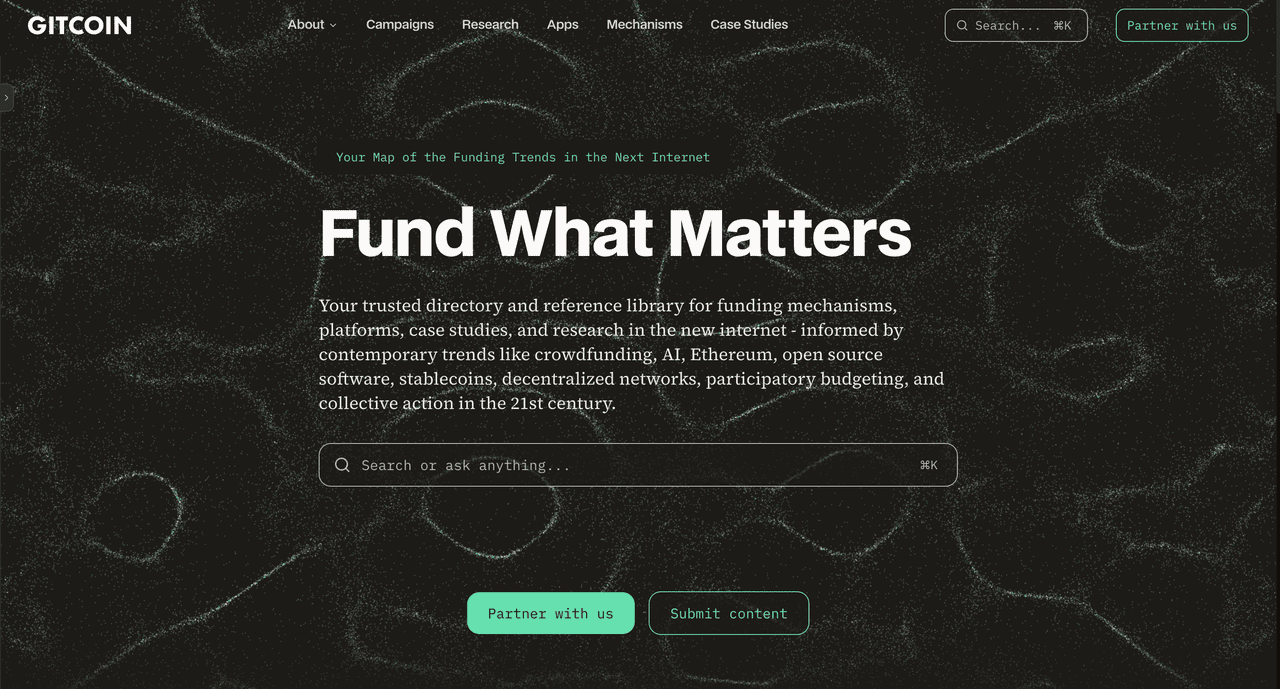
Launched in November 2017, Gitcoin addresses the chronic underfunding of public goods in software development. Public goods are non-rivalrous and non-excludable resources that benefit society broadly, such as open-source code, privacy tools, and educational content. Traditional markets often fail to incentivize their creation because contributors receive little direct compensation.
Gitcoin solves this by creating a marketplace where developers earn through bounties, hackathons, and grants. Funders, including individuals and organizations, support projects aligned with building a more open and collaborative internet. The platform has facilitated millions of unique donations and supported thousands of projects across Ethereum-related initiatives, including translations of core documentation, infrastructure improvements, and educational resources.
In recent years, Gitcoin has evolved into a full DAO structure. It shifted toward community-led governance and introduced pluralistic funding mechanisms. Recent rounds, such as Gitcoin Grants 24, distributed approximately $1.8 million using multiple allocation methods simultaneously, including quadratic funding and retroactive rewards.
Read more: What Is Etherscan for the Ethereum Network? A Beginner's Guide
What Are the Key Features of Gitcoin (GTC)?
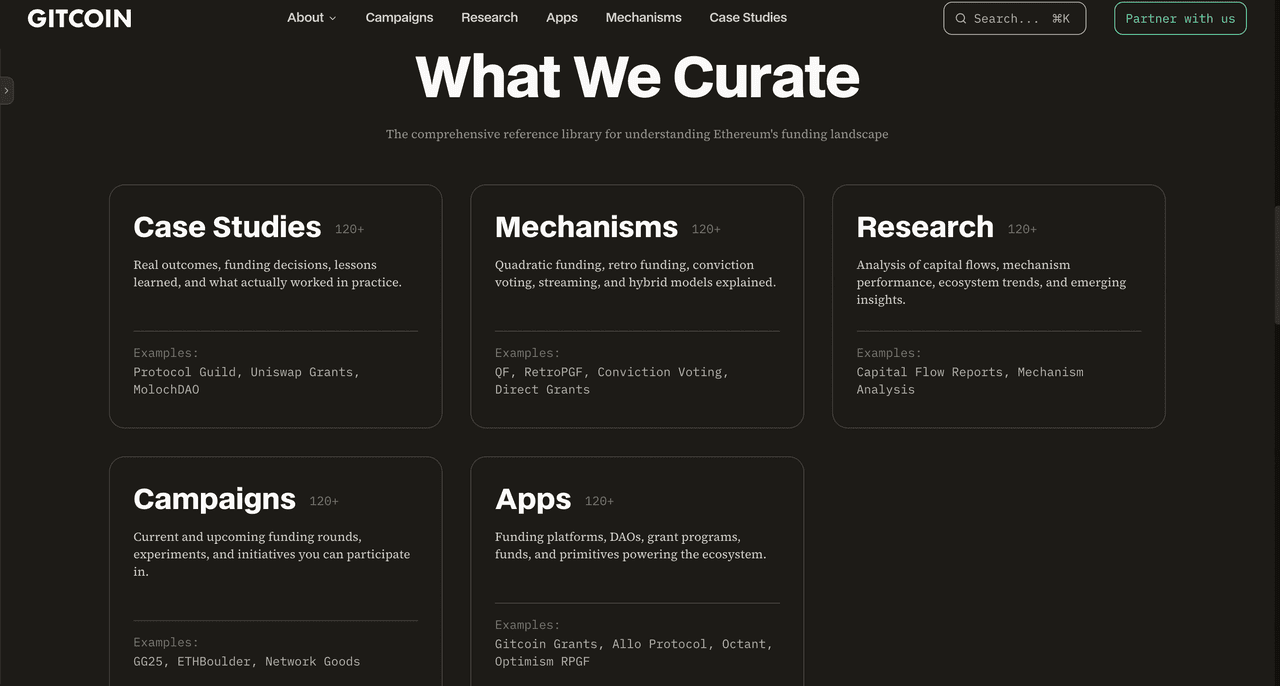
Gitcoin stands out through several innovative components:
1. Core Mechanism: Quadratic Funding
This system matches small donations from many individuals with larger pools, using a formula that squares the impact of contributor count. For instance, 100 donations of $1 each receive more matching funds than a single $100 donation. Since inception, this approach has powered the distribution of over $60 million across 3,700+ projects, with more than 5 million unique donations recorded. Recent rounds continue to demonstrate its effectiveness, with community-led initiatives raising hundreds of thousands in direct contributions amplified by matching pools.
2. GTC Token Utility and Governance
GTC holders participate in the Gitcoin DAO by proposing and voting on decisions related to treasury allocation, dispute resolution in grant rounds, and protocol upgrades. Staking GTC in Human Passport contributes to proof-of-personhood mechanisms, helping verify unique human users and mitigating manipulation through fake identities.
Gitcoin Ecosystem Tools
- Allo Protocol: An open-source, modular smart contract framework that simplifies the creation and management of community funding programs. It supported Gitcoin Grants Stack until mid-2025 and remains available for ecosystem partners in maintenance mode.
- Human Passport: Evolved from Gitcoin Passport, this tool aggregates verifiable credentials from Web2 and Web3 sources to build privacy-preserving digital identities. It now operates under the human.tech ecosystem and integrates sybil-resistance features for fairer distributions.
- Grants and Bounties: Developers submit projects for crowdfunding or compete in permissioned/permissionless bounties with defined timelines and compensation ranges. Hackathons and fellowships further foster collaboration.
These features position Gitcoin as a foundational layer for decentralized coordination, extending beyond Ethereum to support broader Web3 public goods funding.
What Are the Tokenomics of the GTC Token?
GTC is an ERC-20 governance token with a fixed maximum supply of 100 million tokens. As of April 2026, the circulating supply stands at approximately 87.49 million GTC, representing about 87.5% of the total. The token launched in May 2021 with the following initial allocation:
- 15% distributed via retroactive airdrop to early platform users who engaged in bounties, grants, or other activities.
- 35% allocated to existing stakeholders, including the founding team, investors, employees, and strategic partners.
- 50% reserved for the Gitcoin DAO, released gradually through community governance until fully unlocked around May 2023.
The design rewards both past contributors and future participants while decentralizing control. GTC's utility centers on governance voting and identity staking rather than direct payment or staking yields in the traditional sense. Market dynamics, including demand driven by platform adoption and broader crypto sentiment, influence its price. As of recent data, GTC trades with a market capitalization of around $9–10 million, reflecting its role as a specialized governance asset in the public goods sector.
Read more: What Are the 10 Best ERC-20 Wallets to Secure and Store Ethereum Tokens? (2026 Guide)
How to Buy Gitcoin (GTC) on BingX Spot Market: A Step-By-Step Guide
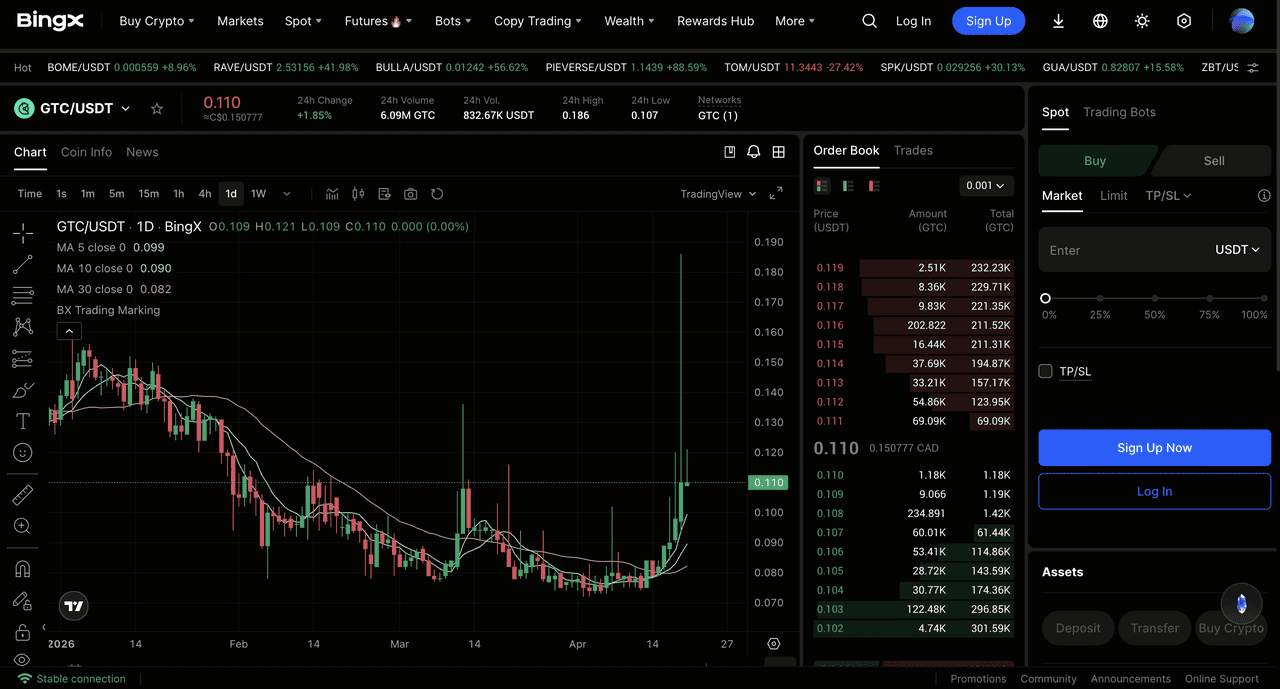
GTC/USDT on BingX Spot Market
You can access GTC through the spot market and use them within their respective ecosystems. Here's a step-by-step guide on how to buy GTC on BingX Spot Market:
Step 1: Log in or Create a BingX Account
Log in to your BingX account. If you don't have one, you can register using an email or mobile number. Completing identity verification (KYC) is required for full access to trading features.
Step 2: Deposit Funds
Go to the Buy Crypto section to deposit funds into your account. BingX supports several payment options such as bank transfer, credit or debit card, and peer-to-peer (P2P) transactions.
Step 3: Find the GTC/USDT Pair
Navigate to the Spot trading section and search for GTC/USDT and select the pair to view the trading interface. Use BingX AI tools to analyze GTC trends and make smarter trading decisions.
Step 4: Place Your Order
Choose between a Market Order to buy at the current price or a Limit Order to set your preferred entry. Enter the amount and confirm the order.
Conclusion: Why You Should Trade Gitcoin on BingX
Gitcoin represents Ethereum's ongoing experiment in community-led capital allocation for public goods. Its quadratic funding model and supporting tools have already channeled tens of millions toward sustainable open-source development, helping maintain critical infrastructure for the decentralized web. As the ecosystem scales and adopts multi-mechanism approaches, GTC holders gain influence over how these innovations evolve. Trading GTC on BingX combines accessibility with professional features, including low fees, high liquidity, and intuitive spot market tools. Whether you seek exposure to governance of public goods funding or wish to participate in a platform with proven impact, BingX serves as a reliable venue to buy, sell, and manage your GTC position securely.
Related Reading
- What Are the Top Ethereum Layer-2 Projects of 2026?
- What Are the Best Ways to Convert Ethereum (ETH) to USD in 2026?
- What Are the 10 Best ERC-20 Wallets to Secure and Store Ethereum Tokens? (2026 Guide)
- What Is Linea, the Ethereum Layer‑2 Network by ConsenSys?
- What Are the Top Ethereum Layer-2 Projects of 2025?
