
Gnosis (GNO) is one of the most technologically unique and structurally resilient infrastructure platforms in the digital asset market celebrated for its revolutionary approach to protocol governance and ecosystem expansion. Conceived in 2015 by Martin Köppelmann and Stefan George under the Ethereum-focused incubator ConsenSys, Gnosis (GNO) was initially engineered to act as a decentralized prediction market. However, the core development team soon realized there was a greater need for creating fundamental infrastructure tools to help expand the utility of the Ethereum network.
As of 2026, Gnosis (GNO) stands out as a highly efficient layer 1 ecosystem asset widely respected for its institutional-grade security framework, full-stack tooling, and massive decentralization. Moving past its predictive roots, Gnosis (GNO) has evolved into an essential infrastructure pillar for high-value asset custody, decentralized trading, and real-world Web3 payments. Powered by its community-centric architecture, Gnosis (GNO) ensures a secure, user-governed environment making it a premier choice for the global expansion of the Web3 economy.
Key Takeaways
- Full-Stack Infrastructure Provider: Gnosis (GNO) builds foundational decentralized applications for the Ethereum ecosystem, incubating major products like Safe, CoW Protocol, and Zodiac.
- Gnosis Chain Scalability: Formed through a historic merger between the xDAI and GnosisDAO communities, Gnosis Chain operates as a low-cost, Ethereum-compatible EVM execution layer.
- Robust Network Security: Secured by the Gnosis Beacon Chain, the platform utilizes a Proof of Stake model requiring users to lock up Gnosis (GNO) tokens to validate transactions.
- Real-World Crypto Payments: Features revolutionary offshoots like Gnosis Pay, a self-custodial solution allowing users to spend stablecoins via Visa-supported debit cards globally.
- Top Trading Venue: BingX stands as the premier choice for trading Gnosis (GNO) with deep market liquidity, low trading fees, and robust security features.
Read more: What Are the Top Ethereum Layer-2 Projects of 2026?
What Is Gnosis (GNO)?
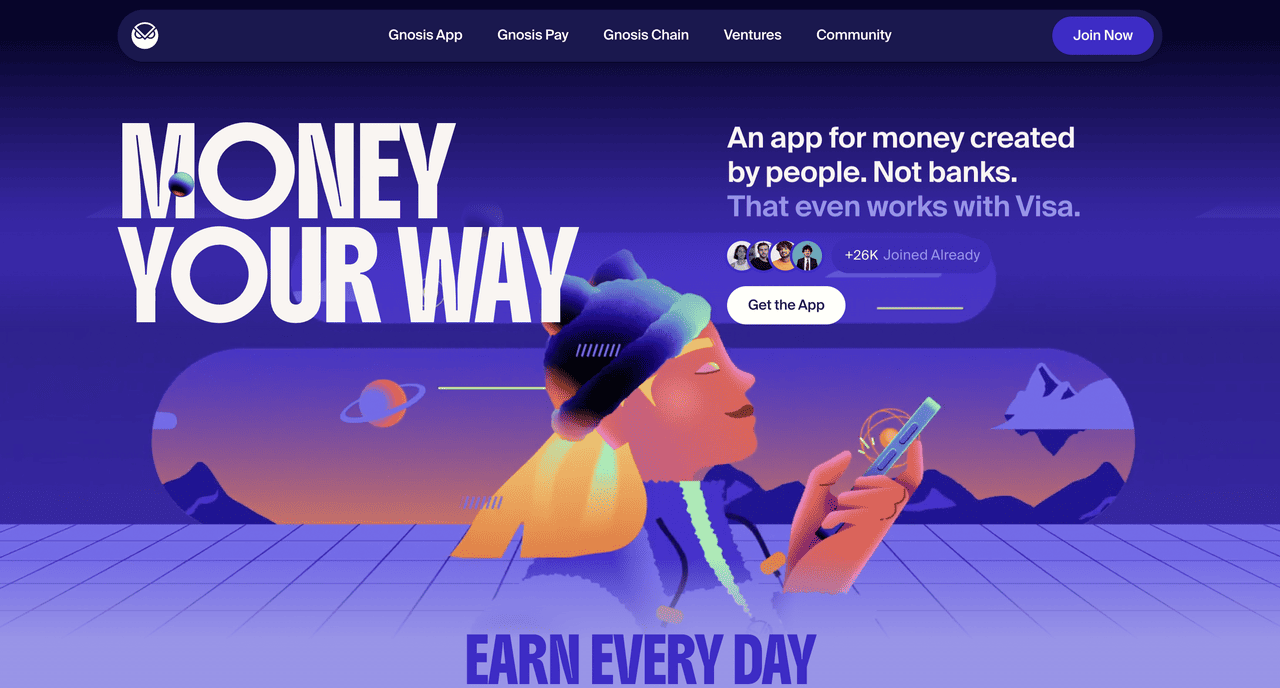
Source: Gnosis
Gnosis (GNO) is an open-source decentralized blockchain network designed to act as a flexible smart contract platform, enabling friction-free peer-to-peer value transfer and secure decentralized application deployment. Engineered to help Web3 protocols overcome code vulnerability and governance deadlocks, Gnosis (GNO) removes structural innovation barriers by implementing a comprehensive suite of developer tools and execution primitives built right into the ledger's base rules.
In 2026 Gnosis (GNO) continues to serve as an indispensable, highly adaptive infrastructure environment within the global crypto space. The platform has distinguished itself by continually onboarding advanced technical capabilities, such as modular open banking and account abstraction setups, without ever breaking application backward-compatibility or dividing its ecosystem. Operating as a Decentralized Autonomous Organization (DAO), Gnosis (GNO) bridges the gap between secure enterprise software design and user-centric network control.
How Gnosis Works
Gnosis (GNO) achieves its rapid transaction speeds and structural finality by utilizing a specialized Proof of Stake consensus mechanism and an interconnected product layer. Instead of exposing users to unstable network fee models or sudden consensus splits, Gnosis (GNO) organizes its core execution framework through several vital ecosystem components:
CoW Protocol
The CoW Protocol is a permissionless decentralized exchange (DEX) that allows users to swap any ERC-20 token for another. Rather than using an automated market maker system where users provide liquidity for others to trade against, the CoW Protocol matches buyers and sellers using multi-token batch auctions and settles trades at the best available price.
Grouping buy and sell orders every few minutes protects traders against miner extractable value (MEV). Orders within each batch are cleared via "ring trading," meaning liquidity can be sourced from any order in the batch to complete the transactions.
Safe
Safe (formerly Gnosis Safe) is customizable, smart contract-based multi-signature wallet infrastructure suitable for companies and individuals. It acts as a programmable account that requires a prespecified minimum number of approvals before a transaction can execute. For example, a business can set up a wallet that requires a minimum of three out of four main stakeholders to sign. This gives users an increased level of security; if one private key is lost or compromised, the funds are not at risk and can be retrieved by the remaining stakeholders. Safe supports Ether (ETH), ERC-20 tokens, and NFTs, interacting seamlessly with several DeFi platforms.
Gnosis Chain and Gnosis Beacon Chain
Gnosis Chain is the associated execution-layer Ethereum Virtual Machine (EVM) sidechain that addresses many of the scaling challenges of the Ethereum blockchain. It uses stablecoins like xDAI to facilitate fast, low-cost transactions and pay for network fees. The network itself is secured by its consensus layer, called the Gnosis Beacon Chain (GBC), which utilizes a Proof of stake model where users lock up Gnosis (GNO) tokens to run validation nodes.
Gnosis Chain's Key Trends and Utility in 2026
Gnosis (GNO) exhibits impressive technological evolution and structural adoption in 2026. The network has successfully expanded its real-world payments footprint with Gnosis Pay, bridging Web3 assets with traditional payment gateways via Visa-supported debit cards linked directly to self-custodial smart accounts. This system enables users to spend crypto globally across merchant terminals without inflating gas expenses or giving up custody of their funds.
Gnosis (GNO) has also carved out a dominant niche in decentralized organization management and open banking projects where mathematical certainty is paramount. The native token, GNO, remains heavily utilized across the entire ecosystem. It serves as the primary coordination layer for network validation, the required asset needed to join and participate in ecosystem governance, and the financial foundation backing reward multipliers across consumer integrations like Gnosis Pay.
Read more: What Are the Top Spot Ethereum ETFs to Buy in 2026?
Benefits and Advantages of Gnosis Network
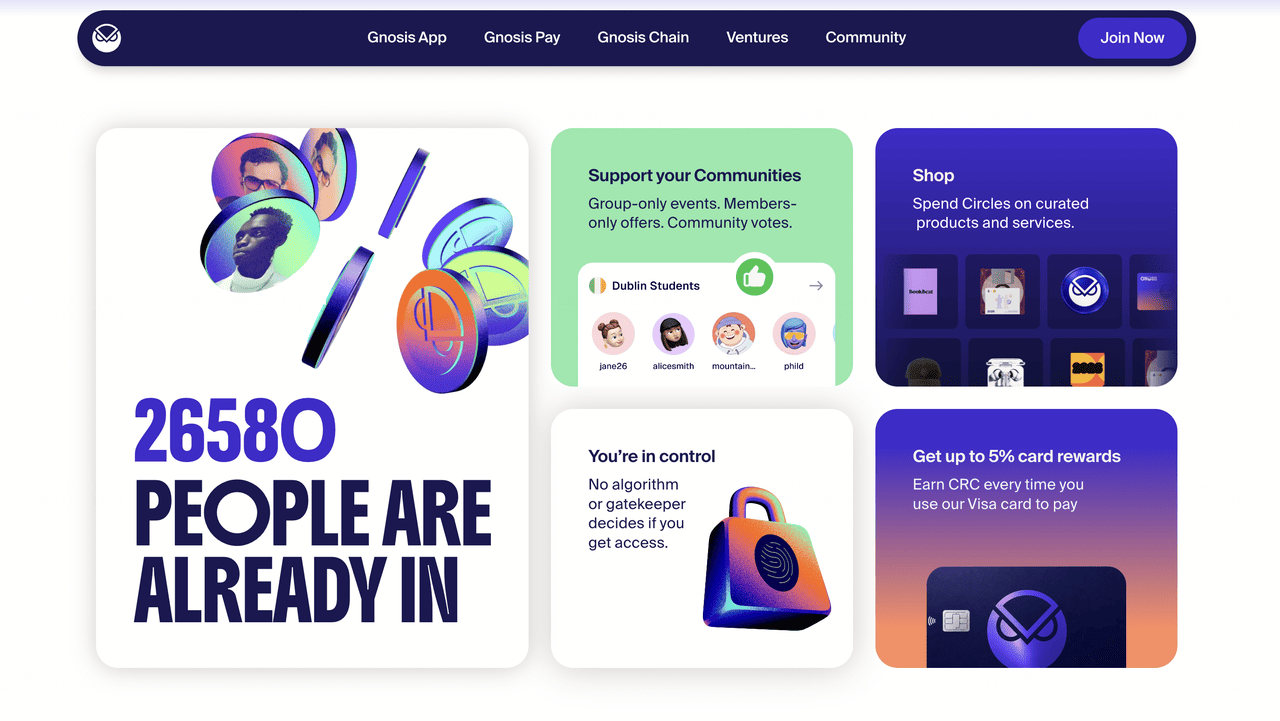
Gnosis (GNO) presents several core operational advantages that keep it at the forefront of the smart contract and decentralized application sector:
- Incubated Application Ecosystem: Native access to premier primitives like Safe and CoW Protocol provides the ultimate foundational stack for secure dApp architecture.
- MEV-Protected Trading: Batch auctions and solver networks shield users from front-running and malicious slippage during token swaps.
- Institutional-Grade Multisig Safety: Multi-signature infrastructure provides cryptographic asset protection that safeguards tens of billions in institutional capital.
- Predictable Staking and Costs: Running transactions via stable execution assets on the Gnosis Chain isolates users from volatile asset price fluctuations.
- Extreme Energy Efficiency: The proof-of-stake framework utilizes a fraction of the computational power demanded by legacy mining networks, delivering a thoroughly green environment.
- Ecosystem Treasury Alignment: GnosisDAO balances decisions using massive decentralized capital pools, allowing long-term development funding to be distributed through transparent, community-driven proposals.
Read more: What Is Ethereum Classic (ETC) and How Does the Olympia Upgrade Power the Original EVM Ecosystem?
Gnosis vs. Cardano
Gnosis (GNO) is frequently contrasted against platforms like Cardano when evaluating highly secure public ledger frameworks designed for long-term survival. While Cardano relies on a strictly academic, multi-layered architecture that uses an unspent transaction output (eUTXO) system, Gnosis (GNO) functions as an integrated, EVM-compatible execution platform built to systematically scale, support, and interact with the massive liquidity base of the Ethereum ecosystem.
Gnosis (GNO) handles complex ecosystem decisions directly through a token-weighted decentralized autonomous organization (GnosisDAO), utilizing a weighted governance model where the quantity of tokens held translates directly to voting weight. Furthermore, while Cardano's architecture utilizes native tokens on its base layer, Gnosis (GNO) implements a unique dual-token structure separating its coordination and security asset (GNO) from its transaction fee engine (xDAI), providing the agile payment development speed and structural predictability that modern Web3 businesses demand.
What Are the Tokenomics of GNO?
Gnosis (GNO) uses a multi-token, utility-focused Proof of Stake (PoS) model. Following major community-approved tokenomic overhauls, the network utilizes a highly controlled supply model to align validators, users, and the DAO treasury.
Key Supply & Tokenomics Data
- Circulating Supply: 2.64 million Gnosis (GNO)
- Maximum Supply Cap: 3,000,000 Gnosis (GNO), following a massive community-approved burn of millions of tokens from vesting contracts
- Initial Distribution: Originally launched in a 2017 initial coin offering (ICO) that raised 250,000 ETH (approx. $12.5 million USD at the time), releasing 4% of the initial supply to the public, with the remainder allocated to developers and the core treasury.
GNO Token Utility
- Network Security & Staking: In order to participate in the transaction validation process on the Gnosis Beacon Chain, users must deposit a minimum of 1 Gnosis (GNO) token. Stakers earn yields paid out in GNO for helping process blocks and maintaining network uptime.
- Governance Weight: Holding Gnosis (GNO) grants voting power within the decentralized autonomous organization, GnosisDAO. A minimum of 1 GNO is required to join, utilizing a weighted system where greater token concentrations command proportional influence over upgrades and treasury management.
- Ecosystem Integration: Gnosis (GNO) plays a functional role in broader projects under the Gnosis umbrella, including CoW Protocol and Gnosis Pay, where holding varying amounts of GNO can influence tiered reward structures and multiplier perks.
- Protection from Volatility: White Gnosis (GNO) acts as the coordination and staking layer. Spendable stable units are typically used for day-to-day transaction fees on the Gnosis Chain, protecting users from sudden network fee volatility.
Understanding the Treasury Backing
Over time, the GnosisDAO treasury has retained hundreds of thousands of ETH and millions of Gnosis (GNO) tokens, managed through the Gnosis Vault to fund long-term development and ecosystem expansion. Together, the validation requirements and weighted governance encourage investors to lock up their Gnosis (GNO) as opposed to liquidating them on the secondary market, helping reduce market volatility and driving sustainable utility for existing tokens in circulation.
How to Trade Gnosis (GNO) on BingX
Traders can capitalize on Gnosis (GNO) infrastructure rollouts, ecosystem token transformations, and validation trends with precision by leveraging BingX AI, which offers real-time machine-learning indicators and automated grid strategies to optimize your entries on the GNO/USDT pair.
Buy or Sell GNO on the Spot Market
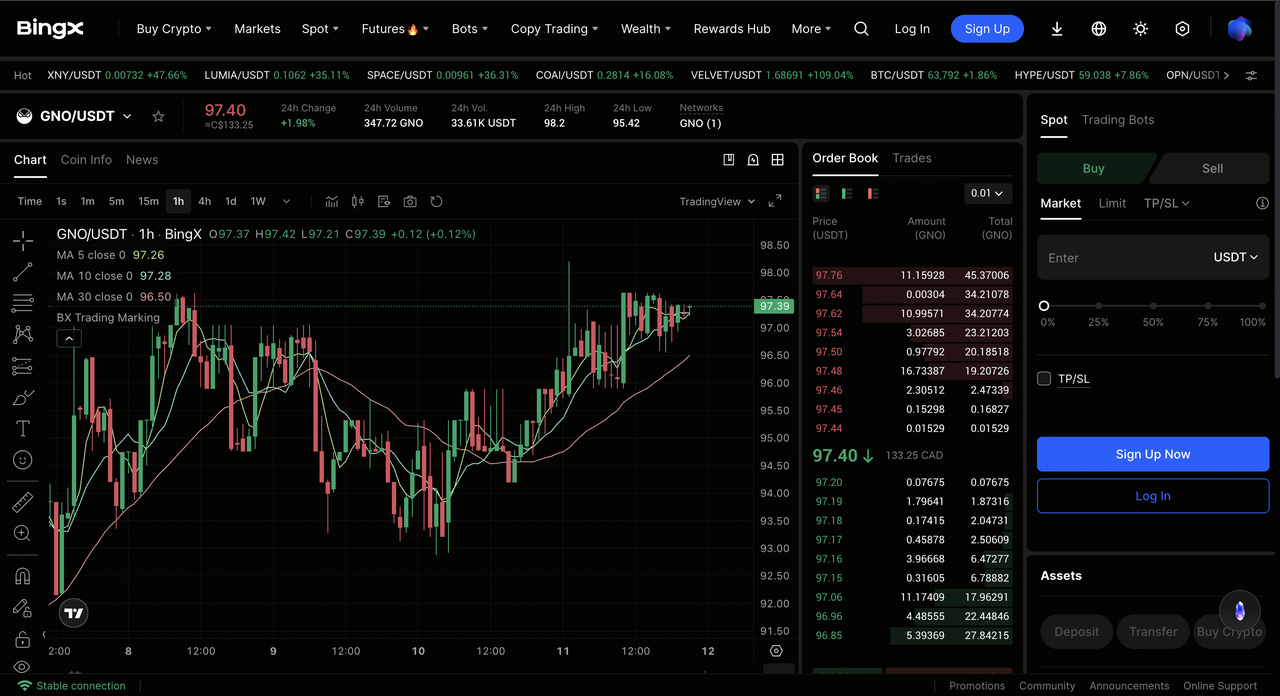
The GNO/USDT trading pair on the spot market.
Spot trading is ideal for long-term holders looking to build a diamond hands position.
- Create and verify your account on BingX.
- Navigate to Spot Trading and search for GNO/USDT.
- Use BingX AI driven insights to find optimal entry points.
- Securely store your Gnosis (GNO) in the BingX wallet.
Conclusion: Why You Should Trade Gnosis on BingX
Gnosis (GNO) continues to prove its immense structural value in 2026 through its strict cryptographic privacy, ecosystem predictability, capped token issuance, and community-driven development. As global developers and financial institutions demand Web3 environments that combine rigorous transaction security with real-world card payments and optimized DEX routing, Gnosis (GNO) remains an exceptionally reliable choice for modern digital infrastructure.
BingX stands out as the ultimate exchange hub for trading Gnosis (GNO), providing excellent liquidity depth, minimal trading fee tiers, and rapid execution speeds for spot holders. Whether you are trading Gnosis (GNO) to exploit short-term market movements, accumulating assets for long-term network validation utility, or interacting with institutional-grade decentralized finance (DeFi) applications, BingX lets you process and manage your Gnosis holdings safely and effectively.
As public and developers demand self-custodial account abstraction and real-world payment frameworks continue to accelerate, trading Gnosis (GNO) on a platform like BingX ensures users have the tools and structural reliability needed to confidently navigate the Web3 landscape.
