

Quant (QNT) is one of the most technologically unique and enterprise refined infrastructure platforms in the digital asset market celebrated for its revolutionary approach to solving the blockchain interoperability challenge without adding complex overhead. Launched in June 2018 by cybersecurity veteran Gilbert Verdian, Quant Network was engineered to act as a bridge across different blockchain networks eliminating the fragmentation data silos and isolated ecosystems that prevent mainstream blockchain connectivity.
As of 2026 Quant Network(QNT) stands out as a highly efficient layer 1 ecosystem alternative asset widely respected for its instant cross ledger finality universal API connectivity and corporate readiness. It continues to be an essential infrastructure pillar for central bank digital currencies (CBDCs) commercial bank tokenized deposits and global supply chain frameworks. Powered by its enterprise focused operating system Quant ensures secure multi chain connectivity making it a premier environment for the expansion of institutional grade decentralized finance (DeFi) and the future of interconnected digital assets.
Read more: What Are the Top Layer-1 (L1) Blockchains to Know in 2026?
Key Takeaways
- Overledger Operating System: Quant relies on its signature Overledger OS which connects diverse distributed ledgers via a single unified layer without altering the underlying blockchain source codes.
- Multi-Chain Applications: The framework allows developers to build and deploy flexible multi chain applications (MApps) that leverage the benefits of multiple networks simultaneously.
- Quant Flow Engine: The platform facilitates automated programmable money ecosystems enabling commercial banks and corporates to easily configure intelligent automated financial workflows.
- Institutional Utility: In 2026 QNT powers high profile tier 1 financial network deployments global bank tokenization projects and cross border corporate settlement structures.
- Top Trading Venue: BingX stands as the premier choice for trading Quant (QNT) with deep market liquidity, low trading fees and robust security features.
What Is Quant Network (QNT)?
Source: Quant
Quant (QNT) is a digital asset network designed to act as a bridge across different blockchain networks allowing seamless data and asset transfer between public systems and private corporate ledgers. Conceived to help institutions overcome rigid network lock ins Quant removes infrastructure barriers by replacing complex physical token bridges with a light API centered operating framework that sits cleanly above any distributed network tier.
In 2026 Quant (QNT) continues to serve as an indispensable blockchain solution within the broader Web3 ecosystem. The platform has distinguished itself by capturing massive multi sector projects ranging from institutional Real World Asset (RWA) tokenization to public central bank infrastructure trials. With a strong engineering base focused on scalability and legacy compatibility Quant functions as a reliable gateway between traditional finance (TradFi) frameworks and high velocity trustless applications.
How Quant Network Works
Source: Medium
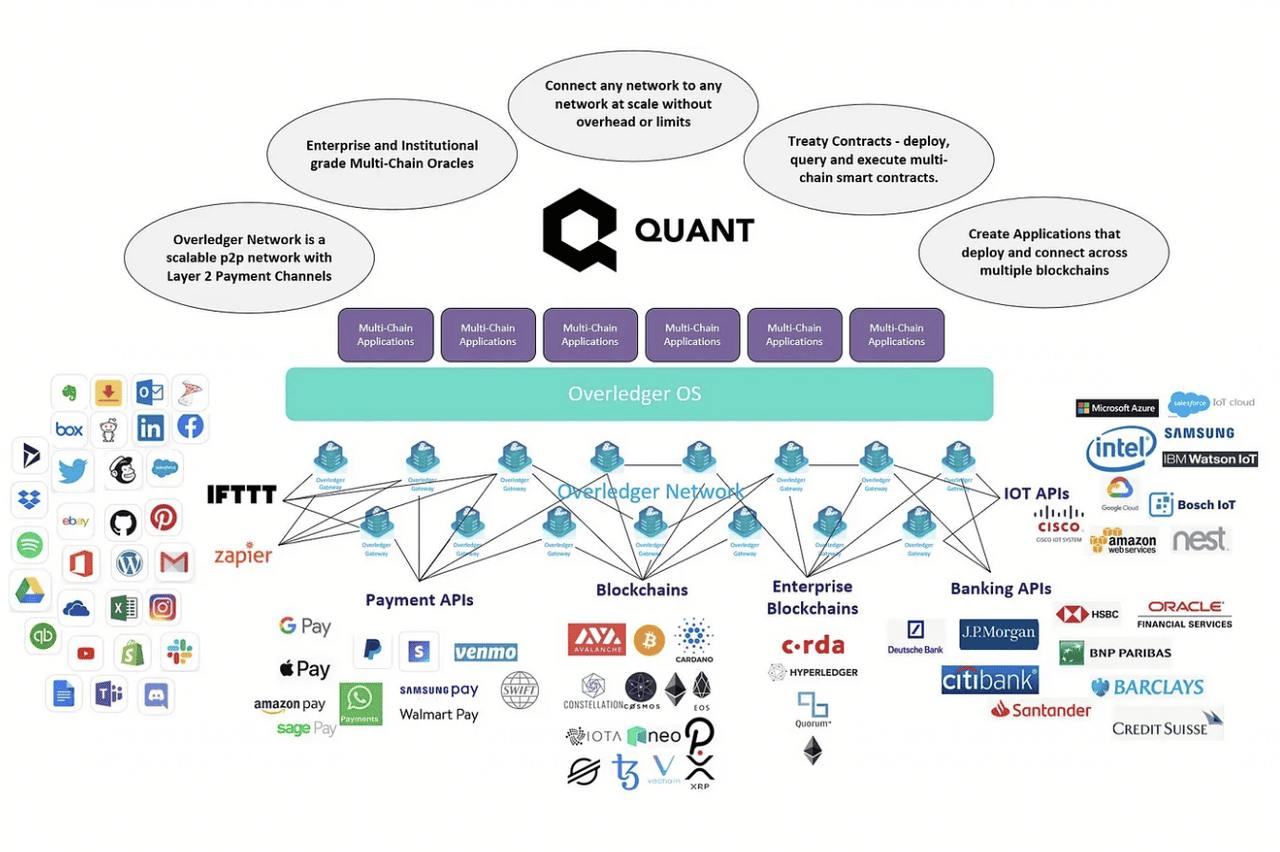
Quant achieves its blazing processing speeds and absolute security by using its signature Overledger Network architecture. Rather than introducing another consensus layer or network chain that slows processing down the Overledger operating system operates directly above existing blockchains organizing data flows through independent functional layers:
- Transaction Layer: This tier handles the consensus time recording and execution tracking of native transactions across separate public and permissioned blockchains.
- Messaging Layer: Highly secure data extraction spaces that consolidate smart contract data parameters multi ledger transactions and metadata records into a single digestible information stream.
Beyond this core layout Quant utilizes its freshly expanded Fusion Rollup mainnet infrastructure. The Fusion Rollup framework unifies fragmented multi ledger complexity into a single execution environment protecting corporate operations with institutional grade firewalls and native cross chain compliance tools. Because developers use traditional API connectors to build multi chain applications (MApps) through this layer there is zero risk of systemic blockchain reorgs or single point bridge failures disrupting the ecosystem.
Key Trends and QNT Token Utility in 2026
Quant (QNT) exhibits impressive technological evolution and structural adoption in 2026. The network has successfully rolled out its signature Quant Flow money engine driving an era of hyper scalable programmable money for banks and corporates. This utility introduces Quant PayScript which functions as an easy to use rules engine giving entities complete control over how digital currencies behave and move 24/7.
Quant has also carved out a dominant niche in tokenized bank deposits where global consortia rely on Overledger to coordinate high value settlement transactions across live commercial networks. The QNT token remains highly utilized across the ecosystem serving as the mandatory vehicle for paying developer platform consumption and annual licensing fees inside a flourishing DeFi and enterprise connectivity hub.
Benefits and Advantages of Quant Network
Quant (QNT) presents several core operational advantages that keep it at the forefront of the interoperability sector:
- Sub-Second Finality: Cross ledger connectivity via standardized APIs means data transfers and execution finality occur in moments offering a web2 like performance.
- Incredible Efficiency: The platform connects numerous public and private networks simultaneously without requiring expensive code overhauls or resource heavy node systems.
- Absolute Security: The Overledger firewall design controls entry access routes meaning corporate data pools remain isolated from public exploit vectors.
- Fork Prevention: Operating above the base chain avoids structural fork risks protecting token issuances and transactional records from unexpected ledger fractures.
- True Sustainability: A software based network framework ensures the protocol uses almost no extra energy footprints aligning with corporate green targets.
- Ecosystem Inclusivity: The Quant Connect layout allows even small scale developer teams to launch enterprise compatible MApps with minimal technical barriers.
Quant vs. Ethereum: Key Differences
Quant (QNT) is frequently contrasted against platforms like Ethereum when evaluating scalable enterprise contract designs. While Ethereum operates as an independent execution environment with decentralized validation constraints, Quant functions as an abstract operating system layer sitting comfortably above Ethereum and scores of other connected ledgers.
Quant handles complex cross network smart contract interactions without relying on asset wrapping or complex secondary rollups that break native liquidity pools. Furthermore while Ethereum requires developer groups to fully commit to its specific programming parameters Quant gives legacy enterprise coders the freedom to build flexible solutions using popular existing languages like Java or C++ linked via clean APIs.
What Are the Tokenomics of QNT Token?
Quant (QNT) uses a strict utility model ensuring a highly predictable supply dynamic where all ecosystem usage directly ties back to token demand.
Supply and Issuance
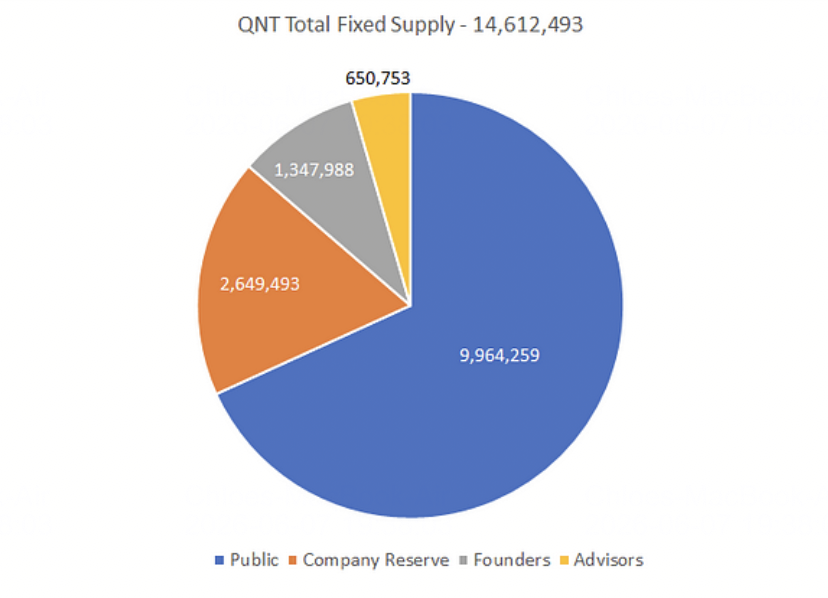
- Maximum Supply: 14.6M QNT (hard cap).
- Circulating Supply: Approximately 12M QNT as of 2026.
- Deflationary Allocation: The fixed token ceiling means no new QNT tokens can ever be minted ensuring that continuous enterprise platform onboarding adds direct buying pressure onto the existing supply.
QNT Token Allocation Breakdown
Based on the QNT Total Fixed Supply metrics, the token distribution is allocated as follows:
- Public: 9.96M QNT
- Company Reserve: 2.65M QNT
- Founders: 1.35M QNT
- Advisors: 650.7K QNT
Quant (QNT) Halving Schedule and Inflation
Quant does not implement a block reward halving schedule because it does not rely on traditional proof of work mining systems. Instead, network economics are driven by licensing demands where developers and enterprises must purchase and lock up QNT tokens in multi-year smart contracts to retain active API access keys. This structure creates an effective circulating supply squeeze during periods of high adoption keeping long-term emissions perfectly flat while rewarding ecosystems lock up participants.
Utility and Distribution
The QNT token functions as the core economic license key across the Overledger network ecosystem. Its fundamental roles include settling multi ledger platform gateway fees validating consumption volume quotas and serving as the primary currency for application market subscription channels. Additionally, QNT token balances back the security parameters of the Overledger Trusted Node program allowing operators to process data flows while generating steady platform revenue.
How to Trade Quant (QNT) on BingX
Traders can capitalize on Quant's enterprise grade interoperability mechanics with precision by leveraging BingX AI, which offers real-time machine-learning indicators and automated grid strategies to optimize your entries on the QNT/USDT pair.
Buy or Sell QNT on the Spot Market
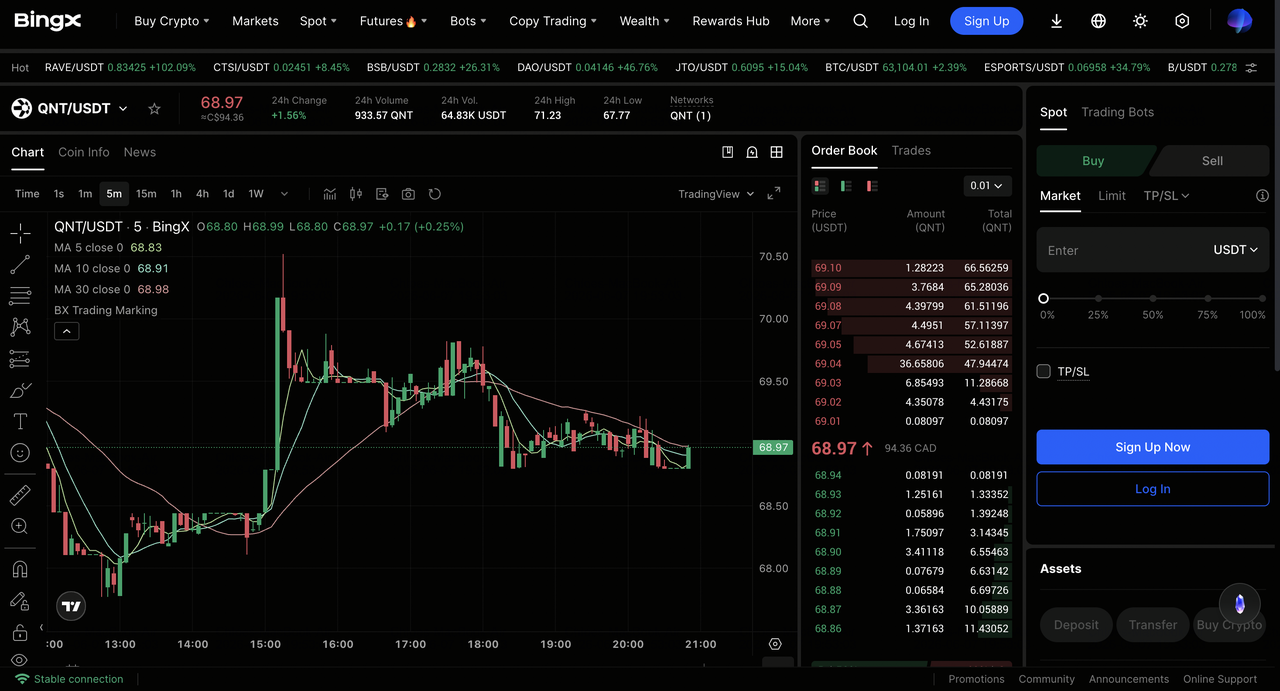
QNT/USDT trading pair on the spot market with BingX AI insights
Spot trading is ideal for long-term holders looking to build a diamond hands position.
- Create and verify your account on BingX.
- Navigate to Spot Trading and search for QNT/USDT.
- Use BingX AI-driven insights to find optimal entry points.
- Securely store your QNT in the BingX wallet.
Long or Short QNT Futures with Leverage
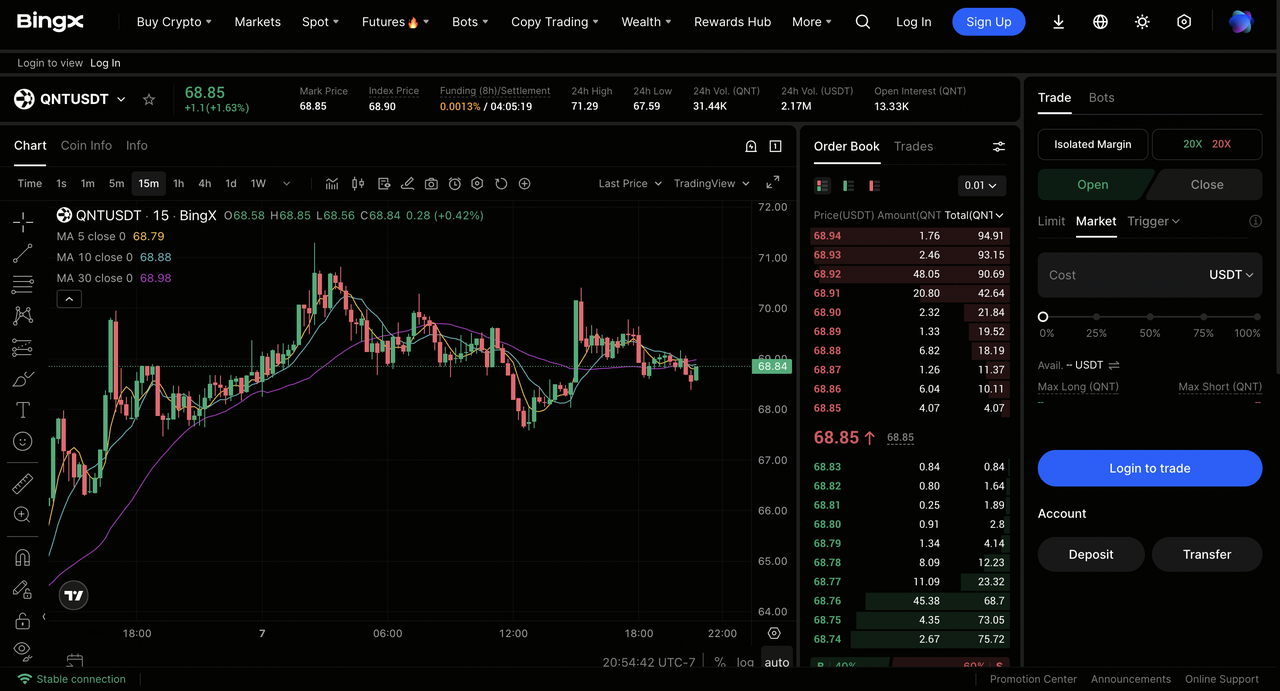
QNT/USDT perpetuals on the futures market
- Transfer USDT to your Futures Account.
- Select the QNT/USDT Perpetual Contract.
- Apply up to 50x leverage with professional risk management tools.
- Set Stop-Loss and Take-Profit to protect against sudden whale movements.
Conclusion: Why You Should Trade Quant on BingX
Quant (QNT) continues to prove its immense architectural value in 2026 through its strict cryptographic security zero-bridge dependency regulatory compliance and real-world institutional relevance. As modern global corporations demand interoperability systems that combine top-tier security with legacy financial system compatibility Quant remains an exceptionally reliable choice for digital financial infrastructure.
BingX stands out as the ultimate exchange hub for trading Quant (QNT) providing excellent liquidity depth minimal trading fee tiers and rapid execution speeds for both basic spot holdings and sophisticated futures traders. Whether you are trading QNT to exploit short-term market movements accumulating assets for ecosystem license locking or interacting with next-generation institutional DeFi applications BingX lets you process and manage your Quant holdings safely and effectively.
As institutional and enterprise demand for friction-free network connectivity platforms continues to accelerate trading Quant (QNT) on an enterprise-grade platform like BingX ensures users have the tools and structural reliability needed to confidently navigate the Web3 landscape.
