
Render Network (RENDER) is a decentralized GPU compute network built for 3D rendering, AI workloads, and other graphics-heavy applications. Instead of relying only on centralized cloud providers, Render connects creators, studios, and developers that need GPU power with node operators that have unused GPU capacity. Its roots are in production-grade 3D rendering, giving the network a real creative workload base before the current AI infrastructure cycle.
As AI inference and GPU demand grew in 2024 and 2025, Render expanded beyond rendering into broader decentralized compute through its Dispersed compute subnet. The ecosystem has several key parts: Render Network is the compute marketplace, RENDER is the Solana-based token used for payments, rewards, and governance, and the Burn-and-Mint Equilibrium (BME) links token supply to actual network usage. OTOY, the graphics company founded by Jules Urbach, created the network and remains closely involved in its core infrastructure. This guide explains what Render is, how Render Network works, how RENDER tokenomics function, the main risks to consider, and how to trade RENDER on BingX.
What Is Render (RENDER)?
Render (RENDER) is the native token of Render Network, a decentralized GPU compute marketplace built on Solana and often categorized as a DePIN project. The network connects creators, studios, AI developers, and other users who need GPU power with node operators that provide unused GPU capacity. Render was originally created by OTOY, the graphics technology company founded by Jules Urbach, and launched its first RNDR token on Ethereum in 2017 before migrating to Solana in 2023 at a 1:1 ratio.
Render started with 3D rendering for creative industries, including visual effects, animation, and game development. By 2026, it had expanded into broader AI infrastructure through Dispersed, a dedicated compute subnet that supports enterprise-grade GPU nodes such as H100 and H200. The network processed more than 22 million frames in 2025, showing real usage beyond speculation.
The core idea behind Render is simple: GPU compute is becoming essential for both AI and digital content creation, but most capacity is still controlled by centralized cloud providers. Render offers a decentralized alternative by aggregating GPU supply from independent node operators and matching it with real compute demand. Its Burn-and-Mint Equilibrium model also ties RENDER token usage to actual jobs on the network, with tokens burned when compute work is paid for and new tokens minted to reward node operators.
Key components of Render Network include:
- Render Network: The decentralized GPU marketplace that matches compute demand with available GPU supply.
- RENDER token: The Solana-based token used for payments, rewards, and governance.
- Node operators: GPU providers that earn rewards for completing rendering or AI compute jobs.
- Burn-and-Mint Equilibrium (BME): The tokenomics model that burns RENDER when jobs are paid and mints rewards for node operators.
- Dispersed: Render’s AI compute subnet, designed to support enterprise-grade GPU workloads beyond traditional rendering.
Read More: What Are the Top 10 DePIN Crypto Projects to Know in 2026?
How Does Render Network Work?
Render Network works as a decentralized GPU compute flow. Users submit rendering or AI jobs, the network matches those jobs with available GPU nodes, and RENDER is used to settle payments and reward verified compute providers.
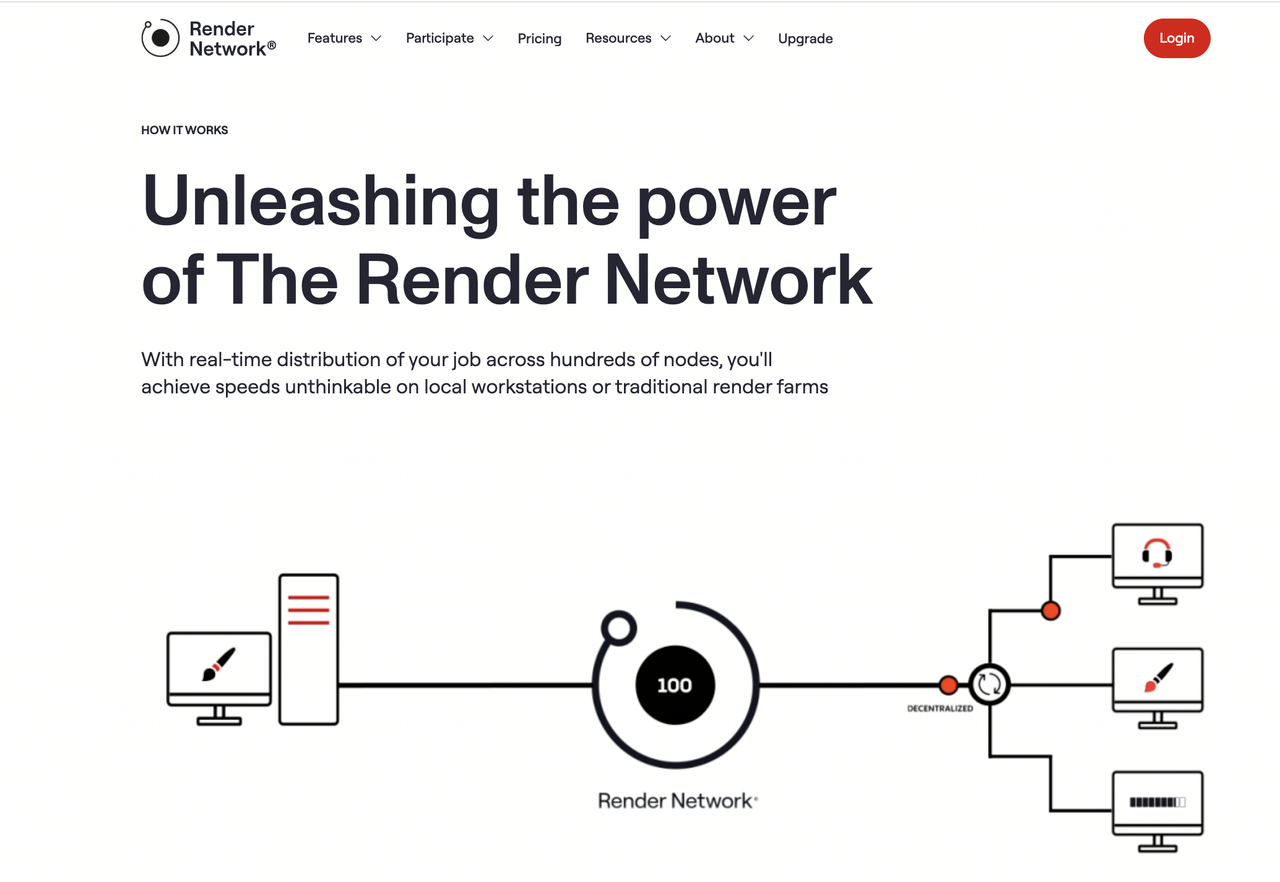
- Users submit compute jobs: Creators, studios, AI developers, and other users submit GPU-heavy workloads such as 3D rendering, animation, AI inference, image generation, video generation, or model processing.
- Render matches jobs with GPU nodes: The network assigns jobs to node operators based on hardware tier, performance, availability, and reliability. Nodes can range from high-end consumer GPUs to enterprise-grade H100 and H200 hardware through Dispersed.
- Node operators process and return results: GPU providers complete the assigned workload and return the output. Render’s original marketplace focuses on creative rendering, while Dispersed expands the model into AI and general GPU compute.
- RENDER is burned and minted: Under the Burn-and-Mint Equilibrium model, RENDER is burned when users pay for completed jobs. New RENDER is then minted to reward node operators, linking token supply to real network usage.
- Governance updates the network: Render Network Proposals allow RENDER holders to vote on emissions schedules, fee settings, subnet additions, and technical upgrades, including changes related to BME and Dispersed.
Render Network vs. AI Cloud Providers vs. Decentralized GPU Compute
Render Network competes in a growing AI GPU compute market that includes centralized AI cloud platforms and decentralized compute protocols. Its main difference is that it combines a real creative rendering demand base with expanding AI compute use cases, while most competitors are either enterprise cloud providers or AI-native GPU networks.
Compared with AWS, Google Cloud, and Azure, Render offers a decentralized alternative to centralized GPU infrastructure, though it cannot match their enterprise scale, reliability guarantees, or service depth. Among decentralized compute networks, Render stands out for its creative rendering roots and OTOY ecosystem, while Akash is positioned more broadly as open cloud infrastructure and io.net is more directly focused on AI GPU clusters.
Read More: Top AI Compute and GPU Stocks to Buy in 2026: The Shift to Inference and Custom Silicon
|
Platform |
Category |
Main Use Case |
Key Strength |
Main Difference |
|
AWS / Google Cloud / Azure |
Centralized AI cloud |
AI training, inference, rendering, enterprise workloads |
Scale, reliability, SLAs, enterprise support |
Most mature infrastructure, but centralized and often more expensive per GPU hour |
|
Render Network |
Decentralized GPU marketplace |
3D rendering, creative workloads, AI inference through Dispersed |
Real rendering demand, OTOY ecosystem, BME token model |
Combines creative rendering heritage with AI GPU compute positioning |
|
Akash Network |
Decentralized cloud compute |
GPU and CPU cloud marketplace |
Broad workload support, open cloud alternative |
Broader than Render, but less specialized in creative rendering |
|
Decentralized AI GPU infrastructure |
AI training and inference GPU clusters |
AI-native positioning, cheaper-than-cloud narrative |
More directly focused on AI compute, but lacks Render’s creative ecosystem anchor |
Major Render Network Developments: From RNDR to AI Compute
Render Network has evolved from an Ethereum-based rendering marketplace into a Solana-native GPU compute network serving both creative rendering and AI workloads. Its key milestones show how the project moved from OTOY’s graphics ecosystem into broader decentralized AI infrastructure.
|
Milestone |
Date |
Main Purpose |
|
RNDR Token Launch |
2017–2020 |
OTOY launched RNDR on Ethereum to connect idle GPU capacity with 3D rendering demand from artists and studios. |
|
Render Network Foundation |
Jan. 2023 |
Established the Foundation and RNP governance process to support community-led protocol decisions. |
|
Solana Migration + RENDER Launch |
Nov. 2023 |
Migrated from Ethereum to Solana at a 1:1 RNDR-to-RENDER ratio for lower fees and faster settlement. |
|
BME Implementation |
Dec. 2023 |
Introduced Burn-and-Mint Equilibrium, linking token burns to paid compute jobs and minting rewards for node operators. |
|
RCN + Dispersed AI Compute |
2025 |
Expanded from creative rendering into AI inference, model processing, and general GPU workloads through Dispersed. |
|
Enterprise GPU and Global Node Expansion |
2025–2026 |
Added H100/H200 support, Windows node support, and global node onboarding to broaden decentralized GPU supply. |
- RNDR Launch and Creative Rendering Base: Render began as an Ethereum-based GPU marketplace created by OTOY to connect idle GPU capacity with real rendering demand from artists, studios, and 3D creators.
- Foundation and Governance Shift: In 2023, the Render Network Foundation introduced the RNP governance process, allowing token holders to vote on emissions, fees, subnet expansion, and protocol upgrades.
- Solana Migration and RENDER Token: Render moved from Ethereum to Solana in November 2023 at a 1:1 RNDR-to-RENDER ratio, improving transaction costs, settlement speed, and integration with Solana-native infrastructure.
- Burn-and-Mint Equilibrium: BME went live in December 2023, tying RENDER supply more directly to network usage. Tokens are burned when jobs are paid, while new RENDER is minted to reward node operators.
- Dispersed and AI Compute Expansion: In 2025, Render expanded beyond creative rendering through the RCN framework and Dispersed subnet, supporting AI inference, image and video generation, document processing, and other GPU workloads.
- Enterprise GPU and Node Growth: RNP-021 approved H100 and H200 GPU support for Dispersed, while 2026 updates added Windows support and global node onboarding. These upgrades broadened Render’s available GPU supply and strengthened its AI infrastructure positioning.
What Are the Render (RENDER) Tokenomics?
RENDER tokenomics are based on the Burn-and-Mint Equilibrium (BME) model. Instead of relying on a fixed supply cap, RENDER supply changes based on real network usage: tokens are burned when users pay for compute jobs, while new tokens are minted to reward node operators.
RENDER Token Utility and Supply Mechanisms
RENDER is the core economic asset of the Render Network ecosystem. It is used to settle compute jobs, compensate node operators, and participate in protocol governance through the RNP process.
- Job payments and burns: Users pay for rendering or AI compute jobs, and the equivalent value in RENDER is burned after the job is completed. Higher job volume increases token burn.
- Node operator rewards: GPU providers earn newly minted RENDER for completing verified jobs. These emissions follow a governance-approved schedule designed to support GPU supply growth.
- Governance: RENDER holders vote on Render Network Proposals, including emissions schedules, subnet additions, fee settings, hardware requirements, and protocol upgrades.
- Dynamic supply: RENDER has no fixed maximum supply. If job burns exceed emissions, supply can contract. If network usage is lower, emissions can increase circulating supply.
- Render Credits: In the rendering marketplace, users can burn RENDER to buy Render Credits, which represent prepaid compute capacity and tie token burns to actual job demand.
RENDER Token Allocation
RENDER does not have a simple fixed Genesis allocation table like many newer crypto projects. The original RNDR token launched on Ethereum in 2017, later migrated to Solana as RENDER, and now operates under the Burn-and-Mint Equilibrium model. This means current supply is shaped not only by legacy allocations, but also by ongoing burns, emissions, Foundation operations, and governance-approved network rewards.
|
Category |
Approximate Share / Status |
Description |
|
Public and private sale |
~18%–25% |
Early RNDR sale allocation, depending on whether public sale alone or combined sale categories are used. |
|
OTOY Treasury / legacy reserves |
~23% |
Tokens associated with OTOY and legacy ecosystem reserves. Exact vesting details are not fully transparent. |
|
Partner and escrow allocations |
~33% |
Includes partner-related and future distribution escrow categories used in third-party allocation trackers. |
|
Inflation / BME emissions |
Dynamic |
New RENDER can be minted to reward node operators and support network growth under governance-approved schedules. |
|
Public circulating supply |
Dynamic |
Available supply changes over time based on migration, unlocks, job-related burns, and BME emissions. |
Render’s allocation transparency has improved since the Solana migration because burns, emissions, and network activity are more visible on-chain. However, OTOY-linked legacy holdings, escrow categories, and historical vesting schedules are not as clearly disclosed as a standard token launch allocation. For this reason, RENDER tokenomics are better understood as a dynamic burn-and-mint system rather than a fixed-supply allocation model.
How to Trade Render (RENDER) on BingX
BingX offers two practical ways to gain exposure to Render, depending on whether the goal is direct ownership or short-term trading. Spot trading is better suited for users who want to buy and hold RENDER directly, and futures trading is designed for active traders who want long or short exposure to RENDER price movements.
Spot Trading: Buy and Own RENDER Directly
Spot trading is the most straightforward way to buy Render on BingX. When users buy RENDER on the spot market, they own the asset directly and can hold it in the BingX spot account, transfer it, or withdraw it to a self-custody Solana wallet.
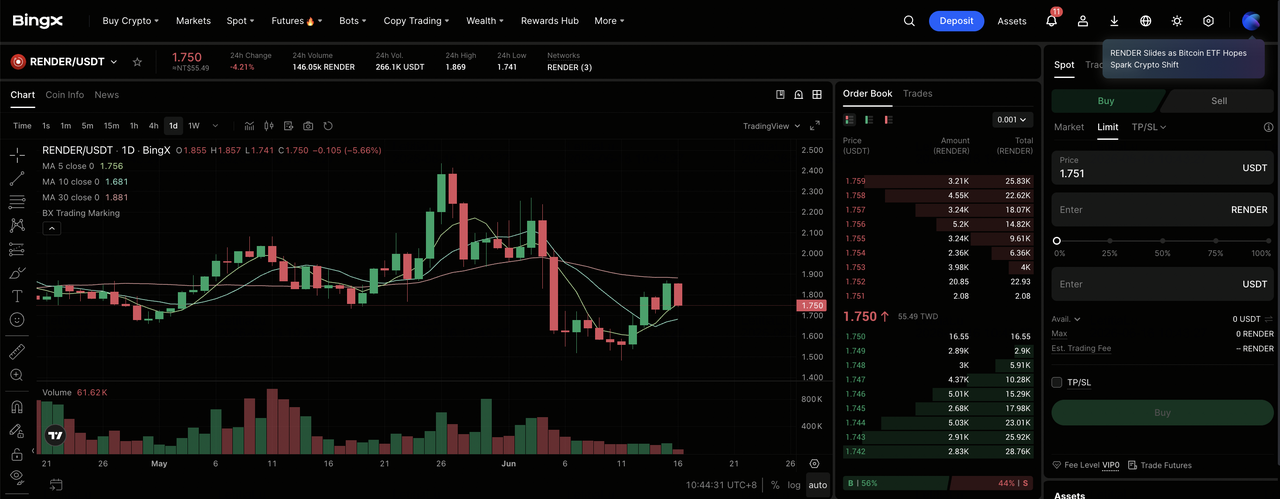
Step 1: Account setup and security. Sign up and log into your BingX account, complete the identity verification (KYC) required in your region, and enable two-factor authentication.
Step 2: Fund your spot account. Deposit USDT or another supported asset into your BingX spot account. Where available, users can also use supported fiat on-ramp options.
Step 3: Navigate to the spot market. Search for the RENDER/USDT trading pair.
Step 4: Place your order. Choose a market order to buy RENDER immediately at the current price, or use a limit order to set the price you want to pay.
Step 5: Manage your RENDER. Once filled, your RENDER appears in your spot account. You can keep it on BingX for convenience or withdraw it to a Solana-compatible self-custody wallet such as Phantom for use in governance voting or direct network participation.
Futures Trading: Trade RENDER Price Movements
For active traders, BingX offers USDT-margined RENDER perpetual futures. Futures allow users to trade RENDER price movements without holding the underlying asset, with the flexibility to open long positions if they expect RENDER to rise or short positions if they expect RENDER to fall.
Because futures involve leverage, they can amplify both gains and losses. This approach is more suitable for traders who already have a clear risk plan and understand liquidation risk, particularly for an asset like RENDER that is sensitive to both AI infrastructure sentiment cycles and on-chain job volume metrics.
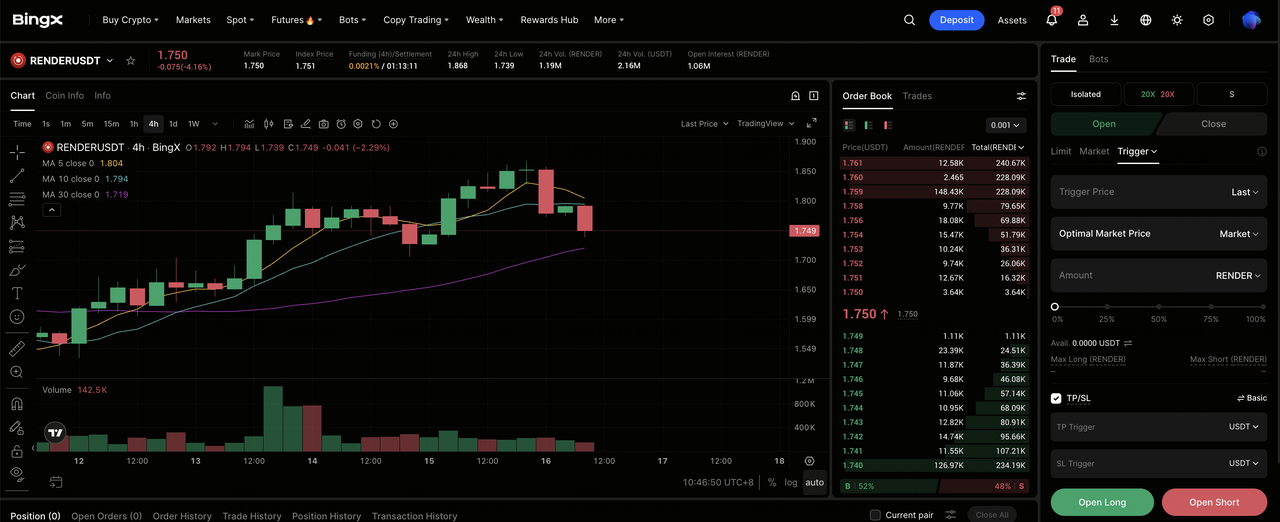
Step 1: Transfer collateral. Move USDT from your spot account into your futures account, where it will serve as margin.
Step 2: Select the contract. Search for the RENDER-USDT perpetual contract.
Step 3: Set direction and leverage. Open long if you expect RENDER to rise, or open short if you expect RENDER to decline. Choose leverage based on your risk tolerance and position size.
Step 4: Execute the trade. Enter the order amount and choose a market or limit order depending on your trading plan.
Step 5: Manage risk. Set stop-loss and take-profit orders before or immediately after entering the position. Profit and loss settle dynamically in USDT.
Risks and Considerations Before Investing in Render (RENDER)
Render Network has real creative rendering demand, growing AI compute ambitions, and a usage-linked tokenomics model. However, RENDER still carries risks tied to AI adoption, token supply mechanics, competition, OTOY dependency, and broader market sentiment.
- AI compute expansion is still developing: Render’s original strength is creative rendering through OTOY’s ecosystem. Expanding into broader AI workloads through Dispersed requires the network to prove it can support AI inference, training, and general GPU jobs at scale.
- BME depends on job volume: The Burn-and-Mint Equilibrium model is most favorable when network usage is high. If job demand grows faster than emissions, token burns can support supply reduction. If usage slows, newly minted rewards may outweigh burns and increase supply pressure.
- Competition is increasing: Render competes with AI-native decentralized compute networks such as io.net, Akash, and Nosana, as well as centralized cloud providers. Its creative rendering base is a strength, but AI developers may still choose platforms built specifically for AI workloads.
- OTOY dependency and transparency: OTOY created Render Network and remains important to its infrastructure and ecosystem. This gives Render a strong commercial foundation, but it also creates concentration risk. Some legacy token allocation and vesting details are also less transparent than investors may prefer.
- RNDR-to-RENDER migration overhang: Render migrated from Ethereum-based RNDR to Solana-based RENDER in 2023. While major exchanges supported the migration, some legacy RNDR holders may still need to convert manually, creating a small residual supply overhang.
- AI infrastructure sentiment risk: RENDER often trades with the broader AI and decentralized compute narrative. Price can move sharply based on sector sentiment, even when actual job volume or burn data does not change as quickly.
Final Thoughts: Should You Invest in Render in 2026?
Render Network is one of the more established projects in decentralized GPU compute. Its advantage comes from real creative rendering demand through OTOY, a Solana-based settlement layer, and the Burn-and-Mint Equilibrium model, which links RENDER supply to actual job activity. Dispersed also gives Render a clearer path into AI inference and enterprise GPU workloads, especially after H100 and H200 support was approved.
The key question for 2026 is whether AI compute demand can grow fast enough to make RENDER burns meaningfully offset or exceed emissions. Render’s creative workload base is real, but broader upside depends on Dispersed adoption, GPU-hour competitiveness, and whether developers choose Render over other decentralized compute networks such as io.net and Akash. For investors and traders, the most important metrics to watch are job volume, BME burns, emissions, AI compute adoption, and broader AI infrastructure sentiment.
Related Reading
- What Are the Top 10 DePIN Crypto Projects to Know in 2026?
- What Is Bittensor (TAO)? A Beginner's Guide to How Bittensor Works (2026)
- Top AI Compute and GPU Stocks to Buy in 2026: The Shift to Inference and Custom Silicon
- Top AI Cloud Infrastructure Stocks to Buy in 2026 Amid Hyperscaler Capex and the Neocloud Boom
- Top 10 AI Infrastructure Stocks to Buy in 2026: Chip Manufacturing and Design Leaders
FAQs About Render Network (RENDER)
1. What is the difference between RNDR and RENDER?
RNDR is the original Ethereum-based token launched by Render Network. RENDER is the newer Solana-based token introduced after the network migrated to Solana in 2023. The migration used a 1:1 conversion ratio, meaning 1 RNDR could be upgraded to 1 RENDER.
2. Which blockchain does Render Network run on?
Render Network now runs on Solana. The project originally launched on Ethereum, but moved to Solana to support faster settlement, lower transaction costs, and higher-volume GPU compute activity.
3. What is OTOY, and why is it important to Render Network?
OTOY is the graphics technology company founded by Jules Urbach that created Render Network. It is best known for OctaneRender, a GPU rendering software used in visual effects, animation, design, and 3D workflows. OTOY remains important because its software ecosystem and creative industry relationships give Render its original real-world rendering demand base.
4. Does Render Network still use OTOY?
Yes. Render Network is now governed by the Render Network Foundation, but OTOY remains closely involved as the original creator and a key technical contributor. OTOY’s OctaneRender ecosystem still supports Render’s creative rendering use case, while the network continues expanding into AI compute through Dispersed.
