

As artificial intelligence systems mature past purely digital bounds, the race to deploy embodied AI into the physical world has ignited a multi-trillion-dollar manufacturing and automation boom. Humanoid robotics represents the ultimate hardware platform for this transition, utilizing forms naturally optimized for human spaces, vehicles, and workflows without requiring systemic industrial redesign. However, access to investment in this rapidly accelerating sector has historically been confined to elite private funding rounds and institutional venture capital. Retail participants and decentralized on-chain capital are routinely left on the sidelines.
XMAQUINA (DEUS) solves this structural isolation by introducing a decentralized infrastructure layer that bridges on-chain capital with private robotics markets. By transforming illiquid private equity into standard, composable on-chain assets, XMAQUINA allows retail users and Web3 native allocators to back the world's top robotics builders. Operating primarily on the high-performance Base blockchain network, the ecosystem turns the hardware-anchored robotics expansion into an open, permissionless, and highly liquid investment index governed entirely by the community.
What Is XMAQUINA (DEUS)?
XMAQUINA is a sector-specific decentralized autonomous organization (DAO) and capital coordination framework engineered to provide structured, democratized access to the global robot economy. At its core, the project systematically dismantles three fundamental barriers in the traditional technology investment space:
- Access Restrictions: Pre-IPO equities in breakthrough hardware startups require multi-million dollar minimum buy-ins and exclusive institutional networks; XMAQUINA aggregates decentralized capital to participate directly in these early-stage private markets.
- Extreme Illiquidity: Venture capital allocations typically lock up capital for 7 to 10 years before an exit event; XMAQUINA anchors these private equity allocations to liquid, on-chain tokens tradeable 24/7.
- Thematic Fragmentation: Evaluating the robotics stack, ranging from cognitive operating systems to sensor arrays, is highly technical; XMAQUINA acts as a unified index, mapping capital directly to the most viable nodes in the value chain.
How Does XMAQUINA Work?
Source: XMAQUINA
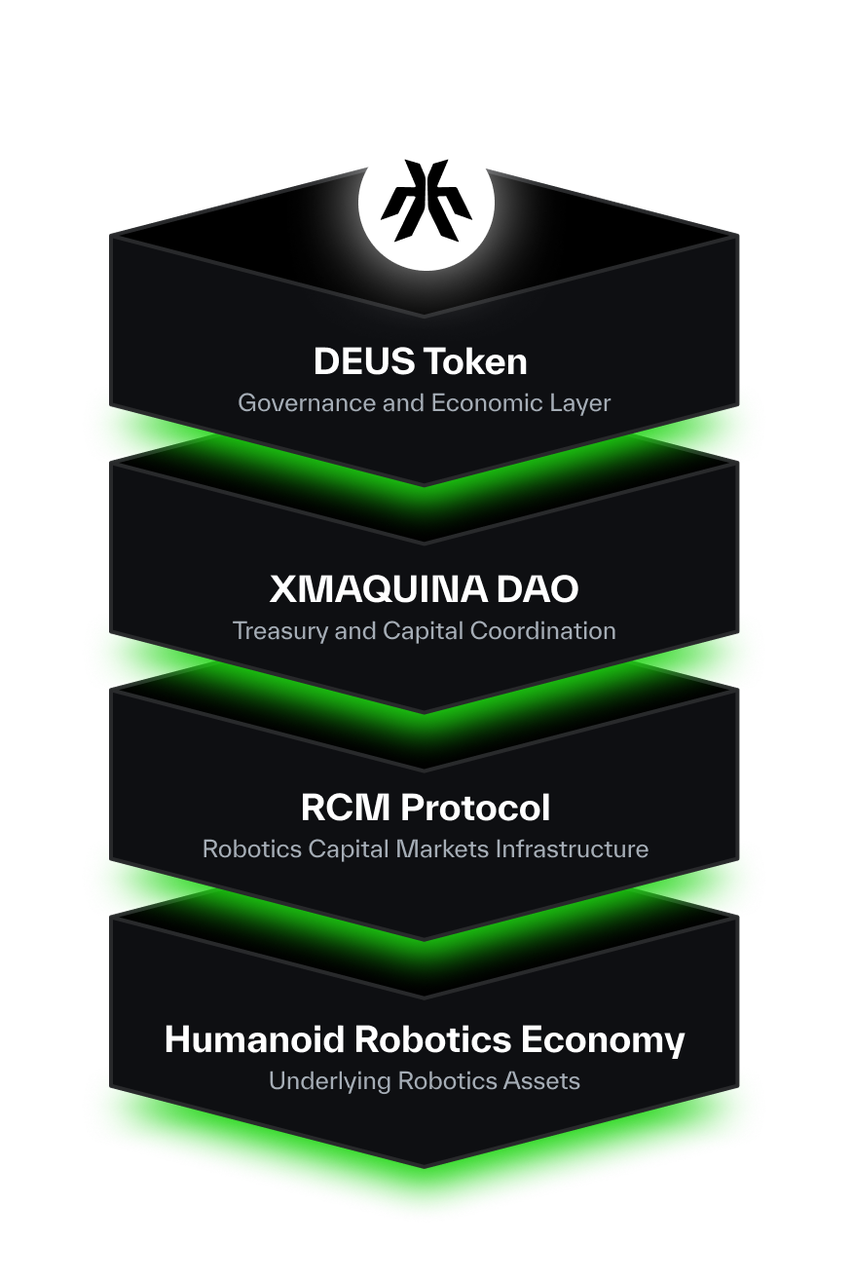
The XMAQUINA ecosystem coordinates capital deployment, secondary market liquidity, and asset creation through an integrated four-layer architecture, ensuring that every transaction reinforces the central protocol flywheel.
1. The XMAQUINA DAO Capital Allocation Layer
The DAO operates as the primary capital deployment vehicle. Guided by transparent, on-chain proposals voted on by token holders, the DAO treasury builds structural exposure across the humanoid robotics value chain. The portfolio targets highly sought-after private manufacturers and specialized hardware infrastructure. To date, the treasury has successfully executed five high-conviction pre-IPO equity allocations:
- Apptronik: Developers of Apollo, an AI-powered humanoid robot designed for commercial labor, backed by over $400 million in capital.
- Figure AI: Engineers behind high-dexterity general-purpose humanoids, which are already actively deployed in BMW manufacturing facilities.
- 1X Technologies: Builders of NEO, an advanced consumer-facing humanoid robot purpose-built for household tasks and everyday assistance.
- Agility Robotics: Creators of Digit, the industry's first safety-approved humanoid robot operating in commercial logistics networks.
- Neura Robotics: Pioneers of cognitive humanoids that embed advanced AI-driven sensory systems for heavy industrial and home use.
2. The Robotics Capital Markets (RCM) Protocol Liquidity Layer
The RCM Protocol is the specialized financial infrastructure responsible for tokenizing private robotics assets and launching them on-chain. Capital is raised publicly through specialized SubDAO Token Auctions. Each successful auction targets a specific private robotics allocation or automated machine array.
When a raise concludes, the RCM Protocol mints an asset-backed SubDAO token anchored directly to a Special Purpose Vehicle (SPV) that holds the underlying equity or physical asset. These tokens are then immediately paired with DEUS inside dedicated decentralized exchange liquidity pools, converting private market equity into liquid, tradable on-chain instruments.
3. DEUS Governance Coordination Layer
DEUS serves as the absolute governance and decision-making engine of the ecosystem. Utilizing a time-weighted voting metric, DEUS holders dictate the macro trajectory of the treasury, approve upcoming asset listings, and control ecosystem resources.
4. DEUS Labs Incubation Layer
DEUS Labs functions as the ecosystem's internal venture hub, bringing together researchers and engineers to build complementary products at the intersection of Web3, decentralized physical infrastructure networks (DePIN), and robotics. The lab's premier incubation is Robotico, a comprehensive data indexing, market intelligence, and structured analytics platform dedicated exclusively to cataloging and scoring the expanding humanoid robotics sector.
XMAQUINA vs. Traditional Tech Investing: Key Differences
|
Feature |
XMAQUINA Ecosystem |
Traditional Venture Capital |
Conventional Equity Trading |
|
Minimum Entry Capital |
Minimal ($1+ entry threshold) |
Multi-million dollar minimums |
Moderate (Brokerage limits) |
|
Asset Class Focus |
Pre-IPO Humanoid Robotics & Embodied AI |
Diversified Technology Portfolios |
Publicly listed equities (Post-IPO) |
|
Trading Horizons |
24/7 continuous on-chain liquidity |
7–10 year lockup periods |
Fixed stock exchange hours |
|
Sovereign Governance |
Direct on-chain voting power |
Limited to General Partners (GPs) |
Passive retail shareholder status |
|
Fee Structure Accrual |
Re-routed to token stakers via DAO |
Standard "2 and 20" VC management fees |
Centralized brokerage/clearing fees |
Traditional retail equity frameworks fail to capture the exponential early growth phase of tech disruptions because companies delay public IPOs far longer than they did in previous decades. By the time a robotics company lists on a major stock exchange, early venture funds have already extracted the highest valuation multiples.
XMAQUINA shifts this paradigm entirely. Through its SubDAO framework, it establishes a continuous, permissionless loop. Every trade executed across the RCM Protocol generates transaction fees that flow directly back into the DAO treasury. This revenue is systematically governed by the community to acquire further robotics equity, execute DEUS token buybacks, or fund staking rewards, separating the ecosystem's growth from basic speculation.
XMAQUINA (DEUS) Tokenomics: Powering the Machine Flywheel
The DEUS token acts as the primary programmatic coordination asset across the entire XMAQUINA landscape, managing asset liquidity and ecosystem value capture.
DEUS Token Utility and Value Accrual
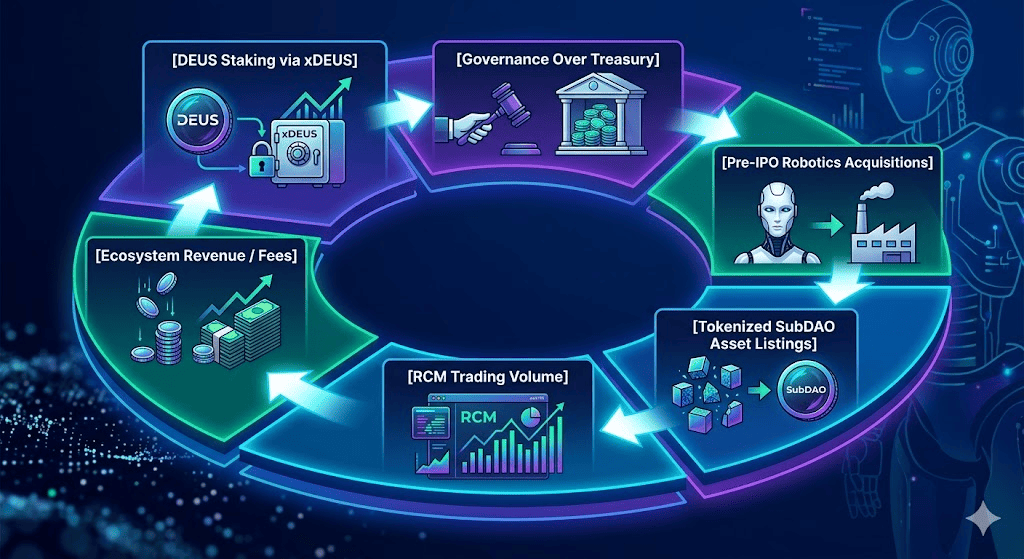
Value flows to the DEUS token through an elegant value-loop design that systematically drives consistent utility and demand:
- Staking to Mint xDEUS: Token holders stake their liquid DEUS to mint xDEUS, a non-transferable governance token position. xDEUS grants voting power over treasury deployments, protocol fee distribution parameters, and project directions.
- The Time-Lock Multiplier: Staking rewards and governance weights are non-linear; the longer a participant commits their DEUS within the governance architecture, the higher their vote-weight multiplier and reward scaling factors become.
- The RCM Liquidity Vault Match: Every single asset tokenized by the RCM Protocol must be structurally paired with DEUS inside decentralized liquidity pools. Consequently, as the number of tokenized robotics companies and SubDAOs expands, massive quantities of DEUS are programmatically locked into liquidity pools, causing a corresponding contraction in available market supply.
DEUS Token Allocation Breakdown
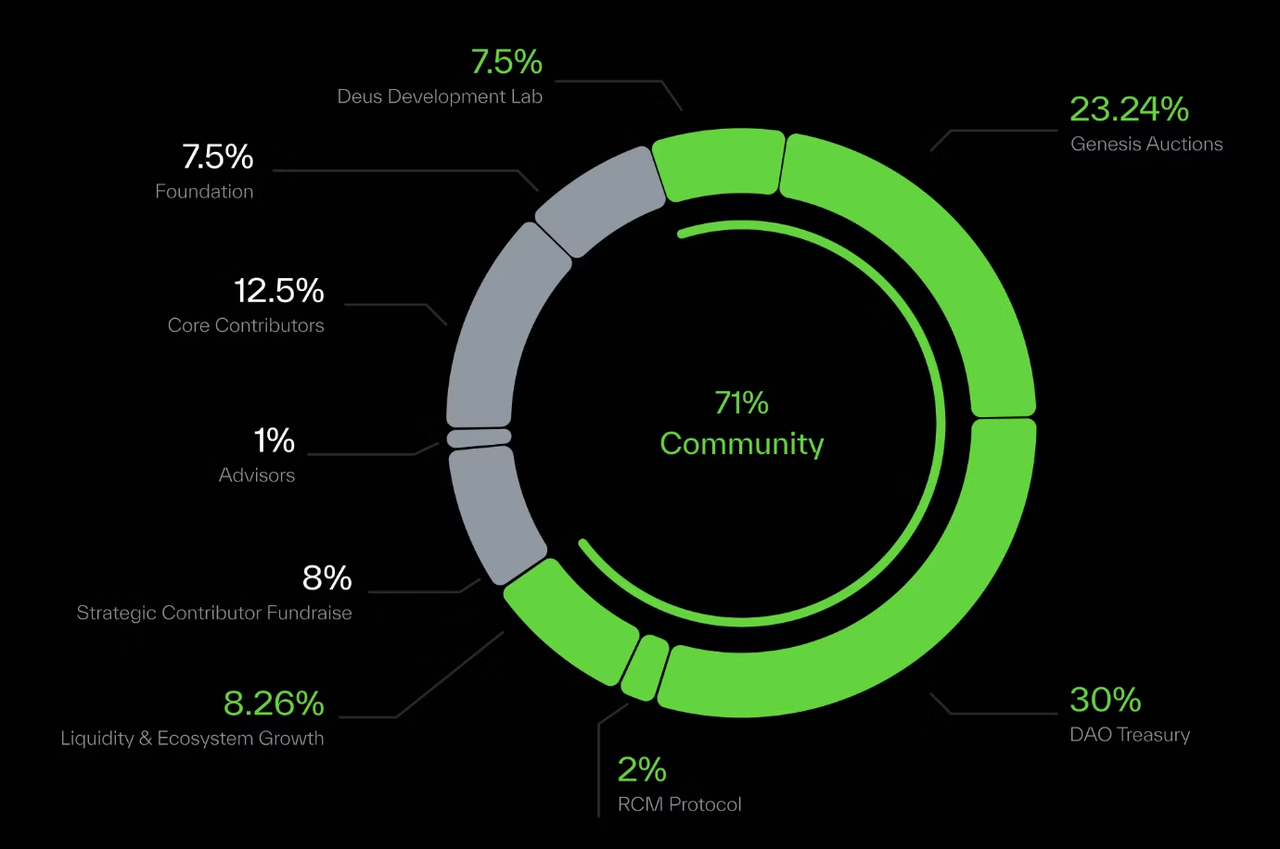
DEUS token distribution | Source: XMAQUINA docs
DEUS maintains a fixed, non-inflationary maximum supply of 1,000,000,000 tokens built natively as an ERC-20 token, utilizing LayerZero standard infrastructure for frictionless cross-chain expansion across Base, Solana, and other top-tier networks.
- DAO Treasury (30.00%): 300,000,000 tokens allocated for long-term capital deployment and strategic acquisitions; 33% unlocked at the Token Generation Event (TGE), with the remainder unlocking linearly over 48 months.
- Genesis Auctions (23.24%): 232,400,000 tokens distributed to the public through decentralized bootstrapping auctions, raising over $10 million to initially seed the treasury; 33% unlocked at TGE, remainder over 12 months linear.
- Core Contributors (12.50%): 125,000,000 tokens reserved for the founding development team, bound to a strict 12-month cliff followed by a 12-month linear monthly vest.
- Liquidity and Ecosystem Growth (8.26%): 82,600,000 tokens dedicated to exchange liquidity provisioning and automated ecosystem incentives; 100% unlocked at TGE.
- Strategic Contributor Fundraise (8.00%): 80,000,000 tokens distributed to institutional and strategic alignment partners subject to structured vesting timelines.
- DEUS Development Lab (7.50%): 75,000,000 tokens allocated for internal product engineering and node scaling; 33% unlocked at TGE, remainder over 24 months.
- Foundation (7.50%): 75,000,000 tokens for ecosystem preservation, compliance, and legal frameworks under structural cliffs.
- RCM Protocol Incentives (2.00%): 20,000,000 tokens allocated to bootstrap liquidity provider pools on launch; 100% unlocked at TGE.
- Advisors (1.00%): 10,000,000 tokens issued to advisory figures with strict cliffs and linear vests.
How to Trade XMAQUINA (DEUS) on BingX
BingX provides a highly secure, institutional-grade trading ecosystem to monitor, analyze, and trade DEUS tokens, featuring advanced charts, real-time depth analysis, and robust risk management tools.
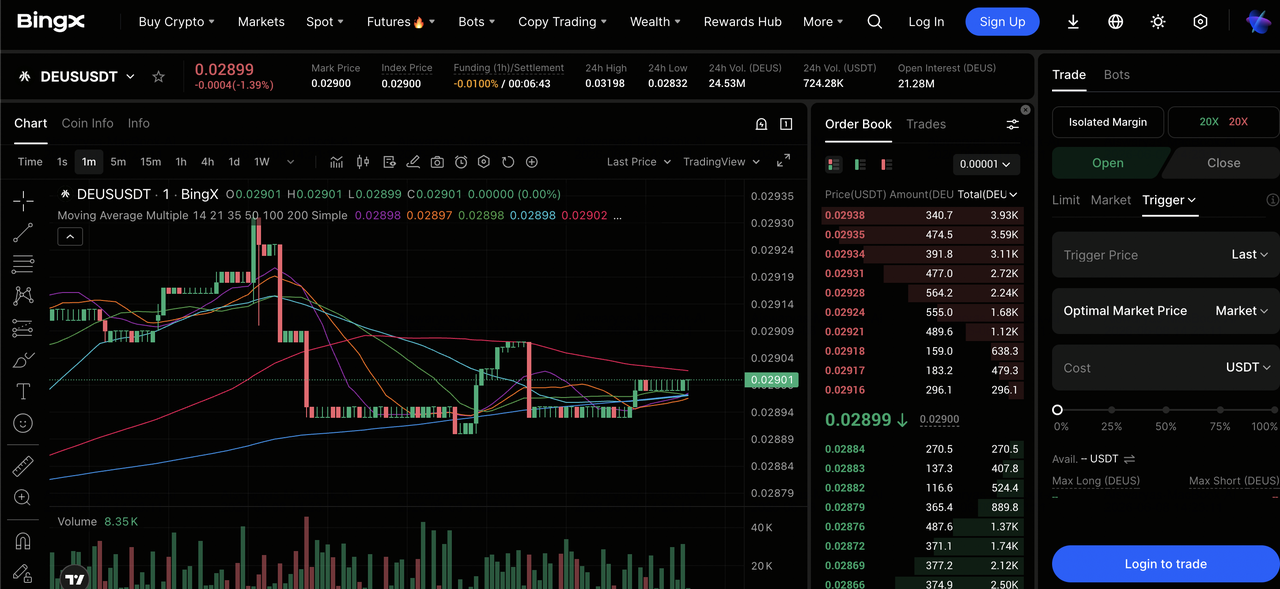
DEUS/USDT perpetuals on BingX futures market
Long or Short DEUS in the Spot and Futures Markets
- Access the Asset Interface: Navigate to the main trading interface, select the Spot or Futures market tab, and locate the DEUS/USDT perpetual contract.
- Configure Your Capital Parameters: If utilizing the futures market, isolate your risk parameters by selecting Isolated Margin Mode to protect your broader balance, or Cross Margin Mode to share margin across active strategies.
- Calibrate Leverage Scales: Carefully adjust the leverage slider to align with your personal risk tolerance parameters. Remember that high leverage ratios amplify both potential profits and real liquidation risks.
- Execute the Entry Order: Submit a Buy/Long market or limit order if your underlying data models indicate structural token appreciation, or a Sell/Short order to hedge spot allocations or profit from near-term market downside.
5 Key Considerations Before Investing in XMAQUINA (DEUS)
Before committing capital to the XMAQUINA ecosystem, carefully evaluate these foundational risk factors:
- Vesting and Supply Inflation: Following its successful Token Generation Event (TGE) on May 27, 2026, the protocol enters a phase of gradual supply expansion as linear unlocks from the Genesis Auctions and DAO Treasury enter circulation monthly.
- Hardware Development Horizons: Humanoid robotics is a long-cycle, capital-intensive infrastructure buildout. Portfolio companies face multi-year manufacturing, testing, and regulatory timelines before achieving massive commercial monetization.
- Illiquid Asset Valuation Complexities: Private market assets do not change price continuously like public stocks. On-chain valuation metrics and SubDAO token premiums depend heavily on periodic private funding rounds and general sector sentiment.
- Cross-Chain Expansion Dependencies: While currently anchored primarily on Base via Aerodrome Finance and Virtuals Protocol, XMAQUINA's pending roadmap expansion into the Solana ecosystem relies on LayerZero cross-chain bridges, introducing common localized smart contract risks.
- Execution & Technical Counterparty Risks: While the DAO governs the assets, the physical pre-IPO equity shares are held within legally structured off-chain Special Purpose Vehicles (SPVs). This setup relies on corporate custodians and legal compliance frameworks to enforce on-chain claims.
Final Thoughts: Should You Buy XMAQUINA (DEUS)?
XMAQUINA establishes a vital financial primitive by converting elite, private-market corporate tech investments into highly composable, democratic on-chain instruments. By anchoring its core thesis around general-purpose humanoids and enforcing a protocol fee flywheel that rewards long-term DEUS stakers, the ecosystem changes how retail investors interact with the next industrial revolution.
Backed by a treasury that holds positions in the absolute vanguard of hardware engineering, including Figure AI and Apptronik, and moving steadily down an ambitious roadmap toward mainnet RCM Protocol expansion, XMAQUINA provides an elegant, liquid index for the machine economy. As blockchains increasingly serve as the ultimate settlement layers for real-world assets, DEUS offers an efficient vehicle for long-term technology exposure that functions independently of standard retail crypto speculation cycles.
Risk Reminder: Decentralized capital coordination, asset tokenization, and pre-IPO investment vehicles carry inherent smart contract, operational, and structural regulatory risks. Always perform your own continuous research, track governance proposals through the official DAO portal, and never allocate more capital than you can comfortably afford to lose. BingX assumes no responsibility for external trading or investment allocations.
Related Reading
- What Are the Top 10 DePIN Crypto Projects to Know in 2026?
- Top 5 DePIN Projects to Watch in the Solana Ecosystem 2026
- What Is ShareX Network (SHARE) DePIN Protocol for the Sharing Economy and How to Buy?
- What Is Spacecoin (SPACE) DePIN Project and How to Buy It?
- What Is XPIN Network (XPIN) AI-Powered DePIN and How Does It Work?
