

For over fifteen years, Bitcoin has reigned as the undisputed king of digital assets, widely revered as digital gold and the ultimate decentralized store of value. However, while alternative Layer 1 assets natively support smart contracts, staking, and decentralized finance (DeFi), Bitcoin has historically remained static and unproductive due to the base layer's structural programming limitations.
Early attempts to activate Bitcoin liquidity relied either on centralized finance (CeFi) lenders like BlockFi and Celsius, which collapsed due to opaque management, or centralized wrapping mechanisms like WBTC, which introduce custody risks. Zest Protocol resolves this dilemma by introducing a fully transparent, battle-tested lending infrastructure on top of Bitcoin. Backed by industry pioneers including Tim Draper, Muneeb Ali, Flow Traders, and YZi Labs (formerly Binance Labs), Zest Protocol establishes a capital-efficient environment where Bitcoin holders can finally put their assets to work without surrendering custody to a centralized intermediary.
What Is Zest Protocol?
Zest Protocol is a decentralized, open-source lending platform built on Stacks (STX), a smart contract Bitcoin Layer 2 network that settles directly to the Bitcoin blockchain. Operating as a cornerstone of the emerging BTCFi (Bitcoin DeFi) ecosystem, Zest Protocol allows participants to deploy their assets into automated liquidity pools to capture yield or access overcollateralized loans.
At its core, the protocol solves three critical friction points in the digital asset landscape:
- Idle Bitcoin Capital: Trillions of dollars in BTC sit unproductive. Zest enables users to supply Bitcoin-backed assets to earn yield or borrow stablecoins against them.
- Counterparty and Custody Risk: Traditional Bitcoin lending requires trusting a custodian. Zest Protocol utilizes decentralized Stacks smart contracts and non-rehypothecated collateral architectures to ensure user assets are never lent out or repurposed behind closed doors.
- Liquidation Inefficiencies: Market volatility frequently triggers cascading liquidations in DeFi. Zest Protocol’s architecture has successfully processed more than 1,500 liquidations with zero bad debt, demonstrating rigorous risk infrastructure across major market cycles.
How Does Zest Protocol Work?
Zest Protocol functions through an automated system of smart contracts that govern capital pools, calculate dynamic interest rates, and manage collateral requirements transparently.
1. Stacks Market V2 and Risk Groups
With the launch of its V2 upgrade, Zest Protocol replaced the rigid, single-parameter model typical of early lending platforms with an advanced Risk Groups framework. Instead of assigning a blanket Loan-to-Value (LTV) ratio to an asset regardless of what is borrowed, V2 establishes isolated configurations for each collateral-debt pair:
- Correlated Pairs: High-correlation or stable asset pairs, e.g., stablecoin-to-stablecoin, support higher LTV ratios, drastically improving capital efficiency.
- Volatile Pairs: Correlated pairs involving volatile assets are assigned conservative LTV limits and earlier liquidation thresholds to isolate and contain volatility.
2. The Role of sBTC and Stacks Nakamoto Upgrade
Following the Stacks Nakamoto upgrade, sBTC, a decentralized, 1:1 Bitcoin-pegged asset secured by an open signer set, became a fundamental pillar of the protocol. Zest Protocol captures over 10% of the total circulating sBTC supply on Stacks. Users bridge native BTC to mint sBTC, deposit it into Zest, and organically tap into Dual Stacking yield mechanics, yielding up to 12.5% APY through enhanced reward boosters.
3. The Endgame: Bitcoin Collateral Vaults (BitVM)
The protocol’s most disruptive feature is its ongoing rollout of Bitcoin Collateral Vaults, bridging the gap between Bitcoin L1 security and DeFi utility. This infrastructure deploys in two distinct phases:
|
Feature |
Phase 1: Pre-signed Vaults |
Phase 2: Full BitVM Verification |
|
Trust Layer |
Watchtower Network & Guardian Council |
Bitcoin Consensus & BitVM Cryptographic Proofs |
|
Verification |
Threshold signing of constrained spend paths |
Optimistic fraud-proof verification on Bitcoin L1 |
|
User Experience |
Native BTC locked on L1; mints non-fungible vaultBTC |
Seamless transition to trustless execution with no UI change |
|
Liveness Dependency |
Independent institutional validators |
Purely mathematical and cryptographic security |
In Phase 1, a user locks native BTC into a Taproot UTXO on the Bitcoin base layer. A distributed network of Watchtowers pre-signs strict transaction variants, restricting the asset's movement so it can only ever flow back to the depositor or to an approved liquidator. An institutional Guardian Council monitors cross-chain state; if an invalid action occurs, the council intervenes to route the BTC directly to the user's failsafe address.
In Phase 2, the institutional guardians are completely replaced by BitVM technology. When a loan is repaid or liquidated on an external chain like Ethereum, a Zero-Knowledge (ZK) or cryptographic proof is verified directly via BitVM on the Bitcoin base layer. If a malicious claim is posted, any independent challenger can submit a fraud-proof during a timelock window to block it. This reduces the trust model to the security of Bitcoin itself.
Zest Protocol vs. Traditional Crypto Lending Solutions
|
Feature |
Zest Protocol (V2 / Vaults) |
Wrapped Token Protocols (WBTC) |
Centralized Lenders (CeFi) |
|
Collateral Custody |
Non-rehypothecated / Self-Custodial |
Centralized/Multisig Merchant Custody |
Opaque Internal Wallets |
|
Smart Contract Risk |
Open-source, audited Stacks/L1 contracts |
Dependent on bridging infrastructure |
None (Pure Counterparty Risk) |
|
Liquidation Model |
Soft, stepped liquidations via Flash Settlement |
Instant collateral auction cliffs |
Manual/Arbitrary Liquidation |
|
Yield Sourcing |
Transparent on-chain borrower interest |
None native to the asset wrapper |
Off-chain rehypothecation/Institutional lending |
Traditional asset wrappers convert Bitcoin into synthetic ERC-20 variants, exposing users to bridge vulnerabilities, smart contract failures, and centralized custodian oversights on external chains. CeFi networks aggregate capital into opaque, internal books, running severe maturity mismatches and counterparty default risks that historically erased billions in user net worth.
Zest Protocol fundamentally alters this dynamic through code-enforced, on-chain accountability. By utilizing Stacks and evolving into BitVM-driven L1 vaults, Bitcoin collateral stays isolated from DeFi tail risks. Under the Flash Settlement Module, when a position breaches its threshold, a liquidator executes a single EVM transaction using flash-borrowed stablecoins. The protocol handles the multi-day settlement latency of the Bitcoin network asynchronously behind the scenes. This eliminates sudden liquidation cliffs, preserves standard DeFi liquidation economics (around 2% bonus), and ensures that the happy-path user is never exposed to external synthetic risk structures.
What Is ZEST Tokenomics: Driving the BTCFi Economy
The ZEST token is the native governance and incentive asset of Zest Protocol, launched via its Token Generation Event (TGE) on May 19, 2026, alongside an official listing on major trading platforms.
ZEST Token Utility
- Protocol Governance: ZEST holders govern the risk profile of the platform, voting on parameters such as acceptable collateral assets, interest rate models, Risk Group configurations, and L1 vault implementations.
- Liquidity Incentives: ZEST tokens are distributed to ecosystem participants who supply liquidity to Stacks V2 markets, bootstrap stablecoin pools, such as aeUSDC and USDh, or secure core lending markets.
- Staking Infrastructure: Future upgrades will allow ZEST holders to stake their tokens to capture structural protocol revenue streaming from both the Stacks Market and Bitcoin Collateral Vault fees.
ZEST Token Distribution
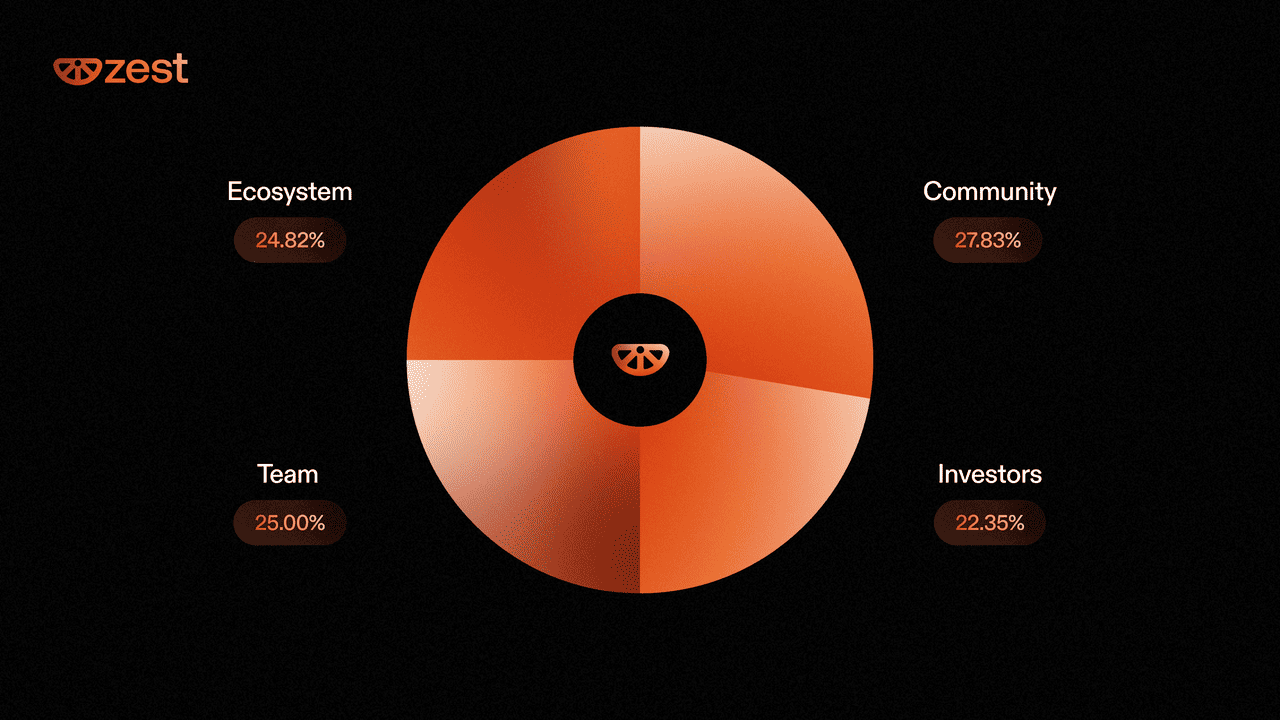
ZEST token allocation | Source: Zest Protocol docs
The total supply of ZEST is permanently capped at 1,000,000,000 tokens. The structural architecture of the allocation is distributed as follows:
- Community (27.83%): Dedicated to airdrops and user rewards. Season 1 points holders receive an initial allocation, with 0.1% unlocked at TGE and the remainder vesting across months 4, 5, and 6, while the remaining 25.83% vests linearly over 24 months to continuously incentivize deep protocol liquidity.
- Ecosystem Development (24.82%): Supports market-making liquidity, cross-chain bridge deployments, including the Stacks–BNB bridge, and ecosystem expansions. 14.5% of this allocation unlocked at TGE, with the rest vesting linearly over 12 months.
- Team (25.00%) & Investors (22.35%): Both allocations are subject to a strict one-year cliff followed by a three-year linear monthly vesting schedule, ensuring complete alignment with the protocol's multi-year development roadmap.
How to Claim Zest Protocol Airdrop
To claim your Zest Protocol (ZEST) airdrop allocations, follow the procedure below depending on whether you participated as an on-chain Stacks Market user or through the recent exchange launch pools.
For Season 1 On-Chain Points Holders (Stacks Market Users)
If you supplied or borrowed assets on the Zest Protocol platform during the Stacks Market era prior to the snapshot on May 13, 2026, you must claim your allocation manually through the official decentralized application (dApp).
- Access the Points Portal: Navigate directly to the official Zest Protocol points portal page to connect your Stacks or Bitcoin wallet.
- Connect Your Wallet: Click Connect Wallet and select the Stacks/Bitcoin L1 compatible wallet, such as Xverse or Leather, that holds your eligible active positions or snapshot history.
- Verify Allocation & Multipliers: The dashboard will reflect your total points and show any applied multipliers, e.g., 1.25× for an Open Position Bonus, or up to 1.7× for holding a Genesis King NFT.
- Execute the Claim: Initiate the on-chain claim transaction. Note the distribution parameters:
-
- At TGE: 0.1% of the overall community pool allocated to Season 1 points holders unlocks instantly.
- Vesting Months 4, 5, and 6: 0.3% unlocks during each of these respective monthly windows.
- Post-Month 6: An additional 1% will be distributed based on upcoming protocol guidelines.
- At TGE: 0.1% of the overall community pool allocated to Season 1 points holders unlocks instantly.
Critical Forfeiture Deadline: All allocated tokens for Season 1 points, including the initial TGE release and the portions unlocked in months 4, 5, and 6, must be claimed no later than one month after the month 6 unlock date. Any tokens left unclaimed past this exact deadline will be permanently forfeited.
How to Trade Zest Protocol (ZEST) on BingX
BingX provides a highly integrated trading environment paired with real-time analytics to monitor ZEST staker inflows, market depth, and broader BTCFi sentiment.
Long or Short ZEST Perpetuals in the Futures Market
- Access Derivatives: Navigate to the Futures interface and open the ZEST/USDT Perpetual Contract.
- Configure Risk Settings: Select your margin structure, e.g., Isolated Margin to silo risk or Cross Margin to utilize account-wide equity, and select your desired leverage ratio.
- Open Position: Click Open Long if your technical analysis points toward upward price discovery, or Open Short to trade downward momentum or hedge spot market holdings.
5 Key Considerations Before Investing in Zest Protocol
Before committing capital to the ZEST ecosystem, evaluate these core macroeconomic and architectural parameters:
- BitVM Execution Schedule: The protocol’s transition from pre-signed Phase 1 vaults to full Phase 2 cryptographic verification depends entirely on the stabilization of BitVM mainnet tooling.
- Airdrop Forfeiture Window: If you are a Season 1 points holder, ensure you claim your vested distributions via the app terminal. Unclaimed tokens will be permanently forfeited exactly one month after the month 6 unlock deadline.
- Liquidation Rounding: To navigate the atomic nature of Bitcoin UTXOs, partial liquidations on Zest round up to the nearest percentage bracket, with excess capital settled asynchronously back to the depositor.
- Dependence on Layer 2 Infrastructure: While L1 vaults optimize security, Zest's primary transactional velocity relies on the Stacks network throughput and the broader adoption rate of sBTC.
- Ecosystem Capital Inflows: Anticipated allocations from the 500 million STX Stacks Endowment could fundamentally lower protocol borrowing costs and accelerate looping strategies, directly impacting ZEST utility.
Final Thoughts: Should You Buy Zest Protocol (ZEST)?
Zest Protocol (ZEST) marks a pivotal structural shift for the Bitcoin economic system, transitioning the asset from a passive hedge into an active, productive financial foundation. By decoupling asset yield from traditional custodial vulnerabilities and introducing a dual-phase BitVM execution architecture, Zest bridges institutional capital requirements with retail self-custody principles. As the protocol scales its Risk Group parameter models and captures deeper stablecoin liquidity against native L1 UTXOs, it stands positioned as a foundational liquidity layer for the trillion-dollar BTCFi landscape.
Risk Reminder: BTCFi and Layer 2 decentralized applications are subject to smart contract vulnerabilities, changing execution environments, and localized digital asset volatility. Always conduct deep technical diligence and monitor protocol updates before participating. BingX assumes no liability for individual trading outcomes or platform performance.
