
When buying and sellingBitcoin (BTC) on different exchanges, you're nominally purchasing the same asset, but the actual costs you pay can vary dramatically. Many users only look at "trading fees" when choosing a platform, but overlook thespread and market depth (liquidity) that equally impact total costs. These three factors together determine the true cost of a BTC transaction: trading fees are the explicitly charged portion, spreads are hidden costs embedded in execution prices, and market depth determines whether large transactions can be executed at prices close to the displayed quotes.
For Taiwanese users, the importance of these three cost components varies with trading scale. For small, occasional trades, differences in trading fees have limited impact on results; but for users making large single conversions, planning withdrawals, or requiring frequent operations, cost differences between exchanges can continuously accumulate with each transaction, creating significant monetary differences. Without systematic comparison, users typically stick to familiar platforms out of habit, without necessarily knowing how much they could save on the same trade using a platform with better conditions.
This article focuses on spreads and market depth to systematically compare differences in BTC trading costs across mainstream exchanges, explains tools available for real-time verification of these metrics, and organizes indicators that Taiwanese users should prioritize when choosing exchanges, helping you make more informed decisions before each operation.
Key Takeaways
- BTC's actual trading costs consist of three components: trading fees (explicit rates), spreads (embedded in execution prices), and slippage (price deviation from insufficient liquidity during large trades). Only by calculating all three together can you approach true trading costs.
- Spreads are the most easily overlooked hidden cost. On platforms advertising "zero fees," spreads can reach 0.5% to over 1%, making overall costs higher than exchanges that charge explicit trading fees.
- Market depth directly affects large trade execution quality. When order book depth is insufficient, market orders execute at different price levels, causing final average execution prices to deviate from originally displayed prices, creating slippage losses.
- BingX's BTC/USDT spot trading fee is 0.1% (same for maker and taker fees), which is relatively low among mainstream exchanges. Combined with stable order book depth, it's suitable as a primary platform for Taiwanese users' BTC trading.
- CoinGecko and CoinMarketCap provide free multi-exchange comparison pages where you can view BTC spreads, depth, and trading volume on the same page, suitable for quickly comparing conditions across different platforms before trading.
Extended Reading:What Are Cryptocurrency Trading Fees? What Is Spread? Complete Trading Cost Guide
How to Evaluate BTC Trading Costs: Fees, Spreads, Depth, and Slippage
Before comparing different exchanges' BTC trading conditions, we need to first clarify the definitions and calculation methods of four core indicators to enable meaningful comparison, rather than just looking at single numbers displayed by platforms.
- Spread: Spread is the gap between the best bid price and best ask price in the order book, usually expressed as a percentage. Even if an exchange doesn't charge trading fees, spread itself remains an unavoidable hidden cost. Exchanges with high liquidity can have spreads as low as 0.01%; platforms with poor liquidity may have spreads reaching 0.5% to 1%.
- Trading Fee: Trading fees are explicit charges that exchanges levy based on transaction amount, divided into maker fees (placing orders in the order book waiting for matching) and taker fees (immediate execution). Generally, maker fees are lower than taker fees, and this is the easiest cost to confirm beforehand among the four indicators.
- Market Depth: Market depth refers to the order volume that can be immediately executed within a specific price range, often expressed as "±2% depth," representing total order volume within 2% above and below the current price. Higher depth means the market can handle larger-scale trades without significantly affecting prices.
- Slippage:Slippage is the cost generated when executing large market orders due to insufficient order book depth, causing actual average execution prices to deviate from original quotes. For example, planning to buy $1 million USDT worth of BTC, but the best price level only has $300,000 USDT worth of orders, so the remainder must execute at higher prices, making the final average price higher than expected. Slippage size is determined jointly by trade size and current market depth, with particularly significant impact on large trades.
Multi-Exchange BTC Price Comparison Tools: Quick Check on Spreads and Liquidity
Before directly comparing exchanges, you can first use the following two free tools to quickly verify BTC quote differences, trading volume rankings, and spread depth data across multiple platforms on the same page, serving as a comparison portal before operations.
1. CoinGecko Market Comparison
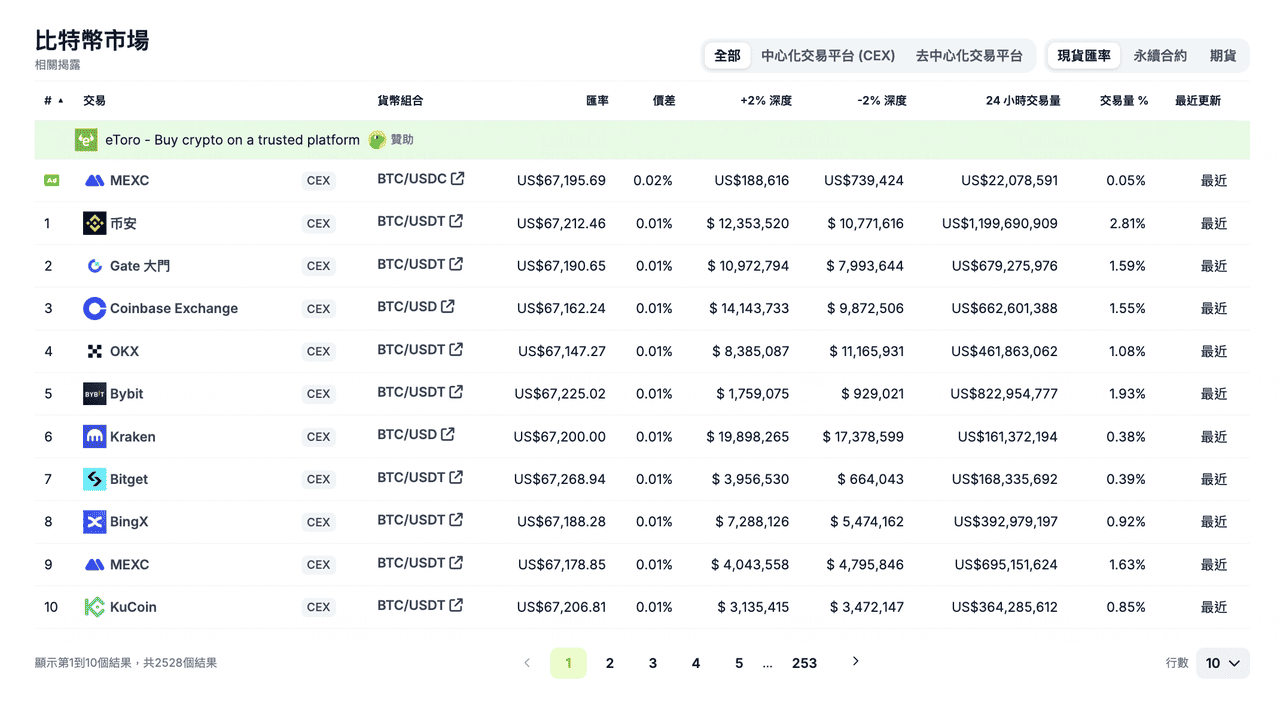
CoinGecko's "Markets" tab on the BTC coin page lists real-time quotes for BTC/USD and BTC/USDT from major global exchanges, simultaneously displaying 24-hour trading volume, ±2% spread depth, and last update time. Taiwanese users can directly compare spread and depth data from platforms like BingX, Kraken, and Crypto.com on the same page. Generally, smaller spread percentages and higher depth values indicate more sufficient liquidity on that exchange at the moment. CoinGecko's data updates approximately every 1-2 minutes, suitable for quick comparison before operations, but not suitable for second-level high-frequency trading decisions.
2. CoinMarketCap Market Comparison
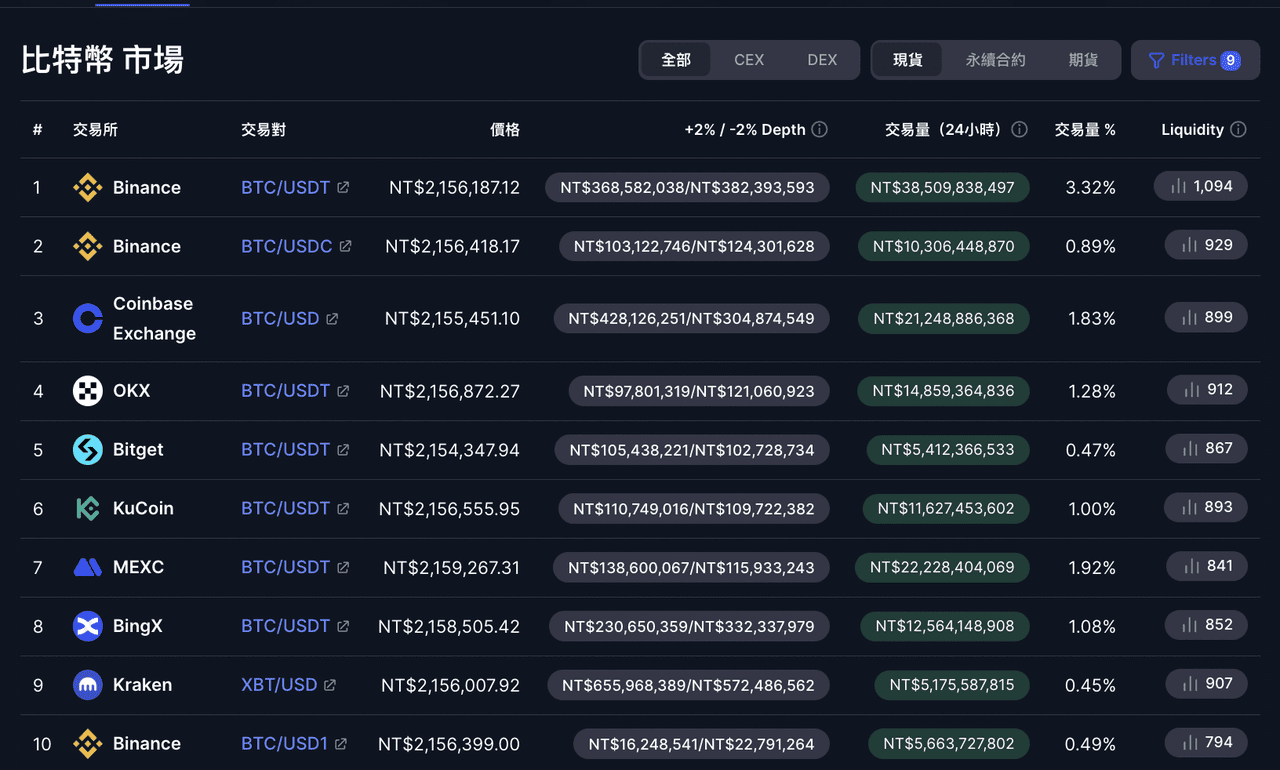
CoinMarketCap provides similar exchange comparison functionality on the BTC coin page, additionally including "Liquidity Score" as an evaluation indicator for quote quality. This indicator measures exchanges' actual market depth and quote reliability, helping users identify platforms where trading volume data may be inflated. For Taiwanese users, this indicator is particularly useful: some exchanges with higher trading volume rankings may not have corresponding liquidity, and liquidity scores can serve as filtering criteria. Additionally, CoinMarketCap provides BTC's 24-hour trading volume rankings, helping quickly determine which platforms have higher actual trading activity.
Best BTC Trading Platforms for Taiwan Users: BingX vs Kraken vs Crypto.com vs MAX & BitoPro
Spreads and market depth are core indicators for measuring exchange liquidity quality. Below we compare mainstream platforms most commonly used by Taiwanese users, explaining differences between exchanges in these two dimensions and their practical impact on different trade sizes.
1. BingX
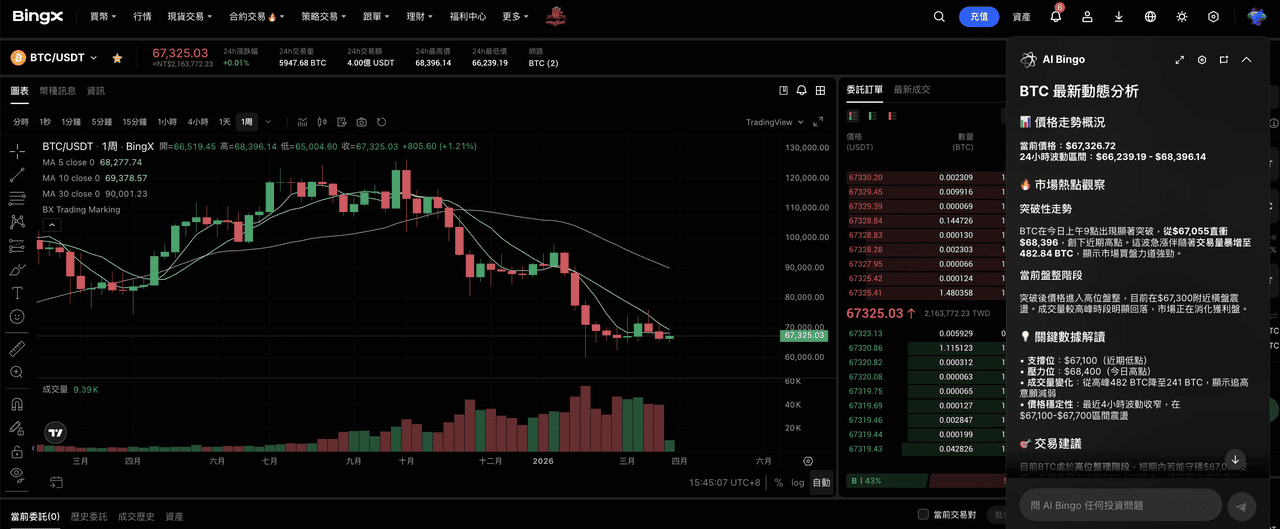
BingX's BTC/USDT spot market has competitive liquidity performance. With over 40 million global users,BTC/USDT is one of the highest trading volume pairs, with dense order book orders. Under normal market conditions, spreads are usually below 0.05%, and medium-scale trades can basically execute near displayed quotes. For Taiwanese users planning to withdraw BTC, after selling to USDT, they can choose TRC-20 network (fees usually below $1) to transfer to MAX or BitoPro for TWD conversion, or transfer to Kraken for USD SWIFT wire transfer. The entire pathway has high cost predictability. BingX also supportsBTC perpetual futures, with maker fees of 0.02% and taker fees of 0.05%, extremely competitive levels in the futures market.
BingX BTC/USDT Liquidity Highlights
- Spread: Usually below 0.05% under normal market conditions, excellent level among mainstream exchanges, medium-scale trades can basically execute near displayed quotes.
- Order Book Depth: BTC/USDT is a core trading pair on the platform with dense orders, lower slippage risk for large trades, depth chart can be viewed directly in the trading interface.
- Taiwan Withdrawal Path Integration: After selling BTC to USDT, can transfer via low-cost TRC-20 to MAX or BitoPro for TWD conversion, or transfer to Kraken for USD SWIFT wire transfer, both paths can start from BingX.
- Full Traditional Chinese Interface: From depth chart interpretation to order placement to customer service, no language switching needed throughout, reducing hidden losses from operational errors.
- Large Trade Recommendation: For larger BTC trades, recommend using limit orders to lock in target prices, avoiding slippage when market orders face insufficient liquidity momentarily.
2. Kraken Pro
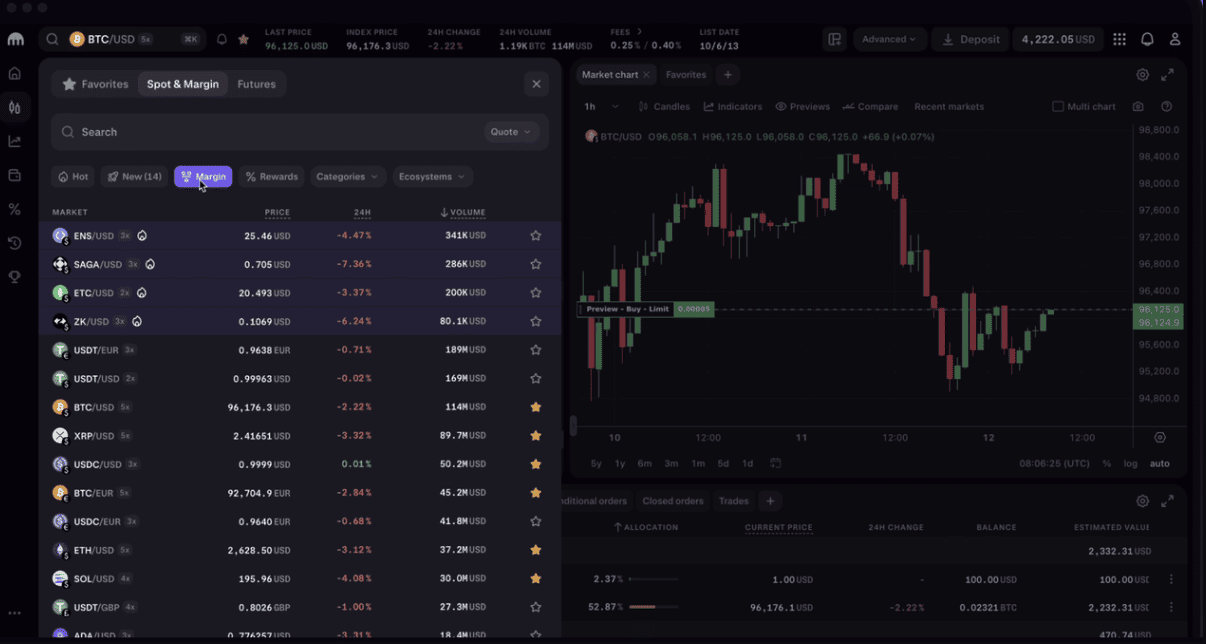
Kraken was established in 2011 and has never experienced customer fund losses. It holds a Wyoming State Bank charter in the US, with compliance framework close to traditional financial institutions. BTC/USD is Kraken's highest trading volume pair, with high institutional user proportion contributing consistently to order book depth, making Kraken's BTC market liquidity stability relatively outstanding during volatile periods.
For Taiwanese users, Kraken's core advantage is supporting SWIFT wire withdrawals, allowing direct USD transfers to Taiwan foreign currency accounts. SWIFT fixed fee is approximately $25, suitable for large single withdrawals to spread costs. Kraken uses full English interface, requires intermediate KYC level (identity and address verification) to enable SWIFT withdrawals. Taiwanese users planning withdrawals should complete verification early.
Kraken Pro BTC/USD Liquidity Highlights
- Spread: Usually below 0.1% under normal market conditions, institutional user participation makes spreads relatively stable during volatile periods, spread expansion during large trades is usually smaller than platforms with weaker liquidity.
- Order Book Depth: BTC/USD depth ranks highly among mainstream exchanges, institutional-grade liquidity ensures execution quality for large currency exchanges.
- SWIFT Wire Withdrawals: Fixed fee approximately $25, suitable for users wanting USD directly deposited to Taiwan foreign currency accounts. Fixed fees are proportionally high for small frequent withdrawals, recommend accumulating to larger amounts for single withdrawals.
- Operation Threshold: Full English interface, intermediate KYC verification required for SWIFT withdrawals, review may take several business days, should start verification process early.
3. Crypto.com
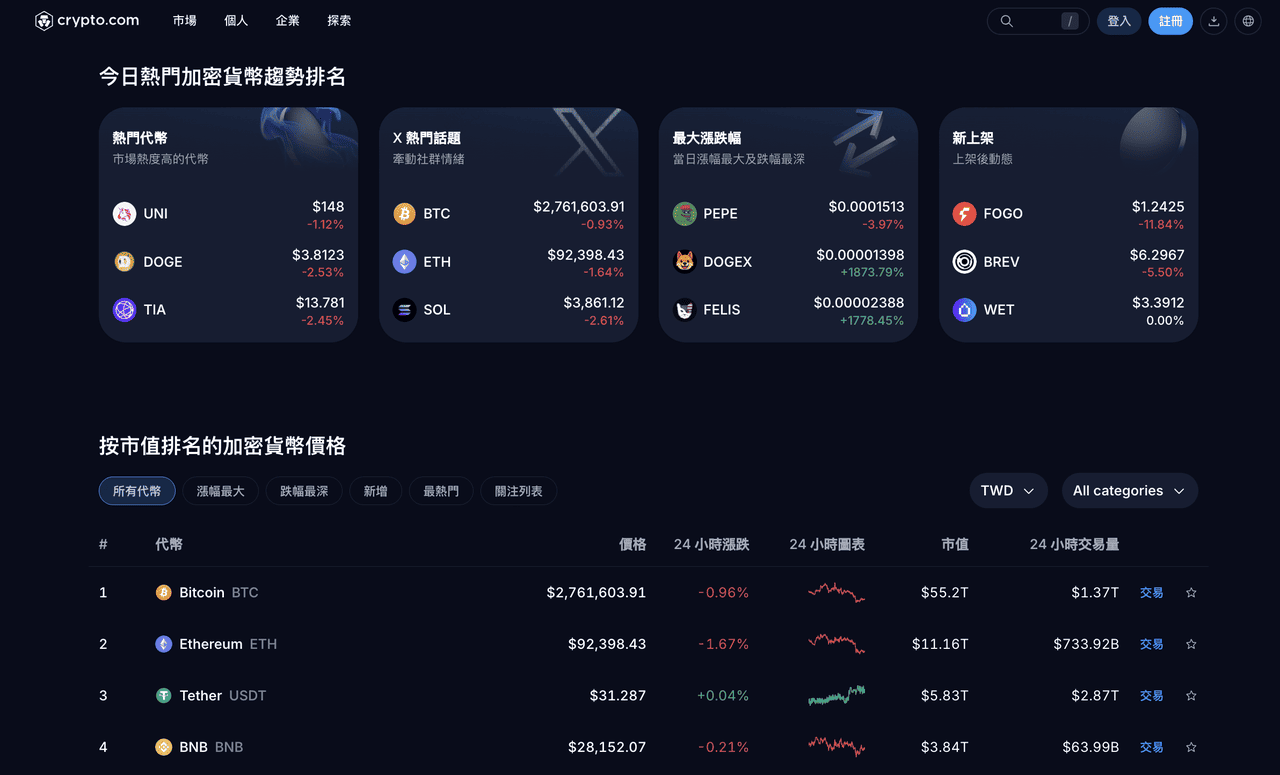
Crypto.com is a large comprehensive crypto platform with over 100 million global users. BTC/USDT is one of its core trading pairs, with spreads usually below 0.1% under normal market conditions. For Taiwanese users, the most distinctive feature is the Crypto.com Visa card, which can convert crypto assets into daily spending, with CRO holdings providing cash back rewards - an alternative asset utilization method besides withdrawals. SWIFT withdrawal fees are fixed at $45 (free for institutional accounts), higher than Kraken's $25, with full English interface.
Crypto.com BTC/USDT Liquidity Highlights
- Spread: Usually below 0.1% under normal market conditions, liquidity is upper-mid level among mainstream exchanges, suitable for medium-scale BTC trading.
- CRO Holdings Discount: HoldingCRO provides trading fee discounts, large holders can significantly reduce trading costs, suitable for users already deeply involved in Crypto.com ecosystem.
- Visa Card Withdrawal Path: For Taiwanese users wanting to directly spend crypto assets, Crypto.com Visa card provides an alternative asset utilization method besides exchange withdrawals.
- High SWIFT Withdrawal Fees: Fixed $45, significantly higher than Kraken (approximately $25), Taiwanese individual users using SWIFT withdrawal paths should note higher fixed costs.
4. Taiwan Exchanges (MAX, BitoPro)
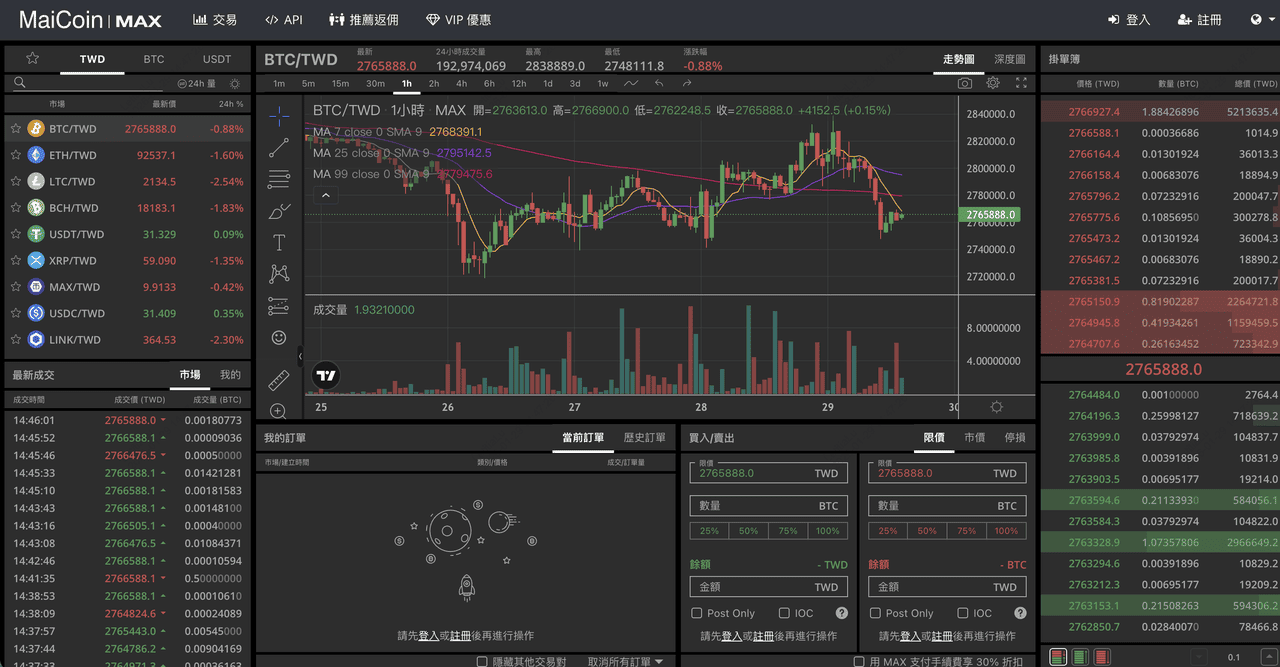
Taiwan exchanges MAX and BitoPro don't directly provide BTC/USD trading pairs. Taiwanese users typically first convert BTC to USDT on BingX, then transfer via TRC-20 network to Taiwan exchanges to sell for TWD and withdraw to local banks, without needing foreign currency accounts or paying SWIFT fixed fees. Taiwan exchanges' BTC/TWD market liquidity is lower than international exchanges with larger spreads, unsuitable for large BTC direct conversions; TWD withdrawal fees are far lower than SWIFT fixed fees, with arrival times of same day to next business day, making it the lowest cost choice for TWD withdrawal paths.
BTC Exchange Comparison: Spreads, Liquidity, and Withdrawal Methods
|
Exchange |
BTC Spread (Normal Market) |
Order Book Depth |
Traditional Chinese Interface |
Fiat Withdrawal Methods for Taiwan Users |
|
BingX |
Usually below 0.05% |
Stable, BTC/USDT core trading pair with high liquidity |
Full support |
USDT transfer to Taiwan exchanges for TWD, or via international wire (like Kraken) |
|
Kraken Pro |
Usually below 0.1% |
Stable, institutional funds provide depth |
Not supported |
SWIFT wire to foreign currency account (~$25 fee) |
|
Crypto.com |
Usually below 0.1% |
Upper-mid level, large global user base |
Not supported |
SWIFT wire (~$45) or Visa card spending |
|
Taiwan Exchanges (MAX, BitoPro) |
BTC/TWD larger spreads |
Lower relative to international exchanges |
Full support |
Direct TWD deposits/withdrawals, local bank transfers, lower fees |
BTC Exchange Fee Comparison: Spot, Futures, and On/Off-Ramp Costs
Spreads affect hidden costs of every trade, while trading fees are explicit charges deducted directly from transaction amounts. Only by adding both together do you get complete trading costs. Below we organize actual cost differences for Taiwanese users from three aspects: spot, futures, and other fees.
BTC Exchange Spot Trading Fee Comparison
In spot trading, trading fees are the most direct cost factor. BingX's maker and taker fees are both 0.1%, relatively low among mainstream exchanges, with no need for platform token holdings or specific trading volume thresholds; for a $100,000 USDT BTC market order, fees would be approximately 100 USDT. Kraken Pro's entry-level rates are 0.25% maker fee and 0.40% taker fee, reducible with 30-day trading volume, with maker fees potentially dropping to 0%, suitable for users with trading volume; Crypto.com's entry rates are 0.25%/0.50%, requiring CRO holdings for discounts, making costs higher for regular users. Taiwan exchanges' rates are approximately 0.05%-0.20%, but due to larger BTC/TWD spreads, overall trading costs don't necessarily have advantages.
BingX vs Other Exchanges Spot Fee Comparison
|
Exchange |
Spread |
Maker Fee |
Taker Fee |
100K USDT Market Order Estimated Cost |
Fee Reduction Method |
|
BingX |
~0.01%-0.05% |
0.10% |
0.10% |
~100 USDT |
30-day trading volume tiers |
|
Kraken Pro |
~0.02%-0.08% |
0.25% |
0.40% |
~400 USDT |
30-day trading volume tiers |
|
Crypto.com |
~0.05%-0.10% |
0.25% |
0.50% |
~500 USDT |
Trading volume tiers + CRO discount |
|
Taiwan Exchanges |
~0.20%-1.00% (BTC/TWD) |
~0.05%-0.10% |
~0.10%-0.20% |
~100-200 USDT |
Varies by platform policy |
Note: The above rates are based on publicly available data from each platform. Rate policies may change at any time; please refer to current displays on each platform's account pages before operations.
BTC Exchange Futures Fee Comparison
For Taiwanese users using leveraged trading or needing to short BTC, futures (perpetual futures) fee structures differ from spot trading with larger differences between platforms. Futures rates are usually lower than spot, but besides maker and taker fees, holding futures positions also requires periodic funding rate payments, with direction varying based on long/short supply and demand ratios - a variable cost that cannot be ignored when evaluating futures holding costs.
BingX BTC/USDT perpetual futures rates are 0.02% maker fee and 0.05% taker fee, relatively low fee levels; Kraken futures rates are the same, but funding rates are settled hourly, having greater impact on long-term position holders. Crypto.com perpetual futures rates are 0.02% maker fee and 0.04% taker fee, slightly lower than other platforms, but require CRO holdings for further rate reductions. Most Taiwan exchanges currently don't offer BTC futures products, still focusing mainly on spot trading functionality.
BingX vs Other Exchanges Futures Fee Comparison
|
Exchange |
Spread |
Maker Fee |
Taker Fee |
100K USDT Market Order Estimated Cost |
Funding Rate Settlement Frequency |
|
BingX (Perpetual) |
~0.01%-0.03% |
0.02% |
0.05% |
~50 USDT |
Every 8 hours (variable) |
|
Kraken (Futures) |
~0.01%-0.03% |
0.02% |
0.05% |
~50 USDT |
Hourly (variable) |
|
Crypto.com (Perpetual) |
~0.02%-0.05% |
0.02% |
0.04% |
~40 USDT |
Every 8 hours (variable) |
|
Taiwan Exchanges |
Not applicable |
Not applicable |
Not applicable |
Not applicable |
Not applicable |
Note: Futures rates and funding rate policies may change at any time, and funding rates are variable fees. The above table only lists fixed trading fee portions. Please refer to current displays on each platform's futures specification pages before operations.
BTC Exchange Withdrawal and On/Off-Ramp Fee Comparison
Besides trading fees, withdrawal and fiat deposit/withdrawal costs also affect overall capital efficiency. BTC withdrawal fees usually range from 0.0001-0.0005 BTC (approximately $10-50), with some platforms supporting Lightning Network to reduce costs; USDT withdrawals using TRC-20 (Tron) network usually cost less than $1, a common choice for cross-platform asset transfers. For fiat withdrawals, Taiwan exchanges can directly transfer to local banks with lower fees, while Kraken and Crypto.com mostly use SWIFT wires with fees around $25-45, making costs proportionally high for small withdrawals.
BingX vs Other Exchanges Withdrawal Fee Comparison
|
Fee Item |
Spread Impact |
BingX |
Kraken Pro |
Crypto.com |
Taiwan Exchanges |
|
BTC Withdrawal Fee |
No direct impact |
~0.0001-0.0003 BTC |
Fixed or network-based |
Fixed or network-based |
Varies by platform |
|
USDT Withdrawal (TRC-20) |
No direct impact |
Usually below $1 |
Varies by network rates |
Varies by network rates |
Not applicable |
|
Fiat Withdrawal |
Indirect impact (exchange rate difference) |
No direct withdrawal |
SWIFT ~$25 |
SWIFT ~$45 |
TWD withdrawal, low fees |
|
Deposit Fee |
None |
Free |
Free |
Free |
Free |
Note: Withdrawal fees fluctuate with blockchain network conditions. The above table shows reference ranges for general situations; actual fees are based on platform interface displays at time of withdrawal.
How to Choose the Best BTC Exchange: Complete Comparison Framework for Fees and Liquidity
Before actually choosing an exchange, you should approach from overall trading costs and capital flow efficiency, rather than just looking at single rate numbers displayed by platforms.
- Trading Cost Structure (Spread + Trading Fees): Spreads and taker fees together determine actual costs of each trade, with spreads being the most easily overlooked hidden cost. Generally, spreads below 0.05% indicate good liquidity markets; maker fees affect long-term strategies using limit orders.
- Market Liquidity (Depth and Slippage Risk): +2% market depth can be used to judge an exchange's ability to handle large orders - higher numbers mean less likelihood of slippage. Before large trades, recommend checking depth conditions via CoinGecko or directly viewing order books.
- Capital Transfer Costs (Withdrawals and Deposits): BTC withdrawal fees and USDT network choices (like TRC-20) directly affect cross-platform transfer costs; for fiat withdrawals, Taiwan exchanges' TWD withdrawal fees are usually lower than international exchanges' SWIFT wires, with particularly significant impact on small withdrawals.
- Operational Restrictions and Time Costs (KYC and Arrival Speed): Different platforms have different KYC level and limit requirements for withdrawals; large withdrawals should complete verification in advance; BTC mainnet transfers usually require about 1 hour confirmation, and different exchanges' required confirmation numbers also affect actual arrival times.
How to Trade Bitcoin Spot and Futures on BingX
BingX provides a complete Traditional Chinese interface, allowing Taiwanese users to complete spot purchases and futures operations on the same platform without switching between different tools. Below we explain the operational process in two sections, applicable to both desktop and app versions.
1. Buy Bitcoin Spot on BingX Spot Market
Spot purchases are suitable for Taiwanese users who want to directly hold BTC. After purchase, BTC is credited to account balance and can be withdrawn to personal wallets or transferred to MAX, BitoPro for TWD conversion at any time.
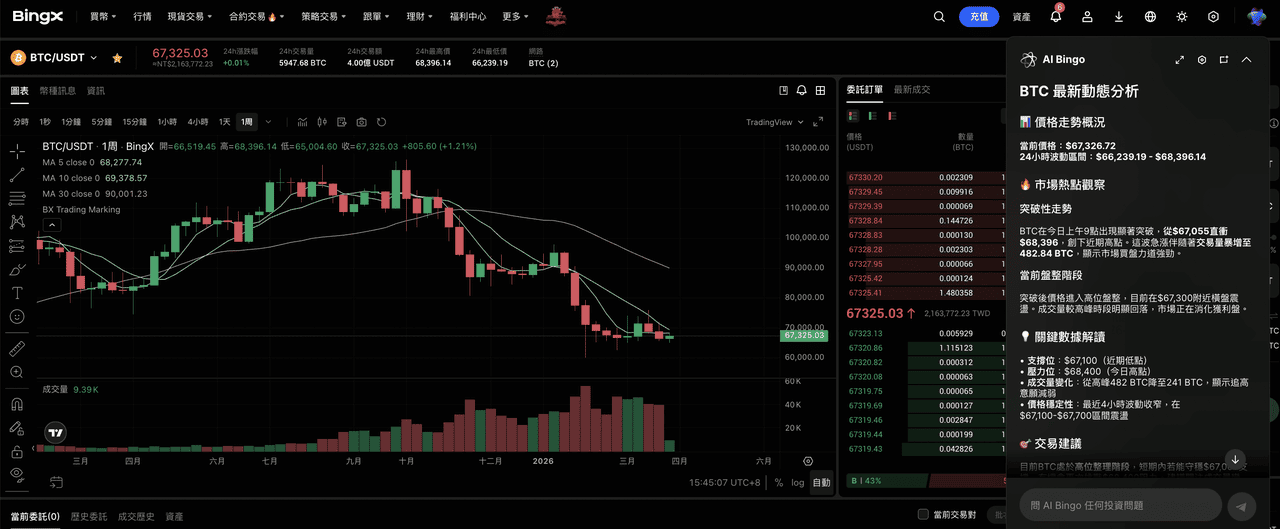
- Register and Log into BingX Account: Go to BingX official website or download the app,register and log into BingX account with email or phone number, and upload identity documents following instructions to complete KYC verification. Recommend enabling Google two-factor authentication (2FA) to protect account security. After completion, transfer USDT to spot account via the deposit page, recommend choosing TRC-20 network to save fees.
- Check Depth Chart to Confirm Liquidity: Go to "Spot Trading" page, selectBTC/USDT spot trading pair, confirm current quotes and order book conditions. Under normal market conditions, BTC/USDT spreads should be below 0.05%; when spreads expand significantly, recommend waiting for market stabilization before executing large trades. Switch to depth chart view - steeper curves indicate larger order volumes and smaller slippage; flat curves indicate insufficient depth, making large market orders prone to deviation from expected execution.
- Choose Order Type: "Market orders" execute immediately at current best quotes; "limit orders" set target purchase prices waiting for matching, suitable for users with clear price targets. Both have the same fee rate (0.1%).
- Input Amount and Place Order: Input BTC quantity or USDT amount, confirm estimated execution volume and fees, then submit order. Market orders usually execute immediately.
- Confirm BTC Credit: After execution, confirm BTC balance update on "Assets" page, and view actual average execution price and fee details on "Orders" page.
2. Long or Short Bitcoin on BingX Futures
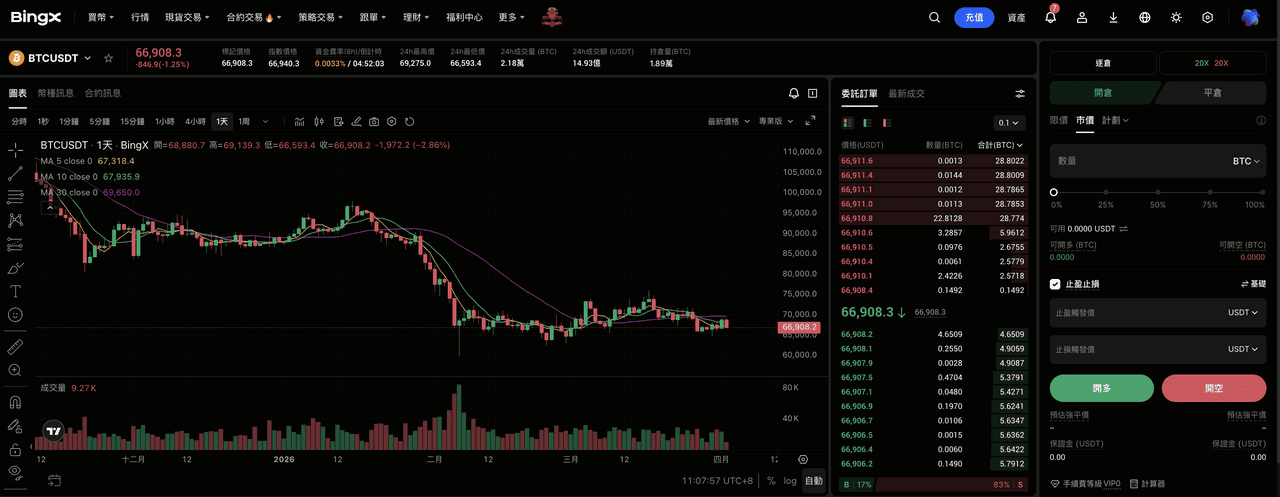
Perpetual futures are suitable for users wanting to go long (expecting price increases) or short (expecting price decreases) on Bitcoin without actually holding the asset, also suitable for amplifying capital efficiency through leverage for greater market exposure. However, while futures trading usually has lower fees than spot, you still need to be aware of forced liquidation risks from leverage and funding rate impacts on holding costs. Recommend fully understanding mechanisms before operations.
- Transfer Funds to Futures Account: On "Assets" page, select "Fund Transfer" to move USDT from spot account to futures account. The transferred amount becomes the margin range this trade can bear; untransferred funds won't be affected by futures positions.
- Enter BTC/USDT Perpetual Futures Page: In trading interface, select "Perpetual Futures" (USDⓢ-M), enterBTC/USDT trading pair.
- Set Leverage and Choose Direction: After adjusting leverage multiplier, choose "Buy Long" or "Sell Short," input order quantity, and confirm required margin, fees, and estimated liquidation price. Beginners can start with lower leverage (like 3-5x) to gradually familiarize with mechanisms.
- Set Stop Loss and Take Profit: After opening positions, you can set stop loss and take profit conditions on the positions page. The system will automatically close positions when prices are triggered, helping control risks and lock in profits during volatile markets.
- Monitor Positions and Funding Rates: During holding periods, you can view unrealized PnL and funding rate settlement times anytime. Funding rates vary with market long/short structure; for long-term positions, they need to be included in overall cost evaluation.
5 Key Factors Taiwan Users Should Consider When Comparing BTC Exchange Costs
When comparing Bitcoin trading costs across different exchanges, there are several common judgment pitfalls that need special attention. Looking only at trading fees or single numbers often underestimates actual costs, affecting trading decisions.
- "Zero fees" doesn't mean no costs: Some platforms advertise zero fees, but actual costs are often embedded in spreads, commonly reaching 0.5% to 1%. In comparison, platforms that explicitly charge 0.1% trading fees but have smaller spreads actually offer better overall execution prices. When evaluating trading costs, include both fees and spreads rather than just looking at single indicators.
- Spreads change rapidly with market volatility: Spreads displayed on CoinGecko or CoinMarketCap are mostly market snapshots at specific times and cannot reflect real-time liquidity changes. During rapid price increases or decreases, spreads usually expand significantly, especially with large volumes in short periods, easily causing price deviations. Large trades should avoid high volatility periods or use limit orders for gradual entry.
- Maker and taker fee differences affect long-term costs: Fee structure differences between exchanges are significant - for example, Kraken's maker fee is about 0.25% and taker fee about 0.40%, a difference of nearly 37.5%. In such cases, long-term use of limit maker orders can effectively reduce trading costs. BingX's maker and taker fees are the same (0.1%), so while fee differences aren't obvious, limit orders can still provide more precise execution price control, avoiding unnecessary slippage.
- Large trades need separate market depth evaluation: Small trades (like under $1,000 USDT) usually aren't affected by depth on mainstream exchanges, but when trade sizes reach $100,000 USDT or above, market depth directly affects actual execution prices. Check +2% depth data on CoinGecko first, then observe order book order distribution on exchanges to confirm sufficient liquidity supports the trade.
- Total withdrawal path costs cannot be ignored: Exchange trading fees are only part of overall costs; withdrawal methods also affect final returns. Transferring via USDT to Taiwan exchanges then converting to TWD usually has lower costs and higher flexibility; in comparison, using SWIFT wires (like Kraken's ~$25, Crypto.com's ~$45) have higher fixed fees. When evaluating platforms, consider complete capital flow paths rather than just single trading segments.
Final Thoughts: Why BingX Is the Best Choice for Taiwan Users on Fees and Off-Ramp
From three aspects - trading fees, market depth, and spreads - trading costs aren't determined by single numbers but are results of multiple factors combined. Spot rates are only surface-level costs; order book depth affects actual execution prices, while spreads directly determine hidden entry/exit costs. In most cases, platforms with low rates but high spreads don't necessarily have overall cost advantages; conversely, platforms with stable liquidity and tight spreads often reduce cumulative costs in long-term trading.
Under this comparison framework, BingX's advantage lies in balanced overall cost structure. Spot rates maintain 0.1% without additional thresholds; BTC/USDT order book depth is stable, with medium-scale trades unlikely to experience significant slippage; under normal market conditions, spreads usually stay below 0.05% most of the time, making actual execution prices closer to market median levels. This combination makes trading costs not only low but also more predictable and controllable.
For Taiwanese users, capital entry/exit paths also affect overall costs. Converting Bitcoin to USDT via BingX, then transferring via TRC-20 to MAX or BitoPro for TWD conversion, is currently a relatively low-cost and stable method that doesn't require foreign currency accounts and avoids overseas wire fixed fees. Combining rates, liquidity, and withdrawal efficiency, BingX remains one of the more cost-advantageous choices for Bitcoin trading.
Related Reading
- Where to Buy Bitcoin in Taiwan? 2026 Bitcoin Exchange Recommendations and Complete Purchase Process Guide
- Which Exchange is Recommended for Beginners to Buy Bitcoin in 2026? Top 10 Cryptocurrency Exchange Comparison
- Taiwan Exchanges vs. International Exchanges: How to Choose the Right Cryptocurrency Trading Platform for You?
- How to Buy USDT in Taiwan? 2026 Cryptocurrency Exchange Recommendations and Complete Purchase Guide
- Which Platform Has the Lowest Fees for Converting ETH to USD in Taiwan? 5 Major Exchange Fee and Withdrawal Cost Comparison (2026)
